Large-scale multi-touch attribution analysis reveals 50% higher ROAS on Meta

If last-touch attribution were a witness in a courtroom, it would confidently raise its hand and say, “I was there at the end.”

That testimony, though accurate, is also incomplete.

Last-touch attribution has long been the backbone of mobile measurement. It tells marketers which channel gets credit for an install, which campaign gets optimized, and how spend is reconciled. When it comes to enabling operational clarity, last-touch attribution still does its job extremely well.

But marketers are increasingly asking a different question: Which channels actually drove growth through influence, exclusive traffic, or a combination of the two?

Answering that question requires multi-touch attribution, a methodology designed to measure influence across the full user journey rather than just crediting the final interaction.

As part of our work on the upcoming ROI Index (launching March 2026), our data science team analyzed performance through a multi-touch attribution lens and compared it with last-touch attribution.

In this post, we’re sharing early benchmarks from that work, based on analysis by Singular’s data science team and using Meta’s mobile gaming performance as a case study. The goal isn’t to promote a specific channel, but to illustrate how different attribution methodologies can materially change how performance is interpreted — and what mobile marketers should consider once they see the fuller picture.

As a certified mobile measurement partner of Meta, Singular works closely with Meta’s product and engineering teams to ensure mobile marketers have accurate, transparent, and fair interpretations of campaign performance across Meta’s advertising suite. While the analysis shared here was conducted independently by Singular’s data science team, these results are part of an ongoing collaborative partnership between Singular and Meta focused on advancing measurement standards, attribution methodologies, and the tools marketers rely on to efficiently grow their apps.

Why multi-touch attribution shapes the story you think you are telling

Modern mobile growth does not follow a straight line. It looks more like a relay race where the baton changes hands several times before anyone crosses the finish line.

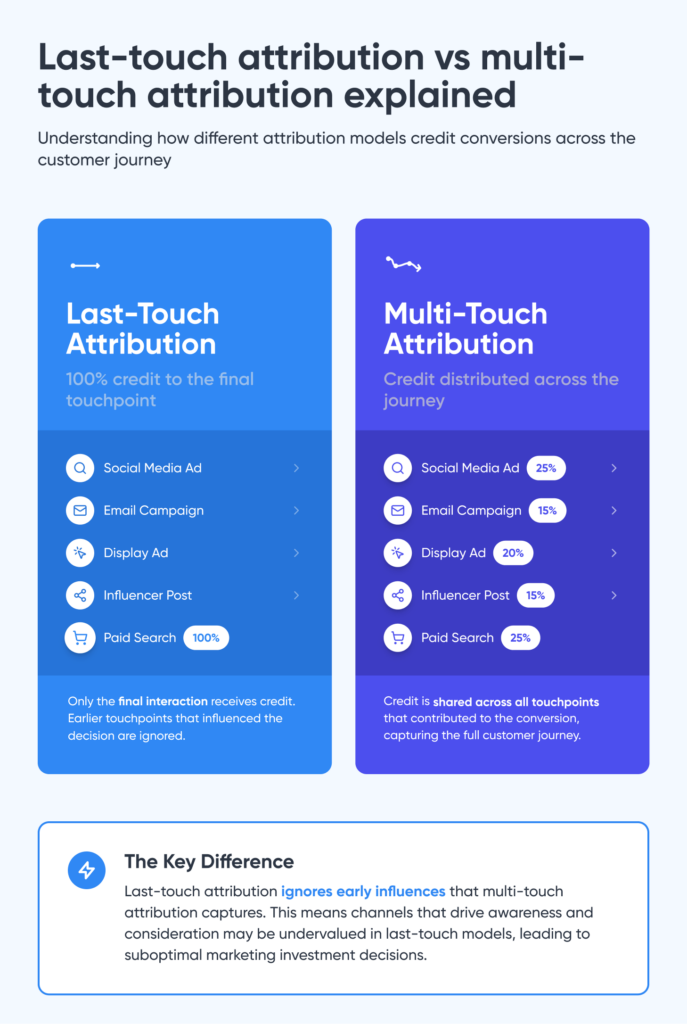
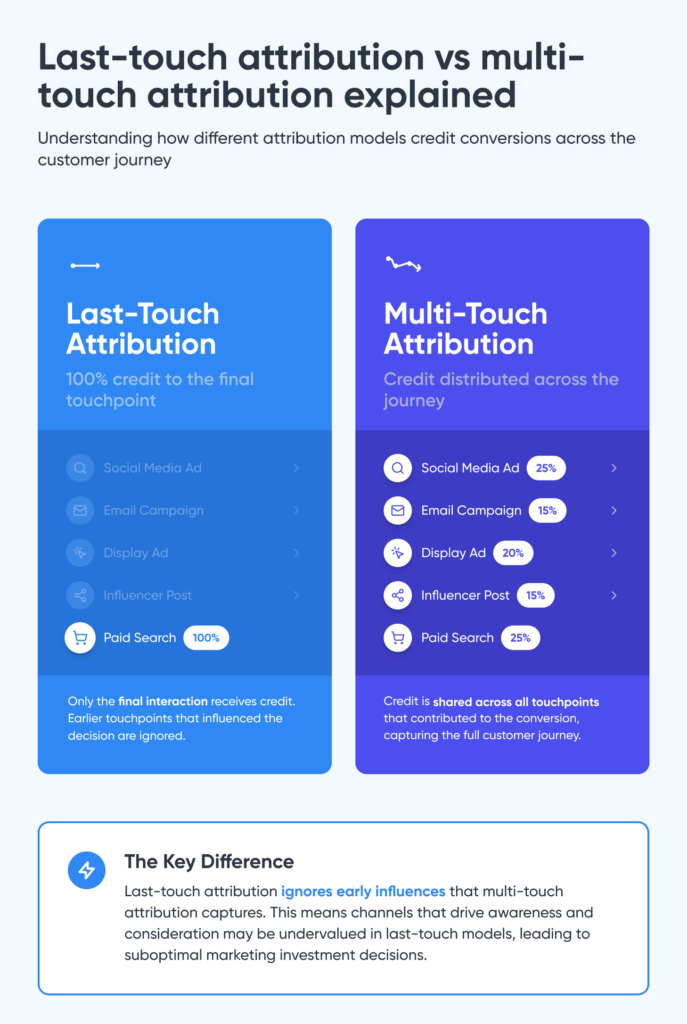
A user might see a social ad, keep scrolling, later search for the app, click an app store ad, and finally install after one last reminder. Every touchpoint plays a role, even though only one receives credit under last-touch attribution.

Last-touch attribution answers an operational question.

Who closed the deal?

Multi-touch attribution answers a strategic one.

Who made the deal possible?

Last-touch attribution vs. multi-touch attibution

Last touch tells you who closed the deal. Multi-touch attribution tells you who made the deal possible. – Omri Gal, Head of Data @ Singular

The solution is not choosing one model over the other. It uses both last-touch and multi-touch attribution, each for the questions they are best suited to answer.

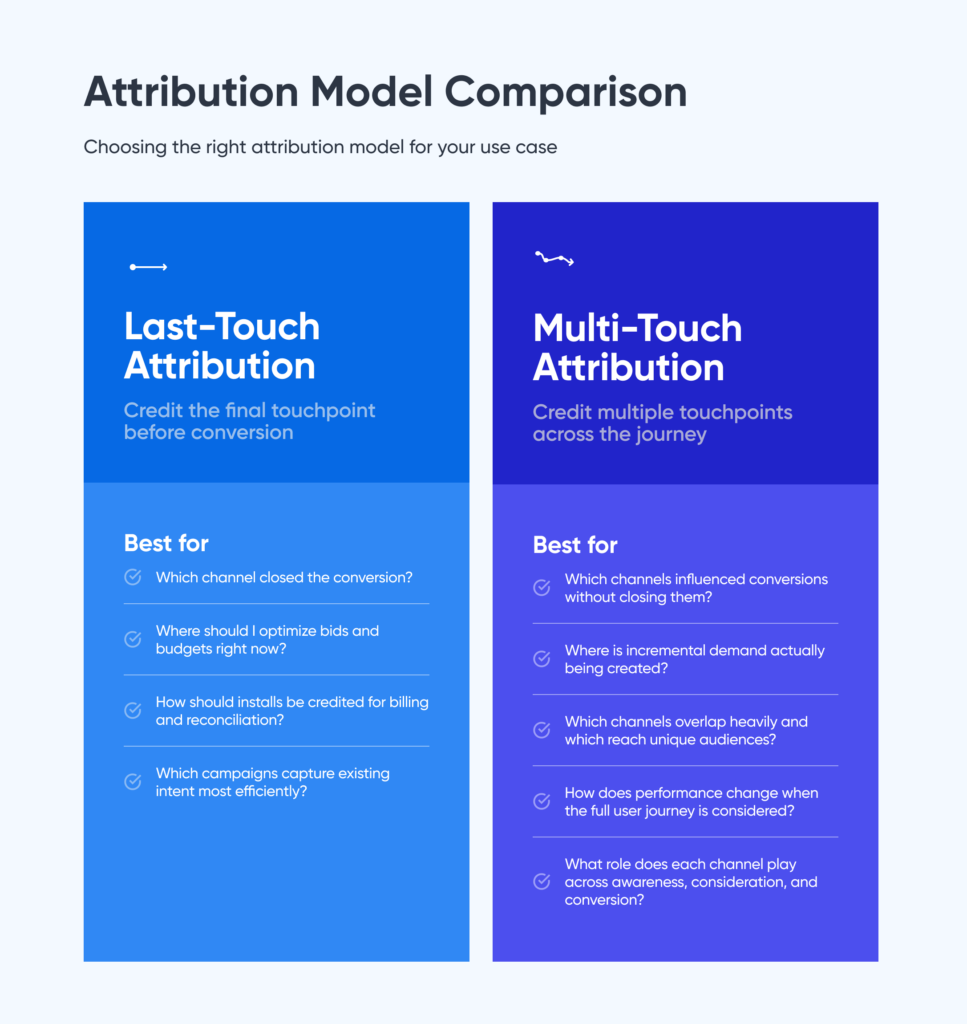
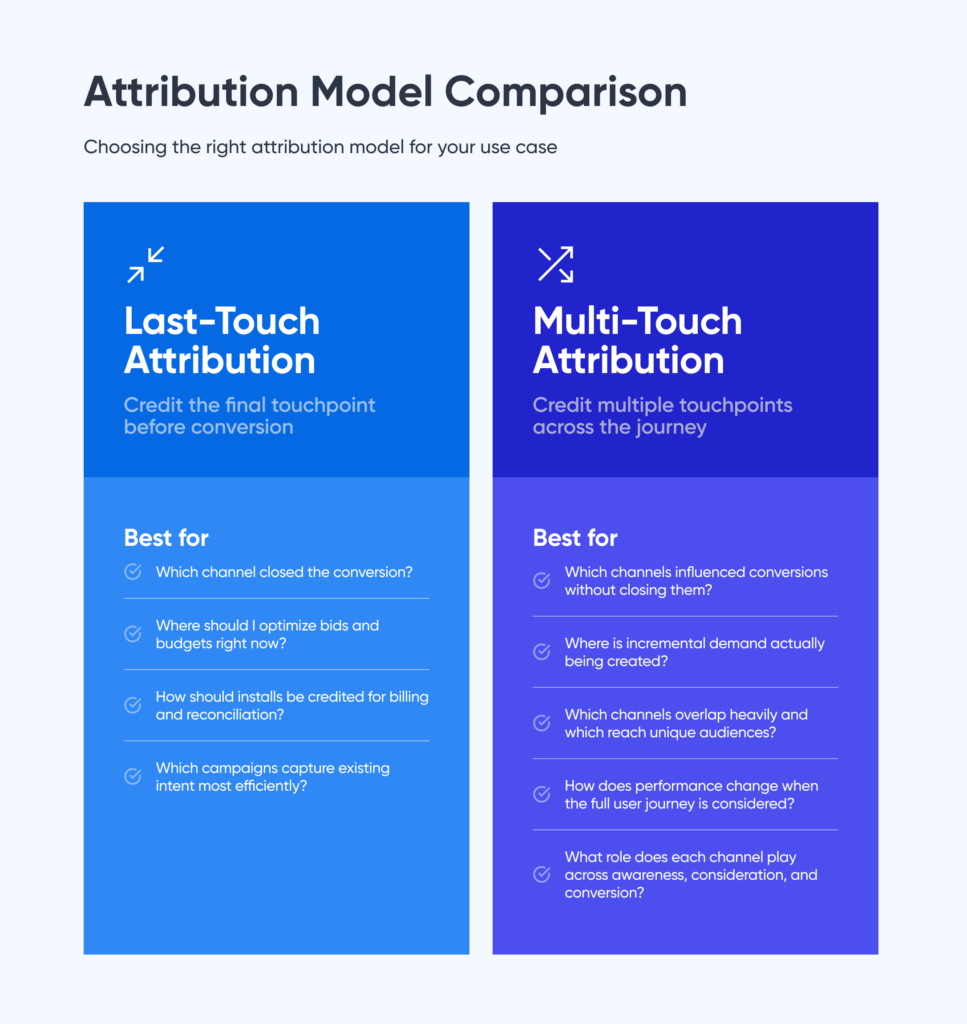
The types of questions that multi-touch attribution answers better than last touch

Attribution models are specialists, not competitors.

attribution model comparison: last touch vs multi touch

Why discovery and community channels rely more on multi-touch attribution

Not all channels are designed to play the same role.

Some channels capture intent. Others create it.

Intent-based channels like paid search often look strong under last-touch attribution because they appear at the moment of conversion. Users arrive informed, motivated, and ready to act.

Discovery and community-driven channels, including social platforms like Meta, TikTok, Snap, and Pinterest, influence users much earlier. They introduce brands, shape perception, and build familiarity over time. Their impact often happens well before the final click.

Under last-touch attribution:

  • Intent channels often look highly efficient.
  • Discovery channels often appear “undervalued”.

Under multi-touch attribution:

  • Intent channels still get credit for closing.
  • Discovery channels get credit for influence, assists, and incremental reach.

Discovery channels rarely look their best at the finish line because their job is to get users into the race. – Steph Pilon, CMO @ Singular

Using multi-touch attribution to separate efficiency from incrementality

Singular’s Advanced Assists framework brings multi-touch attribution directly into measurement, allowing marketers to evaluate performance across multiple dimensions:

  • Single-attributed installs
  • Co-attributed installs
  • Assisted installs
  • Modeled MTA metrics such as MTA CPI and ROAS

Together, these metrics reveal what last touch alone isn’t able to tell you. They show audience uniqueness, channel overlap, and true contribution across the funnel.

What the data shows when viewed through multi-touch attribution

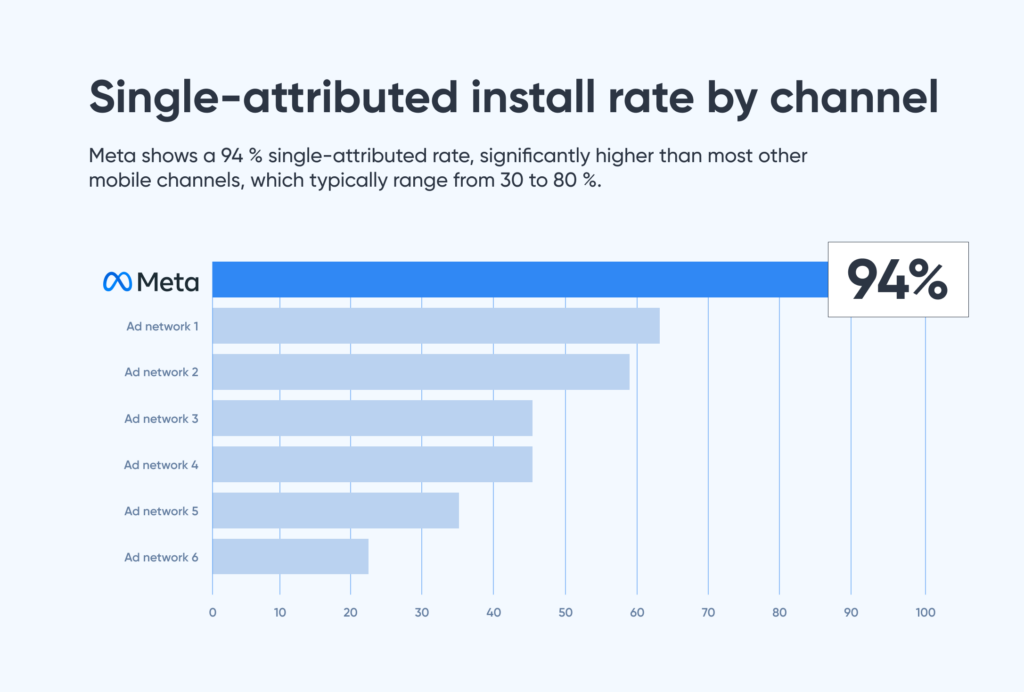
Meta shows one of the highest single-attributed install rates

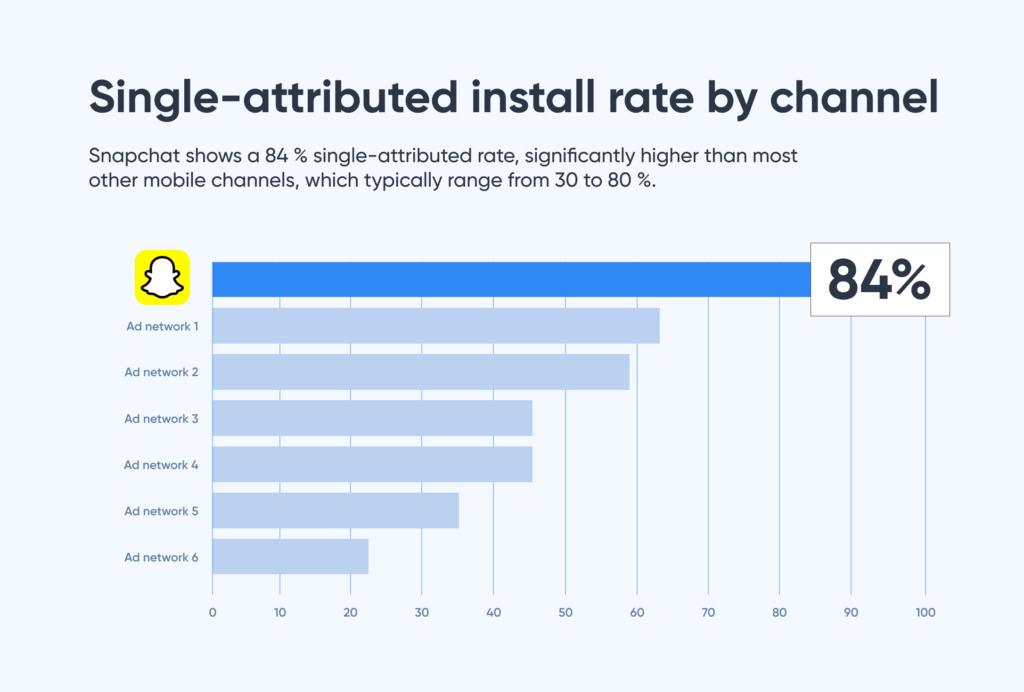
Across mobile gaming advertisers, Meta demonstrated a 94% single-attributed install rate.
Single-attributed installs happen when the attributed install had no prior touchpoints from other channels.

High single-attribution rates often signal incremental reach, not just efficient conversion. – Eran Friedman, CTO & Cofounder @ Singular

Why this matters for mobile marketers: If a channel consistently appears alone in the user journey, it is more likely to create demand rather than compete for credit.

Multi-touch attribution analysis showing single-attribute install rate for Meta

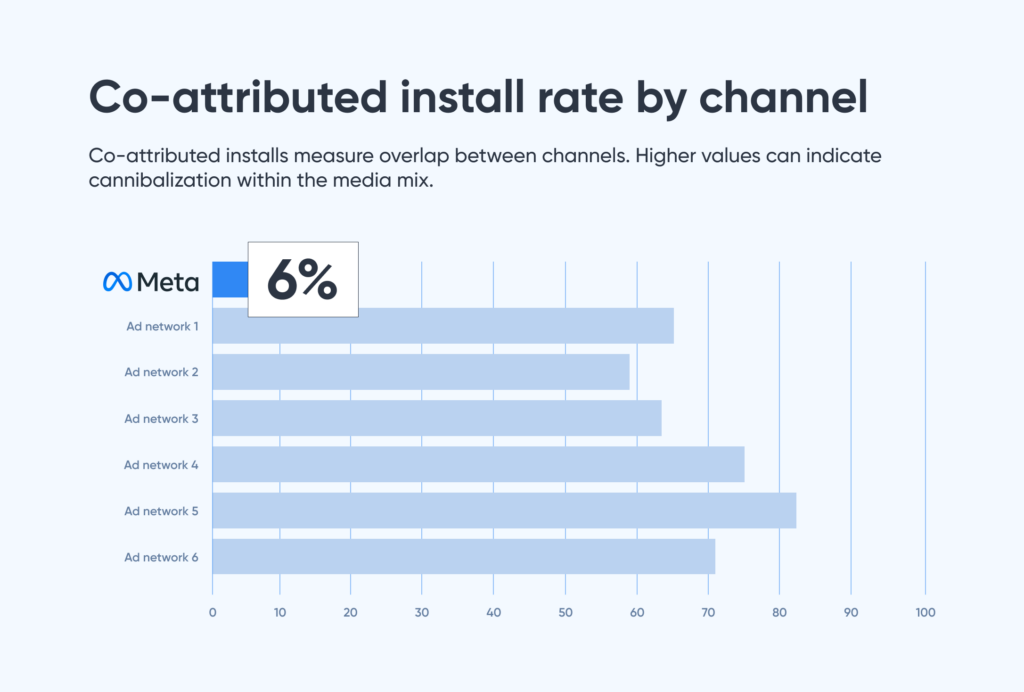
Low co-attribution suggests minimal cannibalization

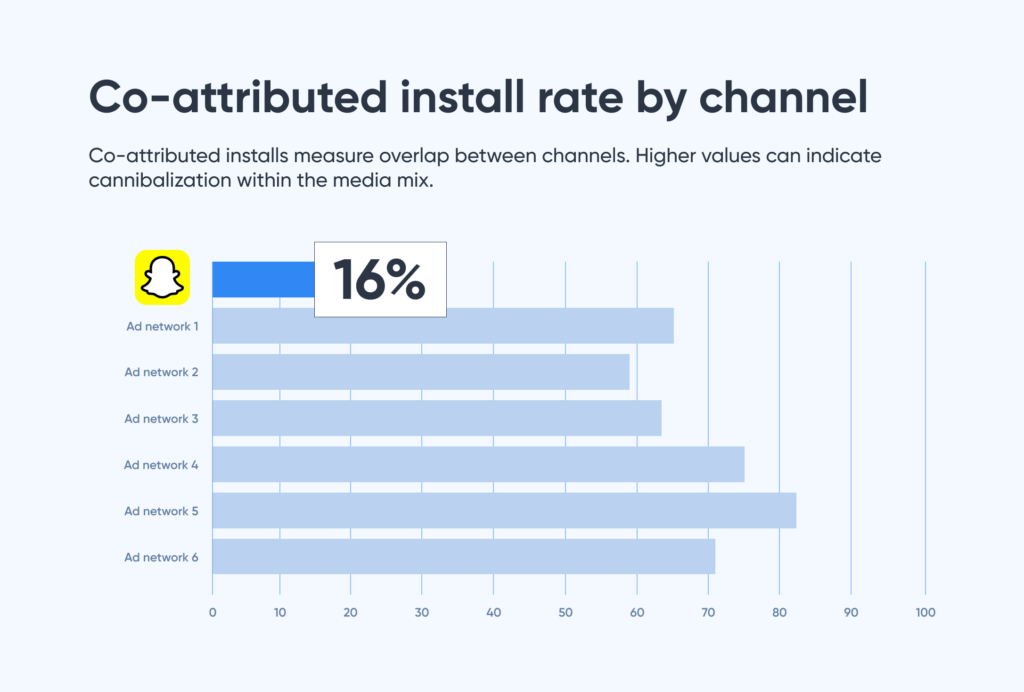
Meta also showed a 6% co-attributed install rate.

Co-attributed installs happen when a channel receives last-touch credit, but another channel influenced the user earlier.

Why this matters for mobile marketers: Low co-attribution means incremental spend is less likely to displace value created by other channels.

co-attributed install rate by channel

Assist rates reveal value hidden by last-touch attribution

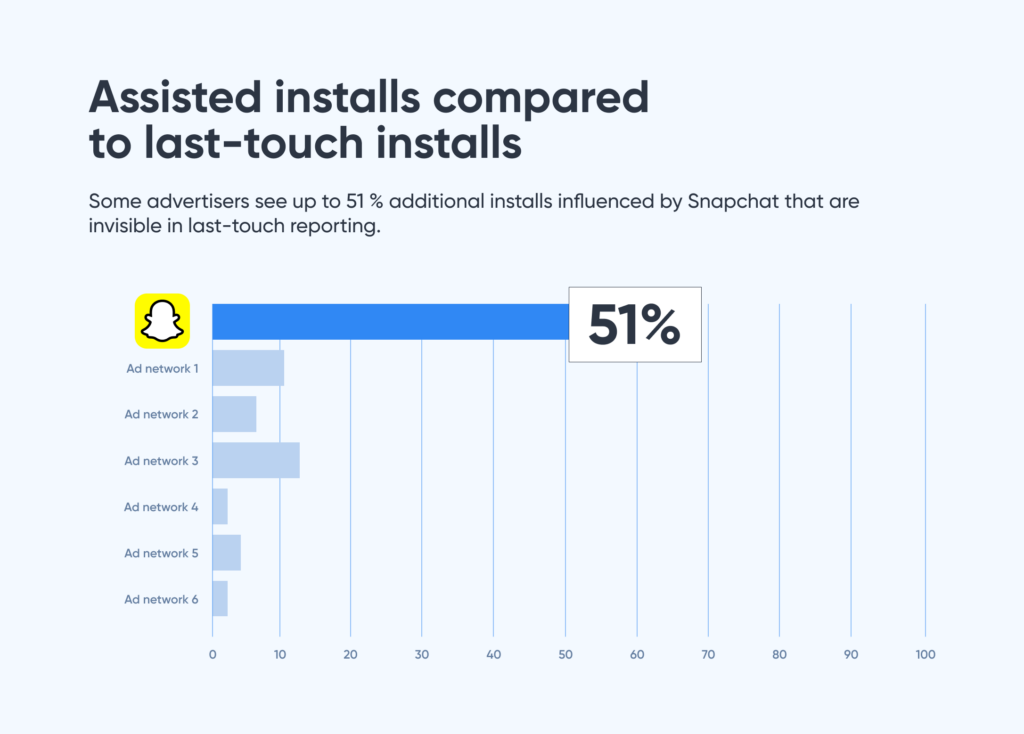
In several gaming datasets, Meta generated up to 29% additional assisted installs.

Assisted installs happen when a channel influenced the install but did not receive last-touch credit.

Assists are not “missed conversions.” They are proof that influence happened earlier. – Omri Gal, Head of Data @ Singular

Why this matters for mobile marketers: Assist rates highlight channels that drive discovery and intent, even when they don’t convert.

Multi-touch attribution analysis compares Meta's assisted installs to last-touch installs

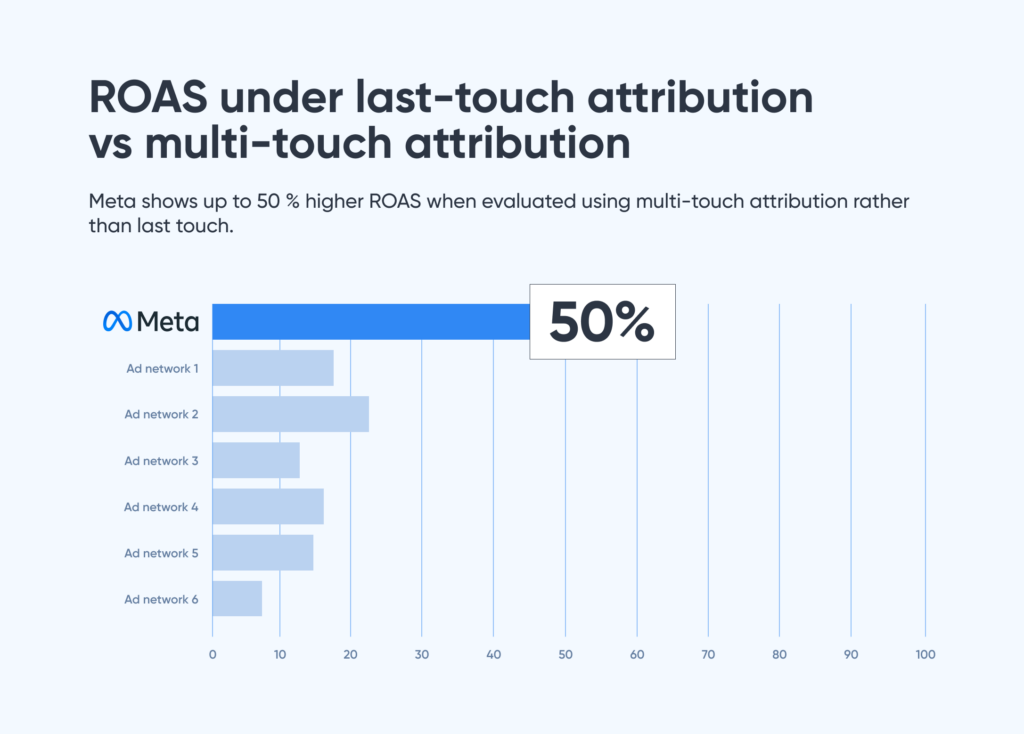
Multi-touch attribution modeling changes ROAS outcomes

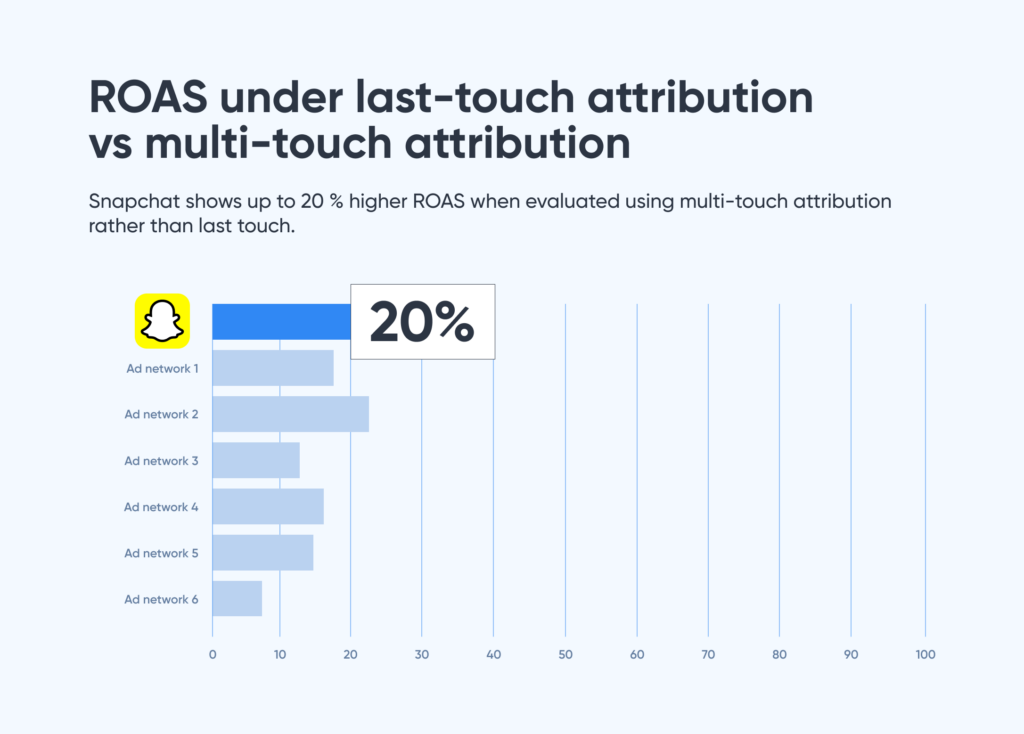
When Singular’s multi-touch attribution model is applied, Meta showed up to 50% higher ROAS compared to last-touch attribution.

Multi-touch attribution does not inflate performance; it reallocates it. The model assigns full credit to single-attributed installs, reduced credit to co-attributed installs, and partial credit to assists based on configurable weighting.

Why this matters for mobile marketers: Improved ROAS under MTA often indicates a channel was undervalued, not over-credited.

Multi-touch attribution model showing up to 50% higher ROAS for Meta compared to last-touch attribution

Last-touch attribution and multi-touch attribution are teammates, not rivals

Multi-touch attribution is not designed to replace last-touch attribution.

Last touch remains essential for billing, partner accountability, and day-to-day optimization. Multi-touch attribution is designed to inform your strategic decisions, like budget allocation, overlap detection, and long-term growth planning.

If last touch shows where the ball crossed the goal line, multi-touch attribution shows how it got there. – Steph Pilon, CMO @ Singular

What mobile marketers should do with these findings

The value of multi-touch attribution is not in the metrics themselves, but in the decisions they unlock. When marketers understand how channels contribute across the full user journey, budget conversations become clearer and more strategic. Based on what we see working with some of the fastest-growing apps in the world, these rules of thumb help turn attribution insight into action.

  1. Do not evaluate channels solely on last-touch ROAS.
  2. Use multi-touch attribution to identify undervalued contributors.
  3. Monitor co-attribution rates before scaling spend.
  4. Treat high assist rates as signals of influence, not inefficiency.
  5. Configure MTA models to reflect your business goals.

Bringing multi-touch attribution into everyday decision making

With Singular’s Multi-Touch Attribution and Advanced Assists capabilities, marketers can move beyond fragmented reporting and evaluate every channel’s role in the full customer journey.

This does not change how partners are paid.

It changes the confidence in your decisions.

And as this analysis shows, when you change how you measure performance, the story you tell about growth often changes with it.

Methodology

Singular data analysts summarized the data from trillions of ad impressions, billions of clicks, and billions of installs. As part of Singular’s role as a certified mobile measurement partner of Meta, these independently produced findings were later shared with Meta to support ongoing collaboration on measurement accuracy, transparency, and innovation for mobile advertisers.

Incrementality attribution: measuring true marketing impact

Introduction

This article explores incrementality attribution in mobile marketing, providing marketers and user acquisition managers with insights into measuring true campaign impact in an era of privacy changes. As privacy-first policies and the loss of traditional tracking signals reshape the digital landscape, understanding how to accurately assess the effectiveness of your marketing efforts is more important than ever. Whether you’re a marketer, UA manager, or mobile growth professional, this guide will help you navigate the complexities of incrementality attribution and its role in driving smarter, data-driven decisions.

What is incrementality attribution?

Incrementality attribution measures the incremental lift, which is the extra conversions or revenue generated specifically because of an ad campaign, beyond baseline organic activity. Incrementality Attribution helps determine the causal impact of marketing efforts on desired outcomes, such as conversions or sales. By comparing the performance of a test group exposed to marketing with a control group that is not, marketers can isolate the true effect of their campaigns and make more informed decisions about budget allocation and strategy.

Incrementality attribution in mobile marketing

Incrementality attribution is a method that measures the incremental lift, meaning the extra conversions or revenue generated specifically because of an ad campaign, beyond what would have happened organically. Incrementality aims to measure the true impact of your marketing campaign based on a specific outcome. This approach is especially relevant in mobile marketing, where privacy changes and the loss of device identifiers have made traditional attribution models less reliable.

Attribution, in general, is the process of matching two data points, such as clicks to installs, or impressions to installs. Attribution models credit a conversion or sale to the marketing touchpoints a customer interacted with on their journey. Incrementality, on the other hand, is a term for measurement of the true effectiveness of advertising activities, focusing on what would not have happened without the marketing effort.

We’ve explored next-generation attribution extensively, including post-IDFA user acquisition, the end of last-click measurement, and the future of mobile measurement. Incrementality attribution is a big part of that conversation as the impetus for all these discussions is the loss of signal that privacy measures, necessary though they may be, are causing for marketers. The shift away from third-party cookies is further impacting advertising measurement and attribution models, making it harder to accurately assess the effectiveness of marketing activities.

Next-generation attribution is about finding new ways to measure true marketing impact. Attribution models have traditionally been used to measure advertising effectiveness by crediting customer actions to specific marketing touchpoints, but their limitations in the face of privacy changes have led to the rise of incrementality attribution as a more reliable approach.

The mobile measurement question

The challenge of privacy-safe measurement

How will marketers measure, attribute, and optimize marketing in a privacy-safe ecosystem?

And let’s be honest, this is not just any old marketing we’re talking about. This is not selling real estate or sports drinks or Lululemon pants. Mobile user acquisition is perhaps the fastest-paced marketing niche around, where shortening the distance between stimulus and response is critical to campaign optimization.

Attribution methods in mobile marketing

There are various methods available for attribution, including:

Each of these offers a systematic way to evaluate marketing effectiveness. Understanding the customer journey, tracking the series of touchpoints and interactions a potential customer has before converting, is essential for accurate measurement and attribution.

Real-world perspectives

I’ve been intrigued by what I’ve been hearing from AppLift veteran Maor Sadra’s new startup INCRMNTAL, as well as what Brian Krebs, the CEO of MetricWorks, has had to say about incrementality as a key form of mobile marketing measurement.

Recently, I had a conversation with Moshi Blum for the Mobile Heroes podcast I do with Peggy Anne Salz for Liftoff.

He’s the VP of Beach Bum, a mobile game studio owned by Voodoo, was a general manager for Adjust, led user acquisition for Viber, and more. And he knows incrementality, with the blood, sweat, tears, and scars to show for it, along with pretty much every other form of mobile measurement from both the high-volume practitioner side as well as the measurement provider side.

He’s kinda been there, done that on a lot of different levels. And he’s pretty realistic about the challenges and opportunities in marketing measurement.

In fact, if you remember Winston Churchill’s famous quote about democracy being the worst of all forms of government except for the rest, you’ll recognize the inspiration behind Blum’s view of last-touch attribution:

“Last touch attribution is the worst way to measure your marketing campaigns … except all other metrics of measuring your marketing campaigns.”

– Moshi Blum, VP Marketing at Beach Bum

As we move forward, let’s explore the benefits of incrementality attribution and how it can provide unique insights for marketers.

Benefits of incrementality attribution

Benefits of incrementality testing

Incrementality attribution has some significant benefits for marketers and UA managers:

  • Isolates true campaign impact: By comparing test and control groups, incrementality attribution reveals how many conversions are outcomes directly attributable to specific marketing actions.
  • Informs budget allocation: It helps marketers understand which channels and campaigns are truly driving incremental results, enabling smarter budget decisions.
  • Optimizes media mix: Incrementality attribution provides insights into the interplay between channels, helping marketers optimize their media mix for maximum impact.
  • Reduces wasted spend: By identifying conversions that would have happened organically, marketers can avoid spending on users who would have converted anyway.

Real-world examples

You could, for example, be adding a brand new app to your portfolio. With limited or no pre-existing campaigns, you can fairly easily check incrementality via different platforms, channels, and partners. In other circumstances, you can pause most or all of your efforts on an app, put all your eggs in one basket, and check the results. While you know you’ve got some existing organic and some persistent lag from prior campaigns, you’ll get a useful read on a channel that you might have been wondering about.

Incrementality testing and incrementality measurement allow marketers to determine incremental lift by comparing test and control groups, revealing how many conversions are outcomes directly attributable to specific marketing actions. This approach goes beyond traditional attribution by isolating the true value of your campaigns. Incrementality tells you what would have happened without your marketing efforts, helping you understand the genuine impact and effectiveness of your spend.

Not only that, you’ll get a sense for the interplay between channels, especially as you see audience overlap between them. Here’s how Brian Krebs put it in a chat I had with him:

“The analogy I hear often is the fishing poles in the stream, right? It’s the same group of fish, each media source you’re adding is just another fishing pole.

And the critical thing here is not really to optimize your marketing based on what the last touch happens to be, the ads that happened to get the last touch. It’s really optimizing the media mix, which is optimizing the perfect number of fishing poles and the perfect mix of fishing poles in that stream.”

– Brian Krebs, CEO of Metricworks

With these benefits in mind, let’s examine the challenges and complexities involved in incrementality testing.

Why is incrementality testing hard?

Challenges in measuring incrementality

So why is incrementality, which is intended to show you the additional or incremental results of your marketing campaigns, so notoriously hard?

Because causes and effects are mixed up, and the relationships between individual causes and effects are spaghettied into difficult-to-separate masses. Also, many effects are over-determined, which means that they don’t have a single cause but multiple factors are working together to create an effect. Everything is changing all of the time as multiple departments in your organization are building product, releasing features, kicking off campaigns, posting to social, crafting offers, building creative. And shocker: the world is changing, as macro-level systems like weather and economy intersect with microcosms of individual situations and moment-by-moment states like hunger, desire, boredom, time, attention, and more.

Steps of incrementality testing

To accurately measure the causal impact of marketing activities, marketers often use controlled experiments, such as randomized controlled trials (RCTs). Here’s how incrementality testing typically works:

  1. Define the objective: Decide what outcome you want to measure (e.g., installs, revenue, paying users).
  2. Set up test and control groups:
    • Randomly divide your audience into two groups.
    • The test (treatment) group is exposed to the advertising campaign.
    • The control group is not exposed to the campaign.
  3. Run the campaign: Deliver your marketing activity to the test group while withholding it from the control group.
  4. Measure outcomes: Track the results for both groups over a set period.
  5. Compare results: Analyze the difference in outcomes between the test and control groups to determine the true causal impact of your campaign.

This approach helps distinguish between correlation and causation, ensuring that the measured lift is directly attributable to the marketing effort rather than external factors.

So much so that separating out incremental impact can seem impossible.

“Over the experience we had with trying to understand how to calculate it or bring it even further from installs to revenue, from revenue to paying users, from paying users to understanding how much of what I spent on Google or Facebook or Apple or any other ad network is actually contributing to my bottom line of profit … that’s something that I found absolutely or almost impossible to get.”

– Moshi Blum, VP Marketing at Beach Bum

Despite these challenges, incrementality testing offers unique benefits for marketers, which we explore next.

Marketing mix modeling and optimization

Marketing Mix Modeling (MMM) is like the ultimate reality check for your marketing efforts. Instead of relying on gut feelings or the last ad someone clicked, MMM uses statistical analysis to untangle the web of your marketing tactics and show you what’s really driving business outcomes, be it sales, conversions, or revenue. By factoring in incremental attribution, MMM goes a step further: it doesn’t just tell you what happened, but reveals the true effectiveness of each campaign, channel, or tactic in generating incremental conversions.

For marketers juggling multiple campaigns and channels, this means you can finally see which marketing activities are actually moving the needle, and which are just along for the ride. Incremental attribution within marketing mix modeling helps you assign credit where it’s truly due, giving you a clearer understanding of how your marketing budget is performing across the board.

The real power of MMM with incrementality is in optimization. With a comprehensive view of your marketing performance, you can make smarter budget allocation decisions, shifting spend toward the channels and campaigns that deliver real, incremental impact. No more over-attribution to the loudest touchpoint or underestimating the value of a steady performer. Instead, you get actionable results that help you maximize marketing ROI and drive more effective outcomes for your business.

In a world where every marketing dollar counts, combining marketing mix modeling with incremental attribution gives you the insights you need to optimize campaigns, boost conversions, and ultimately grow sales. It’s not just about measuring what happened, it’s about understanding why, so you can do more of what works and less of what doesn’t.

As you consider how to integrate incrementality into your measurement strategy, it’s important to understand how it fits within the broader attribution mix.

Incremental attribution as part of the attribution mix

The key is layering and weaving.

Layering in different measurement methodologies as needed. Weaving them together when and where appropriate. Not necessarily relying on just one but using them all to build up a multifaceted and modeled version of reality that is based as much as possible on deterministic and granular data and as much as necessary on probabilistic and aggregated information.

Achieving a holistic view of marketing performance means understanding every marketing touchpoint and the various touch points a customer interacts with along their journey. Attribution tells marketers where marketing activity occurs and which touch points are involved, but it may not always provide true attribution or real-time feedback on which interactions genuinely drive conversions. Traditional attribution models assign credit across multiple touch points, often proportionally, but incrementality attribution goes further by seeking to reveal the actual, additional impact of each marketing effort beyond what would have happened naturally.

Which means there’s a place for incrementality.

It’s not in micro-measurement of the details of a marketing campaign or the performance of one creative over another, or even the relative efficacy of one sub-campaign over another. That’s almost impossible, Blum says, and I think he’s right.

But there is an occasional role in getting good insight whether a campaign adds accretive value or not, or whether a channel is adding valuable fishing poles to the stream or even, could it be fishing in a stream that few other channels access.

Incrementality also has specific value for specific channels like Apple Search Ads, where you can check organic volume on keywords and competing keywords. There, Blum says, it’s easier to measure your impact; whether you’re “buying your own traffic” (AKA wasting ad spend on already-were-going-to-install organic users), or defending your keywords from competitors, or actually creating a would-you-believe-it brand new install that wouldn’t have happened any other way.

(Note, that’s “easier,” not “easy.”)

As we’ve seen, incrementality attribution is a valuable tool in the marketer’s toolkit, but it’s not a one-size-fits-all solution. Let’s look at how last-click attribution still plays a role in mobile marketing.

Love it or hate it, last-click works

That fits where it fits, but most of the time, Blum says, he’s simply focusing on expanding growth through channels that perform well according to last-click mobile attribution data, whether that’s GAID/AAID on Android or SKAdNetwork on iOS.

Where incrementality seems to fit best in mobile marketing is not as a day-to-day measurement methodology but as a monthly or more likely quarterly check-up on channel quality.

And that’s when you do the full meal deal test.

“What you’re doing is you’re really running a randomized controlled trial like you would in a pharmaceutical company … taking a population, dividing it up into two separate groups randomly, that’s key here into a control group and an experiment group, or a treatment group, or a test group, whatever you want to call it. And that treatment group is the one that sees ads. The control group does not.”

– Brian Krebs, CEO of Metricworks

Incrementality testing is considered the gold standard for measuring true marketing ROI because it isolates the causal impact of campaigns. This approach can be used to evaluate the effectiveness of specific platforms, such as Google Ads, within a multi-channel strategy. Additionally, machine learning is increasingly applied to analyze experimental data and optimize attribution accuracy.

Clearly, that’s extra work. And because you’re likely pausing other activity while doing this kind of test and potentially doing it for multiple channels, it takes time and has significant opportunity cost for apps that need to grow fast.

But it is a worthwhile investment, from time to time.

Just not the silver bullet we might wish it could be in an era of less signal and less hard data.

We can help

Working on incrementality? Need a full suite of data from cost to attribution to modeling to probabilistic? Singular can help.

Book some time to chat today.

Singular and Log4j

As you may have heard, on Friday, December 10th, the world became aware of a critical vulnerability in Log4j, a widely used logging Java library.

Dubbed “Log4Shell” when exploited successfully, this software flaw allows attackers to take control of vulnerable systems remotely and among others, steal sensitive data.

At Singular, we immediately responded by taking the following measures:

  • We mapped all of our services to find out which ones use the vulnerable version of the Log4j library, and within those, mapped any potential paths attackers could exploit.
  • We ran scans to detect if anyone has managed to attack our servers. We did not find evidence for any such attacks.
  • We patched one internal component that was running a vulnerable version of Log4j to further ensure there’s no way we’ll get attacked in the future. We have also concluded that this component cannot have been accessed from the public web and has not been compromised.
  • We continue to monitor our systems as well as public information about the vulnerability and associated attacks. At this point, we are confident in Singular being fully patched against “Log4Shell.”

As a customer, no action is needed on your part.

If you have any questions, please reach out to your Singular Customer Success Manager or email us at support@singular.net.


Facebook AMM is gone: Here’s how to keep getting device-level data

Today Facebook’s Advanced Mobile Measurement program is officially over. That means that the granular device-level data you used to receive on Android app installs is going away in favor of more privacy-safe aggregated reporting. (Yes, AMM covered iOS too, but that data has been gone since iOS 14.5.)

Privacy: win.

Marketing measurement: loss.

But there’s good news for marketers as well as users here: you can still get device-level data for your Android app installs. And, little secret: it’s actually a net positive in a number of different ways. At least if you use an MMP that supports Facebook’s new Google Play​​ Install Referrer solution out of the box right now.

(Yes, Singular does.)


Here’s what’s happening

Instead of providing device-level data in the AMM program, Facebook has decided to introduce a Google Play Install Referrer measurement solution.

That works pretty much like an HTTP referrer would on the web:

  • A user clicks an ad
  • They go to the Play Store and install the app
  • Once they open the app, Singular can see the click metadata and assign it to a Facebook campaign
  • The result is that you get independent device-level performance data on your campaigns

As Singular CEO Gadi Eliashiv mentioned a week ago, there’s significant upside here:

The first obvious win is that advertisers can get back much of the Facebook attribution data that was available to them via the AMM program … this means that a lot of disruption to BI/internal analytics systems can be avoided …

This also opens the door for longer cohorts.

Facebook device-level attributions must be deleted after 180 days …. Google does not provide any clear retention requirements for Install Referrer data, which means we’ll be able to offer longer cohorts (e.g. 365-day) for app users.

What that means for you essentially is more granular data on campaign performance for longer periods, providing improved insight for marketing optimization. Existing user-level postbacks and ETL destinations will automatically contain this data once you configure it in your Singular dashboard, and we’ll maintain the Facebook self-attributing integration so it’s available to compare and contrast.

Plus, don’t forget, you still have access to insights from your on-platform Facebook data.

As an MMP, Singular still has access to device-level parameters for app install campaigns. Per Facebook policy, the device-level data cannot be shared, but Singular can still process and combine it with your other data sets, at which point we can share these aggregate insights. As an example, we could run something like user-level LTV predictions, then share aggregated insights back to you at the campaign level.


This is ready now for Singular clients

We know it’s important for mobile marketers to keep on top of campaign performance every single day. That’s why we’ve ensured that we’re ready for Facebook’s change now.

If you’re a Singular customer, check your email for instructions on how to enable the new Google Play Install Referrer measurement solution. Enable it as soon as possible so you don’t lose any data.

If you’re not a Singular customer … maybe it’s a good time to chat with us about why you might want to consider changing that.


Using Google Play Install Referrer is a good, privacy-safe path

As a mobile measurement partner, we’re pretty positive about the change. Moving this direction is actually good for both user privacy and marketing measurement.

The measurement part we’ve already talked about. The privacy part is that referrers, like on the web, only exist based on explicit action. That means view-through — as useful as that can be — isn’t supported, and that means no personal or device data gets transmitted just as a result of someone just randomly loading a screen in an app or viewing a page.

(Which, let’s be honest, can be a little bit creepy.)

You can still get aggregated — not device-level — insights on view-through attribution through Singular’s MMP integration with Facebook. That gets you marketing performance insights without violating privacy.

And for actual clicks on campaigns, using the Google Play Install Referrer means that only specific action with a specific ad produces marketing data … and even then it is simply connecting an eventual app install with a particular advertising campaign.

We think it’s a good solution that respects privacy while still giving marketers — who pay for all the free services we get online and in apps — the ability to optimize their marketing.


Next steps

If you’re a Singular customer, you’ll have an email with easy instructions about how to enable Facebook’s new Google Play Install Referrer solution. If you’re not … now’s a good time to do something about it.

Top mobile games: the global winners capturing players and revenue

The mobile gaming market in 2025 continues to prove just how resilient and fast-moving it is. After a year defined by the rise of hyper-casual hits, the steady strength of multiplayer and simulation games, and the ongoing dominance of franchise blockbusters, downloads are once again on the rise, surpassing last year’s record pace.

What’s new this year is the shape of that success. The biggest story of 2025 isn’t just scale, it’s diversification. Fresh titles from emerging studios are now competing head-to-head with legacy leaders like Tencent, Roblox, and Supercell. It’s a sign that creative innovation, not just brand recognition, is driving growth.

In this analysis, we look at the most downloaded and highest-grossing mobile games from January 1 to November 7, 2025. Using unified global app store data, we spotlight both worldwide leaders and country-specific trends that reveal how players’ tastes across puzzle, multiplayer, and simulation genres continue to evolve.

Global top 10 mobile games in 2025 (by downloads)

  1. Roblox — 278 million downloads
  2. Block Blast! — 272 million downloads
  3. Garena Free Fire — 263 million downloads
  4. Subway Surfers — 196 million downloads
  5. Pizza Ready! — 147 million downloads
  6. Ludo King — 145 million downloads
  7. Hole.io — 118 million downloads
  8. Vita Mahjong — 105 million downloads
  9. My Talking Tom 2 — 103 million downloads
  10. EA Sports FC Mobile — 102 million downloads

Curious how these compare to PC gaming? Check out the top PC games right now from 5 different perspectives

While Roblox maintains its global lead as a multi-platform metaverse experience, Block Blast! represents 2025’s breakout puzzle success story, an indication that lightweight, accessible puzzle titles remain the industry’s most powerful acquisition engines. Garena Free Fire continues its reign in emerging markets with exceptional reach in LATAM and Southeast Asia, while Subway Surfers demonstrates remarkable longevity with over a decade of consistent chart performance.

Top-grossing mobile games globally

  • Honor of Kings (Tencent) — $1.25 billion
  • Genshin Impact (miHoYo) — $1.18 billion
  • Candy Crush Saga (King) — $950 million
  • Roblox (Roblox Corporation) — $684 million
2025 global top 10 mobile games ranked by downloads

Top mobile games by country

United States

  1. Block Blast! — HungryStudio
  2. Roblox — Roblox Corporation
  3. Discord — Discord Inc.
  4. Royal Kingdom — Dream Games
  5. Vita Mahjong — Vita Studio
US top mobile games downloads


Top revenue performers: Roblox ($231M), Royal Kingdom ($170M)

The US market continues to balance entertainment and community. Roblox’s creative ecosystem still drives user-generated engagement, while puzzle-based titles like Block Blast! thrive on daily retention. Notably, Discord’s inclusion underscores the blending of gaming and social communication in user behavior.

China

  1. Delta Force — Tencent
  2. Honor of Kings — Tencent
  3. 和平精英 (Peace Elite) — Tencent
  4. Eggy Party — NetEase
  5. 无畏契约 (Valorant Mobile) — Tencent
Top mobile games in China


Top revenue performers: Honor of Kings ($1.25B), Peace Elite ($655M)

Tencent’s dominance remains unmatched, but Eggy Party’s continued presence signals a growing appetite for lighter, community-driven casual titles in China, a reflection of shifting preferences among younger mobile gamers.

Japan

  1. Block Blast! — HungryStudio
  2. Pokémon TCG Pocket — The Pokémon Company
  3. Color Block Jam — Take-Two Interactive
  4. SDガンダム ジージェネレーション エターナル — Bandai Namco
  5. Whiteout Survival — Century Games
Top mobile games in Japan


Top revenue performer: Pokémon TCG Pocket ($237M)

Japanese players continue to balance nostalgia and innovation. While puzzle hits capture quick play sessions, Pokémon TCG Pocket’s success demonstrates that collectible-based gameplay remains a strong monetization driver.

South Korea

  1. 고스톱M — Noriworks
  2. Block Game — Moca
  3. Block Blast! — HungryStudio
  4. Kingshot — Century Games
  5. 마비노기 모바일 — Nexon
Top mobile games in South Korea


Top revenue performer: 마비노기 모바일 ($87M)

Korea’s 2025 charts showcase the power of traditional card and puzzle titles, with local publishers like Noriworks maintaining a cultural advantage. Nexon’s Mabinogi Mobile highlights enduring loyalty to beloved IP franchises.

Germany

  1. Block Blast! — HungryStudio
  2. Vita Mahjong — Vita Studio
  3. Roblox — Roblox Corporation
  4. Clash Royale — Supercell
  5. Kingshot — Century Games
Top mobile games in Germany 2025


Top revenue performer: Clash Royale ($26M)

Germany continues to favor strategy and competition, with Supercell maintaining a stronghold in monetization through event-driven gameplay.

France

  1. Block Blast! — HungryStudio
  2. Roblox — Roblox Corporation
  3. Vita Mahjong — Vita Studio
  4. Discord — Discord Inc.
  5. Last War: Survival — FUNFLY
Top mobile games in France 2025


Top revenue performer: Last War: Survival ($30.8M)

France shows similar engagement patterns to the US, balancing creativity-focused titles with emerging social and survival games. Puzzle and community genres continue to drive retention.

Italy

  1. Block Blast! — HungryStudio
  2. Roblox — Roblox Corporation
  3. Discord — Discord Inc.
  4. Vita Mahjong — Vita Studio
  5. Clash Royale — Supercell
Top mobile games in Italy 2025


Top revenue performer: Roblox ($35.6M)

Italy’s rankings mirror broader European trends, with Roblox’s metaverse experience resonating across age groups and Supercell’s strategy games maintaining consistent monetization power.

Russia

  1. Block Blast! — HungryStudio
  2. Pokémon TCG Pocket — The Pokémon Company
  3. Color Block Jam — Take-Two Interactive
  4. SDガンダム ジージェネレーション エターナル — Bandai Namco
  5. Whiteout Survival — Century Games
Top mobile games in Russia 2025


Top revenue performer: Pokémon TCG Pocket ($237M)

While hyper-casual puzzle titles dominate downloads, high-value franchises like Pokémon and Gundam continue to deliver strong ARPU, signaling robust monetization among core players.

Canada

  1. Block Blast! — HungryStudio
  2. Roblox — Roblox Corporation
  3. Vita Mahjong — Vita Studio
  4. Discord — Discord Inc.
  5. Clash Royale — Supercell
Top mobile games in Canada 2025


Top revenue performer: Clash Royale ($15.6M)

Canada’s trends align closely with the US, emphasizing hybrid play-and-social experiences. Roblox’s success across North America highlights the strength of player-generated economies.

Key insights for mobile marketers

The 2025 landscape underscores how cross-genre creativity drives both engagement and monetization. Hyper-casual puzzle games dominate global installs due to accessibility and low acquisition costs, while established franchises and community-driven ecosystems lead in lifetime value.

Downloads by game category 2025


  • Puzzle reigns supreme: Block Blast!’s near-global chart dominance proves puzzle remains the genre with the widest audience appeal and retention.
  • Franchise loyalty endures: Honor of Kings, Clash Royale, and Pokémon maintain high ARPU and active user bases despite growing competition.
  • Social ecosystems matter: Discord and Roblox show that community platforms are now central to the player experience, not just adjacent to it.
  • Regional divergence continues: Asia leads in revenue density, while Western markets excel in install volume and engagement diversity.

Conclusion

Mobile gaming in 2025 reflects a maturing but still rapidly evolving ecosystem. Developers that blend global accessibility with local resonance – as seen in the coexistence of titles like Roblox and Eggy Party – are setting new benchmarks for both player engagement and revenue generation.

Looking ahead to 2026, expect greater convergence between social and gaming platforms, the rise of AI-driven personalization, and renewed experimentation in ad-driven monetization models. For marketers and developers alike, success will hinge on understanding not just what players download, but why they stay.

These games show what’s possible when creativity meets great execution. Behind every chart-topping title is a deep understanding of user acquisition, monetization, and ROAS. See the analytics platform top game studios use to get a competitive edge

Singular, TikTok, and SKAdNetwork: fully integrated and ready to go

TikTok is forwarding postbacks to Singular, ensuring advertisers easily get complete raw data access. TikTok is a brand-safe environment, as you can see in our 2021 Singular ROI Index. Still, postback forwarding is a nice confirmation for most ad networks and major platforms that indicates transparency and trust.

TikTok and Singular’s SKAdNetwork integration includes campaign data enrichment with campaign IDs, so you have data to optimize campaigns and conversion value decoding to assess the value of installs, and TikTok can optimize based on your advertising goals.

All you need, just like all of Singular’s other SKAdNetwork integrations, is the latest iOS SDK from Singular. That one SDK manages SKAdNetwork conversions based on the model you’ve defined in the Singular dashboard

Our TikTok integration is just one of our latest SKAdNetwork developments. We’ve already shared details on our integrations with Twitter, Snap, Facebook, AdColony, Fyber, Liftoff, Tapjoy, Vungle, and many more.

We’ve also released information about working with Google, which has said it does not plan to surface the ATT prompt. Google will be modeling some conversions, and I’m sure more details will be coming shortly.

It’s clear from the first week of iOS 14.5 that not everything is going smoothly. Getting app updates passed is challenging for many right now, and there’s a fair amount of confusion over what “tracking” means and who needs to ask users for permission to track via the App Tracking Transparency prompt. We’ve seen some of the most prominent players in tech run into issues, and it may be the case that some App Store reviewers have differing opinions on what requires ATT and what does not.

As that all gets sorted out, however, it’s good to know that the major partners you count on to drive growth and new users are SKAdNetwork enabled.

It’s also good to know that Singular SKAN has marketers covered with the most advanced SKAdNetwork suite available from a mobile measurement partner. Singular SKAN includes:

  • Clear role definitions for all mobile marketing parties
  • Unification of all your SKAdNetwork postbacks from each ad network
  • Mapping of SKAdNetwork campaign IDs to readable formats
  • Support for more real-time configurable conversion models
  • Validation of post-install conversions
  • Clean technical separation from classical mobile attribution, ensuring full privacy compliance
  • Reporting, include ROI and cohorts, that powers easy analysis, optimization, and better decision making


Learn more about our SKAdNetwork solution here.

Or, if you’d like to talk to a Singular representative about how to make SKAdNetwork work for you, simply book some time.


Singular’s SKAdNetwork solution now supports Facebook value optimization campaigns

We’re now only a few days away from the iOS 14.5 release, and the ecosystem is providing its final guidance to marketers around preparing for post-IDFA advertising. Since the IDFA deprecation news dropped last June, Facebook and Singular have worked closely together to solve attribution and conversion management on iOS 14. Along the way, we’ve made enhancements to our partnered SKAdnetwork solution to minimize any disruption for advertisers.

One of the more recent updates to Singular’s Facebook SKAdnetwork integration is support for value optimization campaigns. With that update, Singular’s SKAdNetwork solution is among the first to support all three Facebook campaign types: Mobile App Install (MAI), App Event Optimization (AEO), and value optimization (VO).

What are Facebook’s Value Optimization Campaigns

Value optimization for Facebook App Campaigns uses a prediction of how much return on ad spend (ROAS) you’re driving to optimize campaigns for high-value audiences. While the other two optimization options are tailored for installs or a given event, VO campaigns help maximize your return on investment.

Singular’s Facebook Value Optimization Support

The added support for Facebook’s value optimization campaigns provides three main benefits:

  1. Enable SKAdNetwork optimization and reporting for all Facebook campaigns
    With the addition of value optimization, Singular gives advertisers support for all Facebook campaign types so they can hit the ground running post-IDFA. This support enables Facebook to optimize your campaigns for the highest return possible while providing you reporting transparency in the Singular dashboard or via our API and ETL alongside reporting from all your other ad partners.
  2. Import Singular’s SKAdNetwork conversion models into Facebook Event Manager to launch any campaign type
    Facebook has recognized early on the importance of supporting iOS 14 measurement and analytics via an MMP SDK, and interoperability with MMP SKAdNetwork solutions. Defining your conversion model once with an MMP and leveraging that same model for campaigns across partners is both more streamlined and critical to having normalized reporting and cross-channel insights.
  3. Ensure reporting standardization across ad partners
    Standardization is a big deal for SKAdNetwork Analytics. Being able to use the same Singular-based conversion model across all ad networks ensures compatibility for measurement and reporting. This is a critical role that MMPs take as it ensures that all your media partners are aligned on the same conversion values, and allows you to get apples-to-apples reporting across your entire media mix. MMPs don’t just collect and standardize SKAdNetwork data; we also provide a translation layer for conversion values to ad partners like Facebook. This is critical for being able to optimize campaigns, as well as for extracting back meaningful insights. Without the MMP, advertisers are at risk of incompatible data, disrupted cross-platform measurement, and conversion methodology collisions between media partners.

What’s Next

This is just the beginning of our work with ad partners like Facebook to provide advertisers the solutions they need to continue growth on iOS 14.5 and beyond. There are incredible opportunities to innovate on this foundation, including some exciting new tools Singular is working on for predictive analytics. We’re confident that with iteration and close collaboration, we can continue to evolve for a more privacy-conscious yet still effective form of advertising.

If you’re not already a Singular client, get in touch with us now to get a SKAdNetwork walk-through, demo, and access to testing code and our SDK.

Leveling up ad monetization: Introducing support for device-level revenue data from MAX by AppLovin

The revenue-generating power of ad monetization isn’t anything new for mobile publishers. On Monday, Apple shared that $45B was generated by in-app advertising just last year. And with people spending more time in apps, particularly gaming apps, ad monetization remains resilient to the impacts of COVID.

Granular ad revenue is critical to informed user acquisition

But as with anything, executing a lucrative ad monetization strategy isn’t a walk in the park. Historically, user acquisition teams struggled to get the granular data needed to calculate their campaigns’ “True ROI” — return on investment calculation that accounts for both in-app purchase revenue and ad revenue. This hindered marketers from being able to make informed decisions about the actual performance of their campaigns as ROI could look completely different once you factor ad revenue into the calculation.

“Granularity is critical in mobile ad monetization,” says Singular COO and Co-founder Susan Kuo. “Understanding the relative ad revenue generated per user helps mobile publishers optimize their apps for maximum results. It also helps them improve user experience by making decisions that can minimize irrelevant and wasted ads.”

MAX unlocks device-level revenue data

Singular has been providing ad monetization reporting for a few years with support for a variety of partners, including ironSource, MoPub, Soomla, and AdMob.

Now, AppLovin is providing revenue data to mobile app publishers for every single user through MAX. This is extremely powerful!

With this data, you can understand the ad-based life-time value of your users. That’s increasingly important because just 2% of mobile app users are converting to paying customers via in-app purchases.

Haven’t thought about testing MAX yet? Here are just a few reasons you should:

  • In-app bidding at scale enables advertisers to bid simultaneously in an unbiased and competitive auction for every impression driving higher an LTV for publishers.
  • Visibility into user ad revenue for each impression to optimize towards true ROI.
  • A/B testing in a few clicks powered by real-time analytics to drive continuous revenue lifts for each app.
  • Cohort analysis lets you view the lifecycle of your users. Monitor LTV, ROI, and engagement by cohort.

Singular + MAX = Better Together

We are excited to announce our new granular ad revenue integration with MAX by AppLovin. The combination of MAX’s device-level ad revenue data with Singular’s proficiency to connect that ad revenue to in-app purchase data and acquisition cost unlocks the most accurate and complete view of your true ROI yet.


This is a game-changer for User Acquisition and Monetization teams alike:

  • User Acquisition teams can finally account for Ad Revenue in their ROI formula.
  • With the ability to see the true ROI figures – User Acquisition Managers will be able to make better decisions about the actual performance of their campaigns and channels and scale their marketing efforts efficiently and more intelligently. Channels and campaigns that you thought had a specific ROI could look completely different once we factor Ad Revenue into the ROI calculation.
  • A centralized snapshot of all your Ad Revenue enables better insights and scaling app ad revenue down to the placement level.
  • Streamline work with finance, and have a true end-to-end view of your marketing profit and loss.

The result: better data precision, more accurate and complete LTV models, superior user acquisition and monetization strategies, and ultimately, the potential to earn more revenue – all of it, of course, right inside your Singular dashboard.

Granular ad revenue data from MAX is now supported in our User Acquisition ROI reports and is easily accessible through our ETL product directly to your warehouse. Want to run and measure multiple mediation partners simultaneously? No worries! We support all of them, so measure away. 😊

Ready to level up your ad monetization strategy?

Schedule a quick chat with one of our experts.