Apple Search Ads
What are Apple Search Ads (Apple Ads)?
Apple Search Ads, now officially rebranded as Apple Ads, is Apple’s native advertising platform for the App Store. It lets app marketers run paid placements that appear as sponsored results when users search for apps, browse the App Store, or scroll through app listing pages. Because ads appear inside Apple’s own ecosystem, with purchase intent already built in, Apple Ads consistently delivers conversion rates that are hard to match on any other channel.
Ads at the top of search results convert at over 60% on average, and 95% of those installs happen within a minute of the ad tap, both figures sourced directly from Apple’s product page, based on data from November 2024 through October 2025.
Apple Ads placements
Apple Ads currently supports four placements in the App Store:
- Search Results: Ads appear at the top of the results page after a user enters a search query. This is the highest-intent placement. Based on Singular’s SKAN postback data collected after Apple added SKAdNetwork support in April 2025, Search Results accounts for ~89.5% of all Apple Ads-driven app installs.
- Search Tab: Ads appear on the default search screen before a user types anything. Drives roughly ~10.2% of installs.
- Today Tab: Premium front-page placement visible when users first open the App Store. Over half a billion weekly visitors start here. Generates ~0.1% of installs, expensive CPM, low volume, best suited for apps with broad or mass-market appeal.
- Product Pages (App Listing Pages): Ads appear at the bottom of other apps’ product pages, in the “You Might Also Like” section. Drives ~0.16% of installs. Lower intent than search placements.
The data is clear: Search Results is where performance marketers should concentrate budget and optimization effort.
Need help attributing Apple Search Ads?
Singular is an official partner
How Apple Ads attribution works
Apple Ads uses two parallel attribution methods.
1. Apple Ads Attribution API (AdServices)
The original method. Apple Ads is a self-attributing network (SAN), meaning it reports its own attributed installs directly to MMPs like Singular, which then process them through a last-click model. The Apple Ads Attribution API is not going away, it remains Apple’s primary, first-party attribution path.
2. SKAdNetwork / AdAttributionKit (SKAN/AAK)
In April 2025, Apple added SKAdNetwork support to Apple Ads for the first time, putting its own ad network on the same measurement footing as every other ad partner. Apple now calls SKAdNetwork by the name AdAttributionKit (AAK). Initial support covers SKAN versions 1–3; support for the full AAK spec arrives in a later rollout. SKAN 4 (SKAdNetwork 4.0) is the version currently driving that data.
SKAN 4 sends 3 postbacks per install instead of 1, each covering a distinct post-install window: days 0–2, days 3–7, and days 8–35. For the first time, D7 and D30 user behavior signals are available inside the SKAN framework, not just the first 48 hours after install.
SKAN 4 replaced the Campaign ID with the Source Identifier, a 4-digit hierarchical code that encodes campaign, creative, geo, and placement data in a single field. In SKAN 3, the Campaign ID was capped at 2 digits, meaning just 100 possible campaign values with no room to encode anything else. SKAN 4 expands that to 4 digits and 10,000 possible combinations. How many digits come through depends on Crowd Anonymity, Apple’s volume-based privacy tier system. Higher campaign volume unlocks more digits and a more granular signal.
Conversion values in SKAN 4 come in 2 types. Postback 1 can carry a fine conversion value (0–63) for high-volume campaigns, giving you 64 distinct values to map against in-app events or revenue. Postbacks 2 and 3 carry coarse values only: low, medium, or high. At medium crowd anonymity, postback 1 delivers a coarse value instead of a fine one. Below that threshold, no conversion value is sent, the same outcome as SKAN 3. The real improvement is the new middle tier: campaigns that previously sat just below the SKAN 3 threshold now get a directional signal rather than nothing.
Apple maps each placement to a campaign ID in SKAN postbacks:
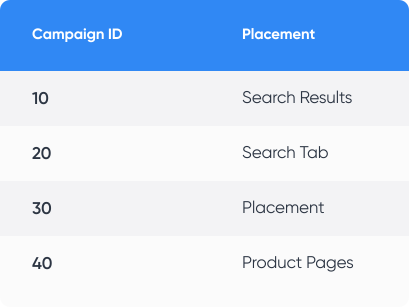
Apple does not forward SKAN postbacks to MMPs directly. To see Apple Ads SKAN/AAK postbacks in Singular, add Singular’s BI endpoint to your info.plist:
Key: NSAdvertisingAttributionReportEndpoint
Value: https://singular-bi.net
Once configured, postbacks appear in Singular’s dashboards and Marketing ETL exports alongside all your other channel data.
Pre-order attribution
Since October 2025, Apple Ads also supports pre-order attribution, crediting ad-driven installs that occur after a user pre-orders an app before its launch date. Attribution windows are 90 days for click-through and 61 days for view-through. This is particularly valuable for gaming, subscription, and entertainment apps, where pre-launch demand is a meaningful signal for budget planning and launch strategy.
Singular provides day-one support for pre-order attribution with no additional setup, data flows directly into existing dashboards and reports.
Why Apple Ads is a priority channel for app marketers
- High-intent audience: Users on the App Store are actively looking for apps — not passively scrolling a social feed. Search is the primary discovery method on the App Store.
- Privacy-compliant by design: Apple Ads operates within Apple’s privacy framework without requiring user consent under ATT. Attribution data is available even in a post-IDFA environment.
- Industry-leading conversion rates: Ads at the top of Search Results convert at over 60% on average (Apple Ads, Nov 2024–Oct 2025, with 95% of installs occurring within one minute of an ad tap. Singular’s own postback data confirms Search Results dominates volume at ~89.5% of all installs.
- Longer measurement windows with SKAN 4: SKAN 4 postbacks span 35 days post-install across 3 windows, giving iOS user acquisition campaigns access to D7 and D30 engagement signals for LTV modeling and high-value cohort optimization, not just install volume.
- Rising strategic importance: As iOS devices continue to represent disproportionate revenue share relative to install volume, Apple Ads reach into the highest-LTV user segment grows more critical.
How Singular supports Apple Ads campaigns
Singular is an official Apple Ads partner and supports the full measurement stack:
- Attribution via AdServices API: self-attributing integration, last-click model, covering all four placements.
- SKAN/AAK postbacks: placement-level ROI visibility using the same privacy-safe iOS attribution framework as the rest of the industry. Singular’s SKAN 4 conversion models support all 3 postback windows with fine and coarse CV configuration, plus cohort modeling for campaigns below crowd anonymity thresholds.
- Pre-order attribution: day-one support, no setup required.
- Cost aggregation: Apple Ads spend data unified with every other channel in a single source of truth, enabling accurate cross-channel ROAS.
- Placement-level ROI: because placement IDs are also available in the Apple Ads campaign management API, Singular can surface performance by placement, not just overall.
The result: complete, accurate visibility into what Apple Ads is actually driving — installs, post-install events, and revenue — without stitching together multiple data sources manually.
Related Terms
Related Articles
- App marketing boost 2023: 20 tips to kickstart growth without breaking the bank
- 2 superwomen in games: Getting featured by Apple and Google, growing a small studio, knowing when to scale (and more!)
- Apple Search Ads attribution: iAd, SKAdNetwork, and AdServices Framework
- Apple Search Ads: new placements, new opportunities, new challenges
- Apple Podcast Ads could be a multi-billion business by 2030