Apple Podcast Ads could be a multi-billion business by 2030

Apple grossed $4 billion last year from advertising via Apple Search Ads, according to reports. But Apple could be in a position to double or triple that number in just a few years.

How?

One way: Apple Podcast Ads. Which, of course, does not yet exist. Nor do I have any insider information that it will soon exist. But if Apple creates it — and there are some signs that it potentially could — Apple Podcast Ads would easily gross nearly $4 billion in 2030 on its own, and return well over a billion dollars in pure profit.

I’ve done the math.

Important note: I have no insider information here. This is pure speculation, but it is based on a variety of known facts.

Apple and ads: growing fast

Apple just increased the number of ad slots available on the App Store, which is going to boost the percentage of the global $150 billion mobile ad spend it captures. But that’s probably not the only thing Apple has on its mind, as there are rumors that the company is building a DSP, a demand-side platform. And not just any DSP, but “the most privacy-forward, sophisticated demand side platform possible.”

At the same time, there are persistent rumors that Apple is pursuing ad deals with agencies for Apple TV, potentially leading up to an ad-supported tier for Apple TV+ not unlike the recently unveiled Netflix offering: Basic With Ads. In addition, Bloomberg’s Mark Gurman has suggested that Apple is set to expand ads to its Maps app as well — think restaurant or hotel ads — and perhaps farther into other apps.

All of that makes sense, and yet, if you think about it, why would Apple stop there?

As I speculated here, there is plenty of opportunity:

Podcasts comes to mind. So does Music, along with maybe Weather and Stocks. But there are multiple options here, including Shazam, which — let’s be honest — is one big ad for Apple Music.

However, there are continual rumors about additional Apple investment in its advertising platform … so potentially the ads the company offers will eventually make their way into additional Apple apps. 

In fact, if you think about it, Apple’s goal is providing digital tools and experiences that enrich people’s lives while leaving the world, as Apple puts it, “better than we found it.” Arguably, one of the ways Apple is working to deliver on that vision is via App Tracking Transparency in its mobile operating system iOS, which enables some degree of marketing measurement via Apple’s attribution framework, SKAdNetwork, while increasing personal privacy by limiting what data marketers can access.

Could that be just step one?

Could it be that Apple sees providing a broader-focused privacy-safe ad network that only uses first-party data as an ethical duty, not just an opportunity?

Certainly it’s one place to grow revenue fast. Apple Search Ads has seen revenue growth rates in the 20-40% ranges in recent years, according to one source. And any massive $2.3 trillion tech company definitely needs to justify its stock price to investors by looking wherever it can for new sources of high-margin revenue. Ads — specifically ads beyond the App Store — could fit that bill, especially since advertising can be very high-margin, low-risk revenue. 

Plus, this all fits the bill of Apple’s stated goal of reducing its reliance on releasing new iPhones for revenue growth. In 2021, advertising accounted for less than 1% of the company’s total revenue:
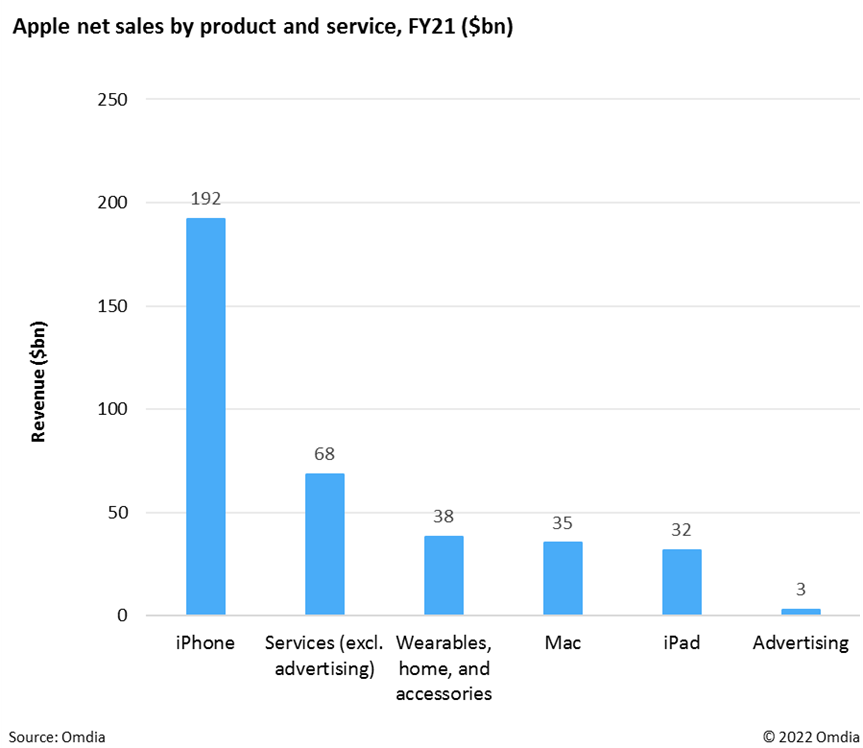
Apple net sales by product

That is something that could soon change, however.

And the interesting part is that advertising revenue, while it certainly benefits incrementally from every additional Apple device sold, crucially also enables monetization of the existing and ongoing Apple ecosystem and therefore does not require any new device sales in order to grow. In other words, it fits right into the Services category of revenue that Apple has been working hard to grow.

So … Apple Podcast Ads, huh?

If Apple is interested in a new advertising adventure in podcasting, what kind of returns could it generate? There are several different ways to estimate that. 

Here’s one …

Podcast ad revenue for this year will total out at about $1.7 billion, according to Insider Intelligence. While Insider only forecasts out to 2024, if we assume similar future growth and run a simple linear regression out to 2030, that total grows to just north of $5 billion. According to Podcast Statistics, Apple’s share of the podcast market is just over 37%.

Assuming Apple can capture as much value from podcast advertising as it has captured share in the space — yes, that’s a big assumption, but we’ll unpack it more later — that means Apple could capture as much as $1.9 billion in Apple Podcast Ads revenue in the same year.
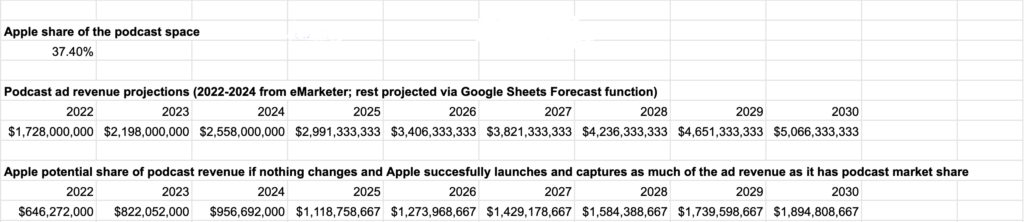
apple share of podcast space

There’s of course much more complexity to unpack here: some podcasts prefer to monetize via direct sponsorships, not all podcasts monetize, and podcast monetization is notoriously poor.

The first of these is likely to remain for many top podcasts and podcast networks, but the second and third are largely a function of an immature space that doesn’t have great measurement capability on two critical components: 

  1. listenership
  2. ad effectiveness 

If podcast ads were both easier for podcasters to implement and simpler for advertisers to measure, there’d likely be a significant boom in ad-based monetization for podcasts. (Remember when TikTok finally figured out its ad platform and revenue literally exploded 75X over a 6-month span? Yes, something like that.) 

So there’s much more to add to the potential $5 billion in total podcasting revenue and the Apple Podcast Ads potential $1.9 billion profit. 

Because …

Apple can potentially do podcast ads better than almost any other company

Apple Search Ads is built on first-party data, which is not subject to the rules Apple has sent up in ATT and SKAN around data-sharing between companies. In other words, Apple is only using data that you’re agreeing to provide to Apple, and no data goes to advertisers, other ad networks, or any other companies.

That’s now the default standard on iOS, and is trending towards the default standard on Android (as the GAID disappears) and the web (as the third-party cookie goes away).

This is good for consumers, and it offers more privacy, but let’s be honest: it privileges those with lots of first-party data, and punishes those who do not. 

Essentially, it privileges platforms that can run both supply and demand at the same time, and have insight (via the supply-side) into what people like/want/buy/do which they can apply to the demand side and make ads more behaviorally targeted, which can provide anywhere from 10X to 100X or beyond bump in the value from an advertisers’ perspective. This is what Eric Seufert calls a content fortress.

More targeted ads with behavioral targeting and search targeting

Apple has insight into many things happening on your phone, including App Store activity, music you like (Music app), places you go (Maps app), stocks you monitor (Stocks app) … Shazam, Pages, Numbers, Keynote … and Podcasts, among other apps. While Apple maintains privacy by packaging segments of at least 5,000 people based on common characteristics, this data is helpful in finding and assembling the right targeted audience for each ad.

And note: it’s not just behavioral data.

It’s also search data, including “insights derived from non-personal historical search terms,” and in-app purchases.

When it comes to Podcasts, think of Apple’s potential advantage versus Spotify, currently the most popular podcast platform on the planet, or Soundcloud, or Pocket Casts, or any other independent podcast app besides those from Google (YouTube and Google Podcasts) and Amazon (Audible). Most podcast apps have really no knowledge of their users beyond what podcasts they subscribe to, and any other demographics people have provided. How much more targeted will Apple’s podcast ads be, if Apple decides to launch this?

That’s hard to quantify, but it’s huge. 

It’s what helps Apple command a premium, simply based on natural auction mechanics of the open market for app install ads on Apple Search Ads:
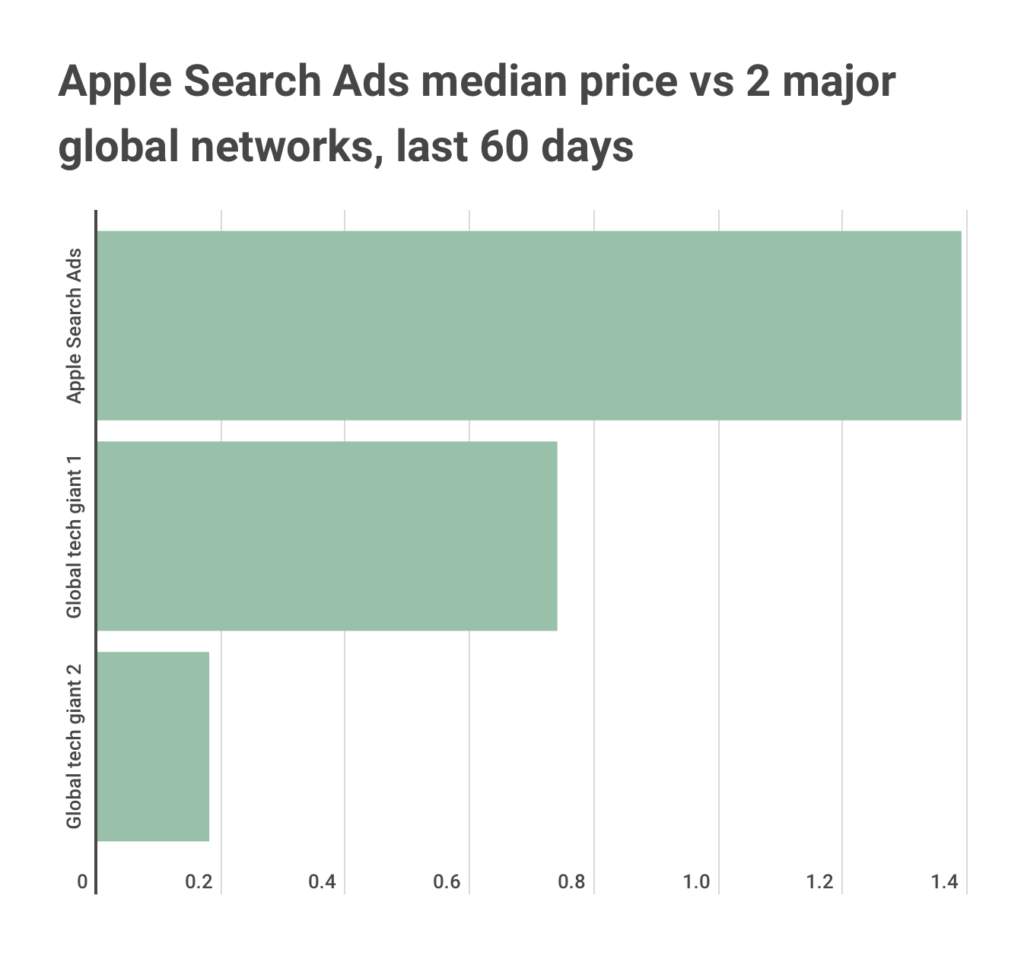
Apple search ads

Apple Search Ads prices app installs at a premium of 2X to 8X over some of the largest global players in the mobile marketing ecosystem. This advantage is at minimum a 2X boost, and often significantly more.

But wait, there’s more: full-stack control

In addition, Apple controls the full stack here: operating system, podcast app, device, podcast platform, ad platform. So Apple has exquisitely good data on listenership, drop-off, and attention that podcasting charts and rankings platforms like Chartable can only dream of.

That’s great, but it’s not just numbers.

This would allow Apple to reinvent the call-to-action or conversion paradigm for podcasts, which is largely now based on visit ADVERTISER-BRAND-WEBSITE.COM/CUSTOM-LANDING-PAGE so that brands can track visits and sales and therefore how many listeners from a particular podcast they are reaching and converting. That’s a tough conversion to create when your potential customer is driving, or running, or busy in other ways, as podcast listeners often are.

Apple could do much better:

  • Shake your phone to click
  • Shake your phone to download the app
  • Tap the screen twice to get the discount code via email
  • Hit volume up to get a push notification in an hour
  • Say “Siri, add to cart” now to put this product in your shopping cart
  • Say “Siri, add this meeting” to put a software demo session on your calendar
  • Or whatever …

No further steps, no URL to visit, no distraction. Just pure and instant conversion.

Plus, perfect first-party measurement with super-granular data for billing. Of course, Apple won’t provide all of that super-granular data to advertisers and thereby violate individual privacy, but Apple has it for internal use.

So what’s the true financial opportunity for Apple Podcast Ads?

First of all, let’s assume the podcast space continues growing at its current rate. Nothing substantial changes, except Apple starts taking a piece of the pie.

Given the above, it wouldn’t be crazy to assume Apple could boost podcast monetization by at least a factor of 3, but I’ll go with a conservative 2X multiple here. Realistically, the premium might start out a little lower than that and grow well above it as Apple builds out the platform, network, and overall service over a period of years, but I’ll just go with a flat multiple of 2 for the next 8 years.

That would mean a potential gross revenue of not too far south of $4 billion in 2030.

Apple premium

Of course, that’s not all for Apple. There’s obviously a split between ad networks and publishers, in this case, Apple and podcasters. If we assume that’s a 70% for podcasters and 30% for Apple split — similar to the original App Store numbers, and basically around what at least some ad networks do — the result is almost $400 million in profit year one, and well over $1 billion in profit by 2030.

Apple ads gross revenue

The upshot is that Apple Podcast Ads is easily a multi-billion dollar business by 2030, with easily a billion dollars in pure profit.

But all of this is at a fairly conservative Apple multiple. As I mentioned above, Apple Search Ads prices for app installs range from 2X to 6X other major global tech companies’ prices. And if Apple would do something like this, it would be a massive disruption of the current podcast monetization scene.

With proper measurement, better targeting, and built-in automated conversion models via Siri or device interactions in no-eyes situations (driving in the car) and no-hands situations (biking), it’s possible for Apple to blow the podcast monetization scene wide open. In which case, it’s likely that advertisers would significantly increase spend on podcasts, potentially flooding the space with billions more in ad spend.

And just think: a huge percentage of the user acquisition market for new users in your app is done via … other apps. In other words, this is a somewhat incestuous marketplace where apps are forever stealing a finite number of users from each other, and spending millions of dollars merrily all the way. If podcast publishers see a good, measurable path to growth, podcast advertising might follow somewhat of a similar trajectory.

What does this all mean?

The numbers above might just be the low end of the opportunity.

Caveats and confessions

It’s really, really, really important to note that I have no insider information here. I don’t know if Apple is planning to start up a podcasting ad service. (If they’re not, maybe this post might persuade them to try?) I don’t know what features it might have. I don’t know if they’d integrate it with the full iOS software stack to provide innovative “click” and conversion capabilities.

It’s also important to note that big services take time to build, time to scale, and have unknown as well as unknowable consequences. Will most podcasters opt out? Will most opt-in? It’s hard to say, but the answer to those questions is critical to knowing whether the above numbers are probable or fanciful. In addition, YouTube is a huge platform for podcasts — some with video and some with a static image — and Google is a good candidate for doing more with podcast ads as well, both on YouTube and in Google Podcasts.

Plus, Apple has recently built and released monetization features for podcasts, including subscriptions. I don’t view that as a negative for ad-based monetization; some listeners will take this option, but the vast majority will not.

A penny for your thoughts?

Let me know if you think an Apple ad network for podcasts is likely, possible, or completely insane.

And one thought grenade to leave with you for another day …

This has been an interesting little thought experiment, but here’s a bigger thought grenade to leave you with that would really blow the mobile user acquisition industry’s hivemind.

What about a version of Apple Search Ads in non-Apple apps?

Something to think about for another day.
iOS 16’s Live Activities offers huge new engagement and retention opportunities for app developers

iOS 16 is just a month old now, and it has multiple changes and enhancements to how apps function and how people will use their iPhones. One that should be particularly interesting for developers and marketers is the new Live Activities API.

Why?

Live Activities has huge potential to boost engagement with your app and retention of your customers, players, and users.

What are Live Activities?

Live Activities are pretty much what they sound like: things that are happening now.

But rather than forcing people to unlock their phones, navigate to or search for an app, open it, and tap through to whatever they want, Live Activities displays relevant updates right on the lock screen. (Or in the dynamic island on an unlocked phone, which is only available on iPhone 14 Pro and iPhone 14 Pro Max, at least for now.)

Essentially, they are push notifications on steroids, but push notifications that are smart: they update and change via iOS widget functionality to keep people up to date.

One significant difference, however: you can only kick off a Live Activity when your app is in the foreground, which means users are in control of enabling your ability to initiate the Live Activity functionality.

What kinds of things can you use Live Activities for?

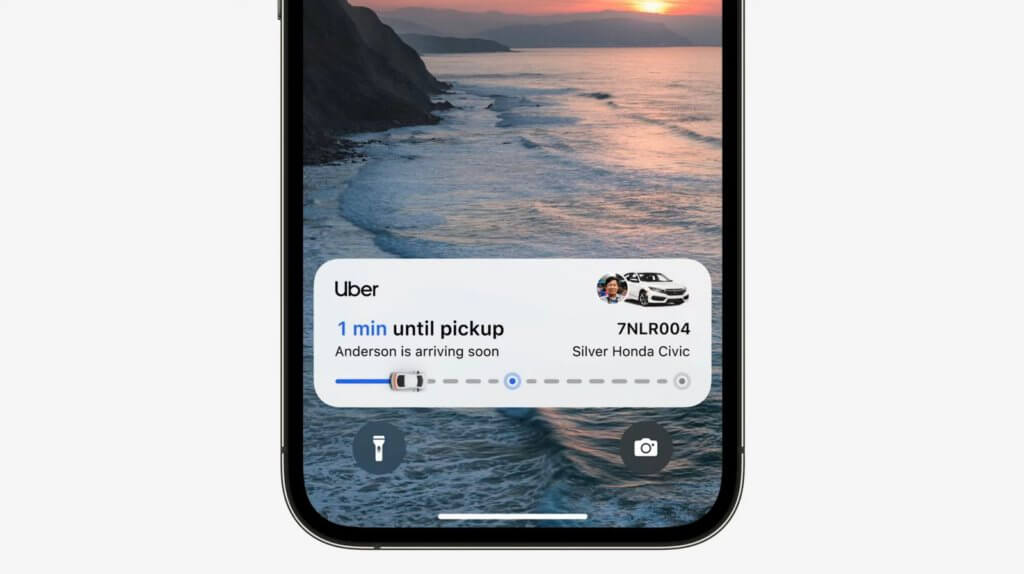
There’s the obvious example, which is using Live Activities when calling a Lyft or Uber for ride-sharing. The Live Activity can update with the car’s proximity changes, and an expanded view shows in Dynamic Island when tapped and held, or on the lock screen when an update arrives.

iOS 16 Live Activities

But there’s much more that you can use Live Activities for, and mobile developers and marketers are sure to add their creativity here.

Some options:

  • Gaming: tournament status updates 
  • Retail: order status
  • Fintech: transaction status
  • Sports: game score updates
  • On-demand: delivery time remaining
  • Social networking: responses or engagement
  • Weather: storm tracking
  • Travel: flight status
  • Productivity: time remaining
  • Maps: next turn
  • Dating: new matches
  • Events: timeline, speaker/session updates
  • Music: live event streaming countdown
  • Medical: treatment steps
  • Health & fitness: workout stages or exercise transitions

Essentially, the options are limited only by your imagination. Yes, the ordering, on-demand, and delivery options are the most obvious. But there are realistic and useful implementations throughout the App Store categories, even in apps and categories that on first thought might not seem to fit very well.

As an Apple Fitness customer, I like the workout idea particularly.

A guided workout with updates on what to do when could be super-useful for many, and they don’t have to have an app running or be watching a video to follow along.

Live Activities limitations

There are some limitations, of course. 

As I mentioned earlier, Live Activities must be initiated by a user. You can suggest them in your app, but your app must be open in the foreground to kick off a Live Activity. So you can’t spam users with Live Activity notifications: probably a good thing.

Also, they last only up to 8 hours, while potentially living up to 12 hours on the lock screen. So they may not be ideal for longer time frame events that take days or weeks. In addition, Live Activities are sandboxed: they can’t access the network or receive location updates. You’ll have to update them with ActivityKit or push notifications from your app.

Live Activities came out pretty late in the run-up to the iOS 16 release — only being made available in developer beta 4 — and there are limited implementations of it right now. So people will probably need some education before they’re familiar with the concept and implementation.

Finally, iOS will only display up to 2 Live Activities, so if there are dozens of apps that want access to the lock screen, some are going to lose out.

Engagement and user retention

App engagement is driven by utility. User retention is driven by long-term success at being worthy of significant app engagement. Both are absolutely essential: in a world where app marketers spend tens of millions annually for new user acquisition, keeping more than 5% of your users for a month or so would be nice.

As such, anything you can do to offer a better user experience and increased utility is a bonus, and pays for itself potentially hundreds of times over in LTV and ROAS.

Coming to Android?

Despite clearly greater flexibility in how Android users can set up their devices, there isn’t a clear one-to-one analog of this functionality on Android yet, at least not without third-party enhancements. 

The reality is, however, that updates on iOS and Android often leapfrog each other, with Google or Apple bringing out new innovations and functionality that the other than implements in subsequent releases in a slightly different way.

Android 13 does allow some controls on its home screen, at least for smart home, and plenty of options for how to view (or whether to view) notifications on your lock screen, but we’ll have to see if 14 brings something similar to iOS 16’s Live Activities.

8 insights on media mix modeling for mobile user acquisition from Meta, Tinuiti, Rocketship HQ, and Singular

  • Where MMM fits and works best
  • First-party data and media mix modeling
  • How to know your MMM is actually working
  • Media mix modeling as part of a hybrid measurement strategy
  • How do to incrementality without pausing campaigns

What can you learn about media mix modeling from an hour with the absolute experts in the trade? Far too much to fit into one blog post, unfortunately.

We recently asked experts from Meta, Tinuiti, and RocketShip HQ to join Singular CTO Eran Friedman in a discussion on how MMM can reasonably be expected to impact the high-pace, granular, data-driven world of mobile user acquisition. To catch that incredible show, check it out now, right here.

Those experts include:

  • Liz Emery, VP, Mobile + Ad Tech, Tinuiti
  • Shamanth Rao, Founder & CEO, RocketShip HQ
  • Igor Skokan, Director of Marketing Science, Meta  
  • Eran Friedman, CTO & Co-founder, Singular

Here’s a sampling of their insights …

1. Media mix modeling is also marketing mix modeling

The first thing to understand about media mix modeling for mobile user acquisition is that it’s also marketing mix modeling. Sure, it’s about channels and partners and advertising effectiveness. And as such, Meta director of marketing science Igor Skokan calls it the “gold standard” for ensuring brands can measure campaign and marketing performance.

But it’s also more than that.

“We also sometimes refer to this as a marketing mix modeling, not just media mix, because MMM itself actually is much more powerful … it’s more like holistic business modeling, so it goes way beyond media, even way beyond marketing into business drivers, price, distribution, other things, even whether all kinds of things that impact business … should be included in the modeling.”

Igor Skokan, Director of Marketing Science, Meta

That makes sense, and it’s worth remembering. 

The bonus: additional insight beyond simply marketing.

2. Yes, MMM can achieve high levels of accuracy

The second thing to understand is that media mix modeling can actually be quite effective. 

The knock on MMM has always been that it provides high-level general feedback only. There’s some truth to that, for sure. But in the right hands and used correctly, media mix modeling can provide a fairly high level of accuracy. 

“It’s very much a function of the volume of data but I would say even for smaller clients we work with, we see R-squared of like 90%-93%. But that’s the minimum we try to look at. So, you know, definitely, I would say that we do see very strong accuracy that informs a lot of our decisions.”

Shamanth Rao, Founder and CEO, RocketShip HQ

R-squared is data science for, essentially, real

As in, the percentage likelihood that the good things you want are being created by the expensive things you’re doing and not by competitive forces, organic factors, or the pink pixie dust spread in the air by magic marketing elves. 

Simpler yet: your advertising is working.

“Using MMM? The best fit is that you can use your past marketing performance to influence your future ROI. Not only that, but you can do that by optimizing your allocation by channel, by tactic. And that’s not just digital landscape, that’s traditional as well. So, that’s that full spectrum influence in terms of optimizing, promotions, pricing, competitor spend, you just have so much insight at your disposal when you do your MMM.”

Liz Emery, VP Mobile + Ad Tech, Tinuiti

As we see mobile app advertising ad spend proliferate beyond just in-app to in-app, that’s not only helpful, it’s essential.

3. But, media mix modeling is strategic, not tactical

The third thing to understand about media mix modeling is that it is strategic, not tactical. 

It’s crucial to understand the value and use cases for every measurement methodology in a hybrid measurement world, and that’s doubly true for MMM.

“Part of the challenge with MMM is with very, very granular and very tactical kind of decision-making. It’s difficult to get insights, for example, at the creative level ROI … of course, if you have a lot of data, if you’re running creatives at scale … then you can optimize things. But generally speaking, usually, it would be easier to seek a solution from the other methods such as deterministic attribution versus MMM for the operational or daily stuff.”

Eran Friedman, CTO & Co-founder, Singular

In other words, you’re not using media mix modeling to optimize adsets or creative or fine-grained targeting. You are using MMM to optimize channel and partner mix, or media intensity.

But when doing so, you get things you couldn’t measure before.

“I think it starts to become really interesting once you start digging into the other things that MMM can give us. Competitive intel, insights on game launches, cannibalization from within portfolio, things that we couldn’t probably measure before …”

Igor Skokan, Director of Marketing Science, Meta

Interesting indeed!

4. MMM is part of an overall hybrid measurement strategy

MMM might be a shiny new thing right now thanks to privacy and the drop in granular attribution data  (even though it’s 60 years old). But it works best paired with multiple methodologies, each being used where it makes the most sense.

“MMM is not a silver bullet. There is no silver bullet. We believe that advertisers need a mix of complementary solutions and that is attribution, experimentation, and modeling mix of approaches and every company needs to figure out what works for them. There is not even a single template or a right balance between these methodologies.”

Igor Skokan, Director of Marketing Science, Meta

I love silver bullets.

Everyone loves silver bullets.

In fact, everyone wants silver bullets.

The fact is, however, that we live in the real world, not the fantasy world. And in the real world, problems are multi-dimensional, circumstances are complex, outcomes are overdetermined, and solutions need to take into account multiple situational intricacies. (This is one reason data scientists are sometimes called data janitors.)

Ultimately, the only person selling one-size-fits-all solutions is the snake oil vendor. Simple answers are great, but they’re incomplete.

“There’s SKAdNetwork and GAID [and Privacy Sandbox on Android] and device-level data and incrementality testing and MMM … instead of relying on a single method to base all your work on, in our view, the future is going to have to require multiple methodologies and it’s really the combination of these solutions that’s going to provide the most actionable and insightful measurements.”

Eran Friedman, CTO & Co-founder, Singular

That’s a more challenging world than one in which you could just rely on freely-available IDFAs and GAIDs. 

But ultimately, it’s likely to be a better, more effective marketing measurement world, too.

5. MMM can save you money

It’s possible that everything that makes sense individually under the microscope doesn’t make sense in aggregate, from the 30,000 foot level. 

And that can include mobile user acquisition.

“You’re just basically trusting Google-reported numbers on iOS [and] the numbers looked wildly optimistic, the numbers looked crazy, because Firebase … [is] the referee and the player … when we did cut the budget, we just saw no change in the overall trials baseline. We’re like, ‘Guys, we just cut your budget in Google 66% because analysis said Google wasn’t driving anything incremental. Your trials just haven’t changed, nothing more.’ And that was, I think, just a huge, huge win.”

Shamanth Rao, Founder and CEO, RocketShip HQ

Saving money on ads that don’t provide impact?

Absolutely a huge win.

And it’s not just about saving money. It’s about optimizing allocation.

“We were able to leverage a combination of an MMM that we have built with them out of Tinuity, some incrementality testing, and projected models … and as we implemented these models, we were able to …  get a much higher return, we were able to actually prove out which channels worked, and we were also able to take into account environmental factors.”

Liz Emery, VP Mobile + Ad Tech, Tinuiti

Thinking you know what’s working is dangerous. Knowing you know: that’s power.

6. First-party data is critical to media mix modeling success

We’ve already seen the power of first-party data in the ongoing privacy revolution. It’s clear that first-party data is also critical for media mix modeling success.

“First-party data is critical to ensure the accuracy of your model. You can use that for so many things, including for tests for ground control, and making sure that your MMM is as accurate as possible … as always, first-party data is gold, right? The more we can have it, the better it is for everything basically.”

Eran Friedman, CTO & Co-founder, Singular

What that means is when you see actual use in an app like conversions, purchases, activity, and engagement, you can correlate that to marketing activity. 

Connecting this data to your MMM model ties the probabilistic projections of the modeling to the deterministic reality of what you’re actually seeing in-app.

7. How to know for sure that your media mix modeling is working

Marketing results aren’t just an input into your modeling. They’re also a way to ensure that your models are correct, accurate, and — the critical part — predictive.

“Whether you do [media mix modeling] in-house or through a partner, it’s really important to put actionability at the core. So request forecasting and simulations to be done to verify the accuracy of models over time because only that’s how you’re going to find that it actually works.”

Igor Skokan, Director of Marketing Science, Meta

It’s simple.

If your marketing measurement methodology can make predictions about the future that have truthfulness and accuracy to them, and if you can test those predictions and see if they actually pan out … then you know you have something that works.

Make predictions with your MMM models. Then test them.

8. Incrementality in an MMM world doesn’t mean stopping everything else

One of the challenges in my mind around measuring for incrementality has been that doing so in a purely clinical and completely scientific gold-standard way is sometimes interpreted as “pause everything else, only do X, and we’ll see what results X generates.”

There’s some sense to that of course, but there’s also a huge disconnect with marketing and business reality, where it’s extremely difficult to just push a big pause button and potentially negatively impact your next quarter results. Doing so has potentially huge impacts for CEOs and CMOs and growth leaders and, in fact, entire companies and their investors.

That, however, is not necessary:

“You need variation in the data to measure it. MMM is a backward-looking analysis, so as long as there is enough variation in the channels, then you are able to get a read on them … you could, for example, switch off a channel for a couple of days, or increase intensity somewhere and decrease intensity somewhere else, and then introduce variability into your factors so you can actually measure them … you can do regions … or different gains within the portfolio.”

Igor Skokan, Director of Marketing Science, Meta

That’s reassuring.

And it’s a reminder to not keep campaigns on autopilot. Adjust intensity, wind up and wind down, change targeting a bit, assign certain creative and certain offers to a specific channel or partner, and then switch things up a few weeks later.

Summing up: you really need to watch the entire show

There’s a lot of gold in this chat with some of the best minds available today on media mix modeling for mobile user acquisition. I get it: it will consume an hour of your time. Trust me, it’s worth it.

Check out the entire chat here.

The evolution of playable ads, with Craftsman+ CEO Alex Merutka

Somewhere around 10 years ago someone created the very first mobile playable ad… a mini-game you could enjoy, and an ad that didn’t suck. Fast forward to 2021, and according to a Liftoff report, “playable ads were the most cost-effective ad format” in every month other than September when they tied with another format.

That’s a meteoric rise.

If you think about it, it makes sense: playable ads generate unprecedented ad engagement. They invite interactivity. Plus, they’re fun. And sometimes, playable ads are even tied to a reward for the viewer. In addition, from a mobile publisher perspective, a playable ad often shows something of what the advertised app is all about, boosting engagement and retention if the ad actual causes a click and a conversion.

But there’s been a big problem.

Playables have been hard to create. Slow. Expensive. Inflexible. Hard to use with user-generated content. Difficult to implement with influencers.

Could there be a solution for that? Should you be looking harder at playables? Could they even solve for some of the targeting that privacy is removing? Check out the video at the top of this post (or the Growth Masterminds podcast) for all the answers and insights, but here’s a few highlights from our chat with Craftsman+ CEO Alex Merutka …

Making playable ads fast and scalable to produce

The problems:

  • Too long to build
  • Too expensive
  • Too risky because most ads fail

“Playables had this kind of 4 week turnaround time that you would go get a developer to build, and once you build one for Facebook or for TikTok, you’d have to rebuild it for Google, for Applovin, Unity, Vungle … all the different channels have different API calls and what you need to plug into them … it’d take 4 weeks, it’d cost you $5K in the US to go build this ad unit, and then you’d have to QA it across all these different channels, customize it for the channels, and by the time it’s like two months in, you’ve spent $7,500 on a playable ad. And then guess what? 90% of ads just don’t work.”

Alex Merutka  

The solution:

  • No-code platform to build, so no developer required
  • Cheap
  • Quick to develop and iterate

“Our idea was: how do we just create a volume of assets to give people and make playable ads super accessible so that you can jump into some software and build a ton of different concepts. You could build 10 concepts in a day, go run them, and then you might find, yeah, 1 of the 10 actually works.”

Alex Merutka

That’s #winning: more at-bats to take more swings to get more home runs.

Important: don’t make annoying ads

The problems:

  • Everyone follows a trend, which gets stale
  • The playable doesn’t actually resemble the game

“I think the issue is when you see these big trends like … pull the pin and save the princess before the lava burns everyone. Everyone’s seen that playable … there are these trends and everyone just reskins that trend and uses their own.”

Alex Merutka

The solution:

  • Show the actual game
  • Don’t overdose on trends

“Build a playable that is similar to your [actual] user experience, like DraftKings … this is the UI and this is your experience. And the same with gaming … if you could play a little version of a match 3 game in the playable ad, I understand, okay, this is the experience I’m getting.”

Alex Merutka

Cheating on the ad might get the click and might even get the download, but it’s unlikely to win engagement and retention.

How playable ads can help targeting and segmentation

The problem:

  • ATT and privacy regulation is making it harder to target the right ad to an interested audience

“Apple kind of threw a wrench into [targeting], and so it’s become a lot harder for those folks to effectively target the right audiences.”

Alex Merutka

The solution:

  • Playables that let people choose what they care about

“Playable ads allow you to … almost host a mini website as an interactive ad and let people pick and choose and engage with the content they want … so they can go through [for example] this Bon Appetit cookie quiz and figure out what is their style of cookie and get a different product and experience based on the choices they make, what their actual interests are. So now you no longer have to target someone so specifically.”

Alex Merutka

Targeting is back, baby? Well, maybe not as powerful as before. But certainly better than a static ad that no one interacts with.

Using playables to pre-test game concepts

The problem:

  • Mobile gaming is very hit-driven
  • It’s expensive to build and market games
  • Most games fail

“The issue with gaming, and everyone’s seen this in the stock market … it’s a very hit driven economy. So you build a game, you get a team together, you have a concept, you build a game … you have like, let’s say $1 to $3 million budget to build the game … as an investor in a game companies, you never know if the company’s gonna hit or not hit, and it’s a pretty big gamble … it’s like, ‘Hey, gimme 3 million bucks and then let’s see if users download this.’”

Alex Merutka

The solution:

  • Build a playable with the core concept
  • Advertise it
  • Direct people to a pre-launch sign-up page
  • If the results are good enough, build the actual game

“You could build these micro experiences, launch a playable, actually market it as if it’s a real game, and go out and test … instead of spending $3 million on the game, spend a couple thousand bucks on the playable spend … and then you have a test for $50K if the game’s gonna work or not. You micro test that across 20 games; you find your 3 winners and then you go build those. Instead of building 20 games, you build 3 that have the best shot.”

Alex Merutka

With literally millions of games on the app stores, the odds are definitely not ever in your favor. Tip the pinball table just slightly to at least even them out.

Much more in the video and podcast

There’s much more in the video and podcast. Check it out above, subscribe to our YouTube channel to never miss one, and hey … while you’re at it subscribe to our Growth Masterminds podcast as well.

Should we be featuring you on a Singular podcast? Do you have insights that other marketers need to hear? Ping me and let’s chat.

Apple Search Ads: new placements, new opportunities, new challenges

Apple Search Ads now has new placements, and it’s a big deal. 

In addition to the search page and search results page ads, Apple is now offering ads on both the Today tab — the default home page of the App Store app — and product pages, where your app is itself listed. The result is twofold: app publishers can now essentially buy something very similar to what an actual Apple-created app featuring, which has always been highlighted on the Today page, looks like … and your very own app listing page is now content for other apps to advertise against. 

Of course, any ads are still clearly labeled as ads.

There are some massive new opportunities coming up in ASA. And, there’s going to be a few challenges as well.

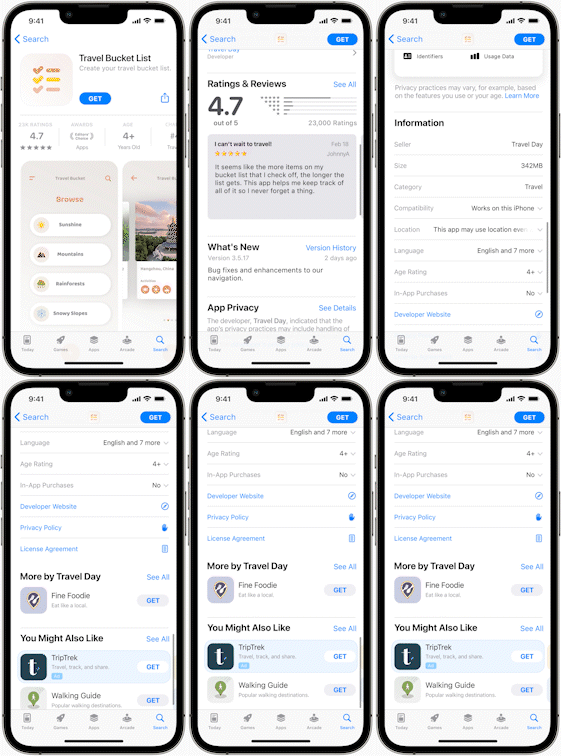
App product page ads on Apple Search Ads

One of the new placements is right on everyone’s app listing pages, essentially turning the millions of apps on the App Store into a massive amount of published content against which Apple can run ad auctions. (Genius, right.)

These placements are a mixed blessing, however.

Hopefully Apple will not put direct competitors on your app listing page, but there’s no guarantee about that. Apple will either select relevant categories for your app by itself, or advertisers can choose the categories in which they run, and the reality is that attempted conquesting is going to happen.

“Ads appear at the top of the You Might Also Like list to users who have scrolled to the bottom of relevant product pages, actively researching apps and getting information to help them decide whether to download,” Apple says.

Apple Search Ads new placements

The good news from the app publisher perspective? The ads are waaayyyy down the app listing page. For instance, I just checked Supercell’s Clash of Clans app product page, and the “You Might Also Like” list is literally 5 full screens down. Honestly, I doubt I would ever scroll that low when checking out an app. And while it’s a cardinal error to reason from your own behavior to everyone else’s … I can’t see too many others doing it either.

The bad news from an advertiser perspective is exactly the same point: the ads are not in an obvious position on the app product page. They may not get a lot of attention and therefore may not generate a lot of action.

Like other ads on the App Store, product page ads are made from your existing assets in your own app product page.

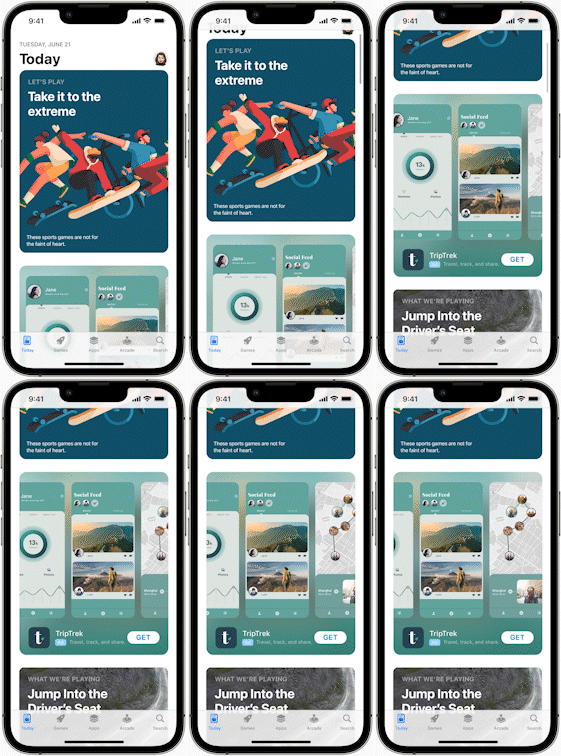
Today tab ads

Today page ads are very different, taking different assets, and requiring explicit Apple approval before publishing.

The benefit is obvious: premium front page placement. When people open the App Store, this is where they come, and while the very top billing is still reserved for Apple’s featured content of the day, a Today tab ad will be at least partially visible by default on app open. Sure, plenty of people enter the App Store via direct deep link to a specific app … but Apple says the “Today tab is where over half a billion weekly App Store visitors start their journey to discover new apps.”

That’s massive scale.

However, the Today tab is where everyone starts, so there’s not a lot of contextual targeting going on. In other words, if you’re planning to do a Today page ad via Apple Search Ads, you better have an app with a near-global appeal or an app that monetizes extremely well so the lack of targeting specificity is not critical.

Note: if you’re going to use a Today page ad, it will be created from a custom product page, and you’ll need to have at least 4 portrait or 5 landscape images associated with that custom product page. Even though it’s from a product page listing, Apple is taking no chances that something shady or inappropriate makes it to the first page of its most important app: each ad will need to be individually approved by Apple in App Store Connect.

Apple Search Ads new placements

Today tab ads are actually sort of carousel/video ads. You get a full-width block as people scroll down the App Store Today tab, and people will be able to see those multiple screenshots from your custom product page. They’ll also see your app name, a very brief description, and the App Store GET button.

There are, of course, a few (perhaps more than a few) additional details:

  • No more than 3 lines of text
  • No more than 50 characters
  • Assets “must “include screenshots from the app you’re promoting”
  • Those screenshots must be at least ⅔ of the ad creative
  • No pricing
  • No offers
  • No ranking claims
  • Font must not be similar to Apple’s in the Today Card
  • Text can’t suggest that this is an Apple-promoted app
  • If you mock up a phone, the bezel must be the same as the most recent Apple devices
  • No violent, sexually explicit, or inappropriate images

One very important note: you can’t just swap out new creative or A/B test creative side by side. With Today tab ads in Apple Search Ads, you get to run one at a time. Want to change it? Make a new one and get it approved. 

Meanwhile, your existing ad will continue to run.

In other words: maybe FWIW spend some money doing some A/B testing on another ad network first to see what works best. Even then, of course, context matters, so you still won’t really know what will operate best in the App Store environment. But, given the prominent placement, you can expect experimentation here to be expensive, so any insight into clickability and value is probably better than nothing.

More ad placements on the App Store is huge

According to a recent Splitmetrics report, ads on the App Store have an average TTR (tap-through rate) of 9.99%. Some categories, like Entertainment, are at just under 25%.

That’s mindblowing for basically any other ad placement in any other network.

Conversions are insanely off the charts as well: 64.96%, according to Splitmetrics, with highs of 78% in Entertainment, 74% in Food & Drink, and 71% in Travel. That means out of 100 people who tapped an Apple Search Ads ad, 65 actually installed an app.

With an average cost per tap of $1.12 in Q2 2022 … that’s a good deal. Expect more publishers to jump on board, and expect Apple to take a higher percentage of advertisers budgets.

But there’s a caveat. 

With more placements and therefore a busier ad environment on the App Store, you can probably expect some of those tap-through rates and conversion rates to drop. Few ads in a sea of content typically means high attention rates; more ads tend to dilute both visibility and engagement.

New measurement requirements

The good news is that the Apple Search Ads Attribution API did not change. The other news is that with more placements, there’s a bit more complexity in managing it all. Expect Singular to be able to help measure and monitor your results in various different places in the very near future.

What’s next for Apple Search Ads?

(Note: I have literally ZERO insider information about this.)

It would not shock me to start seeing Apple put ads in some of its other apps. Podcasts comes to mind. So does Music, along with maybe Weather and Stocks. But there are multiple options here, including Shazzam, which — let’s be honest — is one big ad for Apple Music.

However, there are continual rumors about additional Apple investment in its advertising platform … so potentially the ads the company offers will eventually make their way into additional Apple apps. 

A little thought grenade to leave you with: would really blow the industry’s mind would be Apple Search Ads in non-Apple apps.

Of course, then they’d have to change the name, no?

Live poll: 97% of mobile marketers are doing, planning, or considering media mix modeling and/or incrementality right now

The landscape of marketing measurement in mobile user acquisition is drastically changing. We are literally seeing seismic shifts in how mobile marketers think about marketing analytics and measuring advertising effectiveness.

One example: if you can trust the results of a poll during our recent webinar on Media Mix Modeling, almost every mobile marketer is either doing MMM, planning to do MMM, or considering how to implement MMM in the near future.

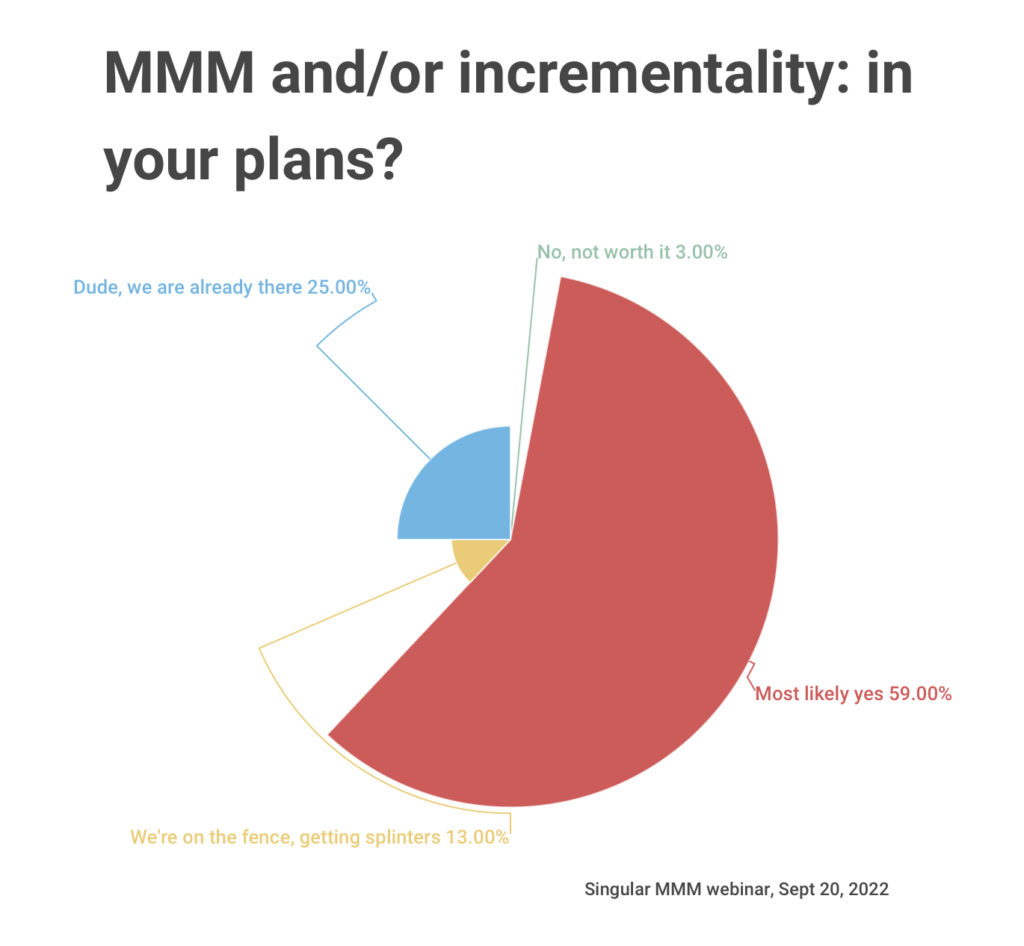
97% of mobile marketers are doing, planning, or considering media mix modeling and/or incrementality right now

I want to say “mind blown,” but perhaps it shouldn’t be.

Here’s the sense in which that’s shocking, however. We are literally not much more than a year away from a time in which last-click deterministic attribution was the absolute unquestioned norm across the entire industry, and while flawed it was good enough to power massive and efficient growth. 

Moving from that to a probabilistic model that is notoriously tricky to get right and even in best-case scenarios more than a little hazy on the finer details of performance is surprising.

Now, there are lots of caveats here, so don’t get too excited. One, it was a webinar on media mix modeling, so there’s very obviously a self-selected audience. Two, while Singular typically has well over 1,000 registrants for webinars, only about 30% of people attend live and can therefore vote in a live poll. Three, we gave people about 60 seconds to make a choice.

However, with all those caveats, I’m still surprised. Only 3% of marketers said they were not considering media mix modeling — or marketing mix modeling as panelist Igor Skokan from Meta reminded us — and not considering using incrementality either.

Media mix modeling: 75% of mobile marketers are buying in

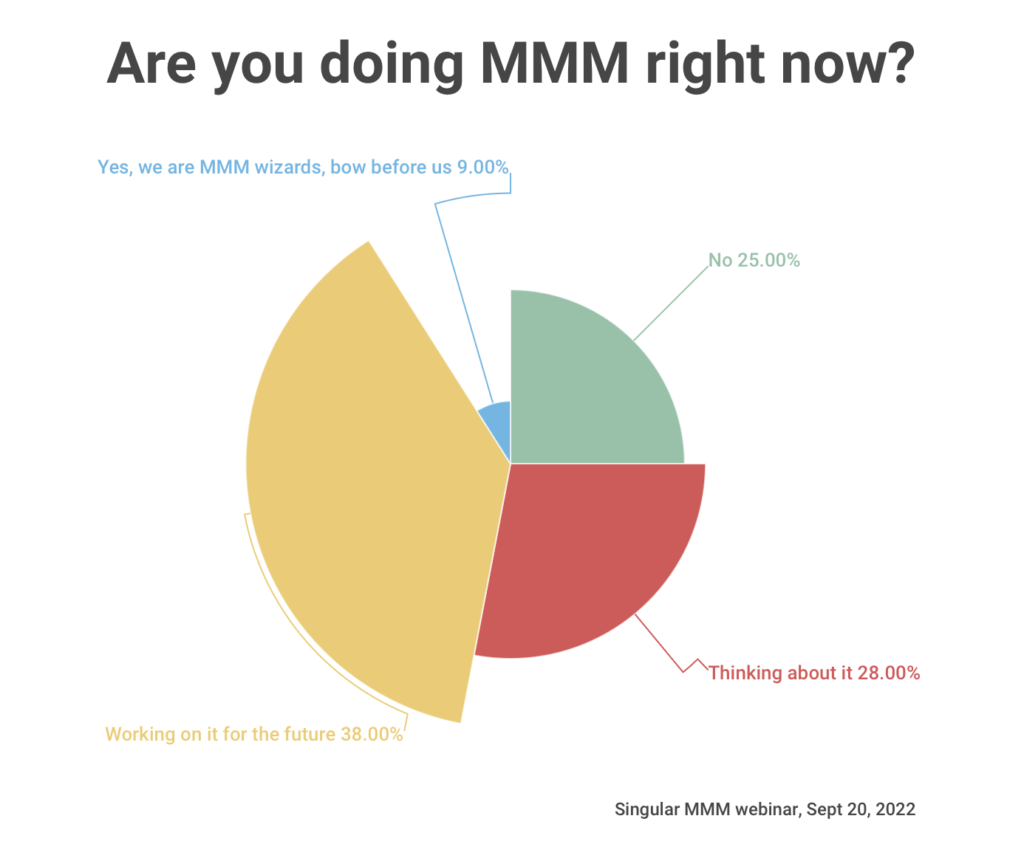
If we dial right into MMM alone, leaving incrementality out of the picture, almost 10% of marketers said they were doing MMM right now. A quarter said they would not consider doing media mix modeling, but but a full 75% of mobile marketers are either doing MMM, working on MMM, or thinking about using MMM to measure marketing results.

media mix modeling poll

Looking at those numbers, there’s clearly a massive market opportunity in providing solutions for MMM, especially if you can do so without forcing marketers into complex and time-consuming forays deep into data science.

Incrementality: 56% of marketers are kinda winging it

Incrementality is an interesting case. 

It’s a way, of course, of checking whether any given marketing channel or advertising partner is providing results that would not otherwise have occurred if you hadn’t used it at all. As such, it’s an important marketing measuring rod for channel or partner effectiveness, and for justifying spend. It has been for decades, and it’s something that doesn’t require huge amounts of data science sophistication, either.

But it does require some discipline. And some commitment, because to do successful tests you either have to pause other activities or generate enough intentional variation in channel/partner activity that you can tease out the results of each one.

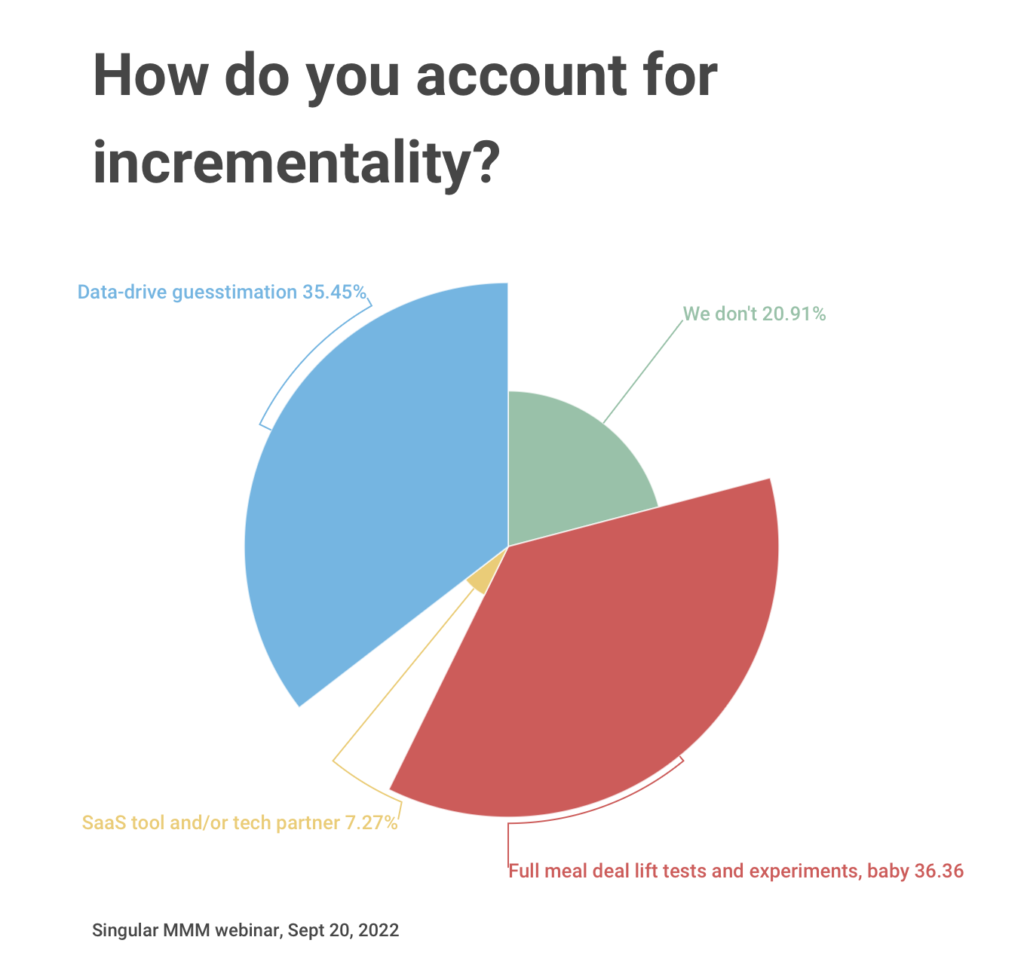
A majority of marketers, however, are either not doing incrementality at all — just over 20% — or just kinda guessing: 35%.

How do you account for incrementality?

That said, over a third said they were doing actual lift tests and experiments, which is a fairly high-level incrementality measurement. And just over 7% said they actually used a SaaS tool or a data partner to run incrementality testing.

Question: will SKAN 4 and Privacy Sandbox for Android change any of this?

The reality is that measurability on iOS has been so bad for so many mobile marketers that they’re desperate for almost anything else. (Note: despite the fact that Singular customers get 50% more SKAN data via mixed models, massively boost visible performance via modeling, and essentially get cohorts back with Singular’s advanced SKAN analytics.) 

And it’s not just iOS. 

About half a year ago, Google said that the GAID will be phased out within two years. Given what we’ve seen with the third-party cookie — and, let’s be honest, ATT and SKAdNetwork too —  that may slide. But the Google Ad ID is definitely on life support.

There’s a big question mark here, however.

On the one hand, will SKAN 4, which provides more data, offers much more insight on what happens after the initial install with 3 potential postbacks, and provides more IDs in the source identifier for creative and other variable optimization, change growth marketers’ perceptions on iOS? And on the other hand, will Privacy Sandbox for Android, with on-device targeting in TOPICS and built-in retargeting in FLEDGE, be enough to entice marketers back from MMM?

I think not. 

I think the ship has sailed, and having lost the IDFA and GAID and deterministic granular data, marketers are going to take what they can get from the platforms in SKAN and Privacy Sandbox, but augment and supplement that with media mix modeling and other sources of marketing measurement. Doing so will make marketers less dependent on doled-out platform data and single sources of potentially biased information and more aware of external factors affecting performance.

In short, I think the future is hybrid measurement: data from all possible sources combined to provide an overview of performance and used individually for what each measurement methodology is best at.

And what that means is using all of spend, delivery data (impressions, clicks, etc.), SKAN, IDFA where possible, GAID now, Privacy Sandbox for Android and Web in the future, revenue, first-party data, and even ecosystem data all together … plus anything else that makes sense to add to the mix.

Which means media mix modeling has a strong future in mobile marketing.

And that’s fairly amusing if you think about it: 3 years ago almost no one in the industry would have ever believed it.

SKAN 4 readiness checklist: how to prepare for SKAdNetwork v4

Are you ready for SKAN 4?

At WWDC Apple promised the next major iteration in SKAdNetwork would arrive this year. As we’re drawing closer and closer to the end of the year, we’re seeing documentation being updated in just a few places (so far) and a few hints here and there that delivery is getting closer.

That might have some marketers worried.

After all, SKAN 4 is much more complex than SKAN 3, with 3 postbacks (but only 1 guaranteed), multiple measurement windows, multiple postback types, conversion values that can go both up and down, and a redefined method of ensuring privacy via crowd anonymity. We’re also faced with the virtual certainty that the ecosystem will be at multiple levels of SKAN compliance and SKAN version implementation for at least several months.

So what can you do?

First, some good news: backwards compatibility

Fortunately, at this moment, it’s pretty simple. Especially given this one piece of really, really good news for Singular customers:

Singular’s SKAN 4 implementation will be backwards-compatible with your existing SKAN v3 set-up. So, worst case scenario, you don’t get around to figuring out which events you want to track in SKAN 4, deciding which conversion model(s) you’re going to use, or updating your SKAN 4 related code, it’s all good. You’ll have time.

However, there are some very good reasons to update. More on that after the checklist.

Your SKAN 4 readiness checklist

If you’re mentally preparing yourself for a 29-item list, breathe. It’s not going to be that difficult.

That said, each of the steps below does involve multiple steps and multiple parties, so there is some real work to be done here.

  1. Prepare to update the Singular SDK. Prepare to update the Singular SDK in your app when SKAN 4 ships. Ensure product and engineering are set up to be able to add this to a sprint.
  2. Talk to your mobile partners. Talk to your acquisition and monetization partners. Find out what their SKAN 4 plans are, and what kinds of timetables they have for supporting SKAN 4, and anything else they’re planning.
  3. Talk to your web partners. SKAdNetwork isn’t just about app-to-app measurement anymore. With SKAN 4, web clicks into your App Store listing can be measured with SKAdNetwork now too. Check with those partners as well to see if they’re getting ready for SKAN 4. Bear in mind that this is a bigger ask for them than your mobile partners.
  4. Share your hierarchies. Share your important source hierarchies with all media partners. They can only help optimize what they understand, so if you’re encoding something that matters to you in your hierarchical source identifiers, let them know. That will provide the greatest opportunity to optimize creative, ad sets, offers, or whatever else you choose to encode into your source identifiers.
  5. Plan your coarse value strategy. Plan how to leverage the coarse values carefully. Remember, you’re only guaranteed to get 1 coarse postback. It could be fine with sufficient volume, and postbacks 2 and 3 are only available with — again — sufficient volume for effective crowd anonymity. So plan how you’ll use the 3 values each coarse postback can contain.
  6. Plan how to evaluate users. Assuming all things go well, you’ll get 3 postbacks for most of your iOS app installs under SKAN 4. Make a plan for what KPIs matter most in each scenario, how you’ll encode their value in both coarse and fine SKAN postbacks, and what you’re going to do to evaluate users based on that.

More good news (and reasons to update)

Work that you have to do for ecosystem and measurement reasons that doesn’t actually improve your product can be painful. But there are additional good reasons to update.

More details on all of this (and additional very exciting features) soon. But briefly, when Singular customers implement SKAN 4 in their apps, they’ll get:

  1. More accurate long cohorts
  2. Visual reporting on D2 revenue, modeled D7 revenue
  3. Additional data via coarse postbacks
  4. Confidence intervals on modeled revenue
  5. D30 revenue

There’s much more, but we’ll be able to share that shortly in a number of ways:

  • A private customer-only webinar that dives deep into technical details
  • A public SKAN 4 webinar
  • Additional blog posts
  • A SKAN 4 explainer page

More questions? You know what to do: talk to Singular.

How brand impacts mobile performance: Chatting with Apptopia and Digital Turbine about BRAG

  • Are the companies at the top of the App Store and Google Play charts really winning mobile?
  • Is install volume a useful measurement for top apps?
  • What influence does brand have on mobile app install velocity and staying power?

We’ve had charts of the top apps for close to a decade now. And while marketing intelligence providers like Apptopia, Sensor Tower, SimilarWeb, and Data.ai have contextualized those with modeled insights on revenue and engagement, it’s still been a partial glimpse into which apps are actually winning, and which brands are actually doing the best in mobile. Part of the challenge is that some apps have off-platform revenue. Part of the challenge is that, like any other marketing measurement challenge, seeing the data through a limited lens provides limited utility.

And another part of the challenge is understanding how higher-funnel squishy things like brand awareness and brand intent correlate with lower-funnel somewhat more measurable things like install numbers and in-app engagement.

Which is why Apptopia and Digital Turbine invented the BRAG index

Brand and mobile performance

It’s a way of combining hard data like install volume and install velocity with the “softer” data like brand recognition and install intent to find companies. The goal is finding companies that punch above their brand weight … and maybe giants that are not growing as fast as perhaps they could be.

“Everyone watching this will know what Peloton is,” says Digital Turbine SVP and CMO Gregory Wester in a Growth Masterminds interview. ”No one knows Greg’s spin bike app. So if we learned that Peloton had a million installs in a period of time, no one would really go: oh, OK, what? But if Greg’s spin bike app that has no brand, no awareness, no interest delivered a million installs … I’m clearly doing something really interesting.”

“If you understand the full funnel, you can really understand people that are executing exceptionally at the bottom of the funnel,” Wester adds.

What the BRAG index reveals is in some cases startling. 

In terms of how well apps translated their brand funnel (awareness and intent) into actual installs, Cash App is a leader in fintech. That doesn’t mean PayPal isn’t #1 in brand power, just that Cash App is doing a better job of harnessing its brand power and activating it via app installs. 

Engagement: DAU/MAU

In fact, what PayPal is doing a great job of, according to the BRAG index, is engagement, which Apptopia and Digital Turbine have defined as DAU/MAU, or daily average users divided by monthly average users. 80% on this score would mean that out of 10 people who use PayPal on a monthly basis, 8 of them use it daily. That would be insanely high, of course, but as the category leader, PayPal’s not far off: 62%.

In streaming video, YouTube, Amazon’s Prime Video, and Netflix are top three, but Tubi’s niche anime content delivers massive engagement.

“If you look at the top tier of providers and their overall brand strength … YouTube, Prime Video, Netflix were way above the other competitors,” Wester says. “[But] anime drives a lot of fandom … these are the guys that don’t necessarily have a household name, but … relative to their overall awareness, they drive massive adoption.”

Brand incrementality

The difference is something Wester calls “brand incrementality.”

Brand incrementality doesn’t just look at the bottom of the funnel to see what resulted from whatever you did. It looks at what incremental brand efforts — both awareness and intent — translate into growth.

This works for both mobile-first/mobile-only companies like today’s mobile games giants and older brands with both mobile, desktop, partner, and non-digital business. That’s because even if enterprise or consumer packaged goods have diverse businesses, mobile is so central to both business and personal life, it’s a good proxy for performance. (Something I studied in depth in 2017 by comparing stock market success for the Fortune 1000 to their mobile performance in what I called Unicorn Dinosaurs. TLDR: “mobile leaders in the F1000 grow market value 15% faster than mobile laggards, and are 1.9X more likely to be financially successful.”

“The main point to take home here is that mobile is a key sales and engagement channel, and it’s going to have this strong correlation with overall company performance,” Apptopia’s Tara Kirkpatrick says.

BRAG index leaders

In finance, the BRAG leaders include:

  • Cash App
  • Zelle
  • PayPal

In streaming video, the top BRAG apps are:

  • Netflix
  • HBO Max
  • YouTube
  • Disney+
  • Amazon Prime
  • Peacock TV

(Interestingly, 92% of YouTube users open the app every single day, for a massively high DAU/MAU ratio.)

In quick-service restaurants, the leaders are:

  • McDonald’s
  • Taco Bell
  • Dunkin’

In shopping, the leaders include:

  • Etsy
  • Walmart
  • Amazon

And in news, the leading BRAG apps are:

  • Yahoo News
  • Google News
  • Fox News
  • The New York Times
  • CNN

Subscribe to Growth Masterminds

Watch the whole conversation above, and subscribe to our YouTube channel so you don’t miss new episodes. 

Prefer audio?

No worries: subscribe to the Growth Masterminds podcast on just about any podcasting platform.

4 ways to make mobile ad creative that doesn’t suck, from Craftsman+ CEO Alex Merutka

People spend 5 years of their lives watching ads, Craftsman+ CEO Alex Merutka recently told us in a Singular webinar. That’s a sobering thought, and a big responsibility: how can marketers make mobile ad creative that doesn’t suck?

Think about it: this is a huge burden for marketers.

Because if your mobile ads suck, you’ve just contributed to making billions of peoples’ lives horrible with BUY NOW and CLICK HERE and LIMITED TIME OFFER. And that would suck. Who wants making people’s lives worse to be their legacy?

Luckily, you have a choice. You can do the opposite. You can literally make people’s lives suck less, be happier, more fun, and more enjoyable, AND you can actually do a better job of hitting your KPIs, mowing down your team’s goals, and boosting overall company growth.

How?

Well, start by checking out the full webinar, now available on demand. We had ridiculously great guests with super-valuable insights, including:

  • Haruna Ohata, Senior Marketing Asset Manager at Ubisoft 
  • Alex Merutka, CEO of the agency Craftsman+
  • Adam Stevens, VP Product at Luna Labs, ironSource’s app marketing platform
  • Alex Moulder, ASO Manager at ASO tool AppTweak
  • Saadi Muslu, Head of Product Marketing and Content Strategy at Singular

In addition, we’ve previously shared 6 of the insights from Ubisoft’s senior marketing asset manager, Haruna Ohata, in this blog post. Finally, read on for some great (and immediately actionable) tips from the CEO of Craftsman+, Alex Merutka.

1. Make your mobile ad creative human centric

People install apps. People use them. People make purchases. People tell others about what you do. People rate and review apps. So … make your ads about people.

“There’s been this shift from very product-centric ads to now consumers are trusting more human elements,” says Merutka. “We’ve seen UGC just take off. If you’re not doing UGC content, you absolutely should be. It’s really cheap to build. It works really well.”

Rovio TikTok

One example, with Rovio, tapped into TikTok trends around dress-up. You’ve seen them: someone magically morphs into a new outfit, twirls or struts, then switches it up again. As you can see above, Craftsman+ and Rovio did a twist on that: Angry Birds characters as outfits. 

Not only are the ads human focused, not corporate, and so polished and professional that they come across as fake, they’re also fun.

“It was really fun,” Merutka says. “The content creator had fun. We had fun creating it. And hopefully, when people play this, it’s actually a fun moment.”

Which seems to be a really good segue into our next tip …

2. Inject fun into your ads

How do you make what you do fun, especially if you’re not advertising a game?

It’s a challenge. 

I mean, think of learning a language. Historically, that has pretty much been an awful process of reading and writing and studying and, generally, failing long and hard enough to eventually get halfways decent enough to order brussels sprouts when you wanted artichoke on vacation in Paris. Duolingo has done an amazing job of making that onerous, boring, and long job much more enjoyable, much more trackable, and much more accessible.

But how do you make fun ads about learning a language? 

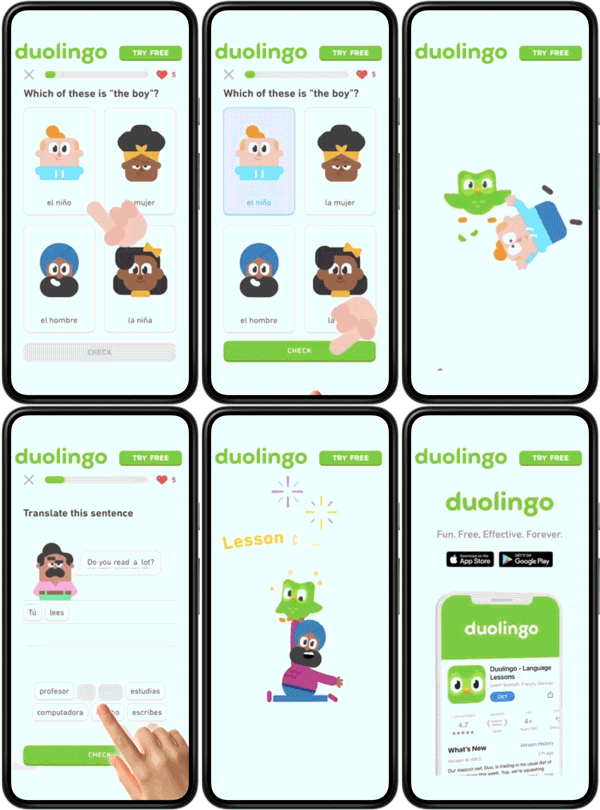
Why not make it visual, short, and gamelike … like this:

Duolingo ad

Look: I play mobile games just like you do. Sometimes I pay for some crystals or gems that enable me to get an upgrade, just like you. And sometimes I watch an ad to pick up a power-up … just like you. It’s not a lot of fun to scratch across the screen to “harvest crops.” It’s not that much fun to watch some character in a game make the completely obvious wrong choice about how to get to the treasure.

But it is kinda fun to guess — or think you know — the answer to a real question and get immediate feedback in a visual, cartoony, interesting way.

If Duolingo can make language-learning fun, can you really say it’s impossible for you to make the ads for your app, utility, or game also fun? Inject that to your mobile ad creative process, and to the ads themselves.

3. Design ads that personalize themselves

App Tracking Transparency is here and you can’t personalize your ads any more, right?

Wrong.

Outsource the hard work of personalizing the right ad to the right person to the ad itself. Offload the burden and you will reap the benefits, because now your potential users/players/customers will like your ads (and by extension you) more.

“Everyone knows that personalized ads work better,” Merutka says. “And it’s really hard now because with ATT and tracking changes you can’t target users the way you used to, you don’t have as much available data. So, instead of us trying to determine what someone is like … give people choices and personalization.”

Example: streaming TV.

Almost everyone likes watching cool shows, but you like sports and I like home renovation shows. So why not let people pick what they like? Craftsman+ did that for MAC Cosmetics because, in the same way, MAC doesn’t know whether you like red lipstick or black. Or purple, or orange.

Viva ad

This is genius because not only does it offload the labor to your potential customer, it enables something you literally could not do: predicting the product that I want most. That also enables commerce for retail companies, Merutka says.

“Retail’s great because the cool thing about these interactive ads is you can have different click URLs based on what people are engaging with to essentially deep link them into the products that they’re looking at.”

Interactive, engaging, personalized … and performant? Sounds like in, win, win … and win to me.

4. Make more playables (the easy way)

A lot of these ads have a commonality that might feel like a barrier: they’re essentially playable ads. And playable ads have a bad rep for being hard to make, slow, and expensive.

Check out this FIFA ad and think again:

Fifa ad

Look, a playable doesn’t have to be a whole game. And it doesn’t even have to be a whole level of a game. It works perfectly fine as basically one action in a game. And believe it or not, simpler is better and less is more.

If you note the playable part of the playable ad above, it’s essentially one swipe — so easy to do even in a coma haze of thumb-flipping phone time — which drives an action that results in something cool. That’s not hard, not complicated, not even very sophisticated … but it does drive results.

“I ask them, ‘How many playables have you run?’” Merutka says of his conversations with brands that haven’t had success with playables. “Like, ‘Oh, we tried one, two, three. How many video ads did you run this month? How many concepts did you try?’ I guarantee it’s more than one. So, playables are in a similar spot. There’s this sweet spot for playables. If you hit it, it works really, really well.”

Of course, it helps if you use a platform to build your playables, especially one easy enough and low-code or no-code enough to enable marketers to do it on their own. Once you’ve found that missing piece of the puzzle, playables could just be your best unit.

Yeah, you really need to check out the rest of the webinar

There is much more in this must-see-TV webinar on mobile ad creative. So I strongly recommend you take the time, tap the link, pay the fine-I’ll-give-you-my-name-and-email tax, and settle down with some popcorn and a beverage.

Here’s where to go:

Cracking the code on creatives: How to create ads that convert

One more thing …

Oh, and one other thing … if you need data on how your creative is performing, Singular’s got your back. Check out our creative analytics solutions right here.

6 tips for better mobile ad creatives from Ubisoft’s senior marketing asset manager

Assassin’s Creed. Rainbow Six. Mario. Far Cry. Avatar. Ghost Recon. South Park. Tom Clancy. Star Trek. Jeopardy. Monopoly. Just Dance. 

These are just a few of Ubisoft’s games, and many of them are global hits. With dozens of hit games, 21,000 employees, and hundreds of millions of players, it’s likely that Ubisoft knows just a little bit about making creative that converts.

That’s probably why we asked Haruna Ohata, Ubisoft’s senior marketing asset manager, to join our recent webinar Cracking the code on creatives. In just literally the first 10 minutes, she shared 6 gems for making better mobile ad creatives that I’m going to break out for you.

1. Brand really, really, really matters

There are billions of ad impressions every single day. You yourself probably account for at minimum hundreds of them, and likely thousands. In that ceaseless stream of photons and data live your ads too.

And guess what: your ad (your special ad, your amazing baby, your incredible ad) is just another ad in the flow to everyone else who happens to see it … unless … unless it triggers a memory. Creates an association. Strikes a note.

“Maximize the power of the brand … really use that IP power and recognition upfront.” 
– Haruna Ohata, Ubisoft

For Ubisoft, that might seem easy. After all, they’ve got Cartman from South Park. They have multiple assassins from Assassin’s Creed. They will have Jake Sully, gung-ho Marine turned Na’vi from the clan Jarhead, when they release Avatar: Frontiers of Pandora later in 2022. And all the iconic characters that are globally known in franchises like Star Trek and so many more.

For you, it might be harder.

But everyone and every brand starts somewhere. 

If you have a title, you have a brand. If you’re advertising that game or app, it’s creating brand associations. The snowball doesn’t become an avalanche overnight, but it does eventually get there if it just keeps growing a little bit every day. And if you are a decent-sized studio or have a large game or app, leverage it! Let all your previous work assist in the tremendously challenging job of capturing attention in our everyday maelstrom of information.

Have no brand at all? See #6 down below …

2. Rich CGI content makes your ad stand out

Sometimes you’re promoting an app or a game that is, for lack of a better word, kind of flat. Maybe it’s a farming or banking or building or fighting app, and it’s hard to show the depth and emotion and richness of your game in a 2D ad. Or, perhaps, reveal the real-world impact of your utility app.

So invest your ad with pop and immersion by introducing rich CGI content.

“Use the technique of CGI to showcase the universe and the storytelling elements … this kind of rich content, which is also high production value content, seems to work really well on gamers for a long time.”
– Haruna Ohata, Ubisoft

One game Ubisoft used this technique with is Might & Magic: Era of Chaos:

The challenge as you do this is to remain true to the gameplay and mechanics of your game, or the user experience and functionality of your app. A great ad with massive CTR and a low CPI isn’t good for you or your brand if it results in disappointed users who flood Google Play and the App Store with poor reviews because the app they installed is not the app they were sold.

But do it well and you capture not only the soul of your app but also the new users, players, and customers you are looking for.

3. Break the fourth wall

The fourth wall is the imaginary transparent wall between a TV show and its audience, a movie and moviegoers, or your ad and a potential user. Because most of what we see on screens, whether room-sized or handheld, is built on the fiction that we, the audience, are invisible spies on whatever is happening, breaking the fourth wall jars us out of customary complacency.

(Or the zombie state that we enter when mindlessly thumbscrolling TikTok or Reddit, or chainsmoking YouTube videos, or wondering how someone could actually say that on Twitter.)

“It’s really effective to catch the audience’s attention because they can see that you’re talking to them.”- – Haruna Ohata, Ubisoft

Watch how Ubisoft did it using Cartman, a character in South Park:

Extra note: this ad combines two techniques: a recognizable, branded character, and breaking the fourth wall. Combining two or more techniques at the same time can often have a multiplicative impact: 2 + 2 = 10.

4. Combat creative fatigue by tweaking

Creative fatigue is real and it sucks, and it will cause ad blindness in people viewing your ads. But here’s something magical about the human brain: it is trained to detect differences. Changes. Variations.

Use that psychological insight to tweak your creative, rather than completely reinvent it. This will save you time and money.

“We always like to iterate on the creative which worked previously. But we need to tweak how we present the game play in order to combat creative fatigue.
– Haruna Ohata, Ubisoft

Reduce, reuse, recycle? Sure, you don’t have to reinvent the wheel. You do have to give it new rubber. So adjust timing, adjust which character you feature, adjust the beginning and end screens: whatever works. But make a bit of change so that people’s brains don’t instantly shut off when they see your same old same old ad for the 15th time

5. Iterate on winners, not losers

Sometimes we love our losers. I get it. And very occasionally you can hit a home run by switching up a few details of an ad that just didn’t really work, for whatever reason.

But in general, iterate on your winning creative, not your failing.

“We always try to iterate on the creatives which are working quite well.”
– Haruna Ohata, Ubisoft

Performance marketers know this about ads: prune the losers, feed the winners.

Then, always engage in an endless battle to beat the winners. Sometimes that’s via iteration; sometimes that’s via complete reinvention. But commonly you’ll find a winning combination of imagery and text, and then tweak it to squeeze out even more performance from the ad unit.

6. Reference things people know

Remember #1: brand really, really, really matters?

Sometimes you don’t have a recognizable brand. Sometimes the recognizable brand you do have isn’t achieving the goals you want. Or sometimes you just need to reset the world (pull plug, wait 5 seconds, reinsert) because performance is lagging.

So reference stuff people know.

“When the game hits a certain time period where user acquisition has been running for a really long time we get into stagnation. So, we always try to open our eyes a little bit and think, get references from popular movies or anything … even outside of the gaming industry.”
– Haruna Ohata, Ubisoft

Top Gun Maverick is the biggest movie on the planet? Reference jet pilots. The economy is reopening? Reference traveling again. Pokémon Go erupts again? Reference catching them all. Heat wave hits? Reference melting.

You get the picture. While you can’t use someone else’s trademarked images or copyrighted characters, you can reference elements of popular culture in ways that most people recognize. And that boosts both recognition and retention for your ads. Last time I checked, that’s good.

There’s so … much … more!

There is literally a ton more insight in our recent Cracking the code on creatives webinar. (OK, not literally.) It’s probably one of the most interesting and fun webinars Singular has done in the past year, and it is well worth your time.

The panelists were all amazing, and they include:

  • Haruna Ohata, Senior Marketing Asset Manager at Ubisoft 
  • Alex Merutka, CEO of the agency Craftsman+
  • Adam Stevens, VP Product at Luna Labs, ironSource’s app marketing platform
  • Alex Moulder, ASO Manager at ASO tool AppTweak
  • Saadi Muslu, Head of Product Marketing and Content Strategy at Singular

Heat up the popcorn, grab a drink, and check out the on-demand webinar on our Webinars and Videos page.