20 reasons why American app publishers need to worry about data privacy laws (plus … how to make privacy sexy)

Since 2020, 20 U.S. states have implemented data privacy laws. That means mobile app publishers don’t just have to worry about data, privacy, and consent when they publish in Europe. They also have to think about it in the U.S.

20 different sets of state regulations mean that app publishers also have to find a way to manage that consent scalably. And given that there are slightly different rules in different countries, publishers need a way to manage privacy and consent scalably both at home and overseas.

I recently chatted with Jerome Perani, CRO of Axeptio, a leading Consent Management Platform (CMP) used by over 70,000 websites worldwide, on the Growth Masterminds podcast.

Adapting your app to align with data privacy laws is a 2-fold challenge:

  1. Obey the law
  2. Provide a great user experience

That might seem like a challenge, but according to Perani, both are indeed possible at the same time.

Which U.S. states have data privacy laws?

It’s not just Rhode Island, Maryland, and Nebraska. Some of the biggest states on different sides of the political landscape like Florida and California also have data privacy laws now.

Here’s the 20 US states with data privacy laws so far:

  1. California
  2. Colorado
  3. Connecticut
  4. Delaware
  5. Florida
  6. Indiana
  7. Iowa
  8. Kentucky
  9. Maryland
  10. Minnesota
  11. Montana
  12. Nebraska
  13. New Hampshire
  14. New Jersey
  15. Oregon
  16. Rhode Island
  17. Tennessee
  18. Texas
  19. Utah
  20. Virginia

Since many app publishers tend to treat the U.S. and Canada as a single market, it’s Interesting to note that at least 3 Canadian provinces — BC, Alberta, and Québec — have their own data privacy laws, and that at the federal level, Canada has PIPEDA: the Personal Information Protection and Electronic Documents Act.

Data privacy: 6 things I learned from Jerome Perani

You have to manage your apps with an eye to data privacy laws, but you also have to present a great customer experience as those laws and regulations change over time.

Here’s 6 things I learned:

  1. Consent is a marketing opportunity
    Most companies treat data consent as a legal burden rather than a chance to build trust and engage users. Making consent a positive, brand-aligned experience can actually enhance user onboarding.
  2. GDPR was initially focused on the web; now it’s switching to apps
    GDPR has been enforced since 2018, but early efforts focused on websites. Recently, regulators have turned their attention to mobile apps, with increasing enforcement actions. For example, Voodoo was recently fined €3M by France. And no … complying with Apple’s ATT does absolutely nothing in terms of your legal obligations to comply with data privacy laws.
  3. CMPs help you manage global complexity
    With 20 states and hundreds of countries all writing slightly different laws and regulations, a consent management platform is pretty important to ensure compliance scalably across the globe.
  4. Consent should be part of your onboarding process
    Consent collection should be embedded into your onboarding experience, clearly explaining why data is collected. Personalization and engaging, creative messaging improves opt-in rates. Transparency is key — hiding consent settings often leads to a user backlash or even worse, legal action.
  5. Globally, more and more nations are enacting data privacy laws
    The U.S we know about. Europe too. But most countries are doing something here, with regulations emerging in regions as distinct as Brazil, India, and Saudi Arabia.
  6. There could be more U.S.-EU tension over privacy
    Especially at the federal level, there’s increasing tension between the EU and the USA. The U.S. government, under the Trump administration, looks like it will push back on EU data laws to protect American tech companies … and which have been used to justify fines to big American tech companies of close to €5 billion in total.

Yeah, I know. Consent isn’t sexy at all. 

You read about compliance at 11PM when you can’t fall asleep and need to knock yourself out for the night.

But … there’s a potential path to making consent with data privacy laws easy, slightly cool, and maybe even just a tiny bit fun. And by treating consent as part of the user experience, not just a legal formality, marketers can increase opt-in rates, build trust, and create a better, more engaging first impression.

  1. Integrate consent into your onboarding flow
    Make it feel natural, not like a roadblock. Instead of interrupting the user’s experience with a legal notice, explain why you need their data as part of their introduction to the app. Example: we personalize your experience based on your preferences … here’s how …”
  2. Make it purdy
    Yeah, a legal form isn’t sexy. And a boring pop-up isn’t going to get you what you need. Make it visually appealing and interactive: icons, mini-animations, toggles instead of checkboxes, swiping gestures to indicate consent, and so on. Think like Duolingo, which greets new users like this: “Bonjour! Before we start, tell us what you’re comfortable with.”
  3. Talk like a human, not a lawyer
    Don’t say “we collect your data in compliance with GDPR.” Instead, try “we respect your privacy! Let us know what you’re cool with.”
  4. Explain the value to THEM, not you
    People are more likely to say yes if they see a clear benefit. For example, a streaming app could say “We use your preferences to recommend the best shows: no more endless scrolling!”
  5. Give people choices (but keep it simple)
    Instead of “Accept All” versus “Reject All,” try tiered options so users feel more in control. Think “give me the basics” for minimal tracking, “make it personal” for a more complete customization, and “all the perks” for a fully unique experience.
  6. Offer small rewards
    Everyone likes to get something for free. A little incentive can go a long way, like 100 loyalty points for an airline app when people agree. 
  7. Make consent adjustable later
    People change their minds. Make it easy to ramp their consent up or down later on. This builds trust and reduces opt-outs because people know they can always change their minds.
  8. Use real-world analogies
    Digital can be hard and obscure for normal non-techy people. Help users understand what’s happening with familiar examples. Think … “just like a barista remembers your coffee, we remember your preferences.”

Much more in the full podcast

Hey, check out the full episode for all the goodness. You can find Growth Masterminds wherever you get podcasts, or always watch on our YouTube channel.

Here’s what to expect in this episode:

  • 00:00 Introduction to Data Protection Regulations
  • 00:45 Guest Introduction: Jerome Piani
  • 01:41 The Evolution of Data Protection in Europe
  • 04:49 Global Data Protection Landscape
  • 12:47 Challenges and Solutions for App Developers
  • 17:43 Future of Data Protection Regulations
  • 27:02 Conclusion and Final Thoughts

Scale ad spend to $10K/week profitably: 5 tips

Any rookie can scale ad spend unprofitably. And it doesn’t take a hugely skilled marketer to spend profitably at low volume. The real challenge is to scale ad spend profitably.

I recently chatted with Lukas Szanto, who runs All The Way UA after managing lead gen and UA at several other companies, where he scaled 2 mobile games to $50,000/month each. Recently, he went from $0 to $10,000 per week for a subscription app, and we chatted about how.

It takes more than you might think.

“It’s not enough to find a creative that will allow you to have a 10% profit or break-even on your $100/day spend and just crank it up,” Szanto says. “You’re going to lose profitability 100% guaranteed.”

So what do you do? 

Hit play:

5 tips to scale ad spend profitably

You can’t just scale and hope for the best. And you can’t just hope that the super-smart algorithms and AI wizardry at all the ad networks today will magically guarantee your success.

Those algorithms are designed to help you grow — sure. But their primary purpose is to ensure that the company that owns them makes money.

So you need a strategy, and you need a plan.

1. Split creative testing into a launch phase and a scale phase

What you need from creative testing before and after scaling are very different things. 

Before scaling, you need to find a unicorn. You need a 10X creative that will significantly overperform.

Profitability declines with scaling, so you need a home run in the launch phase before you add fuel to the fire in the scaling phase.

In the launch phase:

  • Spend $300/day
  • Start with simple, scrappy, CHEAP ads
  • Reserve the UGC and influencer marketer for later
  • Test 30-40 different creative angles

2. Hit the scale phase when you 2X your profitability goals

Most advertisers scale too soon.

You cannot be happy with 10% better or 20% better. Performance will decline when you scale spend, so you need at least 200% better. Better yet, keep hunting until you find your 10X creative that vastly outperforms everything else.

Why?

“For every double of your budget, you’re gonna lose around 10 to 20% of your results. So if you’re at 160% and then you double your budget, you’re gonna lose like 16- 32% of net profitability.”

Your #1 goal: find that unicorn creative that will take you to twice your needed profitability metric, whatever that is. 

Don’t scale ad spend until you find it. 

3. Build a smart campaign structure during the scale phase

Every ad account is unique: there is no 1-size-fits-all for success. 

But what you must do is continue to test. Every creative, including your unicorn creative, wears out over time. You need a strong stable of 10X creatives to take its place when needed.

If, however, you try to test new creative in the same adset as your proven unicorn creative, your new creative will get slaughtered every time: it won’t get a fair shot. That’s simply because the ad networks’ algorithms are optimized for what it knows will work. It’s going to show your proven creative over your new creative almost every time, and unless your new creative has some insane antigravity-cold-fusion-antimatter-reactor magic, it’ll lose and lose and lose.

(One reason: social proof matters, and on social platforms where likes or views are visible, people will pay more attention to anything simply because they see that it’s earned other people’s attention as well.)

So give new creative angles separate adsets with fixed budgets to get good data. You can only do this with manual intervention.

When things are going well with strong creative, shift towards automated tools: they’ll manage it just fine.

4. Be innovative with tracking and tools when you scale ad spend

Of course Singular as your MMP will help you understand where your best traffic comes from and what your most converting campaigns are. 

Still, make a point of asking your users/players/customers where they came from. You can add it to your onboarding flow and it gives you first-hand first-party directional data on which channels are working. 

I’ve heard this advice from multiple marketers, by the way: even the most sophisticated digital campaigns can be improved with this super old-school tactic.

If you use Apple Search Ads, custom product pages will give you better data tracking and conversion measurement because you know which adsets from which ad networks are directing traffic to which custom product pages, and you can use rough cohorts in App Store Connect to analyze long-term conversion trends.

5. Be ready for the challenges

Stuff is going to happen. It always does.

In Szanto’s case, an ad network removed a key in-app event data point without notice, and he lost event tracking. In other cases, your unicorn creative might just run out of steam. Or a competitor releases something stunning.

Something is going to happen.

Scaling isn’t linear, and it takes time. Expect to spend at least 3 months before consistently hitting your target CAC. Some publishers and advertisers expect instant profitability, but most launches are at 50% or less.

Once you do hit profitability, stay in the zone with ongoing optimization.

Scale ad spend: much more in the full podcast

Yeah, you really need to listen to or watch the whole thing. It’s that good.

Subscribe to Growth Masterminds here.

The key idea:

Scaling any app’s ad spend from zero to $10K/week is a process, not an event. Especially if you want to do it profitably. The key is finding the right creative, optimizing your structure, tracking performance accurately, and being patient while building a sustainable acquisition model.

I know patience is a bad word for most of us … but it is critical.

Here’s what’s in the full podcast:

  • 00:00 Introduction to Scaling Ad Spend
  • 01:49 Creative Testing Strategies
  • 03:56 Building a Strong Foundation
  • 05:08 Iterating and Testing Angles
  • 12:54 Campaign Structure Essentials
  • 18:21 Isolating Strong Ads for Better Performance
  • 19:09 Understanding Meta’s Algorithm and Risk
  • 19:40 The Correlation Between Risk and Reward
  • 20:17 Creative Testing and Patience for Unicorn Ads
  • 20:28 Tracking and Tools for Campaign Success
  • 21:08 The Impact of iOS Changes on Attribution
  • 22:22 Survey Strategies for Indirect Attribution
  • 24:48 Using Custom Product Pages for Better Attribution
  • 29:14 Challenges in Mobile Marketing
  • 31:50 Realistic Expectations in Paid Ads
  • 36:35 Concluding Thoughts and Final Insights

10X spike in traffic: Super Bowl leads to Super Traffic (and showcases Super Scalability)

Singular saw a massive 10X spike in traffic on Super Bowl Sunday, proving that super expensive Super Bowl ads can actually be super effective. The intriguing part: you sometimes don’t even need to buy an $8 million 30-second Super Bowl ad to cash in on the annual football frenzy.

And the spill-over impact on your brand can massively boost click-through rates on ad impressions delivered elsewhere.

10X traffic spike: no sweat

It’s not every day you get a 10X spike. While weekends are typically much busier than weekdays, it’s usually just a 2-3X jump. But on February 9th, the day of Super Bowl 59, Singular’s servers managed 10X our normal weekday volume and 5X our typical weekend volume. 

super bowl 10X traffic spike

And did it without flinching. No sweat, no stumbling, no missed measurement or tracking: no downtime.

See for yourself on the Singular Status tracker:

singular status tracker

But it’s actually more than a 10X surge

If you spend big for a massive marketing event, you want big results. But there’s always a risk, and the bigger the bet, the bigger the risk.

At least 10 Singular clients were among the 65 brands that took that bet and ran Super Bowl ads this year. They immediately saw a huge surge in traffic on their ads online and in apps, plus their organic social posts and messages. The result was almost instant boosts in tracking link clicks to in multiple cases millions in a single day. 

The obvious but still shocking part:

Those millions of clicks weren’t spread out nice and even across February 9th’s 24 hours. 

Rather, most of them were clustered around the 4-6 hours of the actual Super Bowl itself. That’s kind of an infrastructure and DevOps manager’s nightmare.

  • Each of those clicks requires measurement.
  • Each might be a deeplink, that requires appropriate routing.
  • If it’s a deeplink, data needs to be stored server side to provide the right customer experience on app open.
  • Whether a deeplink or not, the data for each click needs to be stored, aggregated, costed, and attributed so that each customer gets their ROAS, ROI, MMP install reports, and more.
  • If the clicks are on iOS, Singular runs Unified Measurement, ensuring sanity between your app store, ad network, and MMP install numbers
  • Often, there’s enrichment … and the list goes on … 

Add up all of the compression of activity around the Super Bowl and the extra work around measuring and managing the traffic, and the result is much more than a 10X boost.

Results: massive growth (and not just from the specific Super Bowl ad)

Obviously, we can’t share specific customers’ data: it’s theirs, not ours. We just collect, analyze, and deliver it for them.

But we can say we’ve seen massive leaps in app installs for customers with Super Bowl ads. And it’s not just installs: it’s also app activity: more sessions and higher engagement.

Sometimes, brands can do this without even spending the $8 million it costs to buy a 30-second Super Bowl ad.

Of course, it helps if you do. 

One customer paired a Super Bowl ad with a massive social media contest, which was a significant part of the millions of clicks and installs they drove.

But other customers, particularly in the real money gaming space, simply used the excitement of the biggest betting event of the year to significantly grow users, activity, and revenue. That takes a smart campaign which begins months before the Super Bowl, of course, plus smart execution via digital ads, social media, and owned media, including in their own apps.

And it cashes in on massive general excitement and build-up, at much lower cost. 

(And risk!)

Big bets can lead to a big halo effect

Clearly, when someone watches a Super Bowl ad they’re not clicking on the ad. (We have had customers use QR codes to surprising success previously, but not this Super Bowl.)

Instead, they’re going online.

They’re paying attention to ads that before they just ignored.

They’re going on advertisers’ websites.

They’re following the advertisers’ socials.

That’s the halo effect, and the reason why we saw a 10X spike in clicks for advertisers who ran ads on good old-fashioned linear TV.

Hopefully for those customers, the halo effect will last a long time, and the users/customers/players they brought onboard during Super Bowl 59 will engage and retain.

Looking for unmatched scalability and reliability?

If you’re looking for a marketing measurement company that can handle insane spikes in activity, talk to us. Singular manages attribution and analytics for some of the largest and busiest brands on the planet, and we’d love to chat with you.

Here are just a few examples:

And hundreds more on our case studies page …

Ilkka Paananen TLDR: 9 things I learned from the Supercell CEO’s rollercoaster year-end recap

Supercell’s super CEO Ilkka Paananen just released a 2,500 word blog post on how the iconic mobile gaming publisher hit over 300 million monthly active players for the first time, how all of its games grew in revenue for the first time since 2014, how it hit record gross revenue, how the 5-year-old game Brawl Stars “doubled, tripled, quadrupled (and more) its metrics,” and how the new game Supercell launched, Squad Busters, was a disappointment despite hitting $100M in 7-month revenue and winning the Apple Game of the Year Award.

It’s amazing, wonderful, and insightful, and I recommend you go read it in full.

Of course, it is 2,500 words.

In case you don’t have 20 minutes to read it all, here’s what stood out for me …

1. Supercell had it’s best year ever … at 15 years old

Supercell had its best year ever, Paananen said:

  • 300M monthly actives
  • All games grew revenue
  • Record year for gross revenue ($3 billion)
  • A 5-year-old game blew up bigtime

Obviously Supercell has great games, some of the best people in the industry, and did a bunch of things right, but also, the broader games environment was pretty buoyant. We saw that last part too: our strategic customers ad spend jumped 41% in late 2024. That typically only happens when the overall market is up and to the right.

And that’s encouraging news for everyone.

It’s also encouraging that a 15-year-old mobile games publisher is still growing.

2. A 5-year-old game exploded

Paananen says that Brawl Stars’ performance in 2024 was historic:

“I have worked in games for 25+ years and I have never seen a game, so many years into its life, grow like this. Brawl Stars doubled, tripled, quadrupled (and more) its metrics, especially players, engagement, and revenue.”

When launched, games either die young (the most probable outcome), limp along in maintenance mode, or grow big. But eventually the ones that grow big slow down, level off, and being a long slow fall.

They don’t usually grow explosively years after launch. But Brawl Stars did.

3. LiveOps is a difference-maker

The first mobile games were kinda set-and-forget … launch and let them go, updating via an app upgrade and redownload when necessary or desired. LiveOps changed the scene with in-game events, content updates, offers, community engagement, optimizations, and more, all live.

That’s what made Brawl Stars grow so much in 2024.

Supercell added people to its LiveOps teams, letting them build and ship more. Instead of just working on 2-3 big ideas every update, they could ship dozens of smaller things, each of which was more likely to succeed.

From team lead Frank Keienburg:

“Essentially it’s about a better balance for risk taking. Predictability in outcomes vs. potential (and risk) of big ideas. The team is fearless today, but not reckless.”

Impressive!

4. Supercell is playing the “forever game”

This year is Supercell’s 15th anniversary. That’s probably 5X the lifespan of most mobile game studios, and they’re doing it in style with multiple billion-dollar games.

That’s amazing.

“While these wins are amazing and matter a lot, we are playing the forever game and need to keep continuously exceeding our players’ expectations,” says Paananen.

In other words it’s not just about quick exit or a flash in the pan. It’s about being player-obsessed, humble, and still ambitious.

5. $100 million is failure (!!!)

Perhaps nothing underscores the fact that Supercell is not your average gaming studio when you read Paananen say that a game that grossed $100 million in 7 months is a disappointment.

After 5 years of not launching a game and 500 days of beta and almost getting killed, Supercell launched Squad Busters. 

“Our first new game launch in over 5 years, Squad Busters, despite generating gross revenues in excess of 100 million dollars during its first 7 months in 2024 and winning the Apple Game of the Year Award, has not yet scaled up to the game team’s (or Supercell’s) aspirations – a disappointing, but energizing truth,” says Paananen.

From the outside it’s hard to tell what Supercell’s costs were in development and what its ongoing costs are for marketing, ongoing development, and LiveOps, but clearly the math isn’t mathing in Supercell’s favor just yet.

For most studios, though, $100 million in 7 months is a dream come true. 

6. Launching new games is hard, even for Supercell

As Paananen states, more than 60% of play time is spent on old games: 6 years or older. New games are less than 10% of play time.

“Mobile games is one of the most competitive industries worldwide. It is very hard to break through with a new game,” he says.

In fact, harder than ever, he adds. So hard that some studios have just given up on making new games, and will only buy one that has already been released and achieved some level of traction.

Even good early metrics in a large public beta or soft launch — Supercell had 120,000 players in Squad Busters before its official launch — can’t tell you everything you need to know about how successful it will or won’t be.

7. There’s nothing like listening to your users for getting better

Like, literally nothing.

We heard that from Hannah Parvaz in a Growth Masterminds episode about rocking the cold start: getting your first million users. You must, must, must listen to your users.

And yeah, it’s even important if you’re Supercell and can get over 100,000 players for a beta game.

“While we succeeded in getting a huge audience interested in the game, the audience mix ended up being quite different to what we originally had imagined,” says Eino Joas, who led the Squad Busters launch. “Trying to make a game that appeals to everyone ended up it not being perfect for anyone.”

Knowing your target audience is insanely important. Joas is digging into the Squad Busters userbase now to inform ongoing development for the future.

8. Success in mobile gaming is an art, not a science

There’s a lot of science involved, absolutely. But ultimately, success in mobile gaming is an art. And it’s unpredictable by nature.

“I don’t believe there is a reliable, scientific recipe for creating new games or launching them,” says Paananen.

You just gotta try stuff. And take risks.

And then rinse and repeat.

If you’re good, and if you’re lucky, something will spark an explosion and you’ll find the magic pixie dust of the internet that leads to great growth. And then you can science that growth … with a lot of art too.

9. The experts are not the experts

Paananen talks about a core memory: showing Hay Day and Clash of Clans to video game developers and leaders way back in early 2012. 

Their reaction was … underwhelming.

“Roughly speaking, their reaction was ‘why would anyone play that?’ ‘Are these even real games?’, they would add. They didn’t believe in a very different experience on a very different platform. They couldn’t see it,” he says.

Both are obviously billion-dollar games. 

Hay Day had over $2 billion in lifetime revenue back in 2023. And Clash of Clans is 1 of the most successful games ever made, with over $10 billion in revenue. Note: that’s not 1 of the most successful mobile games ever made. It’s 1 of the most successful games in general.

That means the experts are not the experts. Users are. Players are. Players will tell you when they like something, and they do that by playing … and buying.

The question Paananen asks himself now is: are we the unbelievers now?

Yeah, you should go read it all

There’s a lot in Paananen’s full post. And there are few in the mobile games space who can speak more authoritatively or with better insight. I recommend you invest the 20 minutes.

Check it out and learn!

5 reasons why Web2app spend jumped 54% last year, UA predictions for 2025, and more

Web2app spend for mobile user acquisition is growing fast, primarily at the expense of in-app ad spend on iOS.

In January 2024, web spend by Singular customers was just 22.23% of overall spend, with in-app ads taking almost 78% of ad spend. By December of 2024, web spend ballooned to 34.45% of overall spend, with in-app down to just over 65%.

That’s a massive 54.39% increase.

But is it sustainable? Or was December’s massive leap a temporary flash in the pan?

Web vs mobile ad spend

(All this data and more is in our latest Quarterly Trends Report for Q1 2025.)

We can’t say definitely right now that web2app spend for UA is going to grow significantly and quickly from December’s numbers, but we can be pretty sure that the overall trend is not a flash in the pan. We saw slow growth throughout most of the year, and the overall difference between Q3 and Q4 is pretty stark:

  • Q3: 23.42%
  • Q4: 29.51%

What’s going on? Why is this happening? 

And what does it mean for UA spend in 2025?

Web2app, UA predictions, and more

We’re going to discuss all of this AND share live UA predictions for 2025 in a special live online event that is open and free for all. It’s called Q1 2025: State of User Acquisition, and you can register here

Participants will include:

  • Jonathan Reich
    CEO of Zedge, whose apps have been downloaded about half a billion times
  • Tomas Yacachury
    Strategic partnerships lead at Kayzen and mobile thought leader
  • Ashwin Shekhar
    CRO and co-founder of AVOW
  • Ben Collins Jones
    Solution specialist at SplitMetrics
  • Stephanie Pilon
    CMO at Singular
  • John Koetsier
    VP insights at Singular

Join us simply by clicking here and signing up.

We’ll talk web2 app spend — of course — but we’ll also talk about how AI and LLM-based search engines are impacting mobile user acquisition. And we’ll hit which ad networks are growing fastest, plus UA predictions for 2025.

5 reasons why web2app spend is way up

There are plenty of reasons why web2app spend is up. 1 of them is seasonal, but 4 of them are systemic, deep-rooted, and long-lived.

1. Seasonal ad pricing

CPIs were up in Q4, as you’d expect in a holiday quarter. 

User acquisition for games became 15-26% more expensive in Q4 than in Q3, while apps were impacted significantly harder: UA was more than 60% more expensive.

(All data is from our most recent Quarterly Trends Report.)

The result: marketers looked far and wide for alternative supply. That includes smaller and niche mobile ad networks, which were the only networks to grow in Q4, and it includes web. Web ads are not necessarily cheaper than in-app ads, but they can be depending on vertical, timing, and publisher.

And even when the ads themselves are not cheaper, the extra context of a mobile landing page and onboarding flow that you can deliver in a mobile web scenario can result in lower costs for acquiring active, engaged, and paying users.

2. More marketing data

Web2app spend is also up because mobile marketers get more data when doing user acquisition on the web than they do on mobile … at least in iOS since iOS 14.5 and the resulting IDFA scarcity.

Fractional CMO and growth consultant Gessica Bicego recently told me on the Growth Masterminds podcast that web2app can result in about 20% more marketing data: critical data for measuring campaigns, tracking results, and optimizing creative.

3. Different audiences

Web and mobile have slightly different audiences. 

Mobile app users skew younger than web users, and while younger people are more likely to want to try new apps and experiences, they’re less likely to be buyers … especially for subscriptions.

Some mobile marketers avoid targeting younger audiences simply because they convert at much lower rates. You can accomplish something similar by prioritizing mobile web.

4. Boosting revenue

If you’re going to try to boost your revenue by paying Apple or Google less in in-app purchase fees, you need a multi-platform business model. Kicking off your client relationships on the web rather than in an app is a great way to start. 

Some games have used this kind of web2app strategy to boost revenue by 30%. Others take 80% of their payment off-platform.

Both are reasons to boost web2app spend.

5. Onboarding advantages

Onboarding on the web can be smooth, seamless, and profitable. You have a lot more flexibility to do what you want on a mobile web page than you do in a mobile ad or on your App Store listing.

By the time a new user, player, or customer clicks on a deeplink to actually get your app, you can greet them with a personalized experience on first launch plus also have gathered data that will inform how you treat them in the future.

It’s a strategy that Bicego has used with great success for multiple clients:

“You’re not just asking questions to collect data. You’re creating a journey that makes users feel heard and understood,” she says.

Web2app spend: likely to continue to grow

While January and February are likely to be down from December’s massive jump in web2app spend, the overall trend has legs.

Check back for our next Quarterly Trends Report to see the actual data, but my prediction is that the overall trajectory will continue to grow even if we see a slight temporary dip.

Oh and don’t forget to sign up for our big live event: Q1 2025: State of User Acquisition.

You can register here.

ELT vs ETL: Everything you need to know

ELT vs ETL: which is better?

Well, if you have a lot of data and you need to move it, you have basically 2 options. First, if it’s a one-time thing and a truly massive amount of data, you might try sneakernet … as in, move it on hard drives. (Believe it or not, both Amazon and Google have options for this.) For most people, however, you’re going to do some variety of ELT or ELT, especially if the data transfer will be an ongoing thing.

Which raises the obvious question …

ELT vs ETL … what’s the difference? And where should you use each one? 

That’s exactly what we’re going to answer right now.

ELT vs ETL in 5 bullet points

There’s a lot to be said about ELT vs ETL. For starters, ELT is Extract, Load, Transform, and ETL is Extract, Transform, and Load.

But you knew that already. 

Here’s the too-long-didn’t read with just a bit more insight:

  • Order matters
    ELT loads data into the target system before transforming it, while ETL transforms data before loading
  • ELT is faster and more scalable
    ELT is generally faster and more scalable for large datasets, thanks to the processing power of modern data warehouses
  • Cloud computing is driving change
    Cloud computing has been a driving force behind the shift from ETL to ELT, enabling greater scalability and cost-efficiency
  • ELT wins in some areas
    ELT is often preferred for big data, AI, and real-time analytics use cases
  • ETL remains relevant
    ETL remains relevant for legacy systems, highly structured data, and specific compliance needs

When sneakernet isn’t an option, businesses use data integration methods like ETL (Extract, Transform, Load) and ELT (Extract, Load, Transform). These methods help get and use large amounts of data quickly and safely. 

In both ETL and ELT, the process starts by taking raw data from different sources. Then, we either  transform this data into a format that is easy to use, or load it into a target system. Finally, the data gets loaded into a data warehouse or transformed, depending on which method is used.

With the growth of big data and cloud technology, many businesses are moving from the old ETL process to the newer ELT approach, but each method has its own pros and cons.

The basics: understanding ELT vs ETL

Both ELT and ETL are important for changing raw data into useful insights, but they are different in how they work. 

ETL uses an older method, changing data before sending it to a target system. This way, only clean and organized data goes into the data warehouse … at least theoretically. (In the real world, stuff sometimes happens.) ELT, on the other hand, uses the benefits of modern data integration and cloud data services which have their own extensive transformation capabilities. ELT loads the raw data into the target system or systems first. Any changes happen later, right inside the data warehouse or data lake, usually at the direct instigation of a BI team or data analyst.

Let’s look at ETL first.


ETL is perhaps the most common legacy method of moving and processing data. It focuses on getting data, then cleaning and organizing it, and then saving it into a data warehouse: extract, transform, and load. 


The transformation step in the ETL process is very important. It changes raw data into a format that works with the target data storage system. This step can include data cleansing, filtering, aggregation, and checking the data based on set rules and needs. It could also include enriching, and it likely includes converting the data structure — including rows, columns, and formats — to fit a very structured target system.

ETL works well because it has a clear process. It makes sure that only processed and validated data is added to traditional data warehouses. It’s perfect: clean, efficient (especially in terms of human handling and babysitting), and effective.

Still, there are some issues with this method, especially with the large amounts and types of data we see today in big data.

So what’s the alternative?

ELT.

ELT is an important part of modern data integration. It focuses on managing large amounts of data effectively. In ELT, just like in ETL, the first step is data extraction. This step collects raw data from different sources, such as databases, applications, and sensors. The second step is where things change: raw data is loaded directly into a cloud data warehouse like Amazon Redshift or a data lake, without changing it right away.

The transformation of data happens inside the data warehouse. This method uses the impressive processing power and scalability of cloud platforms, which allow for complex changes to large datasets. ELT works very well with unstructured or semi-structured data, and provides the flexibility to transform data as needed for business intelligence or analytics purposes.

That last point is important.

ELT gives you raw data. If you decide some months from now that you want slightly different insights from your data, you can go back and use all the data you collected in its raw form to extract those insights. With ETL, the challenge is that the cleansing and formatting step might have thrown away data that — at the time — seemed like unnecessary or even garbage data.

A shift in data strategy …

The rise of ELT is more than just a new method; it shows a major change in how we handle data. This change is driven by new technology and the need for quick data analytics. To fully grasp this shift, we have to look at the past of data management and what led to the growth of ELT.

In the early days of data warehousing, storing data was costly, and processing power was low. ETL worked well, because carefully cleaning and organizing data sets before putting them into costly, local data warehouses saved money on storage.

Transformation aimed to lower the amount and complexity of data. It helped use storage space more efficiently. This traditional method keeps data integrity and consistency but it can also make the data integration process more complicated and time-consuming.

When we look at ELT vs ETL, we see why.

The rise of cloud computing changed how we manage data. It made data storage solutions more scalable and affordable. This boost in processing power, along with the fast growth of large data sets, makes ELT a better option in many cases.

With ELT, businesses can quickly load raw data into a data lake or cloud data warehouse, where they can now get very cheap storage. Then, they can wait to transform this data until it is needed. This offers more flexibility as business intelligence needs change. So ELT can lower initial costs while making data transformation easier. 

This approach is great for organizations that want to improve their data analytics capabilities.

When to use each: ELT vs ETL

The ELT vs ETL conversation remains an active conversation because there are still use cases where ETL makes sense, particularly with legacy systems.

Sure, ELT is quickly becoming the best choice for many current data integration needs. But both ETL and ELT have their own pros and cons, and choosing the right method for you and your data depends on different factors, including data volume, data types, business needs, and the systems you already have in place.

Choose ELT for cases like these:

  • Big data, unstructured data
    ELT is great for working with huge amounts of data. This is especially true when it is unstructured or semi-structured. It’s generally better to put raw data into your data lake first and then change it later. This is often more efficient than trying to organize everything before loading.
  • Data exploration
    ELT offers more options for exploring data. You get more flexibility and agility over time with ELT. You do not need to set all the transformation rules before loading the data. This lets analysts try out different business rules and data models without needing to reload all the data each time.
  • AI, ML applications
    ELT works really well for AI use cases where you often need to process large and varied datasets, including unstructured data such as text and images.

Consider ETL for cases like these:

  • Legacy systems
    ETL is still a good choice when dealing with old systems that follow strict data rules and need a high level of data integrity.
  • Compliance, sensitive data
    When rules, regulations, or laws say you must change or hide certain data before storing it, ETL’s organized way can help you guarantee that you meet those rules. Essentially, you become compliant by design, and don’t risk accidentally storing data that could get you in trouble later on.
  • Optimized data warehouses
    For businesses that use traditional local data warehouses with limited storage, ETL’s pre-loading transformations can be very useful.

Summing it all up

In conclusion, ELT and ETL are both very important for data integration strategies. 

ELT is becoming a better option for many because it can be more scalable and efficient, especially with cloud computing and huge datasets. 

But knowing the different technical aspects of ELT and ETL — and how they intersect with your needs and your technology platforms — is key for making smart choices about data processing workflows. ETL is useful in some cases, but ELT can make you more adaptable and flexible for the future. 

Organizations should check their needs and data processing requirements to find the best method for them, and consider switching to ELT to improve data security and scalability, ultimately gaining a competitive advantage in today’s data-focused world.

Data helps you win. 

But only if you are smart about how you collect, store, and use that data.

Women gamers: 9 things game publishers and marketers need to know

How do you attract a gamer who doesn’t identify as a gamer? Figuring that out is a step in attracting profitable women gamers to your mobile game, and it all starts with understanding women’s gaming motivations, says Superbloom CEO Emily Yim. 

She recently released Venue, a new design game with a majority-women playerbase. She’s worked at major gaming companies like EA, Zynga, and Glu, and recently joined us to chat about her experience on the Growth Masterminds podcast:

Hit play and keep scrolling:

Women gamers: yep we still have issues

We know women are important game consumers, but we also know that most people who make games are men, and us dudes might not always know what women want.

(It’s almost like there’s a movie about that.)

In fact, 60% of women said that 30% or fewer of mobile games are made for them in a study published by Google and Newzoo. (It’s an older but still relevant survey result from 2017.) And 72% of women gamers say they have experienced toxic environments in social multiplayer games as recently as 2022.

A big issue for marketers, of course, is this: if your audience doesn’t identify as gamers, how do you market and advertise your game in an appealing non-gamey way?

Here are 9 things I learned chatting with Emily …

1. Women make up at least 50% of mobile gamers

Women represent a significant portion of the gaming audience, especially in mobile gaming. In fact women preferentially like mobile games over console and PC games, unlike men.

In the U.S. and UK, 74% of women play mobile games daily according to a GameHouse study. 67% of them say that gaming is a critically important way to get some “me time” and unplug from everything else that’s going on.

And who doesn’t need a bit more “me time?”

2. Many women gamers don’t identify as gamers

Apparently you can play games but not identify as a gamer.

“ What got me really into getting fascinated by the women gamers persona, especially when I worked at lifestyle game titles, is that these gamers don’t really consider themselves as gamers,” Yim says. “They kind of deny that: ‘oh I’m just using an app and I’m not shooting things.’”

I personally relate to that: I play mobile games and games on other platforms but the “gamer” designation just seems more hard core, more full time, more headset-wearing alien-blasting extreme. In the same way, many women who play games frequently do not consider themselves “gamers,” Yim says, because they associate that term with more traditional gaming. 

The result can be that women’s engagement in gaming is underestimated because they don’t self-identify as gamers on surveys or in interviews.

Marketing to non-gamer gamers, in addition, becomes more challenging. You need to appeal to them in non-gaming ways on non-gaming platforms, Yim says, including via social media platforms.

3. Women in mobile gaming are highly engaged and spend money

Even though women may deny being gamers, they still engage deeply with mobile games. They buy in-game purchases and they’re heavily social in games with social components.

“[They were] ‘not a gamer,’ but they would heavily engage,” Yim says. “They would pay a lot. They are socially really active, and so they have this denial behavior, but also heavily engaging, you know … almost like a midcore behavior.”

Which means female mobile gamers are an active and valuable segment for both monetization and community-building. And the community building effort they put into a game can have spillover benefits not only for other female gamers but also for all gamers … who now have the opportunity to participate in a richer and busier community in and around a game.

4. Women gamers often prefer different game genres and play styles

Women love mobile games, but not all of them equally. 

In fact, women tend to preferentially play casual and lifestyle games. The GameHouse study from 2023 found that bubble shooters were the most popular genre, followed by puzzle and word games, and board and collapse games.

That said, there is not 1 single profile of “the female mobile gamer.” There are differences, and it’s important to remember even if many or most women like non-combat games, there are some hardcore Call of Duty women gamers out there.

In another 2023 study, Bryter found that recently more women are playing multiplayer games, and that action-adventure games — and yes, shooters — were among the top categories.

For women who don’t identify as gamers, even the gameplay and graphics need to change:

“ When we built our game, we crafted our art style to not be super gaming, not super cartoony,” Yim says. “It still needs to have a balance. It needs to have an exciting feel to it. Things need to have animation, but we try to make it quite hybrid, you know, in terms of aesthetics between an app and a game.”

5. Women’s motivation to play games is different from men’s

Women often play games for creativity, expression, and relaxation rather than intense competition, Yim says. Which makes sense if you’re just looking for a chill break from an already stressful and intense day.

But there’s also a drive for productivity … even in a game.

And a feeling of “doing something right.”

“ There could be a lot about expression and creativity, but I think the core of a lot of this older adult women generation, it evolves around sense of productivity, sense of progression, doing something right every day,” says Yim. 

“I attribute that to a lot of women at that age having a chaotic life going on because of the life phases. They might have a kid, they might have a partner, they might be going through their career, which is stressful … there’s a lot going on in their lives. So they want something that’s constantly giving them a nudge in terms of like, I’m doing something right.”

As 1 gaming marketer I spoke to put it: mobile gaming is about getting a win when maybe you’re not getting that successful feeling anywhere else in your life.

6. Women value productivity and progression in games

This is very related to the previous point. Yim says that women who play are drawn to games that provide a structured yet flexible sense of accomplishment. 

That win. That productivity. That bit of success. And that progression to the next level.

In Venue, part of that is in sharing your designs and getting great ratings and reviews.

7. Women prefer collaboration over competition in gaming

Social mechanics matter in games for women, and let’s just put it out there: traditional competitive leaderboards aren’t social, and don’t typically appeal to women.

That means traditional game mechanics might not be a great fit for the majority of women.

“ When we say ‘social,’ we usually just imagine competition, climbing on the leaderboard, winning the tournament,” says Yim. “So there is a lot of competitive motivation in terms of the social side of mechanics. But for women, they like to be collaborative more than competitive, and they are very conversational: they like to chat, they want to exchange ideas. So really kind of beating somebody in PVP is not something they really strive for.”

The result is that Venue offers leaderboards, but not complete ranking. Instead of being #87, you get a score for your design and that score is how you get in-game rewards.

In other words, you don’t have to beat someone else in order to win yourself.

8. Women gamers appreciate real-life inspiration in games

The first thing I thought when I saw Yim’s game Venue is how it could apply to real life. (Probably because my wife and I just went through a massive kitchen and main floor renovation, and there’s more on the agenda for the spring.)

But that’s something that appeals to women playing the game as well.

The insight from Yim: games that offer real-world value or creativity (for example in home design or fashion) tend to resonate well with women.

9. Many women gamers prefer games with a non-traditional game aesthetic

Again, women are not monolithic and clearly many appreciate games all across the various genres, including those with the most mobile game aesthetic possible … think matching games or Angry Bird games.

But there are women who prefer a more photorealistic rather than cartoonish style, Yim says … especially if they don’t identify as gamers. That helps them feel like they’re doing something productive as well as enjoyable: valuable as well as fun.

Much more in the full podcast

As you might expect, there’s much more in the full podcast, including:

  • 00:00 Introduction and Audience Insights
  • 00:27 Meet Emily Yum: Gaming Industry Leader
  • 01:02 Emily’s Career Journey
  • 03:24 The Concept and Development of Venue
  • 06:26 Growth Strategy and Audience Engagement
  • 13:19 Women in Gaming: Insights and Motivations
  • 20:21 Future Plans and Global Expansion
  • 27:15 Conclusion and Final Thoughts

Check it out wherever you listen to podcasts, or subscribe to our YouTube channel.

ChatGPT up 8,400%: Singular’s Q1 2025 Quarterly Trends Report

The age of Large Language Model search engines as major advertising hubs is closer than we think, as Singular saw a massive 8,400% increase in customers getting clicks and traffic from ChatGPT in Q4 2024. In addition, mobile marketers are branching out to the web, with a 54% jump in web-to-app ad traffic from January 2024 to December 2024.

Singular just released the new Quarterly Trends Report for Q1 2025.

Q1 2025 highlights

  • CPIs jumped over 60%
  • Small ad networks gained the most new advertisers and spend
  • CTR was up for games
  • CTR was sharply down for apps
  • Casual gamers are 3-4X more valuable than Hyper casual games
  • ChatGPT traffic exploded in Q4
  • Web2app trended up all year, then significantly increased in December
  • IPMs cratered in Q4
  • ATT opt-ins remained relatively high
  • Average tap-through rates on Apple Search Ads (ASA) remained high
  • Cost per acquisition on ASA jumped 22%
  • Dynamic Preload OEM ads on Android boost organic installs by 48%

The biggest news: ChatGPT

Perhaps the biggest news, however, is the dramatic increase in advertisers who are getting traffic from ChatGPT. ChatGPT announced its web search capability in September of 2024 and made it free for all users in December. The results were almost instant: where only 1 Singular customer had set up ChatGPT as a custom source in Q3 of 2024, 85 were receiving clicks and traffic from the AI-driven knowledge machine by Q4. 

That’s despite the fact that only paying OpenAI subscribers could access the new web search capabilities until December.

“This is only a taste of the future,” says Singular CMO Stephanie Pilon. “Perplexity has already set up ads on its service, and we’re seeing movement from Google’s Gemini as well. We expect LLMs like ChatGPT to be much more significant in marketers’ and advertisers’ plans in 2025.”

Advertisers are diversifying customer and user acquisition: mobile marketers are increasingly using the web for growth and not just in-app ads. Singular saw gradual growth throughout 2024 in web to app customer journeys, but there was a sharp spike in December, resulting in a massive 54.4% increase between January and December.

There’s multiple reasons for that, including cost, accessing new audiences, and developing multi-platform customers to move in-app purchases to owned platforms, thereby avoiding app store fees. 

But a key reason is more marketing data that helps marketers optimize campaigns faster. 

Fractional CMO and mobile growth consultant Gessica Bicego, who is also the former CMO of Paired and former senior director of performance marketing for Blinkist, has made web to app one of her specialties.

“When you run web campaigns, you are able to track much more … around 20% more on average,” Bicego says.

More data means more insight, and more insight means better ROAS.

Smaller ad networks grew more

Smaller ad networks such as Mintegral, AppLovin, Moloco, Reddit, and Almedia grew faster in terms of advertisers added than the large platforms.

CPIs for apps jumped over 60%

Cost per install for apps jumped 69% for Android and 64% for iOS in Q4 as they competed with both holiday/retail spend and election spending in the U.S. 

Game publishers value Casual players 3-4X more than Hyper casual

On Android, it costs $0.21 to acquire a player for a Hyper casual game, but $0.61 to acquire a player for a Casual game. On iOS, the equivalent numbers are $1.18 versus $4.09. The reason for the difference: hybrid monetization in Casual games, along with much longer retention, which makes players much more valuable.

Plus, of course:

  • Regional CPI, CTR, and CVR for most countries on the planet
  • Top categories by percentage of downloads for
    • Android games
    • Android apps
    • iOS games
    • iOS apps
  • Installs per thousand ads (IPM) for multiple breakdowns
  • Platform ad spend share (iOS, Android, web)
  • Organic vs paid split for multiple breakdowns
  • And partner contributions from:
    • SplitMetrics
    • AVOW
    • Kayzen
    • Rocketship HQ

Much more in the full report

There’s much more in the entire report, which is available for free here.

60% lower cost per trial via web2app?

Web-to-app is hot. Super hot. In fact, something you’ll see in tomorrow’s release of Singular’s Quarterly Trends Report for Q1 2025 is a massive surge in web-to-app activity just in December.

There are plenty of reasons why, and we discussed most of them with fractional CMO and growth consultant Gessica Bicego in a recent Growth Masterminds podcast. 

Bicego is the former CMO at Paired, the couples app, and the former senior director of performance marketing and growth for Blinkist, the big book summarization app. She is also the former programmatic marketing manager for Kayak, the travel search engine, so she knows what she’s talking about.

Hit play and keep scrolling:

Web-to-app: better tracking, different audiences

One of the reasons for the big appeal of web-based UA is simple: better tracking. Compared to app campaigns constrained by Apple’s ATT and IDFA restrictions, web campaigns offer more robust data collection capabilities. 

“When you run web campaigns, you are able to track much more … around 20% more on average,” Bicego says.

But it’s not just about tracking. Web-based UA allows marketers to tap into an entirely different audience. Older users, who are often more likely to convert, are more reachable through web campaigns. (In fact, some marketers have told me they intentionally screen out younger people in user acquisition campaigns for subscription apps, knowing they’re much less likely to convert.)

And while web campaigns might come with higher CPMs, their increased effectiveness often makes them worth the investment. In fact, in some cases, Bicego reduced her cost per trial (CPT) by 60%. That’s a bit of an edge case, as you’ll see when you listen to the full podcast, but the fact remains: web2app can have super-high effectiveness and ROAS.

Landing pages … your secret weapon

Web2app is almost a specialty for Bicego now. It all kinda started at Blinkist, where she experimented with directing users to a landing page before the app store. 

“We were able to unlock a new growth channel by putting a piece of content between the ad and the app store,” she says. 

This intermediate step engaged users, gave a more in-depth explanation of product value, and ultimately drove higher conversion rates.

The transition wasn’t always smooth in the past. Tracking conversions from web to app used to be a challenge, thanks to analytics platforms that either measured web success or app success, but not both in conjunction. Gessica notes that modern marketing platforms have improved, though setting up these campaigns still requires careful integration between web pixels and app events. 

(Check out Singular’s industry-leading web attribution and cross-device attribution solutions.)

One of the key tactics Gessica highlights is the use of mini landing pages. 

“We discovered that triggering attribution as soon as users landed on the page—rather than waiting for them to click a CTA—significantly boosted performance,” she says.

Plus, you can automatically preload the App Store via APIs like SKOverlay on iOS, and offer a sneak peek at a Google Play listing with a custom landing page, reducing friction and increasing conversions. 

In some cases, you don’t even need to build a landing page on iOS. The App Store pre-load essentially can be your landing page.

Web-to-app versus web onboarding

Another powerful tool in the web-based UA playbook is web onboarding. Unlike app onboarding, which is constrained by app store environments, web onboarding gives you greater flexibility and more personalization.

It also helps you build an emotional connection with users:

“You’re not just asking questions to collect data. You’re creating a journey that makes users feel heard and understood,” Gessica Bicego says.

That’s not just about engagement, retention, and NPS scores. It’s also about increasing revenue, because when you offer a multi-platform service you build a deeper connection with users, customers, or players, have owned means of communication with them outside of iOS and Android, and, perhaps most importantly, by converting users on the web, you can bypass app store fees. 

Platforms like Stripe charge around 5%, significantly lower than the 15-30% charged by Apple and Google.

As we’ve recently heard from Stash, the resulting savings can boost revenue for some games by 30%. For others, 80% of their revenue is off-platform, and that’s possible for subscription apps and services as well.

Web funnels vs app funnels

One of Gessica’s key insights is the importance of treating web and app campaigns as distinct. 

“You’re not targeting the same users,” she said. “Creative, audience behavior, and even pricing strategies can differ significantly between the two channels.”

She recommended running separate creative tests for web and app campaigns and iterating based on performance. 

“Don’t assume that what works on app will work on web—and vice versa.”

Much more in the full podcast

Check out the full chat wherever you get your podcasts (you’ll find a few links here). Here’s what you’ll find:

  • 00:00 Introduction to Web-Based User Acquisition
  • 01:46 Transitioning from App to Web Acquisition
  • 03:01 Success Stories and Strategies
  • 06:04 Challenges and Solutions in Web Campaigns
  • 07:21 Understanding Audience and Metrics
  • 14:05 Optimizing Mini Mobile Web Landing Pages
  • 17:21 The Impact of Familiar Environments
  • 17:44 The Evolution of Landing Pages
  • 18:58 Innovative Paid Content Strategies
  • 19:55 The Challenges and Rewards of Paid Content
  • 24:45 Web Onboarding: A New Trend
  • 31:19 Personalizing Web and App Funnels
  • 34:32 Conclusion and Final Thoughts

While you’re at it, consider subscribing to our YouTube channel, where we publish all our Growth Masterminds episodes …

Web2app is about a lot of things: it’s a way to reach new audiences, optimize tracking, enhance the user journey, and boost revenue. While it requires effort, resources, and a willingness to experiment, the rewards—higher conversion rates, better retention, and reduced fees—make it a strategy worth exploring.

Finally: ads on Threads. How will the value compare to X or Twitter?

Hell has frozen over, Marvel and DC are going to combine their cinematic universes, and the Democrats and Republicans are forming a giant new super-party in the U.S. Actually not, of course, but 19 long months after Meta launched Threads to the world, the text-focused social network is finally starting to test ads. Very shortly, there will be ads on Threads.

Via Adam Mosseri, who leads Instagram and Threads, posted this on the platform just an hour ago:

“We’re starting a small test for ads on Threads with a handful of brands in the US and Japan. We know there will be plenty of feedback about how we should approach ads, and we are making sure they feel like Threads posts you’d find relevant and interesting. We’ll closely monitor this test before scaling it more broadly, with the goal of getting ads on Threads to a place where they are as interesting as organic content.”

Threads launched on July 5, 2023 as part of a flurry of innovation in the more text-oriented social news network space after Elon Musk completed his takeover of Twitter and eventually rebranded it as X. With over 300 million monthly active users and over 100 million daily active users as of December 2024, Threads is by far the biggest of the “Twitter killer” cadre that includes Bluesky, Mastodon, and others.

Big enough to be significant in terms of ads.

Ads on Threads: what we know right now:

It’s early days, but here’s what Meta has announced so far about the ads on Threads:

  • Small, limited early test
  • U.S. and Japan only
  • No new creative needed
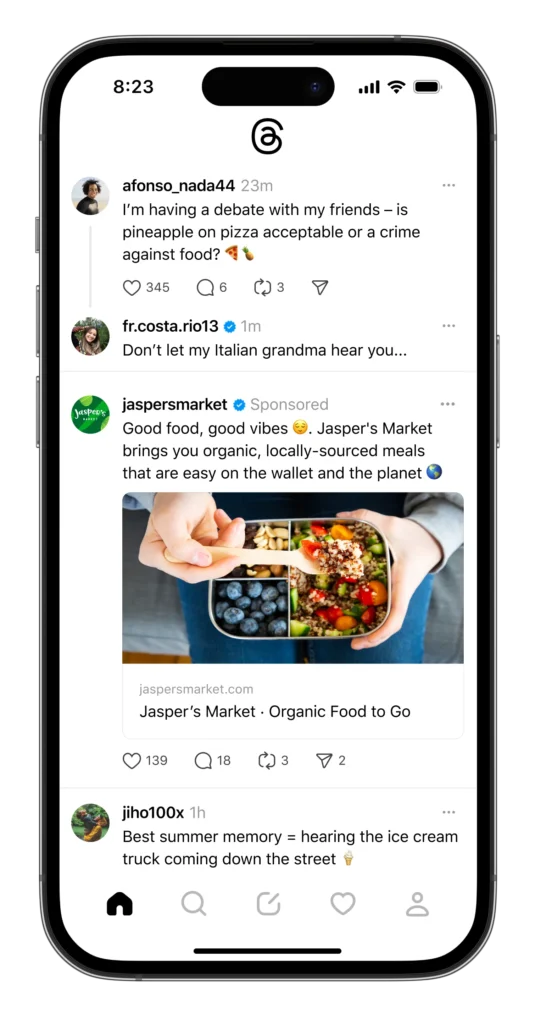
  • Ads are simple: image + text + link
  • Ads will show a “sponsored” tag
  • Uses Meta’s Ads Manager: just check a box
  • Personalized to the content that people engage with
  • Comes with an AI filter to screen what content your ads appear next to
  • Third-party verification to come “in the coming months”

Here’s what they’ll look like, at least initially:

ads on Threads

Again, it’s early days, but a bunch of things are obvious about the launch of ads on Threads:

  1. Meta is going slow to get it right
  2. Once Meta feels like they’ve gotten it right, the company has all the infrastructure and scale to massively ramp up
  3. Meta is going to be able to make ads on Threads vastly more profitable than Twitter was able in the past, or X is able to now

But how much more valuable?

Ads on Threads: more valuable than X?

Twitter was never 1 of user acquisition managers’ favorite ad networks for scaled UA. 

It peaked in 2023, ranking on 14 indexes for various geos and genres in the Singular ROI Index. As X, it dropped but didn’t totally crater in 2024 to 12 rankings, but the subtext was that even on the indexes X still ranked on, it dropped down in comparison with other ad partners.

From last year’s ROI Index:

More telling, perhaps, is that where last year Twitter had quite a number of rankings in the top 5 of ad networks, such as global ROI on Android, global retention on Android, and regional retention in APAC and North America, this year X has zero rankings in the top 5 in any category.

Also in the 2024 Index, its share of ad spend among Singular customers dropped 38%.

So whether as Twitter or X, return on investment for ads has never been stellar, at least for mobile app marketers.

The unfortunate thing for Twitter is that its executive never saw the actual value in its SSP, MoPub, which they sold for just over $1 billion to AppLovin in 2022. MoPub, of course, got integrated into MAX and became a key part of what drove AppLovin’s ascent to a $100 billion ad giant. (When you see pricing on both the supply side and the demand side, you gain invaluable insight into what’s working.)

How will Threads be better?

The ad experience on Threads is likely to start at least somewhat similar to that on X. 

But Meta has a huge advantage over X: its vast trove of data on billions and billions of people, largely including the hundreds of millions on Threads. Because, after all, the only way to get an account on Threads for a significant amount of time after launching was to already have a Meta account on Instagram.

With 3 billion MAUs and 2.1 billion DAUs on Facebook plus billions more across Instagram, WhatsApp, and Messenger, Meta knows a lot about almost all of us. That includes what ads we click on, what topics we resonate with, and which people we engage with. 

And Meta will have a lot of crossover in usage between its various platforms. For example, I personally use Facebook, Instagram, Messenger, WhatsApp (occasionally), and Threads.

  1. Facebook: 3.07 billion MAUs
  2. WhatsApp: 2 billion MAUs
  3. Instagram: 2 billion MAUs
  4. Messenger: 1.01 billion
  5. Threads: 300 million MAUs

That’s a lot of cross-over and triangulation about who I am, what I do, and where I spend money.

Plus, Meta has among the most mature ad management tools for advertisers on the planet, and it’s going to be a simple click to add Threads to the mix.

Add it all up, and Threads is almost guaranteed to have a better advertising experience — and results — than X. Whether it becomes yet another one of the Meta billion-user-platform services is anyone’s guess. But I wouldn’t bet against it in the long term.

The bigger question is going to be how Threads compares to ad experiences on core Meta platforms such as Facebook and Instagram. And how advertisers can use complementary campaigns on all of them to offer a surround-sound marketing experience. 

Plus, of course, whether Meta will pull a Google and offer a UAC/App Campaigns type of product where you give them your objective and (maybe) some art and copy, and they figure out all the rest, including where to place your ads.

One thing you know for sure: there’s going to be more AI everywhere in Meta’s solutions, and that probably includes advertising. Coincidentally, perhaps, Meta CEO Mark Zuckerberg also announced something today: a huge new investment in AI:

We’ll bring online ~1GW of compute in ’25 and we’ll end the year with more than 1.3 million GPUs. We’re planning to invest $60-65B in capex this year while also growing our AI teams significantly, and we have the capital to continue investing in the years ahead. This is a massive effort, and over the coming years it will drive our core products and business, unlock historic innovation, and extend American technology leadership. Let’s go build! 💪