How games are boosting revenue 30% using off-platform mobile payments

When Twitch cofounder Justin Kan references centuries-old railroad monopolies in a podcast on in-app payments, you know you’ve got something interesting going on. Having sold Twitch for almost a billion dollars (and multiple other startups over the past decade) he’s now building Stash, a direct-to-consumer mobile payments platform that lets games escape platform purchase fees and boost revenue by 30%.

For some older and very established games, as much as 80% of their revenue is off-platform, and therefore not subject to app store fees. 

In fact, Stash believes that 50% of all in-app revenue will move to owned channels over the next few years.

I recently chatted with Kan as well as Archie Stonehill, who leads product at Stash, for the Growth Masterminds podcast.

Hit play and keep scrolling …

Railroads and mobile payments

So what do railroads and mobile payments have in common?

I’ll let Kan explain:

“What we’ve seen in the last 20 years around social and mobile is very parallel to what happened 150 years ago as America went through industrialization. You had this rise of these big robber baron monopolies and oligopolies around railroads and banking and I think at a certain point, the American people decided that that was too much concentration of power, and they created antitrust legislation to take power from the oligopolies.”

That’s where Stash comes in.

Stash builds D2C player experiences including web shops and desktop launchers that let game developers engage directly with players — sell directly through them — and retain more revenue. Stash offers tools like loyalty programs, matchmaking, and custom player experiences all intended to fit, mirror, and be a natural extension of your game.

In other words, avoiding the big in-app purchase monopolies.

What does owning mobile payments do for games?

What’s that do for game publishers?

More money in their pockets.

“It’s unsurprising for us to be getting 30% uplift on net revenue from direct channels, as well as a bunch of other non-direct financial benefits,” says Stonehill.

Stonehill doesn’t recommend games entirely drop in-app and on-platform payments, of course. 

No matter how good your web shop is, it’s guaranteed to have more friction than a simple look-at-your-phone-and-click-twice to pay. So no one but the most granola-chewing anti-capitalist rebel die-hard is going to go to a web browser, navigate to a page, pick a product, add it to cart, check by entering the credit card, and then going back to the game for a 99-cent gem.

It’s your top players who provide most of your revenue anyways who will do this. And they’ll do it because you’ll give them a better deal than the on-platform mobile payment system. 

You’ll still make more money for 4 reasons:

  1. You’ll pay 5% for the credit card transaction, not 30%
  2. People spend more when they get discounts
  3. You’ll develop a more loyal multi-platform customer who is actually your customer, not Apple’s or Google’s
  4. You’ll have multiple means of communicating with your customers off-platform (email, SMS) as well as on-platform (in-app messages, push notifications, etc.)

Top-performing games using these D2C monetization strategies can generate 30–50% of their revenue outside app stores, Stonehill says. And some older games with extremely loyal users see even higher percentages: up to 80%.

First off, laws have changed significantly, especially in Europe under the Digital Markets Act. The DMA designates both the App Store and Google Play as core platform services provided by gatekeepers, which means the EU requires Apple and Google to enable interoperability, third-party app stores, and much more. 

In fact, I said as early as 2022 that the DMA would change app stores as we know them. We’re already seeing this: the Epic Games Store is being pre-installed on millions of smartphones from a major European mobile carrier.

In the United States, Epic Games v. Apple revolved around Apple’s App Store policies and its control over in-app payment systems, and the court ruled that anti-steering requirements in the App Review Guidelines violated California’s Unfair Competition Law. That ruling — which is under appeal — required Apple to allow developers to include links or buttons in their apps that direct users to external payment options, bypassing Apple’s in-app purchase system.

Similar things are happening in multiple other countries.

Where this all ends up, and how long it takes to achieve a final resolution, is anybody’s guess.

But those same actual Apple app guidelines themselves, as currently written, offer a method for game publishers to offer off-platform purchases for virtual objects in their games. The key rule is in guideline 3.1.3(b), which states that:

Apps that operate across multiple platforms may allow users to access content, subscriptions, or features they have acquired in your app on other platforms or your web site, including consumable items in multi-platform games, provided those items are also available as in-app purchases within the app.

Translation: multi-platform apps that offer services across different platforms (e.g., mobile, desktop, or consoles) can take payments on their other platforms and allow users to access that content within the app, provided they don’t link to or promote external payment options within the iOS app. Which is probably a big part of the reason why companies like Stash also offer mobile launchers for games so that they can be started and played on your Windows or Mac desktop machine, not just a smartphone.

Depending on how the Epic Games v. Apple case and others like it go, it could get even easier to offer multiple payment options, including right in your app.

Which, of course, is likely to be a key driver in boosting off-platform in-app purchase revenue to 50% of all in-app revenue.

Yep, there are some caveats

This doesn’t necessarily work for everyone and every genre. 

“There are some genres that are much more suited for this than others,” Stonehill says.

First of all and unsurprisingly, you need to have in-app purchase revenue in order to save money on not paying app store fees. (Duh.) 

But it also depends on the genre of your game.

“The genres where you’ve seen the most uptake are midcore and Casino, for sure,” he adds. “And within midcore you have RPG and Strategy, and to some extent Shooter as well, and then Casino and all derivations of Casino have been massive in this market. Monopoly has a phenomenal web store, for example … and then to some extent other genres like Puzzle or Simulation.”

How do you get to 80% revenue from your own store?

“Some games from major, major publishers are doing north of 50 or 60%, depending on the specific profile of that game,” Stonehill says. “Often if you have hyper whale monetization or you are a pretty old game with users who have been playing it for a very long time, who are very bought in, who are very regular spenders, you can get your numbers up to 70 or 80%.”

So it doesn’t work for everyone.

And the more established you are, the more engaged and loyal your players are, the better your odds of success.

Much more in the full podcast

As usual, check out the full podcast for much more, including:

  • 00:00 Introduction and Historical Context
  • 00:53 Introducing the Guests
  • 01:24 Stash: Direct Consumer Player Experiences
  • 03:22 Regulatory Changes and Market Impact
  • 03:38 Justin’s Perspective on the Gaming Industry
  • 06:41 Financial Benefits of Direct Channels
  • 10:59 Future of the App Economy
  • 16:58 Regulatory Developments and Legal Battles
  • 20:21 Historical Parallels and Future Predictions
  • 25:11 Closing Remarks and Future Updates

TikTok shutdown (and re-opening): advertiser impact

Update Jan 20: as expected, TikTok is back up right now in the U.S., though it’s still not available in the App Store and Google Play as Google and Apple likely await regulatory certainty beyond a verbal commitment from president-elect Trump.

For Singular customers:

  • Advertisers can continue using TikTok Ads to connect with US audiences
  • Ad campaigns targeting U.S. audiences that were automatically paused will resume, although LIVE campaigns will have certain limitations
  • Singular services are available to measure TikTok ads targeting users in the United States
  • You can continue to set up and modify campaigns targeting the US via TikTok Ads Manager, and there is no impact on ad campaigns targeting other countries

The volatile and almost unprecedented situation in the United States around the TikTok shutdown just got even crazier.

In a statement published late Friday January 17th night, TikTok says it will voluntarily shut down service and go dark on 170 million American users tomorrow,  January 19. In other words, the massive social video company is not just accepting a ban on app stores stocking and enabling installs of its app, it is going to literally shut down the servers that enable already-installed TikTok apps to work.

Here’s TikTok’s statement in entirety:

The statements issued today by both the Biden White House and the Department of Justice have failed to provide the necessary clarity and assurance to the service providers that are integral to maintaining TikTok’s availability to over 170 million Americans.

Unless the Biden Administration immediately provides a definitive statement to satisfy the most critical service providers assuring non-enforcement, unfortunately TikTok will be forced to go dark on Sunday, January 19.

That’s … quite a statement.

This TikTok shutdown is unexpected (at least for me)

I have always maintained that any TikTok shutdown as originally mandated would simply force Apple and Google to drop the app from the App Store and Google Play, respectively. That is obviously bad for any app and business, but it’s not an immediate execution. Instead, it would be something like a slow-motion suffocation as the app slowly grows worse and worse with creeping bugs and growing incompatibilities with successive evolutions of iOS and Android.

But we’re seeing something very different right now.

What we’re seeing today is a self-inflicted instant death, probably intended to put strong pressure on American politicians to do something as 170 million Americans wake up on Sunday morning to open TikTok and find … nothing. Except perhaps a message explaining why TikTok isn’t working, and who’s at fault.

So what do advertisers do now?

After all, TikTok is literally top-3 in spend for many mobile user acquisition marketers. It hit every single top list in last year’s ROI Index, and there’s no indication that will change in 2025.

That’s a lot of budget to redirect, with not a lot of time in which to do it.

How did we get here: a USA vs TikTok shutdown timeline

Briefly, how has this all happened?

  • February, 2019: FTC fines TikTok for collecting information from minors
  • August, 2020: President Trump signs an executive order to ban TikTok, citing national security concerns 
  • June 2021: President Biden revokes the order and directs the Commerce Department to investigate
  • December 2022: President Biden signs the No TikTok on Government Devices Act
  • March 2023: The House of Representatives passes a bill to ban TikTok or force its sale to a U.S. company
  • April 2024: President Biden signs the Protecting Americans from Foreign Adversary Controlled Applications Act, requiring China-based TikTok owner ByteDance to divest by January 19, 2025, or face a ban
  • May 2024: TikTok and ByteDance file a lawsuit against the U.S. government, contesting the orders
  • November 2024: Former President Trump reverses his stance on banning TikTok
  • January 2025: The Supreme Court upholds the law requiring ByteDance to divest TikTok

And that brings us to today …

What’s likely to happen?

ByteDance has shown that it does not appreciate being pushed around, and it will completely exit a market rather than accept what it considers a suboptimal solution.

In India, for example, when Prime Minister Modi enacted the TikTok ban in June of 2020, ByteDance just walked away from 200 million users, not even attempting a fight in court.

The U.S., however is different.

It’s both a vastly lucrative territory for the company and strategically very important for the Chinese national leadership, who ultimately control what most Chinese companies do, as we’ve seen in the case of Jack Ma, the founder of Alibaba and Ant Group. Ma criticized China’s regulatory system in late 2020, and by early 2021 he had essentially disappeared from public view, while Alibaba was fined a record $2.8 billion for monopolistic behavior.

ByteDance has options here. There are multiple consortiums and companies bidding for TikTok, including a brand new one just today (Saturday, January 18) from Perplexity AI. Other suitors include Microsoft, Oracle, Walmart, even Twitter and Elon Musk.

But ByteDance doesn’t appear to want to sell.

And incoming President Trump has indicated he’s willing to take some time to find another solution. Plus, outgoing President Biden has made it clear that it’s Trump’s mess to handle now:

“Given the sheer fact of timing, this Administration recognizes that actions to implement the law simply must fall to the next Administration, which takes office on Monday.”

In addition, White House press secretary Karine Jean-Pierre said in a statement that the TikTok shutdown for January 19 is “a stunt.”

Based on TikTok’s statement, however, I think the following is most likely to happen:

  1. A brief shutdown so ByteDance can make its point
  2. A negotiated time period for some level of business reorganization so newly re-elected President Trump can save the service for its 170 million American users
  3. Some kind of new business arrangement that the Trump administration is comfortable with
  4. Business as usual for most

This is entirely my own speculation, of course. I have no insider information.


TikTok trouble means happy birthday Meta

Any problems for TikTok, of course, are music to Meta’s ears. What we saw in the India ban is that most TikTok users — remember, 200 million of them — simply moved over to Meta.

“Reels is the outright winner,” Nikhil Pahwa, founder of the Indian tech policy site MediaNama, told the Washington Post with reference to TikTok being booted from India.

And that’s likely to be the case for both users and advertisers in the United States too, if there’s a real shutdown for any length of time.

While we’ve seen a short-term jump in U.S. users flock to RedNote, a Chinese TikTok competitors, the most likely winners are already here:

  • Reels (via Instagram, mostly)
  • YouTube Shorts
  • Snapchat Spotlight
  • Triller
  • Clapper

Triller downloads are up 40% in the last few days, according to Apptopia. Clapper is up 85% on a much smaller base. Instagram is up just slightly, while YouTube is up 12%.

tiktok shutdown: clapper

Of course, nothing is certain. RedNote could maintain momentum, only to be slapped down by a new executive order. Perpetual challenger Triller could seize the moment and gain unstoppable momentum. Perplexity or some other of the potential bidders for TikTok might persuade ByteDance to do some kind of deal, if not make an outright sale.

Stay tuned, and be ready to shift budgets as needed.

But the most likely outcome is that after some turmoil, TikTok remains, and its users stay put, and ad dollars continue to flow. How long that turmoil lasts, of course, is unknowable.

Media buying models: CPM, CPC, CPL, CPA, CPE, CPS, CPI, CPV, PPC, and more!

A media buying model sounds complicated but simply refers to 2 very connected things: how advertisers are charged for ad placements, and how campaigns are optimized for performance.

The problem, of course, is that modern mobile marketing has its own language and its very own mega-galaxy of acronyms. To a new digital marketer, they can be bewildering. Even experienced mobile marketers often have to turn to Google and re-check a seldom-used acronym. Even worse, many of them overlap, causing yet more confusion.

Let’s start by listing the common as well as less common media buying models in mobile. Then we’ll define them below.

They include:

  • CPM (cost per thousand impressions)
  • CPC (cost per click)
  • CPL (cost per lead)
  • CPA (cost per action
  • CPE (cost per engagement)
  • CPS (cost per sale)
  • CPI (cost per install)
  • CPV (cost per view)
  • PPC (pay per call)

While they don’t have fancy acronyms, there’s also flat rate or fixed-cost placements, sometimes done via a sponsorship model, or lifetime cost for brands that want permanent exposure on certain channels.

OK: let’s dive into each one …

CPM: cost per thousand impressions

Before you ask: yes, it is odd that CPM translates to “cost per thousand” but has an “M” and not a “T.” That’s because, just to make it a little more challenging, marketing experts have thrown a little old, dead, mostly forgotten language in for your pleasure (or perhaps theirs).

Yes, we’re talking about Latin. (But not pig Latin!)

CPM is short for cost per thousand impressions (the M is the Roman numeral abbreviation for 1,000.) CPM is one of the most common ways of buying digital media. You essentially pay for every time your ad loads on a webpage or in an app. It’s a simple way to buy, but over the past decade it’s come under increasing scrutiny because the client is charged for the impression whether or not a consumer actually sees it.

On the web, for example, if the ad appears below the browser window and the user never scrolls down, the advertiser still pays. On mobile, the same is true. This can be vulnerable to fraud, with a typical scenario being a fraudster loading up 5, 10, or 15 ads in the same space, stacked over top of each other.

CPM has traditionally been used for brand campaigns, not performance campaigns, because it’s a pre-action metric: no conversions involved. Ultimately, however, some marketers are so used to it they’ll often back out a cost-per-click (CPC) or a cost-per-action (CPA) or a cost-per-lead (CPL) from the CPM that the ad network quoted them.

CPC: cost per click

CPC is probably the simplest media buying model to understand. And no, there’s no Latin involved.

CPC is cost per click advertising. Here the advertiser (that’s you) pays when a click is made on an ad. Some advertisers prefer to buy CPC versus CPM because they believe they only pay when someone is interested enough in the message to want more info. And that’s likely true. Some CPC programs are very effective.

The problem is that there is serious potential for fraud if a company deliberately uses bots or some other technique to drive clicks that are not actually initiated by a real person.

Which is why, as you get deeper and deeper into media buying models that involve measurable metrics, you need fraud prevention solutions to ensure you’re getting what you pay for.

CPL: cost per lead

Cost per lead is not a common model for mobile marketers or even consumer-focused marketers. It’s much more common in B2B or business development scenarios.

With a CPL media buying model, you as an advertiser pay a publisher or an affiliate when a lead form is completed and submitted. As mentioned, CPL is common in B2B marketing, where it is unlikely that someone will make a purchase immediately. It can be a very effective way to buy, though there is some risk of fraud if bots are programmed to fill in leads automatically, or if smart affiliates target people who were going to become a hot lead anyway.

That’s a little harder to do, however, than to fire off fake clicks.

CPA, CPE, and CPS: cost per action, cost per engagement or cost per event, and cost per sale

Remember I said there was overlap between many of the acronyms covering mobile media buying models? Well that’s where we are with CPA, CPE, and CPS.

CPA is often cost-per-action in the mobile marketing world, which means you pay for certain actions taken by a user in your app, such as registering for an account or making their first purchase. (That’s why it’s very similar to CPE: cost per event. And, of course, CPS, or cost per sale, is also an action and, technically, an event.)

Whether it’s an action, acquisition, event, or sale, however, the point is that advertisers only pay if something happens. That’s why CPA is a relatively low-risk way to buy media because the advertiser only pays when a user takes definable steps, or when you recognize revenue.

(As usual, there are ways for this to be gamed by fraudsters as well.)

Some media companies won’t sell media this way because they assume all the risk in the ad buy. If no one buys, they make no money. High-quality publishers with valuable inventory are more likely to want guaranteed revenue. But some can be enticed into CPA contracts if the value is high enough … and if they trust their inventory sufficiently.

CPI: cost per install

At last we come to the most-used media buying model in mobile growth, CPI.

CPI is an extremely common way to price mobile app install campaigns, and even if marketers use a different model, they’ll often work out an effective CPI based on the other model theoretically being used.

In mobile app marketing, CPI refers to media programs where the advertiser pays for every installed app. Lots of app marketing is purchased via CPI, because it is a fast way to drive installs. But, as in anything else, the quality of installs driven varies by media vendor. Some CPI vendors are extremely reputable, and work hard to find users that will likely use an app. Others use incentives in one app to get a user to install another app. Those “incentivized installs” can be low quality, although there are ways with playable ads to increase the quality.

As always, fraud is an issue as well: some fraudsters use bots to drive CPI campaigns and collect revenue. There are even still some physical install farms, where people manually install apps on hundreds or thousands of devices. Most of those are now entirely virtual, however.

CPV: cost per view

It’s rare, but there’s also CPV, or cost per view. If you have a super-valuable video, you might want to pay to have it seen on YouTube, and buy a sponsorship or a certain number of views at a specific cost per view.

Tracking and measurement can be a problem, though many ad networks will offer a view-through conversion model, of course. 

But since CPV is a top-funnel measurement and most mobile marketers are heavily performance-oriented, it’s much more rarely used.

PPC: pay-per-call

It’s old-school these days when millennials barely want to pick up a phone and use it for its original purpose, but there are also pay per call models for businesses that generate most of their revenue when prospects place a call to a sales executive.

It goes almost without saying: PPC is very rare in mobile marketing.

(Also: it’s worth mentioning that PPC in web marketing specifically tends to mean Pay Per Click, which of course is a very different thing.)

The million-dollar question: which model is best?

The easy answer is that there’s no easy answer. (Sorry!)

And there’s some truth to that. It really does depend upon your objectives, target, and what your media partners are willing to do for you. The most critical thing is to have high quality, unbiased third-party-verified information about the results each partner drives, whichever form of media buying you choose.

As previously mentioned, most advertising vendors reverse engineer a CPM from whatever buying model you choose. If, for example, your campaign is good at driving clicks, you’ll find more advertisers willing to take CPC because it reverse engineers into a good CPM. Most companies are looking to drive revenue from their advertising. You need to understand the revenue results of every effort, regardless of how you pay for it.

Ultimately, as a marketer, the best model for you is one that drives high-quality users who engage and retain.

If you get your pick, take a model that has a guarantee of return. CPM can be dangerous because you can burn through thousands of dollars with no visible impact. CPI can be dangerous because you can get thousands of low-quality installs. But both models can work if you’re a savvy marketer with good technology.

If you can get a CPA model with a high bounty on an action that indicates high predictive life-time value, take the deal. The question is whether you can get it.

Measuring results

Whatever model you buy media with, ensure you have a smart, unbiased, fraud-finding way to measure the results of your campaigns across all partners and all sources.

Here’s how to find out if Singular is right for you …

Scaling games beyond 1 million players: 6 challenges

How do you scale your mobile game beyond 1 million players?

Anyone can start a game or an app and get a certain amount of growth. But scaling is hard: you need to find more players, sure, but you also need to expand beyond your initial niche. You probably have to start paying attention to what your competitors are doing. And you’ll learn a lot from new players that will impact how you want your game mechanics and monetization to function.

In this episode of Growth Masterminds, we chat with Sven Jurgens, an independent mobile games consultant, about the challenges and strategies for scaling mobile games beyond 1 million players. 

We chat about 6 core challenges when scaling:

  1. Creative
  2. Ad partners
  3. Cash flow
  4. Monetization
  5. Tools and tech stack
  6. Automation

Scaling mobile games: 6 core challenges

Jurgens has spent over 60M euros on ads in his career. He’s now an independent mobile games consultant, but was previously head of performance marketing at LanguageTool, Marketing Lead at Tivola Games, and User Acquisition Lead at AppLike.

Hit play and keep scrolling:

Core scaling challenges

To scale well, you’ll need to meet and beat hundreds of small and giant challenges. Here are 6 of the most challenging for marketers in particular …

Scaling games challenge 1: creative iteration

Assuming you’ve achieved product-market fit, retention is sane, and monetization is working, you’re going to start scaling marketing. And that means scaling creative.

Which brings new challenges.

“ Creatives are the bread and butter of growing, right?” says Jurgens. “So what you usually do is copy/paste what the competitors are doing.”

That’s a bit of a problem. Yes, you want to know what your competitors are doing. And yes, you can save a lot of money in creative testing if you spy on others to find out what’s working and what’s not (hint: creatives that they’re running for weeks, months, or even longer are probably working).

But when you’re scaling mobile games, you also need to start developing your own style, your own creative, your own messaging, your own unique identity. If the word “brand” smells bad by association with big old traditional marketers, call it your game’s persona, or identity, or reputation.

Just doing the old copy-paste thing might get you from A to B, but it’s probably not going to help you scale to the big leagues.

Why?

You’re fighting ad blindness.

“ The user that you show that ad to in your Instagram feed or Facebook feed, whatever feed … they see that a second time, third time, fourth five, et cetera, et cetera,” Jurgens says. “So for them it’s not new anymore.”

That means you’ll burn through audiences faster. And get less in return for your ad dollars. And invest less in your long-term growth.

Scaling games challenge 2: ad partners

When you start marketing your new game, you probably will just use 1 partner and 1 channel. Maybe a couple, but not 10. And probably not even 5.

There’s at least 3 that you can kick off with to start, Jurgens says:

“ I would always start simple … start with the very basics: Facebook, Google, TikTok … so that’s a starting point.”

You instantly have audiences in the billions on each of these platforms, so you’ve got some runway here. But you may want to choose a SDK network, maybe a programmatic partner at some point. Caution: take your time. Let your operation build and grow naturally.

“ People want too many things too early, honestly,” says Jurgens “So usually they say, ‘Hey, cool, I have maybe $100K of spend … here are my seven networks. No, it’s too much.”

One place to consider looking when it is time: rewarded ad networks, which are doing very well these days …

Scaling games challenge 3: cash flow

The goal is to establish a flywheel of growth that speeds up as you go:

  • Invest $100K
  • Get $150K
  • Invest $150K
  • Get $225K
  • And so on …

But the kicker is the payback period. 

Cash is fairly easy to get, Jurgens says, assuming your core mechanics are solidly in place. The challenge: more users and bigger marketing scale can change things in unpredictable ways.

But the core challenge is retention:

“ What you want to have is these stacked cohorts, right?” says Jurgens. “You throw people in and they grow, grow, grow, grow, grow over time. And then, of course, there’s a dying cohort and a churn curve in there. But you want to have that as small as possible, so usually it’s about building a product that’s not losing money: that’s the challenge.”

Scaling games challenge 4: Monetization

You’ve obviously figured monetization out at a certain level, because you’re at the scaling stage right now. But the thing is … things change.

“ The more players you have, the more data you have, right?” says Jurgens. “So when you just start out, it’s an assumption … it’s the best bet. Maybe it could be like an ad placement, it could be monetization, it could be the difficulty curve of your game … it’s an assumption. And the more time you give to your product, the more people you generate and have in your product, the more data you can generate in the app. And what’s then changing is you do what works.”

For example:

  • You learn a level is too hard
  • A feature leads to churn
  • A player upgrade isn’t driving the monetization you hoped it would

And all of that leads to product challenges to ensure that your monetization at least stays as stable as possible when you scale players, or even improves on a per-player basis.

Scaling games challenge 5: tools & tech stack

If you start with 1 ad partner, you may not think you need an MMP. As you add more, however, it becomes obvious that you do.

The same is true with all your marketing and data tools: start simple and grow.

“ Start as simple as possible, right?” says Jurgens. “So it could be like your research tool, maybe you don’t have the money for that: then do that manually. It could be like your competition analysis … your analytics tool. There’s always a cheaper solution, an open source solution that can do the trick for you.”

(Good time to point out, perhaps, that Singular has a completely free tier.)

Try it out!

Scaling games challenge 6: automation

We all do the crappy busy work that takes up 2 or 3 hours that could otherwise be spent making strategic choices. Or to actually use the data that we’ve painstakingly accumulated to make smarter decisions.

So automation is your friend as you start to scale.

“ Automate the boring stuff away,” says Jurgens. “ This is literally just sitting somewhere and look at the data process that you do, and you will be amazed how many stupid things there are. How many times do you iterate on some CSV upload ads through some tool? Or do some comma versus dot notation change, right?”

Jurgens taught himself a little programming to make that happen, but you could probably get ChatGPT to do some of it. Or a team member with a few spare moments, or a gig worker who can code.

“ These small tools, they can … save a lot of time,” Jurgens says.

More on scaling from zero to hero

Interested in reading, listening, or watching more on scaling mobile games? Check out these resources:

If you want to go to the next level, though, check out this miniseries we just put together:

It’s 5 sessions with 10 experts on:

  • Mastering creative
  • Navigating iOS measurement
  • Channel diversification
  • Retargeting
  • Monetization

And … there’s much more in the full podcast

As usual, there’s much more in the full podcast. Check out Growth Masterminds wherever you get audio podcasts, or subscribe to our YouTube to watch them there.

Here’s what you can expect:

  • 00:00 Introduction to Growth Masterminds
  • 01:37 Journey into Growth Marketing
  • 03:55 Challenges of Scaling: Creative Strategies
  • 09:20 Ad Partners and Scaling
  • 11:39 Financial Challenges in Scaling
  • 13:52 Monetization and Data Utilization
  • 15:39 Tools and Automation in Scaling
  • 18:23 Automate the Boring Stuff
  • 19:04 Building Small Tools for Efficiency
  • 20:37 Competitor Analysis Strategies
  • 25:04 Getting Smarter About Data
  • 28:53 Winning Strategies and Trends
  • 32:55 Reviving Old School Marketing
  • 35:35 Conclusion and Final Thoughts

The rewarded ad space is exploding and it’s all AppLovin’s fault

What is going on in the rewarded ad space? Why is it exploding? We’ve all seen the number of ad networks focused on rewarded ads and incentivized ads lately. Adtech OG Paul Bowen is seeing it too, and when he decided to take a serious look, he found 32 different ad networks focused specifically on rewarded ads for free-to-play gaming user acquisition.

rewarded ad networks

So what’s going on here? 

In a way, he says, it just might be all AppLovin’s fault: the ad network that has grown so fast and so big there’s almost no room to innovate in the traditional gaming user acquisition space anymore.

But of course, reality is complex: there’s clearly more going on than just AppLovin’s recent dominance.

Rewarded ad networks: how AppLovin is fueling the boom in incentivized ads

I had a chance to chat with Paul Bowen on the Growth Masterminds podcast. 

He’s a legit adtech OG: former GM at a Liftoff company (AlgoLift), former VP at Unity Ads, a VP at Tapjoy, and now the chief revenue officer at StreamElements, which sounds non-adtechy but actually shares a lot of the characteristics of an ad network built on the supply side of the creator or influencer marketing boom.

Click play and keep scrolling:

Rewarded ad networks, incentivized ads: following the path of least resistance

75% of the rewarded ad networks Bowen could find revenue model details on use gift cards as their primary mode of reward. And it turns out that this is significant in terms of why there’s been an explosion in these kinds of companies.

Why?

Low barrier to entry, thanks to minimal integration complexity with participating apps. 

“The barrier to entry is relatively low if the type of product you are building gives gift card rewards,” says Bowen. “With gift cards as a reward, you don’t need to work with any third party on the publisher side. You can basically spin up your own product, whether it be a web product or an app, and you own the fulfillment on the payouts, the reward side, which makes it a one-sided marketplace and a lot easier than building a two-sided marketplace.”

Virtual currency requires working with third parties, and publishers need to implement your solution to offer that currency. You need to persuade publishers, talk to product teams, convince the monetization manager …

Once you’re in it’s great, but it takes time, it’s hard, and not every publisher wants the hassle.

Major ad networks can offer large incentives, but not necessarily start-ups trying to scale. Which is a major reason why so many start-ups are doing rewarded ads or incentivized ads, but making the payments in real-world products or currencies via gift cards.

Another reason … AppLovin (and ATT)

And yes, AppLovin is part of the reason too.

When Apple’s ATT made IDFAs scarce, consolidating ad platforms became more important, as did owning your own data. Which is a big reason AppLovin acquired MoPub from Twitter a few months after ATT reached majority share, then sunsetted the product in favor of its own supply side platform Max, migrating customers over.

“AppLovin sees every ad call made,” says Bowen. “That’s why they’re so good at what they do … they own the mediation, they own the header bidding.”

They are by far the dominant player, Bowen says, and every other company in the traditional ad space is suffering as a result. After all, when you get insight into every impression filled and what price it was filled for from the supply side, you can feed that insight into your own demand side pricing strategy. That’s a massive competitive advantage: you know how each publisher values their players. After all, you don’t get profit margins of 78% just by accident.

Which means, Bowen says, there’s very little room for innovation on the traditional ad network side.

“ We went through the ad network phase, we went through the SSP phase, we went through the DSP phase, and that’s all consolidated to like 5 companies now, and they’re duking it out,” Bowen adds.

How does this impact rewarded ad networks?

Rewarded ad networks get a similar privileged position, Bowen says: they see what players do, what ads they watch, and so they can optimize their acquisition and monetization in similar ways.

And that’s why we have an explosion in rewarded ad networks: low barrier to entry, and better data for pricing.

More in the whole podcast

There’s so much more in the full podcast. Subscribe to Growth Masterminds, follow us on YouTube, and get it all:

  • 00:00 Introduction to Adtech and Rewarded Ads
  • 01:18 Building a Database of Incentivized Ad Platforms
  • 02:54 The Evolution of Rewarded Ads
  • 07:12 StreamElements: Tools for Twitch Streamers
  • 09:35 The Resurgence of Rewarded Ads
  • 16:14 Challenges and Opportunities in the Gift Card Reward Space
  • 22:02 Expanding User Acquisition Beyond Gaming
  • 22:35 AppLovin’s Success in Mobile Ad Tech
  • 27:32 The Role of AI in Mobile Advertising
  • 35:21 Challenges and Innovations in Measurement
  • 38:28 Concluding Thoughts on Ad Tech

Creator economy: the $250 billion tailwind behind influencer marketing (and UGC ads) in 2025

There’s a reason influencer marketing has tripled since 2019. There’s also a reason why it’s forecast to continue to grow at a steaming hot 32% compound annual growth rate between 2025 and 2030. Neither of those numbers are an accident, and there are multiple ecosystem-level drivers propelling the continued growth of influencer marketing as well as — by natural extension — UGC ads. And all of it is substantially changing the advertising landscape.

The primary driver is the rise of the creator economy.

In fact, Evan Shapiro, the “unofficial cartographer” of the media ecosystem, says that 2025 is the year of the creator:

“My most specific prediction for 2025 is that November of 2024 will be remembered as the moment that Creator Media surpassed Corporate Media in global relevance.”

– Evan Shapiro

(November of 2024 was, of course, the U.S. election, where chats with Joe Rogan appeared to be more powerful in swaying votes than visits to top broadcast TV news shows.)

While corporate media has grown at about 5% annually over the past few years, creator media has grown at over 25% annually, powered by none other than user-generated content. Or, if you will, creator-generated content. 

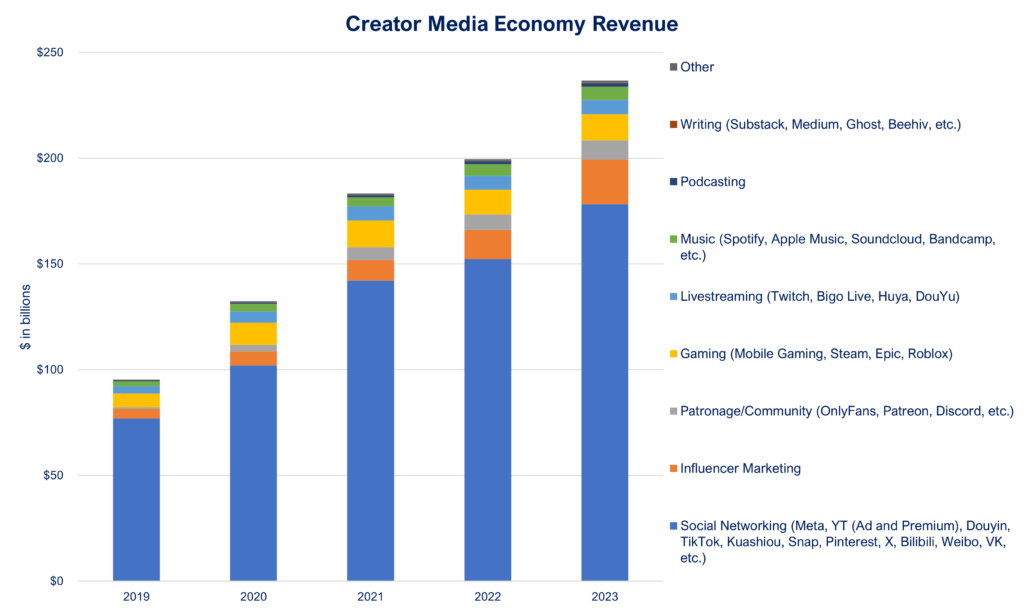
The result is that the creator media economy has grown to a $250 billion dollar behemoth. (We see that in the G2 Creator Economy Statistics report as well, which shows how software — especially AI-powered software — is an enabler, or even a creator superpower, allowing creators to compete and even win against corporate media.)

Note: For this blog post, I’m indebted to both Evan Shapiro, who runs the Media War & Peace substack, and Doug Shapiro (no relation, AFAIK) who runs The Mediator.

Corporate vs creator media economies

The corporate media ecosystem is the one we’re most familiar with. While it has its traditional players like NBC and the NYT, it also has its disruptors in Netflix and Prime Video. In the gaming world it includes most of the major players we’re familiar with in both the console/PC and the mobile spaces: EA, Activision, Ubisoft, Epic, Take-Two, Supercell, Rovio, Zynga, Tencent, and so on.

The core identifier of the corporate media economy is that it takes control of most of the steps between creation of something good, interesting, fun, and valuable (please don’t call it content) and the consumption, use, or enjoyment of that thing.

Those steps, of course, include:

  1. Ideation
  2. Production
  3. Marketing
  4. Distribution
  5. Monetization
  6. Consumption

In step 1, a creator, artist, producer, or coder writes or invents or programs. You and I and all of us collectively handle step 6. The corporate media ecosystem manages everything else sandwiched in the middle.

In some ways the creator media economy is much simpler. 

Creators … create, but they also take on responsibility for production, some responsibility for marketing, and some responsibility for monetization. They’re aided by what Shapiro calls enabling platforms, and we all know their names:

  • YouTube
  • Instagram
  • Spotify
  • Patreon
  • Steam
  • And others, of course

Enabling platforms distribute, sure, but they also help with production in some cases. Think of Spotify’s acquisition of Anchor, which became Spotify for Creators, providing tools to “create, distribute, host, and monetize your podcast, 100% free.” They also market, in a sense: if your video, image, newsletter, or game tickles the fancy of an enabling platform’s algorithms, they’ll ship it to more and more eyeballs and feature it more prominently in the feed.

The result is a collapse of the traditional corporate media model with its traditional intermediaries and steps down to the modern media model:

  • Anyone creates
  • Platforms package/distribute/monetize
  • People read/watch/play … and in some cases pay

And this is across the board in media of almost all kinds. As the former chief strategy officer of Turner (WarnerMedia) Doug Shapiro highlights, it’s everywhere:

  • Social networking
    Meta, YouTube, Douyin, TikTok, Snap, Pinterest, X, Weibo, VK
  • Patronage/community
    OnlyFans, Patreon, Discord
  • Gaming
    Mobile gaming, Steam, Epic, Roblox
  • Livestreaming
    Twitch, Bigo Live, Huya, DouYu
  • Music
    Spotify, Apple Music, Soundcloud, Bandcamp
  • Podcasting
    YouTube, Spotify, Apple
  • Influencer marketing
    Aspire, GRIN, CreatorIQ, Upfluence, BuzzSumo
  • Writing
    Substack, Medium, Ghost, Beehiiv

Influencer marketing is a big beneficiary

I’ve been watching YouTube on the big screen more and more lately. 

What no-one tells you when you buy a big-ass 4K TV is that all the non-4K content on your legacy cable, satellite, or fiber provider looks SO MUCH CRAPPIER than on your old not-so-big 1080P TV. (Yeah, on-the-fly digital upscaling is much more marketing than reality.)

But YouTube has a lot of 4K content, and views are reportedly doubling annually. 

So I’m watching more YouTube. It just looks SO GOOD.

But there’s increasingly a jarring disconnect between the content I’m watching and the shiny happy traditional boob tube commercials with polished jingles and professional soundtracks that brands are pulling from broadcast TV and shoehorning into YouTube pre-rolls. 

They just don’t really … fit. 

What works during the Super Bowl doesn’t necessarily work when watching a dude build an off-grid cabin with 1800’s-era tools. Or a bunch of podcasters vibing about the newest new thing.

And that’s likely to increasingly be the scenario as the creator media economy overtakes the corporate media economy. Which means that influencer content and influencer advertising, often in UGC form, is not only going to fit the increasingly-dominant new form of media. It also means that — as we’ve already seen — existing corporate ads are more and more taking on the flavor of influencer and UGC ads.

Influencer marketing agencies are exploding

Publicis bet $500 million on the creator economy by buying influencer marketing agency Influential in July of 2024. 

We’re likely to see many more such mergers and acquisitions.

A decade ago in 2015, there were only 190 influencer marketing agencies and platforms globally, By 2021, that number exploded to 18,900. That’s up a massive 75% compared to 2019. There’s little chance so many players will succeed, but many will be acquired, acqui-hired, or merged to build larger and more comprehensive solution sets for advertisers.

(Look at any “top influencer marketing agencies” list: almost all are under 200 employees. Most are under 50 … not exactly a hobby or lifestyle business, but not far removed.)

The creator economy end game

There’s no obvious end in sight to the key driver of the creator economy: the unlocking of global creativity in hundreds of millions if not billions of people.

Doug Shapiro estimates that the creator economy was worth almost $250 billion in 2023. That includes all the revenue from advertising, subscriptions, and transactions, but not direct sponsorships, which he did not (could not, because it’s not public information) include in his calculations.

Notice that the bulk is via Meta, YouTube, Doyin, TikTok, Snap, and Pinterest, etc.).

creator economy

That is guaranteed to have grown in 2024, and based on the trajectory we see now, will continue to grow in 2025. 

Importantly, that’s a zero-sum game.

At some point, people can’t consume more content, watch more video, read more, or listen to more podcasts. So revenue added to the creator economy is essentially revenue subtracted from the corporate economy … which is why you see slow nominal growth of 5% annually in the corporate media economy (but actual decline when you take inflation into account) compared to 25% annual growth for the creator media economy.

The reason is that creators have been unleashed:

  • Hollywood makes 15,000 hours of TV and film annually, but creators upload 250 million hours of video to YouTube alone every year
  • 225,000 professional musicians upload about 5 million tracks to Spotify annually, but 10 million others upload 37 million
  • Xbox has 3,000 games, but there are 100,000 games on Steam, maybe a million on the iOS and Android app stores
  • We took 80 billion photos in 2000, but 2 trillion in 2024

Unleashed indeed!

Oh, and generative AI is likely to be a multiplier on both the quantity and quality of creator economy media that gets published. A massive multiplier. At some point, fully genAI stuff created at the instigation of AI without even the intermediation of a creator is likely to become big.

(We already see it in music and have for some time.)

As Doug Shapiro says:

“People create more when creation is more accessible.”

GenAI or no genAI, most of what creators publish is crap, sure. But the best is really, really good, increasingly challenging the best of what the corporate model can create. The end game doesn’t have to be that the creator economy overtakes or consumes the corporate media economy, though it could become more than half of its value. 

But the end game is that the creator economy becomes as important if not more important than the corporate media economy.

And that changes … a lot.

More on that in the future.

More on influencer marketing

Interested in more on this phenomenon? Check out these additional recent resources:

Overlooked niches when growing games globally

Outside of China, 60% of gaming user acquisition spend is concentrated in five markets: the U.S., South Korea, Japan, Germany, and France. The U.S. alone accounts for 40% of global UA spend outside of China: it’s where the largest concentration of high-value players can be found. But if you are growing games globally, it might be a mistake to just focus on the U.S., or just the big 5, or just China, which is of course itself a massive mobile gaming market.

And is it possible that you’re wasting marketing dollars by only doing user acquisition where you always have done it in the past?

I recently spent half an hour with Tom Shadbolt. He’s Moloco’s senior marketing insights manager, and he just completed a report on global gaming spend, analyzing 4,000 apps with $3B in IAP revenue across 195 countries.

Hit play, subscribe to Growth Masteminds, and keep scrolling …

Growing games globally: where to spend

It’s always a valid question: go where you know, or try new options? New options, of course, add the challenge of a learning curve:

“ As performance marketers we are very much focused on that short term, but we also need to marry that with longer term opportunity,” Shadbolt says. “We were able to see pockets of opportunity that advertisers are exploiting already in Europe and Asia, but we’re also able to see markets like Brazil and India and South Africa where the viability of UA is increasing over time.”

Growing games globally is expensive: Moloco estimates that global gaming spend in 2025 for marketers aiming to boost in-app purchases will hit $29 billion. 

And it’s going to stay fairly concentrated:

growing games globally

While most marketers are thinking about the big countries at the top of the chart, Shadbolt says UA can efficiently drive growth in others as well, like Brazil, Greece, Iceland, the Netherlands, South Africa, and the United Arab Emirates.

How?

Using the right ad networks is key: advanced targeting techniques and machine learning play a huge role in identifying high-value users in more niche markets, and marketers will need to commit to continual testing and experimentation if they wish to uncover those growth opportunities.

This is how Chinese gaming companies work

Interestingly, this is exactly the strategy we see from Chinese gaming companies, which have been tremendously successful globally. According to 1 source, 38 of the top 100 global mobile game publishers are from China.

“Diversifying media budgets is incredibly important and we see advertisers take advantage of this already,” says Shadbolt. “So when you look at the Chinese mobile app gaming advertisers, they have much more diversified spend: they are sort of focusing opportunities across EMEA, across APAC, across the U.S.”

“And they’re seeing great success. And when you compare that to U.S.-based advertisers who are actually spending up to 60% of their budgets in North America, the question becomes, are we over-concentrating and are there opportunities to take more of a global mindset?”

Most U.S. game publishers spend most of their budget in North America, and much lower percentages elsewhere. Most Chinese game publishers even out their UA spend between North America, Europe, APAC, and the rest of the world … as well as China, of course.

A key reason:

There’s a lot of value out there in terms of ARPPU (average revenue per paying user), which is great to hit if you’re growing games globally.

arppu globally

What’s clear is that the traditional mobile marketers’ segmentation of Tier 1 (US), Tier 2 (Europe), and other markets is now essentially outdated. 

Sometimes just English works, but often not

This does mean localization, of course.

While 50% of gaming UA spend will be against English-speaking players, Shadbolt says, if you really want to go beyond English-first and English-proficient markets, you’re going to need to localize your game.

Especially in East Asia.

“Through the report, we highlight East Asia as a market of huge potential, with high user value in some of these genres, but also one of the hardest markets to crack in terms of localizing apps and meeting local expectations,” says Shadbolt.

That can be genre-specific as well: RPG is popular in east Asia, Match and Casino games are popular in the U.S.

Grouping markets by cultural or language tendencies can help in strategizing expansion plans and lessening localization costs and complexity.

Growing games globally: much more in in the full podcast (and report)

Check out the full podcast on YouTube or wherever you get your audio podcasts, and see the report for more details.

What you can expect:

  • 00:00 Global Growth Opportunities
  • 00:54 Key Insights from the Report
  • 02:56 Top Markets for Gaming UA Spend
  • 05:44 Challenges and Strategies for Global Expansion
  • 10:04 Diverging Strategies for iOS and Android
  • 11:35 Finding the Right Market for Your Game
  • 13:23 Localization and Market Segmentation
  • 14:34 Average Revenue Per User (ARPU) Insights
  • 16:42 Experimentation and Long-Term Strategies
  • 20:09 Conclusion and Final Thoughts

Marketers, welcome to the privacy end game: you ain’t seen nothing yet

If you think you know privacy, think again. Marketers have been through a lot with GDPR and ATT and SKAdNetwork and (maybe) Privacy Sandbox, not to mention less data from the major platforms and tough choices between deterministic and granular on iOS. But we’re starting to see the privacy end game now.

And while we’ll probably never see a majority or even sizable minority of people sign up for this privacy end game, we just might see the most valuable users, players, and customers go this route.

There’s a brand new mobile carrier that bills itself as “the only mobile carrier built with privacy and security at its core.” and says that its technology masks both location and identity. 

Privacy end game via MNVO

It’s called Cape, and while it was first aimed at serving government officials and military leaders, its currently being expanded to other high-risk users: domestic abuse survivors, activists, whistleblowers, and journalists. Essentially, people who are at high risk of surveillance and/or tracking.

But it’s likely to go far beyond that initial market.

And what this MNVO or mobile virtual network operator does is pretty unique:

  • Automatically changes device identifiers regularly (IMEI, IMSI)
  • Automatically changes ad IDs regularly (MAID/GAID)
  • Collects no names
  • Stores no social security numbers
  • Does not request your birthdate
  • Runs all traffic through its own tech, so subscriber authentication plus call and SMS routing is all controlled internally
  • Minimizes data shared to the network
  • Blocks SIM swapping with a 24-word private key, which it does not store or read

When you sign on as a customer of Cape you get an Android phone with a custom software build. You create a bunch of different personas with different identifiers and characteristics, and the phone cycles through them automatically: as frequently as every hour, and with the option to add some random variance.

You can also geofence areas for each persona, essentially becoming another person in a specific region as far as the internet is concerned.

The internet … and of course adtech.

How big will this grow?

Cape is a startup, but it’s not tiny and insignificant. It has raised $61 million from name-brand venture capitalists like Andreessen Horowitz and A*, which has invested in companies like PayPal, Uber, airbnb, DoorDash, and Palantir.

The $61 million is intended to help fuel a nationwide mobile network with premium wireless coverage … and next-level privacy and security. And Cape’s goal is to make it available for general consumers in early 2025.

In other words, the privacy end game. 

As I said earlier, Cape isn’t likely to become the next AT&T or Verizon. We’re probably not going to see 10s of millions of people suddenly go dark. But we might eventually see something like Mint Mobile, which likely had around 3 million subscribers when it was acquired by T-Mobile.

But many of them are likely to be high-value users.

And if Cape becomes anything of a market threat to the big mobile carriers, we might see privacy, which Apple has monetized as part of its brand in the hardware and software space, start to become something of a competitive layer in the carrier space as well.

Where do marketers go in the privacy end game?

No shock and no surprise here: if the privacy end game as illustrated by Cape becomes widespread, you’ve got several primary sources of marketing measurement and optimization levers left.

Obviously, privacy and security are good things. Also obviously, there are ways for marketers to know which ads worked without privacy violations.

Targeting, of course, becomes very different. Especially if you don’t have first-party data like an email address that you can hash and upload in an audience to an ad partner. In this sense, a Cape Android-based device would be very similar to iOS phones today.

The marketing goal for the privacy end game, however, is pretty simple: work with a partner (like Singular) that helps you measure and optimize campaigns in privacy-safe ways.

Singular now supports ad revenue attribution for Meta installs, providing more accurate ROAS and LTV

How do you know true ROAS and LTV for acquired users and players if you’re only tracking in-app purchase revenue? And how do your ad partners know how to optimize user acquisition for you if they’re not getting that data also? Now you can attribute ad monetization revenue for Meta to get a better sense of ROAS and LTV of acquired users.

Plus, you can send optimization signals to Meta to boost performance in your future user acquisition campaigns for your ad monetized apps.

Ad monetization tracking

Singular’s done ad monetization attribution and analytics for years. There’s a version of the product in our free product tier too.

Fundamentally, it’s a simple concept.

Most modern apps are built for hybrid monetization. In-app purchases are wonderful, and so are subscriptions, but the reality is that most of your users and players are not buyers. Adding ad monetization to the mix is how apps realize value from every user.

The historical problem is that ad revenue hasn’t been attributable at a granular level. So, while app publishers have been able to see their revenue from each monetization partner they’re working with — they eventually get some cash from someone, after all — they haven’t been able to connect that with cohorts in their apps, or with their growth campaigns.

Singular’s ad monetization product fixes that, helping you to determine which partners, campaigns, or creative are driving the highest amount of revenue. It also helps you determine true ROAS based on hybrid monetization: both ad revenue and IAP revenue.

Importantly, Singular also manages real-time ad revenue postbacks to your partners so they have the data they need to optimize your campaigns on their platforms for the highest-value users.

Meta and ad monetization optimization

Meta’s obviously one of the most critical growth partners in the mobile ecosystem. While to this point Meta has focused on in-app purchases due to it being the lion’s share of many games and apps’ revenue, Meta is now enabling ad revenue optimization.

Enabling this is simple:

  1. Integrate Singular’s ad revenue attribution, if you haven’t already
  2. Pass ad revenue data to Meta by mapping your partner configuration SDK event
  3. Review Meta’s eligibility requirements

You can find all the details and instructions in Singular’s help center.

The exciting part: this opens up VO (value optimization) campaigns for ad-monetized apps, provided you meet Meta’s eligibility criteria. That’s huge, and it’s going to help you find the right users or players who will spend the most time in your app and watch more ads:

Via Meta’s requirements doc:

“When you optimize the delivery of your ad sets for value, we use machine learning to predict how much return on ad spend (ROAS) a person may generate for either purchase (website and app) or ad impressions (in-app only). We then use this prediction to bid for your highest value customers. By bidding more for people who are likely to spend more or generate more in-app ads revenue, you can help ensure you are maximizing the ROAS for your campaigns.”

Now you’ve got much more accurate ROAS & LTV

Now you’re attributing ad revenue and IAP revenue together, providing much better data for ROAS and LTV calculations for each cohort. And you’re sending optimization signals back to Meta to improve their targeting, which will boost the quality — and profitability — of future cohorts of users.

That also gives you more data to set bids, which opens up yet more opportunity.

For example, if an ad campaign costs $100 but returns $150, you have a ROAS of 1.5. But if that’s based solely on in-app purchases, your true ROAS including ad revenue might actually be 1.7 or 1.9. And that increases your ability to bid more, potentially opening up new sources of profitable users that you could not previously afford to access.

More details? Talk to us

If you need any more information about ad revenue attribution, how it works, and what Meta is now doing, please do not hesitate to contact us or book a demo.

We’d be happy to chat through your options and possibilities.

How to scale influencer marketing: 10 key tips

How do you scale influencer marketing?

Hot tip: it’s not just by spending more money. There’s a lot more to being great at influencer marketing than just throwing fat checks out the door.

I recently chatted with influencer marketing expert Yuliya Gorenko, cofounder at Mishka Agency. She’s scaled influencer marketing programs to 8 figures (!!!) has over a decade of experience in this still-young field, and has worked with over a thousand creators. 

She’s also a former PR and marketing specialist with L’Oreal.

Hit play, then keep scrolling for some of the key highlights:

How to scale influencer marketing: Yulia Gorenko’s key tips

1. Maintain operational excellence

Running a handful of influencers at a time is relatively easy. But to scale influencer marketing to dozens or even hundreds is much harder. 

“ Each influencer is a unique human being,” says Gorenko. “An individual wants to feel like you care about them, that their requests are being processed in a timely manner, that they’re provided with full onboarding information about your product, your creative expectations …”

Key tips:

  1. Ensure each influencer feels valued and respected
  2. Provide timely responses, thorough onboarding, and clear creative guidelines
  3. Invest in resources (team members or agencies) to manage influencer relationships effectively

That last tip matters. 

You can’t scale influencer marketing without also scaling resources. Yes, there’s software that can help, and agencies. But you’ll need to ensure you have a team that can manage it too.

2. Use diverse platforms

Instagram is big, but if you’re truly scaling, you might outgrow your niche there. And the same is true for TikTok or YouTube. To truly scale influencer marketing, you need to look at diversifying your channels and partners.

“ There are so many other platforms and they all convert,” says Gorenko. “Believe me, from my hands-on experience, I can tell you that all these platforms work great organically.”

Key tips:

  1. When you start saturating one platform (e.g., YouTube), expand to others like TikTok, Instagram, or podcasts
  2. Different platforms can provide new audiences and fresh engagement

Diversification is key to keeping costs down as well as accessing new audiences. It does require software — like Singular — to efficiently track spend and return on multiple platforms and partners.

3. Think beyond your niche

The right influencer for your product, app, or brand might not even be in your niche. To keep costs down but also to reach adjacent markets, think of your target market as a series of converging Venn diagrams. 

Some of those circles contain gold. Not all of them might be right in the crosshairs of your imagined target audience.

Key tips:

  1. Explore influencers outside of your primary category. For example, a fitness brand can collaborate with parenting or lifestyle influencers. A sports brand can partner with men’s grooming or women’s clothing influencers.
  2. This approach helps you reach new audience segments, avoid competition saturation, and stay fresh while keeping costs down

“ For instance, if you are a fitness app, maybe you want to get started with creators who are known for their fitness content,” says Gorenko. 

“But at the same time the fitness creator space might be already so cluttered with other fitness apps, training programs, supplements, you name it, that maybe you want to think outside of this fitness box and go explore some other creator categories, like lifestyle. Or maybe your product works really well for young mothers who want to get back in shape.”

4. Focus on long-term relationships

One-offs have 90% the overhead of longer relationships, and all that getting-to-know-each-other has to be done and re-done and re-done. Ouch!

Don’t waste your time. Find good influencers and keep them.

Just like repeat customers, you’ll ultimately spend less. And you’re likely to get more out of the marketing campaigns, too.

Key tips:

  1. Especially for industries like fitness and health, aim to convert influencers into brand ambassadors rather than one-off partners
  2. Authentic and consistent use of your product by influencers fosters trust and credibility

5. Utilize performance measurement techniques

Ultimately it’s about performance: sales and revenue. 

Early on in influencer marketing days, brand-focused marketers could get very excited about top-funnel metrics. Today, performance marketers demand incremental growth if they’re going to scale influencer marketing.

That’s a bit harder with influencer marketing than with in-app ads, for instance. But just because you can’t click on an Instagram post doesn’t mean it’s not measurable.

“ Influencer marketing is a very strong performance tactic,” says Gorenko. “It’s proven by so many brands: you see them spending 7, 8 figures a month just on this influencer channel alone, which means that they’re probably seeing some good return.”

Key tips:

  1. Track performance with unique URLs and coupon codes for each influencer
  2. Use customer questionnaires asking: “How did you hear about us?”
  3. Be prepared for variability in performance, as not every influencer will deliver the expected ROI

Old-school is fine: some of the best performance marketers in the world use it. And, of course, you can also use MMM, if you’re set up for it, or incrementality testing.

6. Leverage storytelling and experiences

It’s not just about the cash. There are other ways to incentivize and reward influencers for working with you … especially when they are micro influencers.

Key tips:

  1. Create unique experiences for influencers (e.g., beauty brand events with photo opportunities)
  2. For entertainment and media, focus on creative storytelling and organic promotion aligned with the content of the release

When influencers feel special, they engage. When they’re treated like stars, they soak it up. 

And that makes them more likely to post authentically about your brand, app, or products.

7. Adapt pricing to the value provided

You don’t have to go out and pull a Monopoly Go and hire Jason Momoa, Will Ferrell, Keke Palmer, and Chris Pratt. That’ll cost millions of dollars and have uncertain results.

Instead, adapt the amount you pay to the value you receive. And think of creative ways of providing non-monetary value to influencers.

Key tips:

  1. In travel and hospitality, consider offering experiences or discounts instead of high fees, especially for mid-tier influencers who already receive significant value from a free flight or hotel stay
  2. In retail, getting the product for free might be enough for micro influencers

8. Vet influencers carefully

Ensure that whatever agency you use vets all its influencers very carefully, or do it yourself. The last thing you need is a Jared Fogle situation.

Key tips:

  1. Vet influencers for their values, ethics, and reputation to avoid backlash or misalignment
  2. Be even more cautious in sensitive industries like fintech, crypto, and kids’ apps

9. Find diverse influencers

Not all of your fitness influencers should be perfectly trim, fit, skinny, and muscled. Not all of your beauty influencers should be undiscovered supermodels.

Getting what you consider to be the perfect influencer for your brand runs the risk of alienating potential customers, app users, and game players that you need if you’re planning to grow. So scale influencer marketing with diverse people.

“ 20 years ago, all models looked kind of the same,” says Gorenko. “Now be relatable. Be real.”

Key tips:

  1. Look for different body types, genders, races
  2. Sometimes the least traditionally obvious contender for a good influencer for you is the best
  3. People resonate with imperfect
  4. Sometimes perfect inspires a backlash (think Martha Stewart)

10. Be ready to fail and optimize

Your most recent ad on TikTok probably doesn’t look much like the first ad you ran. The same is true for influencer marketing: you need to try, test, and optimize.

Not every influencer is going to work out, just like not every ad works out.

Key tips:

  1. Not all influencer partnerships will succeed 
  2. Be prepared for trial and error: learn from failed tests
  3. Scale those that perform well

Much more in the full podcast!

If you’re truly serious about getting more insight into how to scale influencer marketing, check out the full podcast and subscribe to our YouTube channel.

These strategies can help ensure your influencer marketing scales effectively while maintaining quality, authenticity, and ROI. And, of course, while working: driving ROAS.

Here’s what you’ll find:

  • 00:00 Introduction to Influencer Marketing
  • 01:36 The Early Days of Influencer Marketing
  • 05:16 Evolution and Current Trends
  • 09:13 Scaling Influencer Marketing Programs
  • 15:49 Measuring Success in Influencer Marketing
  • 20:03 Final Thoughts on Scaling and Measurement
  • 20:51 The Realities of Influencer Marketing
  • 22:26 Rapid Fire Tips for Key Verticals
  • 22:32 Beauty Industry Insights
  • 24:10 Fitness and Health Strategies
  • 26:55 Tech and Gadgets Recommendations
  • 27:46 Travel and Hospitality Tips
  • 29:53 Gaming Community Building
  • 30:55 Parenting and Family Influencer Ethics
  • 33:04 FinTech and Financial Services Caution
  • 34:22 Entertainment and Media Storytelling
  • 35:44 Conclusion and Final Thoughts