The secret weapon behind Idle Tycoon’s massive mobile success

I’ve talked to hundreds of extremely successful mobile app entrepreneurs. But I’ve literally never heard anyone tell me exactly what Daniel Stammler, former CEO of Kolibri Games (makers of the Idle Tycoon games) told me about the path he and his co-founders took towards massive mobile success and an eventual 9-figure exit to Ubisoft.

Think market research.

But turn up the dial to 11. Or maybe 111.

And, of course, much more. Hit play, and keep scrolling …

Massive mobile success: 2024 vs 2016

From our perspective right now in 2024, building a massive mobile success in 2016 might seem relatively easy. So many huge apps hadn’t even been released yet. The subscription model wasn’t really a thing. Smart hybrid monetization with IAPs and ads wasn’t as common, and Apple was handing out IDFAs like Oprah at an end-of-season party.

But it wasn’t easy.

It really wasn’t.

“Nowadays everybody is saying it’s too late to go into mobile … it’s so crowded, it’s so hard,” says Stammler. “But actually back then, in 2016, everybody told us exactly the same thing.”

Candy Crush and Clash of Clans were billion-dollar enterprises even in those days. In 2016 Tiktok was just getting started as Musical.ly, LINE was a top-grossing global app, and many of today’s giants of mobile monetization were already around: Tinder, HBO, Netflix, Spotify, YouTube, Pandora …

So how do you break in? 

Stammler and his co-founders set their sights pretty low, actually.

“We played Clash of Clans, we played Candy Crush,” he told me on a recent Growth Masterminds episode. “We looked up the numbers. We realized they’re making a billion or more per year. So we felt like if we can make like 10% of that, we’ll be a great successful business.”

Then they did something truly unusual.

Market research … AKA playing all the games

They played every single game in the top 200 highest-grossing list. 

It took 6 months in between development of their first few games, and believe it or not, it got a little tedious and boring to play so many games. 

But the experience was almost literally invaluable.

“After you play 20 or 30 of them, it starts to be really tough because of course, it’s usually the same core loop, same game, same monetization, and so on,” Stammler says. “But you really, really learn a lot about the mobile gaming industry, learn what works, what doesn’t work.”

It will also reveal where there might be a gap in the market: a niche that is underserved or not served at all. In 2016, that was an idle game that has elements of games like Clash of Clans, where you build up your world, but also like casual games that are easy to get into. In other words: easy start, but growth over time.

(Which makes me wonder: where’s the gap now?)

A critical choice: agile development

Then the team made another fateful choice: agile development.

“So we built an MVP … very agile … it took us eight weeks to build the very first iteration of the game,”  Stammler says. “We just released it because again, we were too naive to do something like a soft launch. So we just pressed go live both on Google and Apple, and then we got like a few hundred organic downloads per day.  So this is basically how we approached it, and then the organics actually grew to like a few thousand per day.”

Inventing a new genre helped with that, and Stammler thinks the same approach of finding an underserved niche is still valid today. He doesn’t believe in the “McKinsey approach” of checking all the App Store and Google Play analytics to find out what’s hot and then copying it.

Building agile was critical to getting that initial organic traction.

Agile development helps teams avoid “a lot of product related mistakes,” Stammler says. Because they were building agile, Kolibri just built a very simple mine. They initially planned to make the mine more complex, adding features and options, which would have made the game’s core loop more complicated. 

“We thought that people would get tired of this repeating core loop, and we need to add more complexity,” Stammler told me.

But since they had only allocated 8 weeks to build the game, complexity and additional features didn’t actually happen. And instead early users said what they wanted was just more mines … a diamond mine to go along with the gold mine. 

Maybe a platinum mine. But not more detailed and challenging mines.

“And we quickly realized what people actually want is they want more of the same experience,” Stammler says. “They don’t want a more complex core loop, but they like to play the same experience again and again.”

If the team had decided to take 3 months or 8 months to build the game instead of just 8 weeks, they would have built a much more complicated game. That, Stammler says, would have killed the game. 

In other words, less was more. 

Way more.

And building agile saved the team from doing exactly the wrong thing.

Luck was also a factor

Every successful person who is honest (and self-aware) acknowledges that chance is part of the process. We don’t choose where we’re born, what opportunities we get very early in life, or the broader circumstances within which we build products and companies.

When I asked Stammler what factors enabled Kolibri and Idle Tycoon to grow so big, here’s what he said:

“I think the first factor is just luck. I think we were at the right time, right place … there were so many things that could have gone wrong that didn’t go wrong just because of luck. So  I think that’s always very important to appreciate.”

100,000 other developers were likely working on mobile apps at the same time as he and his partners were building their games, but not everyone — even talented, experienced, and driven people — gets the same success.

That’s just life.

Of course, when the opportunity arises, you then have to grab it and make a thousand good decisions and likely invest tens of thousands of hours of hard work to fully take advantage of it.

Focus on retention, but start from the front

Another key factor in Idle Tycoon’s massive mobile success: Kolibri focused on retention. 

Everyone wants players who last for months and eventually years, but you have to start from the front, not the back, Stammler says. That means focusing on day 1 experience.

“I believe you can’t start from the back. You need to start from the front, which means Day 1, Day 7, Day 30, but you need to have a concept in mind of how you can build the game, in a way where it it is able to grow for many years.”

Of course, that’s easier said than done.

And most games lose 70% of their players right on day 1, Stammler says. Also, this is not really predictable. You will never know, he says, how good your retention will be until you actually release the game.

(Which is another argument, of course, for agile development: investing months and millions is risky!)

But retention is where the value is:

“You want to build a company that has value in itself and you don’t want to build just a game that makes a few million for a few months that basically just goes down,” Stammler says. “Because the real value is in those long term successful games. If you have a game like Candy Crush that is growing year over year, your franchise is worth many, many billions. If you have a game that is declining after launch, it’s super hard to actually create any long term business value with it.”

That is the advantage of hybrid casual: you can get players started and into the game relatively quickly and cheaply.

The AAA space: not so much.

Much more in the full podcast

There’s so much in this great discussion with a mobile expert who’s achieved huge success. Check it out on your favorite podcasting platform.

Find all the links here …

Top mobile app publishers right now: overall, fintech, games, music, and travel

Looking for the top mobile app publishers? I have just 2 words for you: big tech!

There are a lot of popular apps on Google Play and the App Store, and every week some new ones pop up on the growth charts. But the publishers that stick are typically the publishers that you’ve heard of. Think Google, Meta, Amazon, Microsoft, 

They’re huge.

But of course, you also have the challengers. Right now we’re seeing companies like Temu (shopping) and Uber and Supercell (gaming), along with TikTok (of course) and Netflix and Voodoo (more gaming, mostly) and a bunch of others. 

Here’s a mid 2024 snapshot of the top mobile app publishers. 

While many won’t slide out of the top lists from week to week some of the others will drop out or pop up, thanks to changing spend levels, new app launches, marketing bursts, and peaks or valleys in virality.

Top 15 mobile app publishers: overall

Based on Apptopia data, here are the top 15 mobile publishers on each major mobile platform in the United States by downloads over the last 90 days. 

Note: Meta presents itself as Meta, WhatsApp, and Instagram (which now includes Threads). I’ve combined them all together for a more realistic presentation of where Meta should sit with its big tech competitors. Note that Threads has now become a significant contributor to Meta’s downloads. I’ve also combined ByteDance and TikTok, which also appear separately.

A big difference from the last time I looked at this in 2023: Temu and Shein (ROADGET) were not nearly as prominent: fast fashion and cheap good are definitely a thing right now.

iOS Android
Meta (Facebook, WhatsApp, Instagram, Threads) Meta (Facebook, WhatsApp, Instagram, Threads)
Google Google
ByteDance (including TikTok) Microsoft
Microsoft ByteDance (including TikTok)
Amazon Temu
Temu SayGames
Uber CrazyLabs
ROADGET (Shein) SayGames
Supercell Supersonic
Disney Amazon
Netflix Casual Azure Games
Block Telegram
DoorDash Voodoo
SayGames Zego Studio
Voodoo Disney

It bears saying again: Threads has been amazing with now over 175 million users. This is huge scale that is approaching the network Mark Zuckerberg created Threads to compete with, X (former Twitter).

It’s also clear that gaming, commerce, streaming video (especially on iOS), and social are some of the most significant categories in the app stores. And both DoorDash and Uber are leaders in a fight among giants for the on-demand category. In streaming, we see Netflix and Disney hit the top most downloaded list.

Top 15 fintech app publishers

When you go from all apps overall to a specific category of apps, branded apps from a single company that typically has only one or a few apps start to appear higher in the rankings.

In 2024, Google stays tops with apps like Google Wallet. But we also see Shopify (commerce), insurance companies like State Farm, and traditional banks like Bank of America and JPMorgan Chase appear on the list. 

And, of course, we have all the new and relatively new fintech challengers: PayPal, Chime, Zelle, Credit Karma, and more. 

iOS Android
Google Google
Block Block
Shopify Ton Apps (crypto, DeFi)
PayPal PayPal
Venmo Chime
Zelle Venmo
Capital One Zelle
ADP Capital One
Progressive Insurance ADP Ince
JPMorgan Chase & Co ONE Finance
ADP Progressive Insurance
Chime JPMorgan Chase
Credit Karma State Farm Insurance
State Farm Insurance Credit Karma
Rocket Money Bank of America

As I mentioned last year, you don’t see Apple here on the iOS side. That is simply because the Apple Wallet app is pre-installed on iOS and therefore no-one needs to install it.

My guess: it’s likely that Apple Wallet would be at the top of the list on iOS if it were measured equally, even though it’s not an exclusively financial wallet, as Apple is investing heavily in adding features and functionality to its wallet app.

Top 15 mobile game publishers

There’s been a big shift in 2024 with SayGames surging to the top on Android with apps like Race Master 3D and My Perfect Hotel.

Longtime massive publisher Supercell has done the same on the iOS side. 

Other top games publishers include Supersonic, Playrix, Voodoo, and Homa Games, while Aviagames has jumped into the conversation with hits in the bingo, solitaire, tiles, and matching areas.

iOS Android
Supercell SayGames
Disney Supersonic
SayGames Casual Azur Games
Voodoo Voodoo
Scopely Zero Studio
Hungry Studio Disney
Playrix Homa Games
Roblox Scopely
Supersonic Outfit 7
Activision Roblox
ABI Games Studio Supercell
Aviagames CrazyLabs
Homa Games Hungry Studio
FirstFun ABI Games Studio
Century Games Playgendary

Voodoo is still massive on both iOS and Android, with titles like Helix Jump, Paper.io, Deliver It 3D, and — of course — hot games like Tall Man Run and Going Balls.

It’s worth noting that Disney is just about the only old-school massive corporation that shows up on this list. Arguably Take-Two has almost gained that status. It is, after all, the third-largest publicly traded game company after Activision Blizzard and Electronic Arts, worth about $13 billion. And it was founded 30 years ago, in 1992.

But other than that, almost all of the companies are relatively young: children of the digital age. (See also: the top 50 mobile games of 2024)

Top 15 mobile app publishers: music

You don’t usually see Apple on any top music apps downloads list for iOS, mostly because Apple Music literally comes with every single iPhone, iPad, and MacBook that Apple sells. But it’s on the list now at Apptopia, and it — interestingly! — comes in below Google and Amazon.

The tech giants Google and Amazon come in just above Spotify, but Spotify does beat Apple Music on Android. 

iOS Android
Google Google
Amazon Amazon
Apple Spotify
Spotify Hitchhike Tech
MWM Apple
Musi Easybrain
JoyTunes Pocket FM
BandLab Pandora
Pandora SoundCloud
Skywork MWM
Bose Harman Consumer
SiriusXM Simply
TouchTunes SiriusXM
Harman Consumer BandLab
Audiomack Apple

Regular top list publishers such as SirisXM, AudioMack, Pocket FM, and Pandora show up on the top lists, while there are some relative newcomers such as BandLab, Skywork, and TouchTunes.

Top 15 travel app publishers

Google’s at the top, and it’s easy to know why. There’s Maps, of course, but there’s also Google Translate (important for some trips!) and Google Earth.

Wondering about NBC Universal? Think theme park maps/ticketing/information/purchasing apps. Similarly, while HomeAway may not ring a bell, it’s the core app for vacation rental company VRBO.

iOS Android
Google Google
Microsoft Disney
Uber NBC Universal (Universal Studios)
Disney Airbnb
Airbnb Expedia
Lyft United Airlines
NBC Universal (Universal Studios) VRBO
Expedia Booking.com
East End Technologies (flight tracker app) American Airlines
Waze Delta Airlines
HomeAway (VRBO) Mobile Heroes (flight tracker app)
American Airlines U-Haul International
Delta Airlines Southwest Airlines
Southwest Airlines Frontier Airlines
US Customs and Border Protection US Customs and Border Protection

Some surprise apps include flight tracker apps from East End Technologies and Mobile Heroes. But a real surprise is the US Customs and Border Protection, with apps for mobile passports, global entry programs, and border wait times. 

Top app publishers and the power laws of mobile

It’s important to remember that power laws apply to the top mobile app publisher lists. The top player in a category might generate as many app installs or game downloads as the next 5 combined.

The top 3 generally will have more app installs than the next 12.

And it’s hard to get to the top.

The rewards for winning are great, but the challenge is immense, with most categories besides gaming being dominated by one or more members of the very small community of big tech companies … generally Google, Meta/Facebook, or Apple, with Amazon showing up as well. For some reason, gaming — though it follows its own internal power laws — is not dominated by the typical big tech companies.

Gaming has developed its own giants, led by Take-Two, Voodoo, and Supersonic, and challenged by Disney and others.

Subscribe to the Singular blog to get timely insights and data

Jump to the blog home page and scroll just a bit to where you see “Stay up to date.”

Pop your email address in, and you’re all set.

Privacy Sandbox Simulator: get a sneak peek NOW at the data you’ll get

Welcome to Privacy Sandbox Simulator, the way to know now what kind of data you’ll get once Google flips a switch and most Android devices globally start using Privacy Sandbox for attribution and install analytics.

Mobile marketers have a ton of questions about Privacy Sandbox.

And there aren’t many answers.

  • What mobile attribution data will Privacy Sandbox give you?
  • How many in-app events will you be able to track when using Privacy Sandbox?
  • What kinds of campaign, creative, and geo breakdowns will Privacy Sandbox allow that will help you analyze your marketing measurement data? 

Few really know, unless you’ve started testing Privacy Sandbox. But now you can get a sneak peek, thanks to Singular’s new Privacy Sandbox Simulator.

Get access immediately right here.

Or, watch Singular CTO Eran Friedman and I play around with varying models for different verticals, multiple monetization methods, and both high and low scale. Each will reveal the data Privacy Sandbox will return, with an error margin or confidence interval. Watching this will give you a good sense about how to start prepping conversion models for your Android apps that will work under Privacy Sandbox, in much the same way as you’ve had to build conversion models under SKAdNetwork for iOS apps.

Privacy Sandbox Simulator is a noise calculator

The first thing you become aware of when you check out Privacy Sandbox is that it is amazingly customizable. Depending on what you want in terms of granularity, events, and attribution windows, you can customize much more than you can in SKAN or AdAttributionKit.

But that power has a cost.

And there’s a very important choice to be made. 

You can …

  1. Track a large number of events (and get limited fidelity)
  2. Or, get extremely precise data (about a limited number of events)

The more events you want to track, the more noise Privacy Sandbox will add to your data. At low volumes, that noise will obliterate the signal: meaning you get little useful information out of Privacy Sandbox. You can think of Privacy Sandbox’s noise as similar to SKAdNetwork’s privacy thresholds and AdAttributionKit’s crowd anonymity.

A good way to test how much noise you’re going to get is to use Singular’s Privacy Sandbox Simulator.

How the Simulator works

First, navigate to the Simulator home page and get access. Note: there is a sign-up process.

  1. App Volume
    Enter your estimated App Volume: how many installs your app typically gets per day
  2. Allocate tracking budget
    Decide where to allocate your event and revenue tracking “budget” between installs, events within 7 days, and revenue within 7 days
    1. Higher percentages result in better measurement accuracy
    2. Note, however, that under Privacy Sandbox, installs are “cheap” to measure (allocating just 20% or even 10% with high volume will often be sufficient to get relatively noise-free data)
  3. Pick data breakdowns
    Decide what data breakdowns you want to be able to slice and dice your event and revenue by


privacy sandbox simulator


Learning from the Privacy Sandbox Simulator

Play with the Simulator to see how different emphases on events and data breakdowns work under Privacy Sandbox. For example, with …

  • Low volume
  • Focus on events and revenue
  • Breakdowns for source and campaign

… you can see that small campaigns with large campaigns with large ad networks will work pretty well, but smaller campaigns with small ad networks will have a few issues:

  • 5% error margin for installs
  • 12% error margin for events
  • 142% error margin for revenue


privacy sandbox simulator


The same is true for Source and Campaign.

Where the confidence interval is tight, the Privacy Sandbox Simulator shows results in green. Where the error margin is greater, results show up in orange. And where the results are nowhere near good enough for useful marketing analytics, results show up in red.


privacy sandbox simulator


Boost the daily installs to 10,000, however, and you’ll see what increased volume does. Google is still adding noise, but the impact of the noise as a percentage of the overall signal is significantly reduced.


privacy sandbox simulator


What this tells us about Privacy Sandbox (scale matters)

What the Privacy Sandbox Simulator clearly reveals is that Privacy Sandbox is very much like SKAdNetwork and AdAttributionKit, or AAK in at least 1 way.

Scale is key.

The early months of SKAN 3 were chaotic for many. They weren’t getting sufficient attribution signal to guide their campaign and partner optimization.

Clearly, Privacy Sandbox has the potential to be very similar. There is a critical mass of installs that you have to achieve in order to maximize attribution and analytics.

Small networks and small campaigns on large networks will be problematic. Large publishers with large budgets and high daily install counts will be basically fine as long as they concentrate campaign spend sufficiently. Smaller advertisers or large advertisers that are used to running hundreds or thousands of small campaigns will need to adjust what they’re doing in order to maximize data harvesting.

And yes, ad networks will need to adjust as well, especially those who create sub campaigns non-transparently to test targeting and optimize conversions.


privacy sandbox simulator


At high scale, like this app that gets 100,000 app installs per day, you get pretty much all the data you want. You can increase the number of events you want to track, and you can add sophisticated data breakdowns to deeply analyze the data you get back. 

Even your smaller campaigns return actually fairly usable data. The error margins are not entirely horrific.

Watch the whole video above for more insight

Check out the entire Growth Masterminds episode above for more insight that might be more relevant to your specific app, monetization model, and vertical.

For example, Friedman and I go through a variety of scenarios:

  • High scale
  • Low scale
  • Subscription apps with free trials
  • An indie game with IAPs
  • Casual games with ad monetization at varying volumes

Once you’ve done that, play with the simulator right here. It should give you a good sense of what to expect under Privacy Sandbox.
Oh, and if you want to go to the next level and actually start testing Privacy Sandbox, we’ve got your back there too. Check out what’s happening, and talk to your Singular representative about beginning a test yourself.

Why you need creative for Google: a Google-specific creative strategy

Mobile app marketers need to build creative for Google specifically. 

Why?

Because YouTube.

There’s probably more to it than just YouTube — Google has other ad placements on other properties with their own qualities — but it’s especially about YouTube, which is a unique combination of legitimately immense global reach with some very platform-specific ad slots.

I recently spent 30 minutes with mobile growth consultant Ashley Black. 

She’s an ex-Googler who spent most of her decade with the tech giant in the mobile user acquisition space. She’s now running her own company, Candid Consulting, and sharing the results of her insider insights into what works on Google and other platforms. 

(And yes, what still kinda sucks at Google Ads.)

Hit play, keep scrolling:

Black box blender?

Many major platforms these days feel like black boxes for advertisers. They have proprietary algorithms for how they’ll deal with your ads, find an audience, engage with them, and report the results. 

Google can feel like one of the blackest of the black boxes and pioneered what I call the “rip, mix, burn” of adtech. That’s simply making up ads on the fly from your components to test hundreds or thousands of iterations and find what performs best.

It’s essentially the adtech blender: give us your text, your images, your videos, your desired conversions, and we’ll slice and dice and saute to create the perfect adtech meal … AKA achieving your ROAS goals. 

(Of course, soon that might not even be necessary. All of the big platforms are playing with generative AI for ads: maybe you won’t have to give the platform anything but your website URL and app listing, and it’ll invent everything needed for high performance ads out of thin air.)

But the rip, mix, burn blender is not entirely the way it works. 

Especially with regard to YouTube.

And that’s a key reason you need to build creative for Google: specifically designed and engineered just for Google App Campaigns. And for YouTube’s very specific ad opportunities.

YouTube: a key reason you need creative for Google

It’s easy to forget, but YouTube has grown into a truly massive platform.

Google has about 2.5 billion monthly active users: billion with a B. Half of the people on the internet visit YouTube at least once a month. All told, we watch a billion hours of video a day on YouTube, and to feed that insatiable thirst for new content, YouTubers, media companies, and brands upload almost a million hours of new videos every single day.

(Some of that is Growth Masterminds. Subscribe here.)

Most importantly in adtech terms, YouTube made $22.31 billion in ad sales last year. That’s almost $25 billion in spend that advertisers have given to Google, and Google has chosen to deploy on YouTube.

“I think one of the big things that people don’t realize is that YouTube, especially on iOS, is a massive portion of inventory for Google,” says Black. “And you have such different types of video content on YouTube.”

A brief overview of what YouTube offers for advertisers and brands:

  • Shorts
  • Long-form videos (of course)
  • Bumper ads (6 second pre-rolls)
  • Longer pre-roll and mid-roll ads
    • Partially-skippable 
    • Non-skippable 
  • Sponsored cards (in-stream discovery)
  • And, of course, non-video ads (banners, text, overlays)

Most of the video ad formats are available for landscape and portrait depending on whether you’re targeting mobile users or desktop. Some of them are unique or unusual in other ad networks or platforms, and that’s a key reason why you need to build creative for Google specifically.

“There’s just so many differences and you do have to test them all, but you can’t just try and replicate what worked well on one network without paying attention to how users are actually using the different inventory types on Google’s network,” says Black.

In other words, using creative you designed for a social network on YouTube can be as silly as using TikTok ads on Reddit. There’s no ironclad guarantee that they won’t work, but you have a much higher likelihood of success building custom creative for Google.

Google could help change the black box perception …

Part of the problem is that this misperception is at least partially Google’s own fault. Google’s ad tools aren’t quite as advertiser-friendly as its big blue social network competition, says Black.

“Google’s not doing itself any favors by not showcasing where the ads show,” she adds. 

“I’ve been working a lot more on Meta’s platform and they do a great job at visualizing for people: ‘Hey, this is what your ad’s gonna look like here, and this is what it looks like here’ … and Google just doesn’t do that. And so I think a lot of times people assume it’s just this black box. Like, just throw it in and see what happens without really any real strategy or intention.”

Building specific creative for Google, however, can unlock big rewards.

A client who used a lot of user-generated content on Meta decided to bring that over to Google. 

But the UGC didn’t perform well and — thanks to size and format — only ran on a fraction of the available inventory. Black tested some new ads designed specifically for Google’s inventory on YouTube and found that not only did they perform better, they also got picked up by Google’s algorithm for brand-new inventory that the client had never tested before.

The results were eye-opening.

“It was just really interesting to see that … a lot of their UGC style was serving on YouTube and on shorts because that’s where the system knew it would do well, but it had never had an opportunity to go out and test these other pockets of inventory,” Black says. 

“You gotta test more stuff.”

Your creative for Google strategy sometimes needs a friendly Google Ads rep

It’s always good to have a friend on the inside. And while insights about ads can be limited on Google Ads, your rep can actually get a bit more data for you than is visible in the dashboard.

(Singular can also help: proper data governance reveals where ad fragments and creative components were used. Also, see Multiple breakdowns: how to get more data from your ad networks than they offer.)

Which means, if you have a conversation with your rep, you can get an inside edge — sometimes — on how you can tailor your creative for Google to be more effective. More performant.

Much more in the full Growth Masterminds chat

There’s much more in our full Growth Masterminds chat. 

Subscribe to Growth Masterminds on your favorite audio or video channel to get all of that insight, including the level of spending you have to commit to on YouTube to really get good results. Spoiler alert: it’s higher on iOS than it is on Android.

Find all the links to subscribe right here …

Singular is the best MMP, say G2 results based on 1,434 marketer reviews

Singular is the best MMP on the planet, according to business software and services reviews site G2. That’s based on in-depth verified reviews from almost 1,500 marketers who use mobile measurement partner software on a regular basis. Singular also won badges in 6 additional categories including ETL, marketing analytics, and fraud, showcasing that the modern “MMP” is much more than just mobile attribution.

The latest G2 report compares 5 MMPs, each of which received at least 100 marketer reviews:

  • Singular
  • AppsFlyer
  • Adjust
  • Branch
  • Kochava

Check out the results right here, or see them below:


Best MMP reviews


Best MMP based on 26 categories

Singular was rated the best MMP overall in no fewer than 26 different categories including aspects of traditional MMP software and services as well as customer support and care.

Those categories include:

  • Average ROI
  • Average go-live time
  • Likelihood to recommend
  • Quality of support
  • Ease of admin
  • Ease of set-up
  • Ease of use
  • Engagement
  • Conversions
  • Segmentation
  • Cross-channel insights
  • Cross-platform attribution
  • Custom reports and downloads
  • Analytics dashboard
  • Custom dashboards
  • Retention
  • Custom event tracking
  • QA testing
  • API integrations
  • User, role, and access management

Average go-live time is impressive, especially considering that Singular has tended to focus on larger enterprise customers: an industry-best 2 months. 

And average time to ROI is particularly critical:

  • Singular averages 11 months
  • Branch averages 16 months
  • Kochava averages 17 months
  • Adjust averages 19 months
  • AppsFlyer averages 19 months

This suggests that brands and publishers using Singular achieve ROI 42% faster than those using AppsFlyer and Adjust, 35% faster than any using Kochava, and 31% faster than Branch. That’s important: while you may buy an MMP’s service out of sheer necessity, you want payback on your investment via more efficient marketing spend … and the faster the better.

Marketers rated all MMPs to find the best MMP

In all, 1,443 marketers ranked MMPs in at least 27 different categories, including 292 marketers who use and know Singular’s tools, 483 marketers who know and use AppsFlyer’s tools, and hundreds who rated the rest of the MMPs.

These are not paid reviews.

G2 is very clear about that:

“Keeping our ratings unbiased is our top priority. We require the use of a LinkedIn account or verified business email address to validate a G2 user’s identity and employer. Additionally, all reviews are manually checked by our team. Only the opinion of real users and data from public sources factor into our ratings.”

It’s not easy to be the best MMP. You can’t just be the best at 2 or 3 things and call it a day. Most marketers need multiple functionalities that are not just checkbox item. Marketers need their tools to work at scale and with extreme reliability and quality.

That’s what makes Singular’s performance so impressive:

Marketers rated Singular’s marketing analytics technology above every single competitor in every single category.

That’s actually pretty hard to comprehend. 

Singular’s product, engineering, integrations, customer success, and product management teams have put in tremendous and ongoing effort to build, maintain, perfect, and support key technologies in every area of attribution, analytics, cross-platform journeys, custom dashboards, and more. It’s beyond impressive, and most of it is thanks to our customers, who continue to push us to develop new and innovative technology.

Of course, there’s much more to the “MMP” story

Once upon a time, MMPs were just about mobile user acquisition attribution, usually done via a simple and short mobile-to-mobile customer journey. That was when the postback was a novel technology.

Not any more.

Now, what we grew up calling an MMP integrates with PC and console games, powers multiple measurement technologies including MMM and incrementality, works with connected TV and streaming services, supports out-of-home campaigns, web to mobile journeys, deep links for multiple platforms, and many other technologies. 

So it was gratifying to see that Singular received badges in no fewer than 6 categories beside Mobile attribution, including:

  • API management
  • Click fraud
  • ETL
  • Marketing analytics

Add to that Singular’s historical roots as the world’s most comprehensive advertising cost aggregation solution on the planet and continued investments in being the world’s leading attribution engine for the privacy era, and there’s a comprehensive solution emerging for all of marketers’ attribution, analytics, and data management needs.

(Stay tuned for some big announcements on that soon!)

Interested in working with Singular?

Not only does Singular offer a great on-ramp for those who are just starting out with our free tier, we have a huge amount of experience in migrating massive enterprise clients to our analytics and attribution platforms.

No, it’s not easy.

Yes, it is worthwhile. Quantifiably.

If you’re interested in finding out why marketers rate Singular as the best MMP, maybe it’s time to invest 30 minutes in a chat with 1 of our solution engineers. Doesn’t your growth stack deserve the best?

Fintech apps: 4 themes & 9 trends to watch in 2024

Are fintech apps still hot? According to a recent report by Boston Consulting Group, the answer is pretty much “yes, but …” 

The bad news is that fintech funding has plummeted 71% since the pandemic. The good news is that revenue growth has increased every year since 2021 and is now at a 14% compound annual growth rate. The even better news: fintech has a projected market size of $1.5 trillion in revenue by 2030. 

That’s a staggering 5X growth from today and it means that there’s a ton of potential for fintech apps in 2024 and beyond. 

Let’s dig in.

First, the big numbers for fintech and fintech apps 

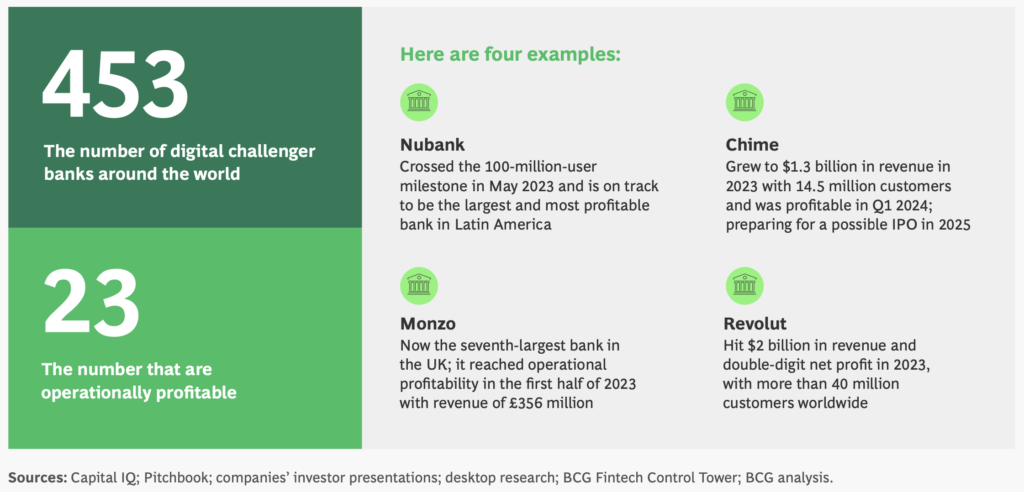
Fintech is not a small space. Literally everyone has to deal with money, and for most of us, that means banking and fintech apps. Mobile apps are where the growth is: global fintech revenue keeps growing, and the percentage captured by challenger banks that tend to be more digitally savvy also keeps growing.

fintech apps
Fintechs & neobanks (source: BCG)

Here’s the big fintech picture:

  • $1.5 trillion
    Global fintech revenue by 2030
  • 14% growth
    Annual global fintech revenue growth
  • $320 billion
    Embedded finance revenue by 2030
  • 100 million customers
    Neobanks are getting bigger: Brazil’s Nubank just crossed this customer threshold
  • 453 challenger banks
    The number of neobanks across the world as of 2024
  • 71% funding drop
    $42 billion investment in 2023 versus $114 billion in 2021

Add it all up, and while fintech apps have a bright future, they’ll need to get there more efficiently on less capital and with a greater focus on profitable growth, not just growth at all costs.

4 major fintech themes right now

Fintech took off with cheap money and restricted travel during the pandemic. But while its wings might be a bit clipped now, big trends continue to shape fintech and fintech apps.

1. Embedded finance

Embedded finance is the integration of financial services into non-financial platforms or products. The result is a hybrid that offers multiple services in a single place.

A few examples:

  • Lyft or Uber embedding a wallet into their apps
  • Amazon offering point-of-sale financing
  • Walmart operating as a banking service with checking and savings accounts
  • Expedia offering insurance along with your trip
  • Apple and Google offering payment technology as well as a wallet

Embedded finance will be a $320 billion market by 2030, says BCG. Half of that will be SMBs, $120 billion will be consumer offerings, and another $50 billion will be in the enterprise segment, according to their projections. 

2. Connected commerce

Connected commerce is an integration of financial services into diverse digital ecosystems, including the adtech space. 

Banks are custodians of some of the most insightful data about their customers, BCG says, and that provides opportunities to target ads much more effectively than many other existing adtech players.

“With the increasing value of first-party data, given cookie depreciation and app-tracking transparency, connected commerce is emerging as a triple play for banks—it creates a new revenue stream, increases customer loyalty, and enables banks to offer a marketing channel to their SMB and enterprise customers,” BCG says.

Examples of early contenders:

It’s unclear both how big connected commerce can get in fintech, and also how customers will react to their second-most-sensitive data being shared with advertisers (medical data is even more sensitive than financial). 

Clearly, they’ll need some kind of assurance of identity anonymization, at minimum, if their data is being shared. Doing it wrong could kill a neobank or seriously damage a traditional financial institution’s brand image.

3. Open banking

Open banking involves third-party services connecting to your bank to provide additional services. In open banking, third-party developers build applications using financial data that customers permit their bank to share.

Budgeting and investment applications come to mind when you think of open banking, but it’s still largely a nascent space driven by regulation. 65 countries have enacted some form of open banking legislation, including:

  • The EU’s Revised Payment Services Directive (PSD2)
  • UK’s Open Banking initiative
  • Australia’s Consumer Data Right (CDR) framework

That said, there hasn’t been a lot of uptake. Only 12% of people in the EU have taken advantage of open banking services and products, and it’s lower than 30% in Sweden and Norway, early advocates for open banking. That’s not a shock: while we might be OK using our Google or Apple or social identities for logging in all around the internet, it’s hard to convince us to connect our bank accounts to a random app or website.

Where’s the big opportunity for fintech apps and open banking? 

Potentially in adtech, according to BCG:

“We believe that open banking will continue to be relevant but is unlikely to change the basis of competition in consumer banking … in advertising, access to transaction-level data will enable more timely and targeted personal offers.”

The same kinds of privacy concerns apply as in connected commerce, of course.

4. Generative AI

I just used ChatGPT 4o to summarize about 30 pages of investment statements down to a few paragraphs and bullet points. Generative AI will be big in fintech, but not for product innovation, says BCG.

Instead, it’ll be focused on productivity enhancements.

“GenAI is already delivering tangible productivity gains in financial services … the use of GenAI in product innovation will lag its uses for productivity—but we expect it to follow.”

Those 4 themes intersect somewhat with 9 existing and emerging trends in fintech, BCG says. They include:

  1. High interest rates
  2. Convergence of evolving regulations around finance, fintech apps, and fintech-adjacent areas like crypto
  3. New regulations around KYC and AML
  4. Acceleration of digital public infrastructure: digital governance
  5. Fraud and cybersecurity
  6. Generative AI
  7. Embedding financial services into more and more apps
  8. Alliances between fintech and adtech
  9. IPO and M&A markets re-emerging over the next few years

Fintech apps and growth

What does this mean for banks, neobanks, and fintech apps? 

In short, it means get busy getting profitable. 

The cash-flooded days of over $100 billion of fintech investment in 2021 are gone. The ability to access non-dilutive capital for debt financing is also largely gone, thanks to higher interest rates. That means it’s absolutely critical to use your remaining capital efficiently and to grow profitably, not wildly.

And growth is still possible. 

There are still billions of unbanked people across the globe, highlighting the ongoing opportunity. With fintech revenues growing by 14% annually over the past 2 years, there’s an opportunity to continue growing while making money.

In addition, fintech apps and brands are expanding their addressable market space by providing wallets, financing, insurance, and even investment embedded into non-traditional contexts. 

Although neobanks speak technology like a native, traditional banks have an advantage, according to the BCG report. Banks get 55% more usage per month than fintech apps, and 78% of their customers open banking apps weekly. That opens the door for traditional banks to offer what the neobanks and fintech apps have promised for years.

4 frameworks for killer mobile app retention

How do you achieve insane mobile app retention rates? One way is magic. Another is pure accident. The third is by applying smart frameworks to science (and magic) your way to better user retention.

If you opt for magic, hey, I feel you. I’d like that too. And sometimes it can feel like magic when you see insane retention rates like 56% in the wellness space. Accident is also nice, but the problem with achieving high mobile app retention by accident (or by magic, for that matter) is that it’s not very repeatable.

Plus the 1 thing we know for sure about mobile app retention is that it’s a land war in Asia, not a special forces surgical strike. (In other words, fighting to improve retention never ends.) So I recently chatted with a mobile app retention specialist who shared 4 frameworks to boost engagement and retention over the long haul. Using a framework, he said, is like standing on the shoulders of giants: they’re force multipliers to reveal insights and unlock previously overlooked avenues of growth.

The 4 frameworks are:

  1. The Psych’d Framework by Darius Contractor
  2. RICE prioritization
  3. Eisenhower’s Urgent vs Important Matrix
  4. Elena Verna’s conversion rate decline diagnostic

The mobile app retention specialist is Jacob Rushfinn, who writes Retention.blog, and we went through each of the frameworks in a Growth Masterminds episode

Hit play and keep scrolling …

Psych Framework for mobile app retention

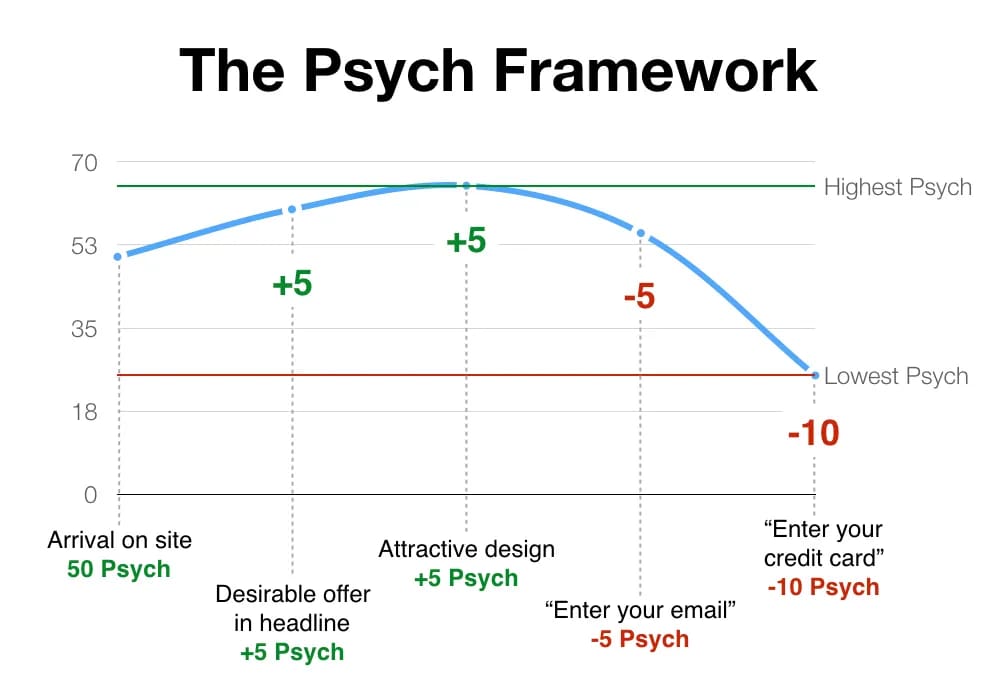
The Psych Framework, used and shared by Darius Contractor, is a way to work through app open experiences in a systematic way while adding up experiences, visuals, and requirements to build out a “psych” score.

“For each element on the page, you are assigning the psych score,” says Rushfinn. “Is this element generating positive or negative emotions?”


The Psych mobile app retention Framework


This visual depicts using the Psych Framework on a website landing page, but it’s easy to imagine using it for app onboarding.

  • Brief welcome: +5
  • Simple, clean, attractive design: +5
  • Great invitation or offer: +10
  • ATT prompt with request to allow to track: -5
  • Request for notifications permissions: -5
  • And so on …

“The idea is that you add up all these points, add up these positive emotions and negative emotions,” Rushfinn says. “Ideally, you get to a positive score.”

Of course, this requires a degree of guesswork. What counts as “an attractive design?” What counts as a “great invitation” or a good offer?

Here’s where you need to know your target audience: geo, age, culture, design influences, likes, needs, wants. If you know this — and ideally if you have a team member who embodies this target audience — you have a better shot at getting your app’s Psych score right. 

Once you do — and you can do some testing to figure out if you are getting it right — then you have a framework for holistically evaluating all the components of a screen, an onboarding flow, a first app experience, or whatever you want. And that means you can then “debug” it to ensure people’s Psych scores are as high as possible.

RICE prioritization

All app teams have at least 1 common problem, and that’s prioritization. What should we do next, and what will move the needle the most? That’s the case for all things in app development, including product management, live ops, user engagement, and user retention.

A potential answer: RICE prioritization.

Essentially, it’s a way of estimating the value of a project. When prioritizing with RICE, you estimate the Reach of a change (how many people it will affect), the Impact of the change (how important will it be), the Confidence level you have in those estimates, and then multiply all of those together. Finally, you divide by the Effort required to complete the project.

mobile app retention via RICE score

(Yes, GPT-4 made this image, and yes, it sucks.)

“It’s kind of a more holistic way to think about what you should do first,” Rushfinn says.

The best thing about a framework for prioritization is that a common challenge for product and development teams is when everything is a top priority. Or, everyone has their own pet project, and to reject it is to invite negative emotion between team members. Or you just really can’t agree on what’s top priority.

The good thing is that when you prioritize systematically like this, you can avoid some of that tension and add clarity.

But there’s a flaw to watch out for:

“As much as I love it, sometimes you get a lot of quick wins based on the framework,” says Rushfinn. “I like quick wins, but you need to balance your bets, right? And so we need to have maybe 50% quick wins, but then we also need to take some big shots that we’re a little less confident about.”

His point: some of the big swings lead to home runs. 

And it’s hard to win just hitting singles all the time. Occasionally you need a grand slam.

The Eisenhower Decision Matrix (yup, you can use this for mobile app retention projects)

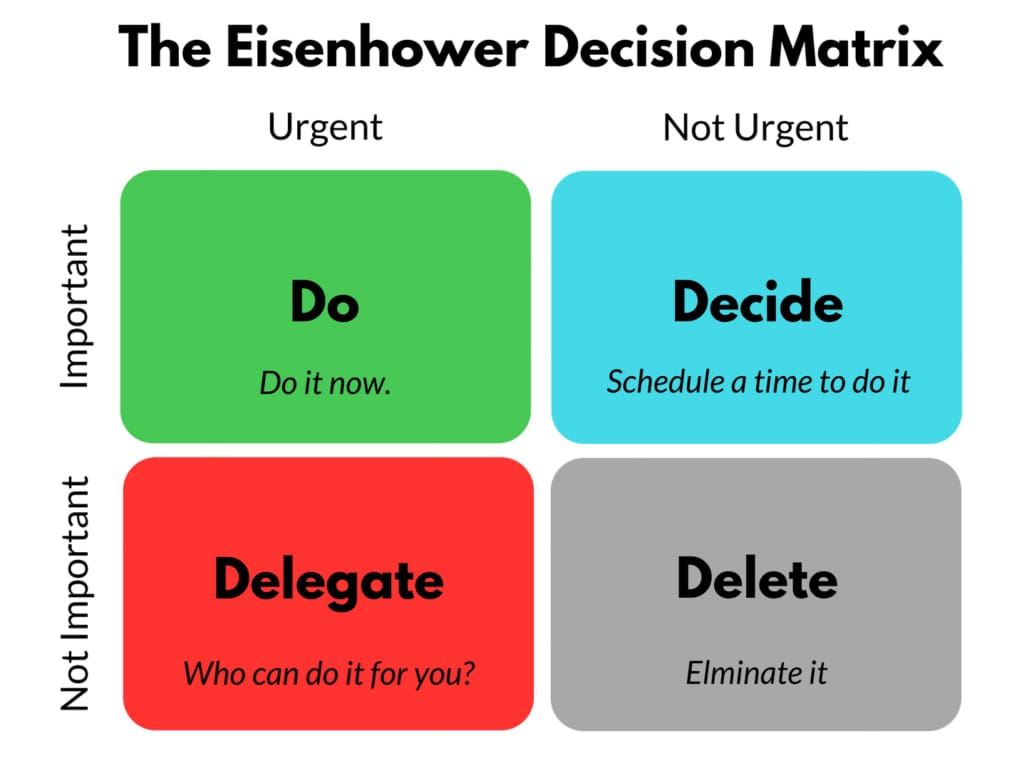
The Eisenhower decision matrix is none other than the Urgent/Non-urgent and Important/Non-important 2 x 2 matrix you’ve seen a million times before. Eisenhower, of course, was the World War II general who led the combined Allied armies as well as the 34th president of the United States.


The Eisenhower Decision Matrix


“I think that’s the most valuable part of this framework of understanding what’s important but not urgent, and making sure you make time for that,” Rushfinn says.

What that means is spending time in quadrant 2 as much as possible, on things that don’t ring or alarm but will set you up for significant future success. Stephen Covey, author of The 7 Habits of Highly Effective People, called this the quadrant of value.

Mobile app retention can feel like a quadrant 2 activity almost all the time. There’s a lot of urgency, typically, to get new users, players, customers in the front door. In most organizations, there’s a lot less urgency around creating such a wonderful experience for them once they enter that they never want to leave.

Elena Verna’s conversion rate decline diagnostic

Mobile app retention is about maximizing the opportunities you have with existing users to boost engagement and boost monetization. But when your conversion rate declines or your performance drops and your monetization goes backwards, you need to diagnose the situation.

The challenge is figuring out exactly what the problem is.

And that’s where Elena Verna’s conversion rate decline diagnostic comes into play. (Check it out at Reforge.)

“In our digital world, there’s so many different potential options of what are all the inputs,” Rushfinn says. “I love this systematic approach where it’s a simple kind of flowchart — a little yes/no flowchart — but it breaks down a great process for really digging into a conversion rate decline.”

What you do is simply follow the steps down the tree to diagnose a problem:

  1. Is it simply a data issue?
  2. Is it a significant trend?
  3. Is it seasonality?
  4. Did you just release a significant new version?
  5. Did UA just significantly change?
  6. And so on …

Based on the answers, you’re fixing your data inputs or checking cohorts or channels for substantially changing metrics.

“If you have a decent tool, it usually doesn’t take that long and then it points you in the right direction to uncover what happened,” Rushfinn says. 

Finding out the why, of course, is the first step to figuring out the what, including in mobile app retention challenges or changes.

Much more in the full podcast

Check out the full podcast in the video above, or subscribe to it on your favorite podcast platform:

User acquisition Olympics: Win gold at the 2024 summer games

Let’s face facts: you’re not the best swimmer in the world. You’re not the best runner, the best discus thrower, or the best boxer. And you’re probably not even going to the super celebration of sport we call the Summer Olympics later this month in Paris. But you can be a world class user acquisition specialist, and you can use the Summer Olympics as a catalyst to kick-start your app’s growth.

Here’s how:

Start now

It’s going to be busy during the Olympics, and it’s only a couple weeks away. Start early and build your user base now to activate during the Olympics.

(Yes Karen, this would have been better advice 2 months ago. But it’s still better than trying to break through the avalanche of noise that will coincide with the Summer Olympics in just a few weeks.)

Update your app icon for the Olympics

Real-world performance marketing shows that having a topical or seasonal twist on your app icon can boost installs up to 40% during a major event. 

“We even have a case with a customer who changed the icon and increased their installs by 40% with just a minor change on an icon … adding snowflakes,” says Darya Radchykava, a Senior Account Executive at Splitmetrics.

What’s going on here? Big events in the world make big noise. That buzz vibrates around in the correlation/connection engines we all own called brains. And when we see something that visually connects to that noise and buzz … BOOM … attention kicks in.

There are few bigger, noisier, and buzzier events than the Olympics. Updating your app icon with a winner’s gold medal or a wreath, or with some relevant sporting equipment, or a connection to Paris, where the summer games will be held, could just be the thing that makes you stand out from the crowd of other apps.

And, crucially, makes you relevant right now: enough to hit the download button.

Extra bonus: it’s super-easy and quick to implement. No code required!

Segment your app users to find your Olympic influencers

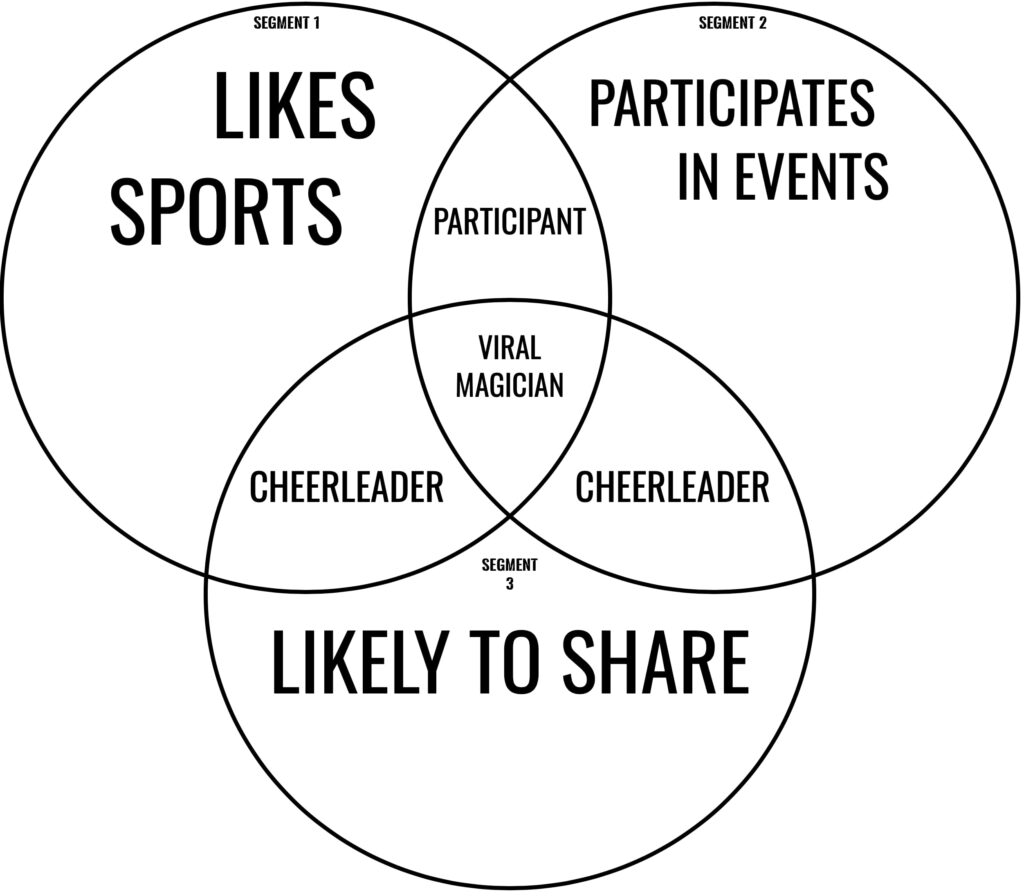
If you haven’t already, segment your app users to find the ones who might be more interested in sports (and therefore the Olympics).


Segment your app users


Add more segmentation for those who are mostly likely to participate in events, and another for those who are likely to share. Correlate all these segments to find the Venn diagram of who your super influencers are most likely to be, and focus your in-app messaging on them.

Messaging about what, you ask?

Keep reading …

Create an in-app Olympics event

The one free way to get App Store exposure without being featured is to hold an in-app event, which Apple surfaces in the App Store. Same thing with what Google calls “Promotional Content.” You can use this to get free buzz while boosting engagement for existing users and giving new users a specific and timely reason to start using your app right now.

Start by creating an Olympic-themed event that coincides with the actual Olympics, while being careful about copyright and trademarks. 

Some examples:

  • Dating app: Olympics of the heart … 5 speed dates in 5 days
  • Fitness app: Walking games … walk the 5K or 10K together
  • Game: Gold-medal games … iIn-app tournament, with medals and rewards
  • Productivity app: Unofficial Olympics … get-er-done games
  • News or information app: Olympic Trivia … ask some questions

Provide personal and social rewards for actions, continued engagement, level achievement, and winning. Personal rewards could include in-game currency, special ships; social rewards include leaderboards, publicity, and so on.

According to Google, half of “high-quality” events result in statistically significant uplift, and the median uplift is a fairly nice 106%.

Over twice as many “Explore” acquisitions is nothing to sneeze at, especially if they’re essentially free.

Make an Olympic character/ship/award

If you have ships or characters in your game, consider making a sports or games or gold medal version that aligns with the Olympics. Perhaps players can win this ship when playing in the in-app Olympics event. 

Give it special powers … rings of doom? … and make it temporarily available so it’s more desirable.

Get your ASO in gear

If you’re doing a bunch of Olympics-themed stuff in your app, tell the world. That means ads, sure, and maybe other channels like social and owned channels, if you’ve built them up over time, but it also means the primary way your app tells the world what’s in it: your app listing page.

Update your app listing with a few key mentions of the Olympics, including any updates or events you’re doing to celebrate. Just don’t forget to remove it within a week or 2 of the end of the Olympics!

During the Olympics

If you’re advertising during the Olympics, remember that creating topical ads that are relevant to major world events boost attention, interest, and action. 

So add an Olympic flavor to your ad campaigns that matches with your activity in-app to celebrate the event as well as boost your click-through rate. 

(Bonus: if you’ve updated your app listing and maybe given your app icon a game flavor, you should also be boosting your conversion rate post-click.)

Take an Olympics influencer long shot

If you have a big enough app, you’re likely to have a few Olympic-associated individuals using your app. And if you have privileges and permissions to see their location, you might even notice a few who are usually in Arkansas who happen to be showing up in or around Paris, and might even be connected to the Olympics, or even an athlete.

Pop up a message asking them to share your Olympic event while they’re at the Olympics … and you just might get lucky.

PR for the Olympics win

Take it from me as a Forbes contributor and long-time journalist: reporters are looking for stories that connect to major events. We’ve seen several occasions where PR has resulted in tens of thousands of quality installs recently.

  1. Hannah Parvaz with Quit Social Media
  2. Sara Neill with Mys Tyler

So try it.

Showcase your Olympic winners in a press release with all the relevant information and a few pictures, and connect it to the news in the Olympic summer games. Maybe it’s the “Games For The Rest Of Us,” or the Festivus of Olympics, or Feats of Mobile Gamedom, or whatever.

Hint: give journalists everything they need to write a story with, including quotes, and you’ll get more uptake.

Hint #2: keep at it with updates, sending replies to your first email. Journalists get thousands of emails a week. You need to be persistent to get your signal through the noise.

Geotarget for the win

People in China want to know about Chinese athletes. People in Argentina want to know about Argentinians, and so on around the world.

Update timelines and schedules in your app for key geos, letting people know when their key events are on, and then time your internal events along with that so they can second-screen your app along with their TV or laptop showing the action.

So much more you can do

There’s so much more you can do to make any major world event, including the 2024 Summer Olympics in Paris, an opportunity to make your app or game relevant. The only barrier is a slice of creativity and a serving of effort.
If you make something cool, let me know!

What’s winning in mobile games in 2024?

What’s winning in mobile games in 2024? 

According to Adjoe’s recent mobile games report, the market as a whole is growing, casual gaming is growing in all demographics, and daily engagement is back up after a decline last year: 22% up according to Adjoe’s report. Also, older people play more mobile games than younger people, and women are showing even more engagement.

I had a chance to chat with Adjoe’s director of growth, Carly Ostasiewski. 

Hit play and keep scrolling for the highlights:

Old people game (and they have money)

People aged 40-50 are massively engaged in mobile gaming: more so than kids. And they have money, which is interesting when you consider user acquisition priorities.

“When you think about a mobile gamer, you think it’s probably a kid or maybe it’s a college student between classes,but really there’s engagement across the board in every kind of demographic, whether you’re under 20, 30 years old or 40 and above,” says Ostasiewski. “And the surprising thing for me is always that people between 40 and 50 are massively into mobile gaming.”

(Hi mom!)

Kids are more into adventure games and building games like Roblox, but older adults love casual games and casino games (especially women). And kids have school, sports, and social activities, limiting time for mobile games.

Men are from Mobile Legends, women from Wild Casino

No shocker: in general, men and women differ a little in the types of games they play. 

Women tend to pick games they can just pick up and hit for a few minutes, while men tend to pick games that take a longer span of time. (Of course, these are just averages, and as such they don’t say anything about any specific individual … by this measure I’d be a woman.)

One specific genre women are more into: casino games.

“Women are playing more of these casual and casino apps that you can just kind of pick up and play, whereas male users will probably pick more of a strategy game,” says Ostasiewski. “And when they sit down, it’s going to be a different experience.”

I rarely have the time or patience for big strategy games, but clearly I’m in the minority here as a man.

Mixed monetization models everywhere

Mixed monetization between in-app purchases and rewarded ads is common in mobile games, but not in all genres. Now we’re increasingly seeing it in Casino games so publishers can monetize all players and not just payers.

“I’m seeing more and more casino games incorporating rewarded videos,” Ostasiewski says. “Huuuge Games or Sciplay or all these different big casino companies, Playtika … they never really had rewarded videos.”

Mixed monetization adds complexity, but the rewards are clearly worth it.

Add it all up, and according to Adjoe’s report, mobile gaming revenue is up 7% across the board, which tracks with what Singular is seeing

Europeans game more than Americans

Perhaps this is not a shock because they get the most vacation time, but Europeans tend to game more than anyone else in the world.

“One of the most interesting trends we’re seeing is that European players are actually the most engaged players,” Ostasiewski says. “So they’re leading the way with the average daily app usage time.”

Here are the averages:

  • Europe: 23.2 minutes
  • Oceania: 22.6 minutes
  • Asia: 21.7 minutes
  • Africa: 21.5 minutes
  • North America: 21.2 minutes
  • LATAM: 18.6 minutes

That’s impressive: even ahead of Asia. Of course, the difference between North America and Europe is only a couple minutes or just over 9% more, but still …

Mobile games everywhere

Perhaps the most interesting trend? 

Mobile games are showing up everywhere (I even found them in LinkedIn recently).

“I think the biggest opportunity is how gaming is really going to blend together with everyday app usage,” Ostasiewski says. “So we see that 60% of overall app store revenue is coming from gaming, and how other kinds of brands and apps are going to align more with games to really harness this growing consumer interest.”

That could be in Roblox, with IKEA, or Candy Crush and Prada, or Uber Arcade, or Netflix adding games to its movies and TV shows.

In fact, that might be the back door through which we get super apps in the west, with multiple functionalities for multiple things.

Much more in the full Growth Masterminds

The full podcast has much more, of course. Check it out, along with all our Growth Masterminds episodes, either in audio or video.

And maybe if you’ve got some unique insights from your corner of the world, ping us about becoming a Growth Masterminds guest!

Creative winners: tips from the best in the world on how to make creative that converts

How do you win in advertising? Good targeting, sure. Great partners, absolutely. Excellent analytics and attribution, you bet. But not a single one of them beats great creative. Creative winners make all the difference.

Excellent, novel, intriguing, attractive, but above all CONVERTING creative is the single most important thing to get right in advertising.

Unfortunately, like most things, it’s easier said than done. So how do you craft great creative?


winning with creative guide


We asked the experts:

  • Tato Mikadze, Head of Gaming at MobileAction
  • Sara El Bachri, Gaming Growth Consultant and CEO at Shamsco
  • Paolo Vergani, Director of Creative Production at Liftoff
  • Sara Neill, CEO and Founder of the fashion app Mys Tyler
  • Doug Manson, Chief Creative Officer at Craftsman+
  • Gökçe Oğuz, CEO of Playable Factory
  • Hannah Parvaz, Growth Consultant and CEO of Aperture

Plus, we added unique insights from Snapchat on authenticity and influencer marketing, and a creative testing methodology that AppAgent uses with clients like Supercell, Square Enix, DoubleDown, and InnoGames. 

And then we wrote it all down in Singular’s new Winning with Creative report, available now.

Creative winners and ads that convert: what’s in the report

Creative winners give you a shot at high click-through rates, good conversion rates, and positive return on ad spend. Bad creative disqualifies you immediately as people ignore your ads and keep right on scrolling.

The trick, as usual, is knowing which is which.

What we’ve packed into the report:

  • Using creative to drive faster time to install, leading to less app abandonment
  • Using creative to build trust that what you’re advertising is accurate
  • Being creative about generating a lot of creative, quickly
  • Building creative with generative AI
  • Localizing creative with generative AI
  • Fighting creative fatigue (and knowing when you have to)
  • Getting out of a creative rut
  • Aligning creative from influencers with your app or product
  • Testing creative the right way
  • Best practices for creative on Google
  • Top ad formats for the top 500 apps
  • CPI, CTR, and IPM benchmarks from our latest Quarterly Trends Report
  • And much more …

Get some help today making more creative winners

We all know that driving growth via paid user acquisition campaigns is hard work. Being creative after weeks and months and years of making ads for the same app or game is sometimes soul crushing. And constantly inventing new ways to tell your store in pictures, text, and video is exhausting.

Get some help.

Grab the Winning with Creative report from Singular and see what some of the top experts in the field suggest for making more creative winners. Worst case scenario: you get just 1 tip that makes a difference in your current struggle to sweat out just 1% better performance.

Best case scenario: you encounter something that’s a game-changer for your performance, 2Xing or 3Xing your results.