Installing a third party app store on your iPhone

How do you install a third party app store on your Apple iPhone? Like, for example, the Epic Games Store?

It’s actually pretty hard to get a third party app store on your iPhone or iPad. At least it used to be, before the Digital Markets Act and the Epic Games Store. While there are plenty of blog posts suggesting “great App Store alternatives,” most of them are defunct, not for iOS, or look completely dodgy and super-risky.

Third party app stores for iOS

There are not that many third party app stores for non-jailbroken iPhones. Here are a few examples, along with what I found when trying to access them on my iPhone:

  • Tweakbox: “server can’t be found”
  • Tutu App: no response, connection timed out
  • Appland: white label app store maker, no obvious way to install
  • GetJar: Android and several other platforms, but no iOS
  • AppValley: Redirects to TopStore, advertises “tweaked” apps and looks suspicious 

Thanks, but no thanks: I like my iPhone without spyware, adware, and tweaked apps that just might be stealing developers’ and publishers’ hard work and repackaging it.

There are some new options, though:

The Epic Games Store does in fact work, unlike many of the ones in the first list above. In fact, Epic has a lot of experience running app stores for multiple platforms. There is, however, another problem. At least, if you’re not in the European Union, where the Digital Markets Act actually matters. And it’s a bit of a fatal problem: you simply can’t install it.

Here’s the flow from my recent attempt:


third party app stores epic games store


You can try … but Epic will inform you that the Epic Games Store on iPhone is only available for customers in the European Union. You can still “continue anyways,” but then iOS will notice what’s going on, step in, and put a stop to these third party app store shenanigans by providing an alert that you cannot install this app. 

Clicking “learn more” brings you to Apple’s support documentation on installing third party app stores in the European Union … and not anywhere else.

Fortunately, some enterprising individuals who are in the European Union have actually installed the Epic Games Store, and shared their experiences. One is Julie Tonna, a user acquisition expert and former Apple employee. In fact, she was a platform specialist at Apple Search Ads with a focus on gaming. 

And she knows a bunch about adtech too: she’s also a former growth partnership manager at ironSource.

Installing the Epic Games Store in the European Union

If you live in the EU, it’s a whole different ball game. Now you can actually install a working third party app store.

Here’s how it works, according to Tonna’s LinkedIn post:

  1. Visit epicgames.com on your iPhone or iPad
  2. Tap the “Install on iOS” button, then confirm by tapping OK
  3. Tell iOS you’re OK with this by going to Settings, hitting Allow For Marketplace, where Apple tells you that your device settings currently don’t allow it and that installing this app — and others via it — “may give them access to your data”, then confirm again
  4. Go back to your browser and hit Install again, then confirm again
  5. After the Epic Games app installs, you’ll be able to launch it from your home screen or App Library
  6. Tap Accept yet again when you open the app to accept the Epic Games EULA
  7. Find a game you like … and hit Install Game
  8. In the prompt that pops up, hit the Install App button

It’s more than just a few steps, and there are plenty of warnings along the way that this is unusual, non-standard, and potentially dangerous behavior.

But now you’re cooking with gas: using apps and games via a real, functioning third party app store on iOS. 

At last, after more than 4 long years, you can yet again enjoy Fortnite on your iPhone. (Apple booted Fortnite off the iOS App Store in August of 202 when Epic turned on a direct payment option in the app that bypassed Apple’s in-app purchase system.)


Epic Games Store
Epic Games Store … but not the mobile version


Plus, if you happen to buy anything in Fortnite, the Epic Games Store will take just a 12% slice of your cash and Epic Games (the publisher) will get 88% of your payment … as opposed to 70% in most cases via typical in-app purchases on iOS.

If there are any other good third party app stores available for iOS, let me know. The list of potential app store providers out there is significant, and there are some pretty interesting names on it … but the list of actual functioning third party app stores is much smaller.

Will the Digital Markets Act spread to other countries?

The big question, of course, is whether the ideas around openness and competition in app stores and in-app purchases that are embedded in the EU’s Digital Markets Act will go viral to more countries. 

And in a lot of ways they already are. As I mentioned in a recent post on how the traditional App Store model is under attack both from above and from below, at least 6 other countries are looking at similar legislation:

  • USA
  • South Korea
  • Japan
  • Australia
  • India
  • UK

You can add the Netherlands to that list, as well as Spain, and even U.S. states are getting into the act.

Louisiana reportedly proposed legislation that would have required that Apple allow apps to use alternative payment methods without penalty. Apple was able to squash that particular piece of the law, according to the story that became public, but the fact that a small U.S. state was even considering something like this indicates that the idea is gaining traction in North America.


Digital Markets Act


I talked about the core concepts in the Digital Markets Act that are relevant for app marketplace owners like Apple and Google in 2022. Essentially, large companies designated as “gatekeepers” are being forced to:

  • Allow third-party interoperability with their services
  • Allow businesses to promote their services and make sales outside the gatekeeper’s platform
  • Not prevent consumers from connecting with businesses outside their platforms
  • And much more …

The upshot will likely be the ability to install apps from wherever you want and use payment methods outside the platform-controlled services.

Apple’s rebuttal, of course, has been the Core Technology Fee, which even for a moderately successful free game with 10 million downloads would incur platform fees of over $400,000 per month. Which, naturally, the EU is investigating as a case of malicious compliance. 

Their initial take: not gonna work.

“We have sent preliminary findings to Apple,” says Margrethe Vestager, the EU’s executive VP in charge of competition policy. “Our preliminary position is that Apple does not fully allow steering. Steering is key to ensure that app developers are less dependent on gatekeepers’ app stores and for consumers to be aware of better offers.”

Ultimately, we’ll most likely have a long game of cat and mouse with government legislation, Apple/Google response, then threatened or actual fines … and eventually things will come mostly to rest with a better-if-not-great option for third party app stores on iOS.

And that’s likely to happen in most countries.

Just don’t hold your breath. The wheels of government turn slowly.

Player motivation: are we forgetting the most important topic in game marketing?

We talk a lot about CPI, CPA, core loops, targeting, engagement, and retention when we’re talking games and growth. But we talk far too little, says Google’s Mariusz Gąsiewski, about player motivation: why people are actually playing games … why they pick the games they play … and why they stick around.

I recently interviewed Gąsiewski, who leads mobile apps and gaming at Google for central and eastern Europe, about this on Growth Masterminds

Hit the play button and keep scrolling:

Are we forgetting player motivation?

“It seems to me that there is a lot of discussion about retention rates, conversion rates, growth, data, and design in gaming, although there is much less discussion about users’ motivations in gaming,” Gąsiewski said recently on LinkedIn

“This is especially true when it comes to understanding the motivations of users in different countries. As the data shows that these motivations differ.”

Player motivations are personal.

But they’re also cultural.

In the U.S., for instance, 66% of people say they play games for fun, 62% to relax and unwind, and 48% to pass the time, according to the 2023 GWI report for gaming. In India, 55% of people say they play games for fun and 44% say they play to relax and unwind.


player motivation mobile games


The difference is even more stark when you ask them deeper questions.

34% of Indian gamers play “to learn new skills,” and 26% “to improve my reflexes/coordination.” The equivalent numbers in the UK and U.S. are 11% and 15%, respectively, to learn new skills. Amd 9% and 13% to improve reflexes. Brazil, Indonesia, and the Philippines all index much higher than the UK and U.S. on these answers.

It’s also about social factors

People in the U.S. and UK game for a lot of reasons, but a core one is that it’s “me time,” Gąsiewski says. 

35% of people in the U.S. and 32% of those in the UK say they game “to escape from reality.” It’s a little break from work, from routine, from school, or even from other people.

Not so much in India and other countries:

“If you look at the data, for example, for countries like India, we see that still a lot of users feel guilty when they play a game because it’s kind of a waste of time,” he told me.

“It’s not something that brings a lot of value … that’s why they feel much better when they play, for example, logic games … that’s why those puzzle board games are so popular in the country because it’s not just entertainment, but there is specific value coming from that as well.”

Also, many cultures value the social aspects of gaming.

“India, Philippines, Vietnam have much more playing [for] this connection with peers and friends,” he says. “I remember discussions with my colleagues from Vietnam where they mentioned that, for example, gaming started from playing in the Internet cafe when people were coming and playing with each other. So it became kind of part of the culture that you’re not playing by yourself, you are playing with other people.”

People are having fun, sure. But they’re also spending time with friends … making the time twice as valuable, from their perspective.

As a result, the user acquisition ads for games in Asian countries often mirror that: social gameplay.

Player motivation and growth

It’s super-tough to grow games today: competition is everywhere. (I mean, when Netflix and YouTube are getting into gaming … )

And that means game publishers are trying crazy new combinations of different mechanics, trying build and fail fast so they can flood the market with 100 combinations and hope that 1 of them goes viral, or anything else they can think of.

But success — especially success in different countries with different cultural expectations of gaming — is more likely when taking player motivation into account.

“It seems to me that there is a much higher potential for success if you spend some time thinking about whether these new mechanics are relevant to the motivations of specific groups of people,” Gąsiewski says.

The results, he says:

  • More users
  • Happier players
  • Higher engagement
  • Higher spending
  • Better retention

And, games like Monopoly Go or Clash of Clans, that aren’t just a flash in the pan and make a few bucks for a few months, but become almost iconic brands and retain their players for years and years.

But it all starts with growth.

And that’s where a deep understanding of player motivation can help game makers break free from the pack and get attention.

“The only way to steer the attention to your new products [is to] really make sure that you really understand their motivation.”

Does your north star metric suck? And do you really need a growth team?

How do you do your most impactful work as a growth marketer? Prioritization is hard for most of us, but even harder — maybe — is having the right north star metric that everyone aligns around. And perhaps even tougher is having an accurate awareness of what growth marketing is and what it isn’t, and aligning your whole team.

I recently chatted with Hannah Parvaz, CEO of Aperture and app marketer extraordinaire, on Singular’s Growth Masterminds podcast.

Hit play, subscribe to our YouTube, and keep scrolling:

Getting the right North Star metric

A good north star metric is supposed to be the 1 key thing that will guide global, profitable, and long-lasting growth. It’s not something that you can game by getting cheap (and worthless) installs, or clicks, or impressions.

But it’s also not supposed to be just yours.

That’s just half the puzzle.

It should also be your users, players, or customers.

And balancing that is absolutely critical to long-term success.

“Our North Star metric … is this most important metric that everyone in the company can unite around,” says Parvaz. “So at Facebook that’s daily active users. You know, it’s how many people can come back to the product because that’s how they monetize as well.”

“This is a metric that represents both what the customer wants — they’re getting value, so they’re coming back — and it also represents what the business wants: they want that usage. So your North Star metric, it’s really important that you’re balancing both of these.”

Tip too far to your own side, and you’re a huckster, a shill artist, a get-rich-quick type that doesn’t care about users or customers except insofar as they represent a paycheck. This can work in the short term, but it almost never builds long-lasting and successful companies.

Tip too far to the customer side, and you do something amazing for people, but it doesn’t last because you can’t continue to fund it without adequate revenue. As Stephen R. Covey, author of The 7 Habits of Highly Effective People, used to say: no margin, no mission.

The right north star metric can’t be gamed, is truly indicative of both the value you provide and the revenue you receive, and is broad enough to be something the whole team can work towards together.

“Let’s say you’re a subscription app … a meditation app,” Parvaz says. “A perfect north star metric for this kind of company would be something like weekly meditating subscribers … here you’ve got a cadence, you know, people are coming back — it’s not just meditating subscribers, you know, which might happen once a year — they’re coming back. 

“They’re receiving value, they’re doing a key action, which would be meditating, and then they’re paying us because they’re subscribers.”

Growth marketing may not be what you think it is

What is growth marketing, after all?

“I’m getting people in my inbox telling me, you know, we’re hiring a growth marketer,” Parvaz says. “And I always ask them back, what does that mean? And every single time someone says it means something different … and so there is a bit of an identity crisis happening in marketing.”

When we think about the growth marketing function, we tend to think about stuff people do:

That’s all good stuff, and it’s all valid activities for a growth marketer. But it’s not precisely what growth marketing is, says Parvaz.

Instead, it’s a mindset. A perspective. A way of thinking and approaching problems on a global scale, and then applying that thinking to specific tasks or tactics.

“A person in a growth role within your company really should be leading on what is the priority for us at the moment,” Parvaz says. “I’ve looked at all of the metrics, I’ve looked at all of our opportunities and this is where we should be focusing on.”

Do you really need a growth team?

Which kinda speaks to something else we chatted about: Mark Zuckerberg’s recent advice about growth teams.

“He said, startups do not need growth teams,” Parvaz told me. “You do not need a head of growth. Your CEO should be your head of growth and your whole company should be the growth team. Your marketer could be working on prioritizing CRM for retention. Your developer could be working on features for acquisition. And it’s really about how we are focusing together to make the biggest impact on this area so that we can move on quickly to the next, so that we’re collaborating.”

The point?

Everyone is in growth.


Developers build features that lead to growth. Designers create images and brands that lead to growth. Data scientists build models of reality that lead to growth. And, yes, marketers — growth marketers or just marketers — use a smorgasbord of marketing techniques to facilitate, stimulate, foster, and capitalize on growth.

So what Zuckerberg is kind of saying is: you don’t need a specific growth team because everyone is on the growth team.

(Which kind of is a growth team, of course, just a bigger one. But we won’t quibble.)

The right north star metric + a global perspective on growth enables building flows from ads all the way through to product

I have a particular beef with some ads.

They’re not necessarily fake ads, but they represent a part of the eventual app experience, or product experience. The problem is when the aspect they represent isn’t visible in the app store listing (leading to cognitive dissonance) and isn’t present in the first open experience (leading to more cognitive dissonance and … perhaps … and quick deletion).

Having a global growth marketing perspective, however, can fix this.

For Parvaz, it starts with jobs to be done, the Clayton Christensen framework that helps innovators understand how and why people make decisions.

“What we have to do first is really identify the jobs to be done,” she says. “What are the reasons that someone might use this product or buy this product? And so what we do first is we start testing all of the different jobs or themes why someone might start using this product.”

Finding that — or finding 5 or 6 different things, which is possible in some apps — is first. 

Once that’s done, marketers can build flows from ads that hit a specific job to be done, custom product pages on the App Store or custom store listings on Google Play that sing from the same song sheet, and then a deep link into the product — if possible — to continue the flow of focus on the topic or theme or capability that attracted a person in the very first place.

“It’s all connected,” Parvaz says.

Which, of course, is also true when you have the right north star metric.

Much more in the full episode

Take my word for it: this one is worth listening to in full. (All Growth Masterminds episodes are, right?)

Subscribe to Growth Masterminds on whatever podcast platform you prefer, and get connected to our YouTube channel as well so you never miss an episode.

In the full episode …

  • 00:00 Introduction to Growth Masterminds
  • 02:16 Hannah’s Recent Activities and Achievements
  • 05:52 The Importance of Prioritization in Growth Marketing
  • 11:12 Full Funnel Approach and Team Collaboration
  • 16:52 Defining the Growth Role
  • 18:31 Building a Growth Team
  • 20:10 Prioritizing Growth Initiatives
  • 24:05 Testing and Iteration
  • 26:02 Aligning Ads with Product Experience
  • 32:46 Full Funnel Approach
  • 33:58 Conclusion and Final Thoughts

ATT opt-in rates 2024: down, down, down (but here’s how to improve)

ATT opt-in rates have been decreasing quarter over quarter for most of the past year, reaching critically low levels for many verticals that threaten to make the IDFA near extinct on the iOS platform.

For context, in May of 2021, App Tracking Transparency opt-ins were at 19.4% overall, with some countries at over 30% (France) and nearly 24% (Korea) or around 23% (Japan and South Africa). By July, they had risen somewhat to 26% globally

So they were never really high to begin with.

But now in mid 2024 they’ve sunk to just under 14% globally, across all verticals. (Note: 14% is the percentage of devices that allow tracking permission upon first open.)

That’s a pretty clear (and depressing) trendline:


ATT opt-in rates by quarter


(Note: There is a way to improve your ATT opt-in rate, and patience is the key. More on that later: keep reading.)

ATT opt-in rates: massive vertical variance

As you can see in Singular’s Q2 2024 Quarterly Trends Report, there’s a ton of variance in ATT opt-in rates by vertical.

The first and most obvious variance is between games and apps. Games are much better at getting an immediate yes to the App Tracking Transparency prompt. While just 11.92% of apps get an immediate yes to tracking, 18.59% of games get a positive response, boosting their ATT opt-in rates significantly higher.


ATT opt-in rates Q2 2024


But when you look by vertical, you see that there’s a much more significant amount of diversity in ATT opt-in rates. For example, Music games hit 35% yes, while Adventure, Card, and Simulation games were all in the 24-25% range. 

Casino and Trivia games, by contrast, were both sub-10%. Also, Educational games are largely for children, and cannot ask for tracking permission.


ATT opt-ins by gaming verticals


When it comes to apps, you see a similar range.

Weather apps still get an amazingly high yes rate for ATT at 38%, but it’s not as high as in Q1, when it was almost 45%. Art & Design as well as Food & Drink are high as well, along with Maps & Navigation: all above 25%.


ATT opt-ins by app verticals


News, however, is below 5%, as is Medical. 

Business, Social, and Entertainment apps are all just above the 5% threshold.

Why this is a massive problem

While some app marketers tossed IDFA as a component of their marketing measurement after iOS 14.5, others who achieved relatively high ATT opt-in rates have continued to use it to this day.

Think about it: yes, IDFA is dead in terms of a deterministic granular vector of mobile app attribution. But if you’re just looking for a (highly reliable) probabilistic indicator of your overall success, getting ATT tracking permission for even 10% or 20% of your iOS app installs serves as a pretty good sample size that can be extrapolated to entire cohorts.

Remember, to survey the entire U.S. population to the 95% confidence level and a 1% margin of error, you only need about 10,000 respondents.

So this can be super-powerful.

But there is a problem. 

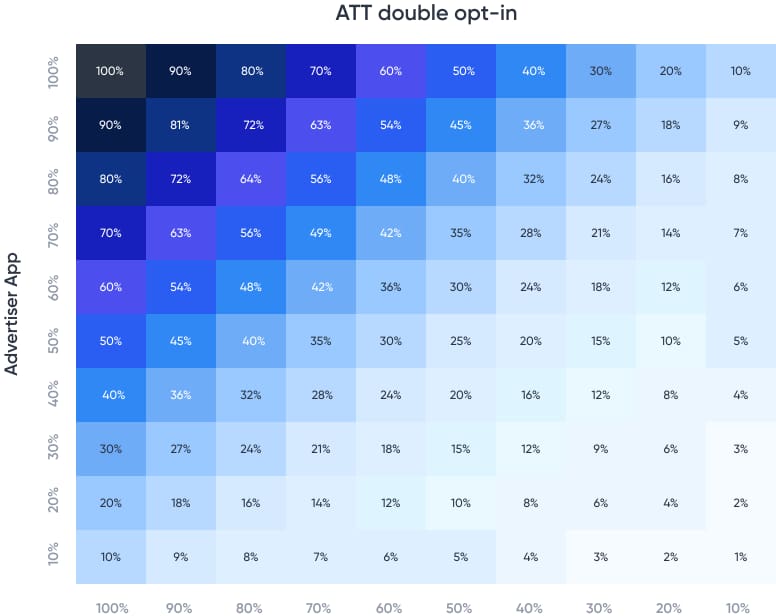
For ATT opt-in rates to matter and for marketers to actually get an IDFA for an install, you need double opt-in (advertising app AND advertised app. And the numbers can get very small very quickly. For example, a 10% opt-in on both sides gives you just a 1% IDFA rate. Even a fairly decent 20% on both sides gets you just 2% of the IDFAs you’d ideally want.


ATT double opt-in


You can calculate required sample sizes yourself with this equation, where:

  • n is the sample size
  • Z is the Z-value (e.g., 1.96 for a 95% confidence level)
  • p = is the estimated proportion of the population (use 0.5 for maximum variability)
  • e is the margin of error


So if you’re willing to sacrifice some margin of error, you can get pretty interesting results on 100,000 installs. At a 95% confidence level, here’s what the required ATT opt-in rates look like:

  • 5% margin of error: 383 installs with a yes to ATT
  • 3% margin of error: 1,056 installs
  • 1% margin of error: 8,763 installs

That’s not huge, which is encouraging. 

Another example: for 10,000 installs, you’re looking at 370 installs with an ATT opt-in to give you a 95% confidence level with a 5% margin of error. Unfortunately, the needed sample size doesn’t decrease linearly with the population size. 

That’s 3.7% of the population, so you need 20% opt-in rates on both sides (advertised and advertiser apps).

And that looks like it’s getting harder to achieve.

But there is some good news.

ATT opt-in rates: patience is the key

Suggestion: stop asking for ATT tracking permission immediately.

If you look at the categories that are getting high ATT opt-in rates, they’re ones that brands tend to dominate: Weather, Food & Drink, Maps & Navigation, Lifestyles, Travel. What makes a brand a brand? People know them, hear about them, have an opinion about them.

When that’s largely positive, ATT opt-in rates go up.

(It’s no surprise that casino games and social media apps are among the worst-performing verticals for ATT acceptance.)

So don’t ask right away.

Build a relationship. Build some familiarity. Establish trust. In other words, build a brand, and then ask later when you have a higher chance of getting a yes.

The cost is the loss of immediate signal, which is really nice to have when you want to optimize campaigns. The benefit is higher opt-in rates for your best users, players, and customers, which will be useful for months and hopefully years to come.

Next steps

Go get Singular’s latest Quarterly Trends Report for insight on ATT opt-in rates and much, much more.

And check out this post on ATT prompts that don’t totally suck, and use smart strategies that allow honesty and openness to win.

The traditional app store model is under attack from both above and below

The app store model is exploding in front of our eyes, under siege by both macro factors (government regulation) and micro factors (mini app stores). In effect, the App Store and Google Play are being eaten from both sides: above and below. But the explosion of the 2010’s era app store model is hard to see because it is mostly happening in extreme slow motion. 

We’ve all seen the Digital Markets Act maneuvers in the EU in which Europe is exerting control over how Apple and Google do business in that part of the world. This will take years and cost billions in legal fees before we reach a new equilibrium. 

At the same time, however, mini app stores in multiple apps are starting to be a really, really big deal. In fact, 2 have just surpassed the 500 million monthly average user threshold in different ways.

WeChat & Telegram: 2 mini app stores with 500 million MAUs

We’ve known for years that mini-apps, or mini-programs, are huge on WeChat. It’s hard to imagine scenarios where most of its 1.35 billion users aren’t using mini-programs to buy products, order food, or get relationship advice.

But it’s not just apps anymore: it’s games, too.

In July we learned that 500 million active users are playing games within WeChat in mini-programs. 

In fact, games now account for 15% of WeChat’s overall advertising revenue: an impressive and growing proportion which jumped during Covid — like games in the west — and which WeChat can continue to  augment by directing user attention and behavior towards on-platform WeChat gaming.

240 of these WeChat mini-games have generated at least $1.38 million in quarterly revenue in the past year, says Technode. 

While WeChat was always going to be a poster child of the in-app mini-app phenomenon, there’s a newer contender for super-app status: Telegram.

Telegram has in-app programs too in its mini-app store. And it has almost a billion users to present them to.

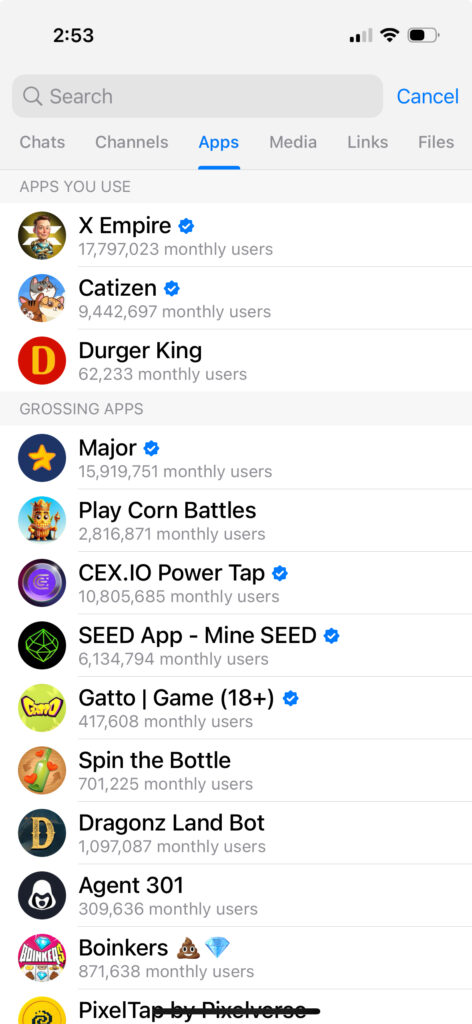
Hit the search tab, tap on apps, and you’ll see the most popular ones while being able to search for thousands more. All of them are tiny web apps, essentially. Built with Javascript, they work both in Telegram’s mobile and desktop apps, and have access to payments, messaging, and wallet capabilities.

App Store model under attack

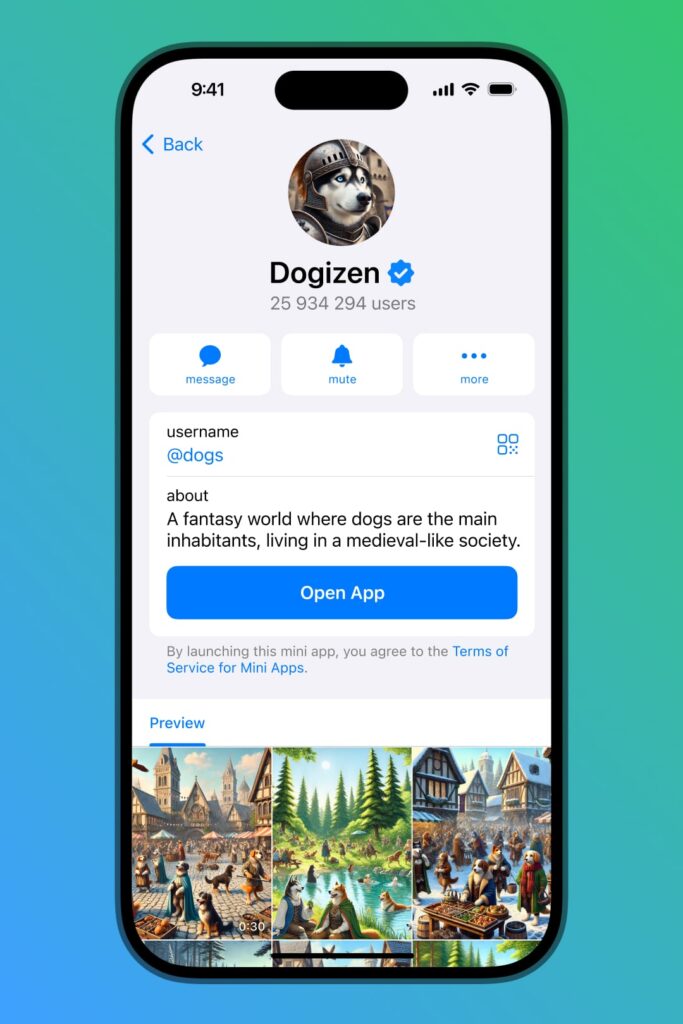
Developers of Telegram mini apps can add app listing pages in a roughly analogous way to Google Play or the iOS App Store, with videos, screenshots, and blurbs about their apps. 

telegram mini apps

Some of Telegram’s mini apps have close to 20 million users. And more than 500 million of Telegram’s users use a mini-app on Telegram every month.

Mini-apps and Apple’s App Store guidelines

In case you are wondering, mini-apps are actually perfectly fine by Apple’s App Store guidelines, within some boundaries, as specified in guideline 4.7:

  • They can’t use their own in-app purchases infrastructure
  • They can’t use native platform APIs
  • They can’t get data or privacy permissions from the parent app without user consent
  • They must filter objectionable content
  • They must follow all privacy guidelines

Note that the parent app takes some risk here.

The developers of the parent app “are responsible for all such software offered in your app, including ensuring that such software complies with these Guidelines and all applicable laws. Software that does not comply with one or more guidelines will lead to the rejection of your app.”

This change happened around 2020 as WeChat charged ahead with its mini-program strategy … probably thanks to WeChat being too big in China for Apple to raise a fuss.

The app store model under attack from above and below

Mini-apps and mini-programs add third-party functionality to parent apps or super apps, rendering the super app increasingly important in a smartphone owner’s use of their device, and boosting the parent app to higher and higher levels of usage. 

Since a person’s time allocation is generally a zero-sum game in which an activity that gains time steals it from another activity, that makes both the official App Store or Google Play and the default smartphone experience less critical and less central.

As such, mini apps and mini programs take power away from the underlying platform owners and give it to the super apps, which are in turn setting themselves up as platforms.

That’s powerful, because generally the platform closest to the user gains the most rewards.

This innovation is happening quickly compared to the legislative process which is slowly cracking open the mobile software publishing castles that Apple and (to a slightly lesser extent) Google have built.

We knew 2 years ago that the DMA would change app stores as we know them. 

But despite EU action and initial platform response early this year, nothing has really changed yet. Likely there will need to be several rounds of negotiation, legal action, and legislative action before the EU gets what it wants: more free and open third-party developer access to the 2 major global mobile platforms.

Of course, this is not just the EU. 

Many countries are doing similar things at various stages, in either legislation or regulation:

  • U.S.: Open App Markets Act
  • South Korea: Telecommunications Business Act Amendment
  • Japan: Fair Trade Commission Guidelines
  • Australia: Australian Competition and Consumer Commission
  • India: Competition Commission of India
  • UK: Digital Markets Unit 

As this evolves, we’ll likely see major digital brands start to test more innovative ways of bringing their services to consumers.

Evolving marketing needs

As all that happens the growth tech stack needs to evolve significantly. 

Right now, it’s becoming more critical to get analytics for WeChat mini-programs that might be driving tens of millions of dollars of revenue for retail brands. The same is true for user or client acquisition and monetization. And while there are some options for WeChat, Telegram is an even newer mini-app platform with fewer obvious analytics solutions.

Now think about multiple app stores or direct app downloads, and what services like SensorTower or Apptopia will need to do to provide mobile ecosystem analytics. Or what Singular will have to do to provide growth insights.

It’s an interesting, challenging, and very different world that we are entering. There’s a lot to be concerned about and prepping for. 

The good news is that the big changes, the app store level changes, are slo-mo.

The mini-app revolution, however?

Not so much.

Growing fintech apps in 2024: 5 things I learned in a chat with Self Financial’s Paul Kovalski

Growing fintech apps in 2024 is interesting. Sort of like the alleged Chinese curse may you live in interesting times (AKA tough times). 

Consider these data points from a Boston Consulting Group report:

  1. Fintech funding is down 71% since covid
  2. Fintech revenue is growing 14% annually
  3. Fintech has a projected market size of $1.5 trillion by 2030
  4. That’s 5X growth from today (!!!)
  5. Fintech’s leading lights, neobanks, are starting to cross the 100 million customer threshold
  6. Fintech now has 453 challenger banks, or neobanks

In other words, funding might be drying up, and the industry seems to be approaching some level of maturity, but it’s still growing fairly fast like new markets often do. And the potential is literally staggering.

So yeah. Interesting!

Growing fintech apps

In the middle of all this, I wanted to chat with a soldier in the trenches of the fintech growth wars. His name is Paul Kovalski, and he’s currently the Growth Marketing Manager at Self Financial. 

Self was founded in 2015, has raised $127 million in funding, has helped 4 million people build their credit scores to qualify for loans and mortgages, and was named one of Forbes’ America’s Best Startup Employers in 2024. 

Kovalski has a long history of growth roles including stops at Rally, Freshly, and AdRoll, and runs his own podcast, Efficient Spend.

Hit the play button to watch our convo, and keep scrolling for the highlights:

Fintech has been a rollercoaster ride

With growth, funding, and market size numbers like the ones at the top of this post, fintech is clearly a quickly evolving space. Add covid and all the changes it brought to the mobile ecosystem as well, and you can add some ghost pepper, or maybe even a Carolina Reaper, to that already spicy mix.

“It’s been quite a rollercoaster ride for sure,” Kovalski says. “There’s been a lot of changes in the macro environment.”

He joined Self in June 2020, right in the early stages of covid, rode through the Silicon Valley Bank collapse that shook so many startups, and continues to work at growing fintech apps through the increased challenges with old-school competitors as well as new.

“It’s been really intellectually stimulating and a fun ride as well,” he says. “Exciting!”

So what characterizes the fintech growth ecosystem now?

1. Growing fintech apps: multiplatform acquisition benefits (and costs)

One of the key distinctions in fintech mobile marketing is the ability to drive acquisitions across multiple platforms. The ability … and perhaps almost the requirement.

Most games and apps have traditionally used in-app ads in other games and apps. Fintech does this too, but along with a few other verticals, has a particular ability to use both web and app for user or client acquisition. 

There’s some big benefits to that.

“We can deploy our spend to those different areas,” he says. 

That means fintech can take advantage of lower pricing on the web, or better story-telling ability in CTV. And that flexibility has big payoffs on the web when growing fintech apps: you have a greater ability to tell a story on an owned web platform after the click than in an app store listing.

But there’s also some cost:

“That brings up a lot of measurement complexity as well,” Kovalski says.

Especially when you add very traditional means of client acquisition to the mix: direct mail and out-of-home.

The big benefit: you’re looking “in a bunch of different buckets to see what the most efficient spend is.” Another one: the web supports retargeting, which allows marketers to amplify and reiterate messages over time, resulting in more conversions after initial clicks.

2. Fintech has a very different value curve

Games, especially casual or hyper-casual games, have a very steep value curve. It’s quick: you install a mobile game, start playing it, and if you like it, you’re getting value as a player almost instantly.

Same with many apps: get, use, enjoy.

Growing fintech apps, however, means working with a very different value curve: a much more gradual slope.

“With a game the value happens more immediately after downloading the app,” Kovalski says. “With fintech … the value happens over time.”

I don’t know about you, but I don’t hand over financial details after just learning about an app 10 seconds ago. That’s a reason to drive potential fintech customers to the web and sign them up to something less extreme, like an account, Kovalski says. The web is also a better place to educate potential customers about the company and the value, and provide social proof and other signals that doing business with this neobank is safe.

Then later the app starts to matter more because customers with the mobile app have direct, immediate control of their financial affairs wherever they are, and are also more valuable to neobanks or other fintech providers.

3. Growing fintech apps means you need to understand the “paid marketing fit”

Kovalski has developed his own framework for deciding where to invest marketing dollars in the fintech space. Referencing the well-known “product-market fit” that startups need to achieve to become real, profitable, sustainable companies, he calls it the “paid marketing fit.”

“Product market fit is you have to create a product that aligns with market demand,” he says. 

“Paid marketing fit is that you should be spending your dollars and aligning towards consumer demand, meaning that your first dollar spent should be on the highest demand audiences wherever they are … that’s where conversion rate is gonna be the best. That’s where your costs are gonna be the lowest, and then you can scale into these lower demand areas.”

Paid marketing fit will first align your marketing spend with those who are most likely to click, to install, and also to convert into users and customers.

Those are the segments currently experiencing the pain that your product takes away.

After that, you can probably get more customers, but they might be getting a vitamin to enhance their lives, not a painkiller that transforms their lives.

4. Humor works

About 6% of Americans still don’t have a bank, and about a fifth of those making less than $25,000/year don’t have a checking or saving account. 

That’s certainly 1 source of growth.

But there are plenty of regulations on how fintechs can approach the market and what they say in ads as well, which means that marketers need to be careful about how they construct their ads … and, increasingly, whether they allow generative AI tools to write copy, or platforms like Google App Campaigns to mix and match ad components.

(More about that later.)

But humor is often a good tactic.

Kovalski talked about building creative for growing fintech apps:

“It’s really putting yourself in the mind of that consumer and what they really need, and then speaking to them in a compassionate way about that,” he says.  “And maybe sometimes also in a humorous way too … one of the things that I found that has worked really well for talking about stressful topics or things like that is adding a bit of humor, a bit of of levity to the ads.”

As long as you avoid the potential minefields humor can bring, of course.

5. Automated ad copy and generative AI is not as good … for lots of reasons

It’s tempting and easy to just use the tools that the big ad platforms are releasing to make your ads for you. That’s potentially dangerous in the tightly regulated fintech space, however.

Plus, it’s also not as good as doing it yourSelf.

(Sorry, couldn’t resist.)

“If you just go blind and don’t look at all of it and just press yes, automate, automate, automate … you’re gonna create some shit, right?” says Kovalski. “The copy will not be as good.”

That’s particularly true on the big blue used-to-be-just-social-network, where you can use Advantage+ Shopper Campaigns for credit advertisers that will automate your ads, optimize your ads, and automatically apply “best practices” for you.

But … you can’t exclude existing audiences.

You can’t do holdout audiences.

“Then those turn into like defunct retargeting campaigns,” Kovalski says. “Marketers really need to be mindful of this stuff, right?

So: use the automation, but don’t over-use it. Generate the automated ad, but then improve it. Vet it. Make it human, relatable, humorous.

Kovalski actually uses ChatGPT for a lot of initial copy generation, then makes modifications and improvements to ensure his ads fit the brand, have some sparkle, and don’t break any regional regulations.

Growing fintech apps: much more in the full podcast

If you don’t subscribe to Growth Masterminds yet … do it today. And subscribe to our YouTube channel

There’s tons more in this full podcast, plus many more.

Singular’s Quarterly Trends Report: Q2 2024

Hello trends! And hello Singular’s Quarterly Trends Report for Q2 2024!

We’re seeing massive change in the mobile and wider marketing ecosystem, and the Quarterly Trends Report is a good way to share it with the world. It’s Singular’s unique view of adtech today, and it’s based on billions in ad spend, trillions of ad impressions, billions of app installs, and hundreds of billions of in-app events.

Here’s some of what we’re seeing right now in mobile and marketing:

  • ATT acceptance dropped again (and the growing divergence between games and apps)
  • Ad spend shifts from iOS to Android
  • Significant growth in in-app purchase spend in apps (but not games)
  • Big shifts in app and game category monetization
  • Growth in CTV (connected/streaming TV) providers
  • Growth in OEM and white-label OEM ad networks
  • CPI shifts
  • The continued growth of hybrid casual games at the expense of hyper casual
  • Major evolution of what ads and ad elements work best on
    • YouTube
    • Facebook
    • TikTok
  • Which Apple Search Ads placements work best (by a long shot)
  • The massive impact age and gender have on monetization 
  • Global game retention shifts by genre and geo
  • And much, much more …

Mobile insights, with a little help from friends

Singular sees a huge chunk of the adtech, mobile, and marketing ecosystem. But we absolutely could not pull this off without amazing partners bringing in their deep insights. For Q2 2024, the Quarterly Trends Report includes insight from 5 partners:

  1. SensorTower: consumer spend trends
  2. Alison.ai: 2024 creative trends
  3. Splitmetrics: Apple Search Ads insights
  4. Persona.ly: monetization insights by age and gender
  5. Movista: global game retention data

Thank you to all our partners!

Going deeper by country and region

Global data is interesting, but regional data is often more actionable. That’s why we’re happy to be able to share per-country data for many metrics.

CPI, CTR, CVR by country

That includes:

  • Cost per install
  • Click-through rate
  • Conversion rate
  • Spend by platform (iOS/Android/Web)
  • Game retention benchmarks

Going deeper by vertical

Obviously, you want to know what’s going on in the verticals or genres you’re most invested in, or your competitors are in. So we break down key metrics like CPI by genre.

Android CPI by genre

As you can see in this case, Casino game installs are expensive on Android, while Sports, Action, or Trivia games installs are comparatively cheaper.

The report is entirely free but does ask for your professional information.

Sign in to access it here.

How to sell your app: insights from an expert

How do you sell your app?

Dunno about you, but I can spend hours browsing Flippa or Sell My App, checking out all the apps and games for sale. But where my interest is mostly buyer’s curiosity, with a little dreaming, you might actually be looking to sell your mobile app in order to fund development elsewhere.

Sometimes you’re just not the right person or company to take your app to the next level. You need more cash, or you need marketing expertise that you don’t have. If that’s so, how do you sell your app to another publisher, studio, investor, or app aggregator?

I recently chatted with an app sales expert, Charlie Ryan of AppFlip, about how this whole process works. Hit play and keep scrolling …

Why you might sell your mobile app

Not all your apps are hits. In fact, most of them are not. But that doesn’t mean that they couldn’t do really well in another publisher’s portfolio. 

Because while sometimes apps are successful mostly because they’re just so freakishly awesome, sometimes they’re successful mostly because they have the right marketing, support, maintenance, and live ops.


how to sell your app


“Publishers  might want to sell their apps, for example, because they might have a change in strategy, or it could be they’re targeting a certain sort of category and they want to build out a portfolio there,” says Ryan. “By taking that approach, there’s a lot of benefits they can have from it: things like cross marketing, things like getting a lot of synergies by focusing on a certain category.”

“And you see it with some publishers, they might have started broad — they were developing a lot of different apps across different categories — and then from that they see, okay, if we actually just get a bit more specific here in the apps that we acquire and the apps that we build ourselves, we can get a lot of synergies from that and it will be more beneficial for us as a company in terms of growth and generating more revenue.”

Or you might simply want to sell your app to make some quick cash, or realize a return on a long term investment.

Sometimes it’s a developer with a build-and-flip business strategy, which (to my mind) makes for a more risky investment proposition for a buyer.

Who’s buying mobile apps?

Individual investors might buy mobile apps if they fancy a fling as a mobile mogul, but most of the business is app aggregators, Ryan says.

Some of those are publishing studios looking to add to their stable and generate scale. Or maybe wanting to fill a gap in their portfolio, or acquire some specific unique code or value. And some of those are ad networks that have their own studios so they develop their ad supply they can fill with the demand from their clients: a sort of poor man’s walled garden, if you will.

But some are purpose-built app aggregator companies, which have gotten particularly popular in the last few years, Ryan says.

“[An app aggregator is] a company that just went and fundraised cash,” he says. 

“So what they would do is they would assemble a team — some rock stars who’ve been in the app space before — and they would raise that cash and go out and use it to start buying mobile apps.”

Prepping your app for sale

If you’re prepping your app for sale, you need to get your ducks in a row both technically and financially.

You’ll want to optimize performance and ensure your app is bug-free, updated, performs well, and has both quality reviews and a significant quantity of them (along with some new or recent ones).

You’ll need some level of documentation: the cleaner and more extensive the better.


how to sell your mobile app


And you’ll need a clean, clear, and verifiable track record of growth: users, subscribers, revenue, ideally for as long as possible. Ryan deals in the higher end of the market, not the build-and-flip, and he’s looking for a couple of years of revenue history, typically.

User and revenue retention matter, unsurprisingly.

“It’s really focusing on the cash flow of the mobile app … your revenue and your profit margin for the last 12 months versus the previous 12 months, and as well looking at what the retention looks like on your subscriptions,” he says.

That helps both a seller and a buyer estimate future revenue potential, user growth and retention, and app longevity — both with extra investment and without — in order to value an app appropriately. 

You’ll also need to do some market research: what are similar apps selling for?

Your app’s potential longevity also matters: is it technologically complex? Hard to maintain? Does it play on something that’s super-hot right now (like AI friends and chatbots) but hasn’t been around long enough to demonstrate staying power?

Hot verticals if you want to sell your app

If you’re looking to sell your app, it’ll be helpful to be in a hot app category.

Hot verticals might be a bit counterintuitive, because they’re not just flash-in-the-pan categories but long-lasting apps. Evergreen categories include:

  • Health and fitness
  • Utilities
  • Productivity
  • Education
  • Fintech
  • Password managers

Categories that are high in demand are practical. They get used daily or weekly. They matter to their users. They have lasting use cases generating high retention numbers that provide revenue certainty, making them more attractive to buyers.

Best monetization methods if you want to sell your app

It helps to be big into subscription revenue if you want to sell your app.

“[The payment method ]that’s most popular is definitely subscription,” Ryan says. “There’s just so many of them out there compared to OTP (one-time purchase) or compared to advertising revenue apps.”

Subscription gives a buyer some level of confidence that historical revenue trends will continue. But there’s also a market for a certain kind of one-time purchase apps or ad monetization apps: ones that can clearly and simply be converted into subscription apps.

There is an additional benefit for ad-supported apps, though, depending on what buyers are looking for:

“The thing with the advertising revenue apps is they can get to such a huge user base because so many people would use them,” Ryan says. “Typically, any of the ones that I’ve seen, the user base has been enormous compared to what it would be like to us compared to a subscription app.”

That could be very attractive to an ad network that aggregates app supply, or to an app publishing studio that knows how to cross-market apps very effectively.

Actually selling your app

Clearly, if you have a high-end app that makes significant revenue, or has significant worth to a buyer, you might use a broker like Ryan.

If you’re more of a DIY type of person, you might pick a marketplace like Flippa or Sell My App. Just like doing user acquisition for your app, you’ll need to create a high-quality listing with the best photos and videos you can generate, along with an app description that highlights your app’s unique features and competitive advantages.

And then you’ll need to ensure you’re covered legally, that funds will be held in escrow, and that both seller and buyer are protected from fraud or other unpleasant surprises.

You might also have to provide a transition period of support while the app’s new owner gets up to speed with everything.

Much more in the full podcast

Check out the full Growth Masterminds podcast if you’re interested in learning more, or just if you want to subscribe to Growth Masterminds and suck up some knowledge from smart guests from time to time.

Check out past episodes here …

Hello Web AdAttributionKit … the new Private Click Measurement

When Apple released AdAttributionKit for iOS, they called it App AdAttributionKit. In a curious mirroring of Google, which has Privacy Sandbox on Android as well as Privacy Sandbox on Web, Apple also hinted at the existence of something called Web AdAttributionKit, the successor to Private Click Measurement.

We’re only now starting to see what that might really mean in upcoming versions of Safari.

And we’re also seeing the future of privacy — and marketing measurement — on Apple’s default web browser. Which actually matters, given how popular Safari is … particularly in rich countries.

Lots of new privacy tech in Apple’s Safari browser

Apple’s desktop and mobile browser, Safari, is built on the open source WebKit project. 

While Google’s Chrome rules the desktop web, Safari is fairly dominant on mobile where Apple has significant iOS market share, thanks to its position as the default and pre-installed iPhone/iPad browser. Almost 30% of global mobile web use happens via Safari, and in countries like the U.S. where iOS is dominant, that browsing share hits 54%.

Plus, since WebKit is open source, others can use the engine that powers Safari, and a couple of Linux projects like Epiphany and Midori do just that.

WebKit just announced significant new privacy changes unrelated to Web AdAttributionKit:

  • Private browsing updates (think “incognito” in Chrome)
    • Link tracking protection
    • Blocking network loads of known trackers
      Including those that attempt to appear as first-party domains when they are not
    • New fingerprinting blocking tech
      Safari will inject noise into APIs for checking device configurations, and will set default values via overrides to fixed values for “certain web APIs related to window or screen metrics”
    • Extensions with website or history access are off by default
  • Standard browsing privacy updates
    • Third-party cookies capped at a 1-week lifespan
      Safari blocks third-party cookies by default, but users can turn them off security features. This new feature refers to cookies set by cloaked third-party IP addresses … in other words they were masquerading as first-party cookies
    • Partitioned session storage
      Components on a web page, which can be from third parties, can’t access data (you could interpret this as fixing cookies’ original sin)
    • Partitioned blob URLs
      Again ensuring data from an iframe or component on a page can’t be accessed by other sites, components, or iframes

Will this break stuff on the web? 

Probably … keep reading.

Web AdAttributionKit: part of the updated Safari browser

App AdAttributionKit is the new SKAdNetwork, and it’s even harder to say 3 times quickly. But it’s pretty much the SKAN 5 mobile marketers were expecting.

Web AdAttributionKit is part of the fix that Apple is offering to web marketers in exchange for blocking ad measurement via links, third-party cookies, and fingerprinting. But it’s more of a rebranding than any new technology: the “learn more” link Apple offers on the “Measuring ad performance with AdAttributionKit” page is literally a click through to a 3-year-old blog post that introduces, repeat INTRODUCES Private Click Measurement.

3. Years. Old.

So we can expect (hope?) to see actual Web AdAttributionKit documentation coming at some point, likely with an updated list of capabilities, and likely more closely mirroring the functionality of App AdAttributionKit.

But what we have so far is this:

  • Privacy-preserving ad click measurement across websites and from iOS apps to websites
  • No use of cookies; instead, data is stored on-device
  • 8-bit click source identifier (256 possible values) and 4-bit conversion identifier (16 possible values)
  • Delayed reporting (24-48 hours) to prevent linking events in time
  • Fraud prevention through unlinkable tokens (upcoming)

Some of that totally sounds familiar: source and conversion identifiers, delayed reporting, on-device storage, limited numbers of values. 

The new morsels of information just announced is that attribution in private mode is only scoped to individual tabs, and tabs you open from those tabs via a link. In addition, when a private browsing tab is closed, any pending attribution requests are discarded.

That’s minimal new information, but the only bits we’ve gotten on Web AdAttributionKit since literally February of 2021.

Will Safari’s updated privacy protections break websites?

In a word, absolutely.

For publishers and marketers who are using components or iframes on a website to serve ads and set cookies as first-party, that’s going to break. And for users who have turned off privacy protections to accept third-party cookies, they’ll be eaten within a week, limiting attribution functionality as well as long-term tracking capabilities.

The question for users is more about whether websites legitimately use similar techniques that communicate between iframes and components to create functionality. For them too, there’s a problem: “there is a risk that some parts of some sites won’t work,” Apple’s WebKit blog post says.

Oh, and remember the enhanced security solutions that Apple is implementing for private browsing mode? 

They’ll all also available for standard browsing in Safari settings. most won’t select them, but it’s possible some will.

The suggested solution from Apple: a real-time per-site reduction in privacy protection capabilities built into Safari, which are only remembered for a current browsing session. Of course, that’s challenging, time-consuming, and requires some knowledge of iOS or iPadOS, so it’s likely not going to be something that 99.9% of users will actually do.

What’s next for Web AdAttributionKit?

Good question.

My hope is some actual documentation on the actual Apple developer website with actual details in-depth about how everything works, including any new features Apple has added or plans to add to Web AdAttributionKit since February of 2021, will soon be forthcoming.

Plus any new features developed since Web AdAttributionKit was introduced as the new name for Private Click Measurement in WWDC 2024.

One thing we know to not expect is anything like Privacy Sandbox’s Topics API, which the WebKit team sees as easily fingerprintable.

How the cookie crumbles: on Google, Privacy Sandbox, & third party cookies

What does Google’s recent step back from deprecating third party cookies mean for Privacy Sandbox on Android? Does the third party cookie’s death row pardon mean that the GAID will now live on as well?

Or, is ATT how the mobile cookie will crumble?

A brief history of advertising identifiers, including third party cookies

In mobile, we’re pretty familiar with device identifiers. 

In the beginning, there were device identifiers (Android ID on … Android, and UDID, or Universal Device Identifier on iOS). The big problem: they were basically hard-coded, non-user-changeable, and massive privacy risks thanks to being universally available while also being essentially eternal. 

In 2013 Google switched advertisers to the Google Advertising ID (GAID), sometimes also referred to as the Android Ad ID, following Apple’s equivalent move to IDFA in 2012.

Cookies, however, are from an entirely different era.

Think Netscape Navigator era.

23-year-old developer Lou Montulli created cookies as one of the early employees of Netscape in 1994. That tiny little 4-kilobyte container, enough to hold a couple pages of text, became a great way to identify a particular user with a particular web browser to a specific server and maintain state. 

Interestingly, cookies were sandboxed — hey, that term again — so that only the server that set them could read them. 

But because web pages are often made up of components from multiple different servers — including ad servers — that sandboxing essentially became irrelevant. The first-party cookie plus the architecture of the web led some pioneering adtech innovators at DoubleClick (yep, the one bought by Google later on) to start using cookies as persistent identifiers to target ads just a year or so after their introduction.

A decade and a half later, questions and concerns from regulators about surveillance capitalism and privacy started to get louder and louder. (Technology typically moves much faster than regulation, or our ability to understand the consequences of new innovations.) Apple began restricting third party cookies in 2017 and blocked them in full by default by 2020 in Safari 13.1. Firefox did the same between 2018 and 2019.

So Google started to think: if everyone blocks cookies, and if regulators force us to block cookies too, how will we target and attribute ads on the open web? 

Privacy Sandbox on Web was born.

Those of us who have grown up in mobile will recognize a similar progression on smartphones: device identifiers to ad IDs, and then on Apple to SKAdNetwork (AdAttributionKit going forward). 

On Android, the path was supposed to be Android ID to GAID to … Privacy Sandbox on Android because there was an assumption that the GAID was going to be deprecated. 

In fact, I’m pretty sure Google initially said that. You can find some evidence of this on the web, but all Google-owned and controlled websites have been scrubbed of such language if it ever existed there.

But is that still the case? Is it even in Google’s best interest to do so?

Google’s interests, advertisers’ interests, regulators’ interests

Google is an ad network.

It’s also many other things: videos, cloud computing, consumer electronics, AI, operating systems for mobile, wearable, and desktop devices, mapping, photos, news. And — oh yeah — apparently they have a search engine too.

But fundamentally, Google is a massive ad network (and exchange and DSP and DMP and ad server and SSP and so on). More than 75% of the company’s revenue comes from advertising in one form or another.

However, it’s not always clear what Google’s interests are.

The Electronic Frontier Foundation is pretty sure it knows:

“Google’s announcement underscores their ongoing commitment to profits over user privacy,” EFF staff technologist Lena Cohen told Bleeping Computer.

Others, including perhaps the most knowledgeable mobile adtech person on the planet, see things somewhat differently. 

“Google is very obviously motivated to excise the cookie from the open web ecosystem for the benefit of its owned-and-operated channels: its Network business is in a state of systemic decline, YouTube and Search feature higher margins than Network, and Network presents the company’s most acute regulatory liability,” says Eric Seufert. “The benefits to Google of cookie extinction are manifest: more demand for its higher-margin channels.”

There’s economic incentives on both sides of cookie for Google, clearly:

  • More third party cookies mean more potential revenue opportunity on Google’s network side, which has been declining as a percentage of total revenue over the past 18 months
  • Fewer third-party cookies increase the value of Google’s owned-and-operated channels (just like ATT and SKAN resulted, eventually, in walled gardens with owned first-party data doing better)

Call me naive if you wish: I also think there are good people at Google who care about privacy and are trying to balance it with profit: both Google’s and the open web’s.

Like it or not, Apple’s non-deprecation deprecation of the IDFA was genius. 

With a gray-to-black pattern via a scary prompt that made marketers have to think about how to ask people for permission to track them, Apple at one and the same time didn’t deprecate the IDFA (officially) and did deprecate the IDFA (at least mostly, in practice).

My first thought on seeing Google’s retraction of the third party cookie’s execution was: they’ll ATT the GAID. Apple has already shown them how. And that’s kinda funny, because today, most of the cookie-placement requests on the web that GDPR has forced us to click through are annoyingly syrupy: over-zealous and saccharine. 

Allow us to place this cookie or puppies will die a horrible death. Allow us to set cookies or children will starve. Take a cookie, please, or western civilization will crumble.

The key for a non-deprecating deprecation of the GAID will be the interface: will Google make it a setting far far away in the preferences? Will they actively pop up a prompt to get users to set a universal preference that will be applied to all websites? If so … what language will they use?

If the prompt is ominous, we already know what happens in this scenario: people are likely to say no. That’s exactly what happens with ATT.

But again, as with third party cookies, it’s not entirely clear where Google’s own interests lie:

  • GAID enables more intelligent targeting and attribution for AdMob
  • But Google’s owned and operated properties don’t need it as much
  • And Google can achieve similar objectives with its SDKs, very likely, which are in almost all Android apps

Plus, at least some of Google’s people are sincere in their desire to boost privacy

Likely, Google’s approach on the web could be significant for how GAID and Privacy Sandbox evolve on mobile: user choice:

“We are proposing an updated approach that elevates user choice,” says Anthony Chavez, Google’s VP of Privacy Sandbox. “Instead of deprecating third-party cookies, we would introduce a new experience in Chrome that lets people make an informed choice that applies across their web browsing, and they’d be able to adjust that choice at any time.”

Regulators will have their say as well, but here’s where we are:

  1. Third party cookies are here to stay
  2. But people are unlikely to say yes, I want third party cookies in my browser
  3. Android is likely to follow the path of web in Privacy Sandbox
  4. GAID is likely to become optional

GAID: available but scarce

If that third point turns out to be true, ATT could be how the mobile cookie (GAID) crumbles on Android smartphones. 

Which means: theoretically available (and yes, some percentage allow it), but actually scarce. 

Which at this point is probably a net positive for mobile marketers. After all, the default reality mobile marketers have been living with for several years now is that GAID is on death row, and Privacy Sandbox is their only salvation. 

Now at least there’s some hope that GAID won’t quite die.

And that’s probably also aligned with Google’s conflicting interests.

Because frankly, even when Google tries to do the right thing, it gets static. The EFF, for instance, says that “even if it’s better than third-party cookies, the Privacy Sandbox is still tracking, it’s just done by one company instead of dozens”  … clearly not understanding that the Sandbox within which Privacy is happening is users’ own devices, meaning that no company is tracking.

So if you can’t win for trying, you might as well just let the world kinda have what it wants.

And that probably shows the future of device identifiers … theoretically available, but actually less and less relevant, both due to the changing priorities of the biggest of big tech (Apple & Google) and privacy tools, regulation, and practices.