Fastest growing ad networks 2021, biggest hidden gems, and CPI, CTR, CPM benchmarks

Earlier this week Singular announced a new product: benchmarks. Never one to let an opportunity go to waste, I quickly started digging into the new feature for interesting observations. Which ad networks, for instance, are growing the fastest in 2021? Are there ad networks that are hidden gems that marketers should experiment with? And what’s happening recently with CPIs, CTRs, and CPMs?

Now it’s pretty easy to find out.

The new Singular benchmarks product gives mobile marketers insight into the macrotrends in their space as well as the specifics: what ad networks are growing, where spend is being directed, and where most of the industries’ app installs are happening. (And FYI: most spend and most installs are only loosely correlated. Some platforms that claim bigger numbers of installs capture lower percentages of spend.)

Marketers can also compare their ad spend with the industry at large, generating insights about how their spend follows or differs from their counterparts in other companies.

One of the things I wanted to look at: top growing ad networks.


Fastest growing ad networks

The top market share gaining ad networks for this year is a critical measure, because we’re at a unique juncture in mobile marketing. We are quite literally in probably the greatest period of upheaval in mobile marketing in a decade. We knew iOS 14.5 was a big deal, and we knew losing the IDFA was going to be a problem.

But I’m not sure we really viscerally understood how much of a disturbance in the force it was going to be.

As we shared last week, dollars are leaving iOS for Android, where (now) too much spend is chasing too few users, resulting in rising CPIs, declining ROI, and an increase in paid user acquisition supplanting organic growth.

So it’s a crazy market, which makes it all the more impressive when many of the top ad networks can continue to grow.

The top gainers as of July 2021 include:

  • Apple Search Ads
  • Digital Turbine
  • Liftoff
  • ironSource
  • Applovin
  • Vungle

And just to be clear, this is out of all potential media partners: SANs included.
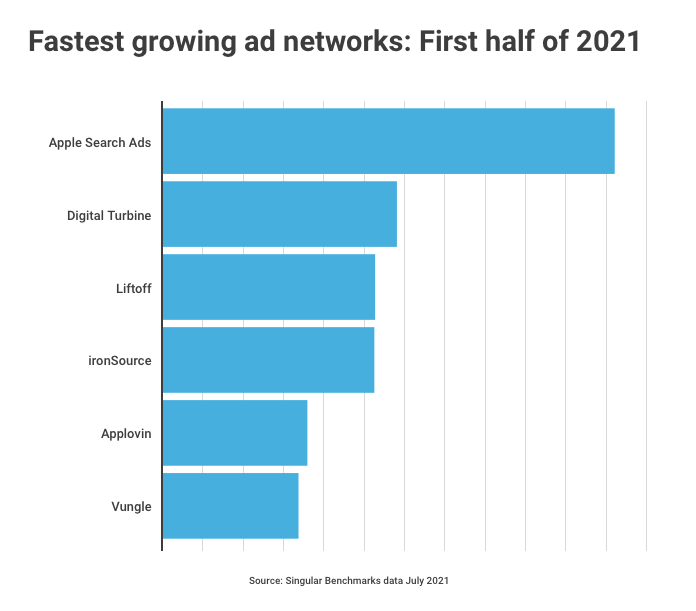
 

fastest-growing-ad-networks-2021


Apple Search Ads? It’s pretty clear why ASA made this list.

Not only did Apple release a new ad placement at the top of search results in May, ASA has access to first-party on-platform Apple data for ad targeting — including but not limited to keywords and search data — that others simply don’t have. And Apple Search Ads has always been high quality and effective: it is, after all, right at the point of user decision and action.

So it was natural that ASA would grow post-iOS 14.5 and SKAdNetwork.

The other ad networks are interesting. Most of the big gainers have one thing in common: they were early adopters of SKAdNetwork technology. They leaned hard into the new methodology for deterministic advertising attribution on the iOS platform, prepared early, adjusted quickly as Apple changed timetables and added capabilities, and were the most prepared.


Biggest hidden gems

As I was looking at the benchmarks, a few things became apparent. The early winners of the upheaval, sure. But also some hidden gems that marketers should consider for additional spend.

Look: in all the change that is hitting mobile marketing right now, mobile growth specialists are throwing budgets around like crazy. There’s always been a percentage of top mobile user acquisition specialists that is reserved for experimentation and testing, but that’s grown significantly in the past few months. In fact, in our recent webinar 5 Ways to Drive Faster Growth for Gaming Apps, one growth leader suggested that while traditionally mobile marketers have reserved a small portion of their budgets for experimentation … now the entire budget is experimentation.

Gulp.

That sounds dangerous.

But here are a couple of opportunities to think about:

  • Bluestacks
  • Mistplay

Neither grew a huge amount in the early part of 2021, at least for Singular clients, but they’re both well-positioned to absorb new growth demand. As we mentioned earlier, money is moving to Android right now. Both of these players target Android … but they’re different than most ad networks. Each is an interesting and unique play on mobile user acquisition.

Where Bluestacks offers a desktop-based way to play Android games and a new cloud-centric gaming platform, Mistplay presents a loyalty program for mobile gamers: discover new games and earn rewards. Both are differentiated offerings, both ranked well on our most recent Singular ROI Index, and both are, IMHO, worth a shot.

Especially if you’re spraying your entire marketing budget around experimentally.


Benchmarks: CPI, CPM, CTR, and CVR

The new benchmarks tool also offers interesting insight around cost per install, CPM rates, click-through rates, and conversion rates.

I’m not going to share those in detail here, except for a few highlights. One reason: the benchmarking tool looks just enough at the past that not all of the recent industry changes — spend flowing to Android and bumping up costs there while depressing costs on iOS — are priced in yet.

But here’s a taste.

North America and Western Europe – Gaming
Outside of the biggest self-attributing networks, we’re seeing effective CPIs in the $2-4.50 range for mobile user acquisition costs on Android. The biggest SANs are in the $3-6 range.

For iOS? Add $2-4 to each range.

Hyper-casual, however, is generally under $0.50 and as low as 4-8 cents on some significant platforms for Android. For iOS: add 50 cents to a dollar.

Europe – Non-gaming
Android installs in Europe can be quite inexpensive. While there’s some spiking to almost $3, there are many opportunities to get sub-dollar installs in Europe on Android.

For iOS, while there’s still some chance of getting fairly cheap installs, costs spike higher, of course.

South Asia – Gaming
Some of the midsize ad networks offer outstanding values here with media eCPI in the single-digit pennies. And while the big SANs spike up to multiples of that, they also average out well under $1 per install for both Android and iOS.

The majority of the spend here, of course, is on Android.


And the future of mobile user acquisition on iOS?

We’ll update these insights in a month or two.

But a few things are already obvious about the flight from paid user acquisition activity from iOS to Android:

  • iOS isn’t going away
  • Apple’s actually increasing market share in the U.S., according to TechSpot and Consumer Research Intelligence Partners
  • People haven’t stopped playing games on iPhones
  • People haven’t stopped downloading games on iPhone
  • The iOS segment of the mobile market is still by far the most lucrative
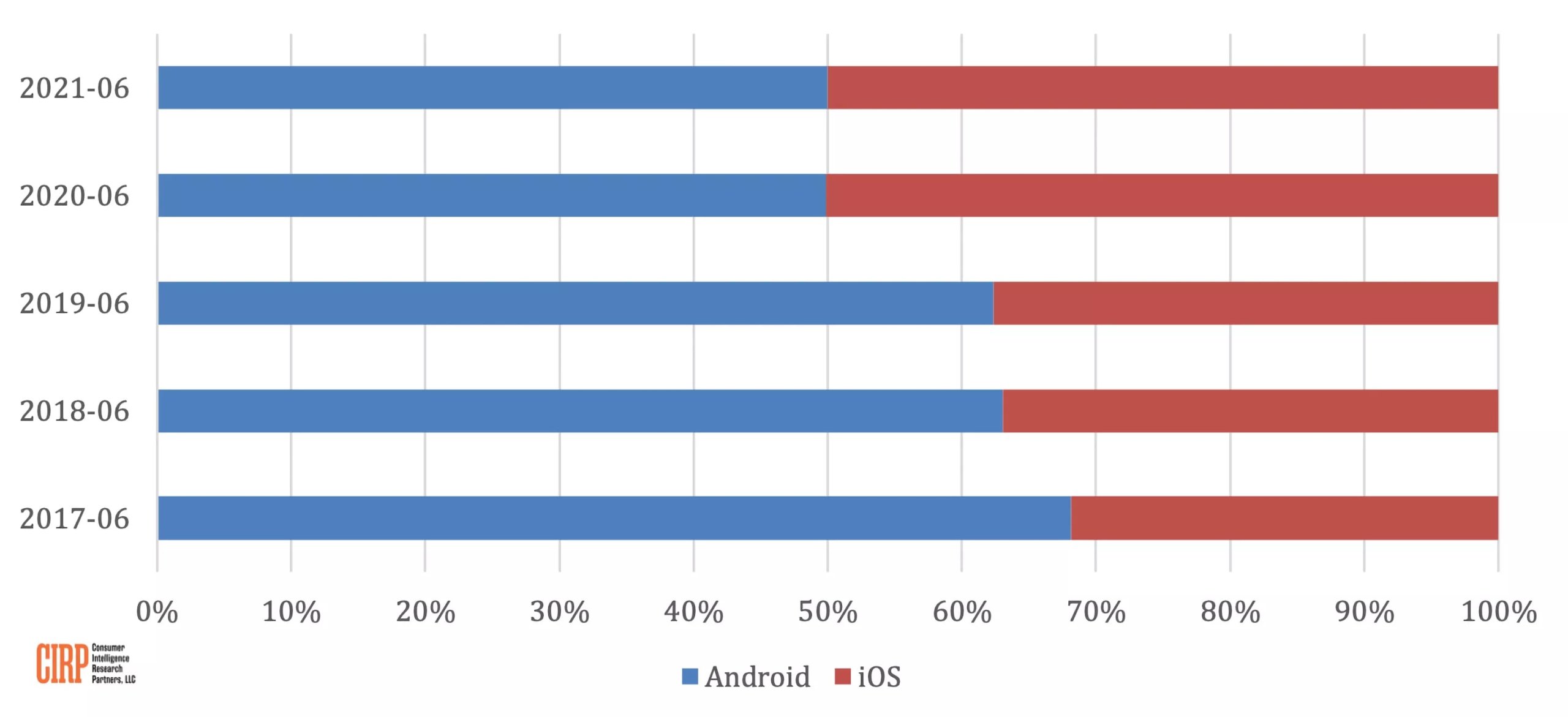
 

ios-apple-android-market-share-usa


What that all means is that mobile games user acquisition specialists and mobile growth marketers can’t simply keep redirecting budget to Android in order to satisfy some arbitrary target or a random CEO demand for 35% growth this quarter. And that they’re going to have to invest the time, energy, and experimentation budget to figure out mobile growth in the new world of privacy-safe iOS.

So we should see budgets swing back to iOS.

And in fact the smart money already has.

One of the participants on our recent 5 Ways to Drive Faster Growth for Gaming Apps webinar just told us that since CPIs are down on iOS, there’s a one-time buying opportunity there that he’s not passing up. Installs are currently on sale, discounted, for iPhone and iPad. That kind of opportunity doesn’t generally last long.

The early bird gets the worm, so don’t delay.

Of course, just maybe … the second mouse gets the cheese.


Get more insights?

There’s one surefire way to get more insights: chat with Singular, book a demo, and see what Singular can offer. Here’s how to get started …
Mobile games advertising 2021: spend, partners, ROI, iOS 14.5, and SKAdNetwork

What do successful mobile gaming companies do differently? How do the best mobile games apps win? How are mobile games developers attacking the iOS and Android segments of the mobile gaming market differently? And what kind of ROI and ROAS are the top mobile games making?

It’s been a while since I’ve taken a deep dive into mobile gaming installs, revenue, and ROI numbers, and frankly, it’s about time.

The mobile advertising market is in upheaval thanks to SKAdNetwork, mobile adtech companies are buying each other left, right, and center, what we think we know about mobile advertising on iOS and Android is changing rapidly, and game developers and marketers still need to operate and advertise in an increasingly complex growth data environment.

We took this opportunity to look at 20 of the world’s top gaming companies and analyze what they’re doing to succeed in the changing mobile marketing ecosystem.


A few of the highlights up front

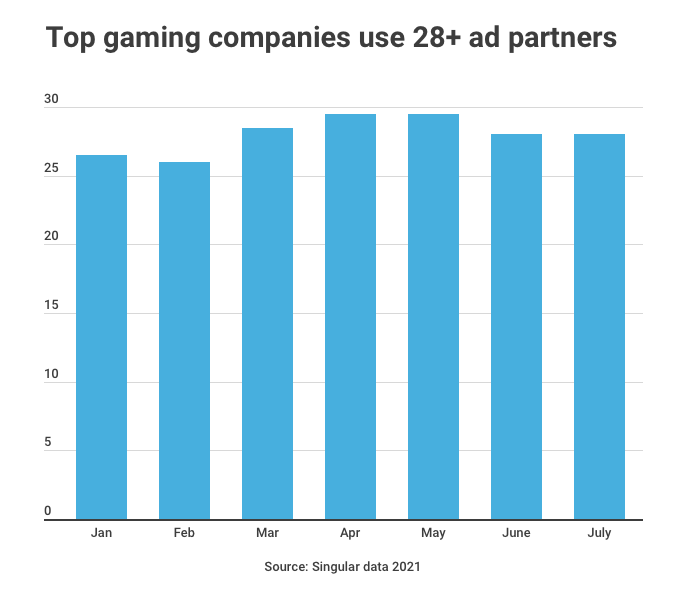
  • Top gaming companies use 2-3X more ad partners than average mobile app marketers
  • 8 out of every 10 mobile gaming app installs are on Android
  • But only $5-6 out of every $10 spend on mobile app installs is spent on Android
  • SKAdNetwork is normalizing ad spend between Android and iOS
  • ROI looks higher on iOS when organic revenue is included
  • ROI is higher on Android when organic revenue is excluded


Mobile gaming advertisers use a LOT of partners

While there are outliers, small scale mobile advertisers who are less successful tend to use just a few ad partners. In the past I’ve seen groupings around four — usually a group of SANs including Facebook and Google — and significant jumps in performance for marketers with massive scale at over ten.

Mobile games advertisers knock that out of the park.


gaming-apps-UA-number-ad-partners


The median number of ad partners per month varies, but for the most successful gaming companies it’s generally in the high twenties. There are outliers, of course. The lowest we saw was 10, while the highest number of ad partners with active campaigns in a single month for a top gaming publisher was 60.

That’s impressive, but it’s not the highest I’ve ever seen. It’s not unheard of for top games advertisers to have over 100 active partners in a given month.

More partners means more management, of course, so all other factors being equal, the fewest number of partners you can successfully grow with is good. But most top mobile game marketers find they can access efficient growth opportunities better with a fairly high number of ad partners.
Advertisers should look for programmatic partners that can help them carve this path, who are prepared and understand how old strategies can be revamped to this new industry reality and are 100% transparent at every level.

A programmatic DSP (Demand Side Platform) provides advertisers access to incremental uplift enabling advertisers to understand how much value a channel is adding to their advertising. This way, your decisions to optimize your campaigns are backed by data and ROI-focused.

SKAdNetwork is increasing Android’s share of game installs

Everyone knows that Android has significantly more market share than iOS. While in the U.S. that’s simply a 54% to 47% edge (rounded, so numbers can total more than 100%), China is 82% Android, Brazil is 94% Android, and even the richer European countries tend to be 60-80% Android.

So it’s no real shock that eight out of every 10 game installs is on an Android device.

But it is interesting that that percentage is growing, and that it’s driven by increasing spend on Android marketing campaigns.


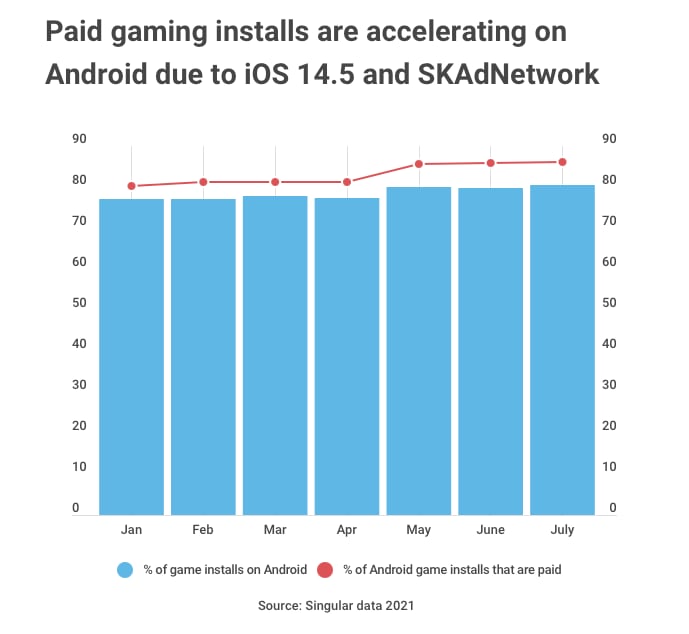
paid-gaming-installs-up-android-2021


At the beginning of 2021, 77 out of every 100 game installs for top mobile games publishers were on Android. In the last three months, that’s edged up to 80 out of a hundred. Note: the overall number of app installs for Android games is not significantly up (keep reading!) but the percentage of all games installed on mobile (iOS + Android) is. Which means, of course, fewer games are getting installed on iOS.

Driving that is significant amounts of paid app install spend moving from iOS to Android, and that’s driven a rise in the percentage of game installs on Android that are paid increasing to 86% from previous levels around 80%.


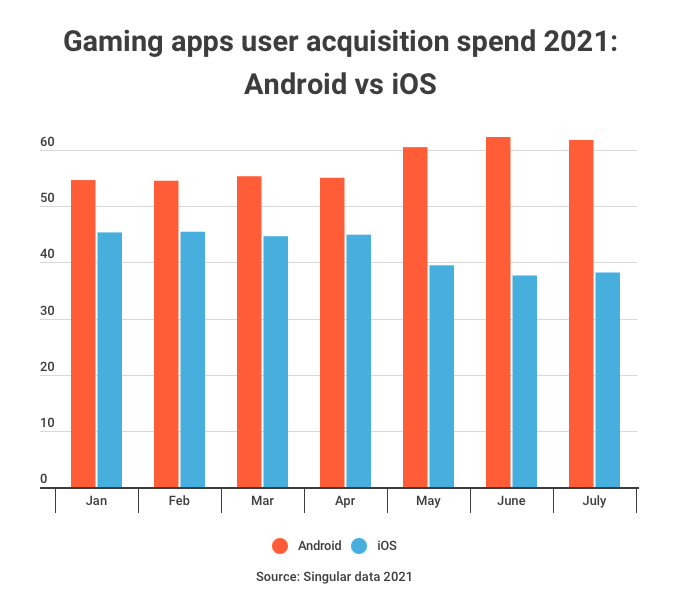
gaming-apps-UA-spend-2021


While at the beginning of the year 54-55% of gaming publishers’ ad spend was focused on Android, now 60% or more is directed to Android app installs versus just 40% or less for iOS. (Note: the July data is limited, so I’m basing my analysis on the April/June data. But so far, the July data appears to be fully on-trend.)

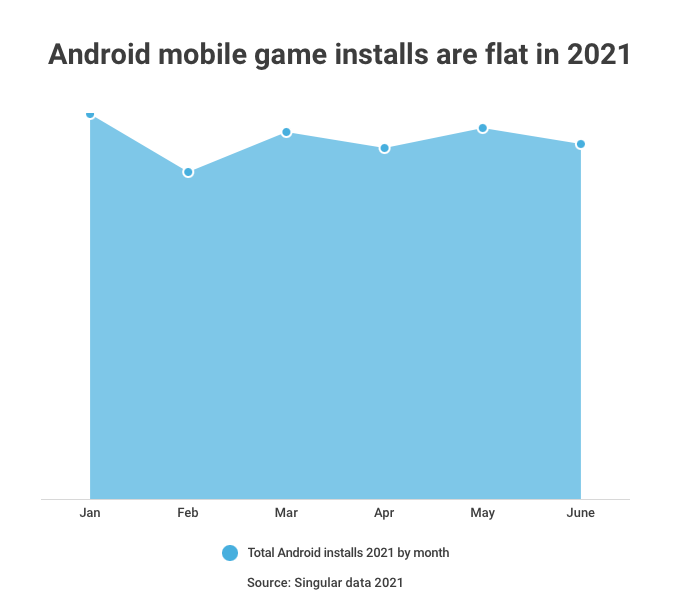
Unfortunately, that spend does not appear to be increasing the overall installs of games on Android. In fact, total game installs on Android are essentially flat across 2021.


android-game-installs-volume-2021


Which means that so far, we have the worst of all possible worlds.

Ad spend is down on iOS because measurability by traditional mobile user acquisition methods using IDFAs is gone. That ad spend has transitioned to Android because … growth targets must be met. But instead of generating new demand on Android, the new ad spend is simply taking a share of installs that would otherwise have happened in any case via organic.

Of course, when looking at big trends you need to compare them to previous years to see if what you’re seeing is a seasonal event or a real consequence of some major industry change. As I reported in a somewhat aged holiday trends report:

Big picture, the app install cycle is simple: slow in February/March/April, ramping in late spring and early summer, and peaking in October, November, December, with some run-off into January.

Which is significant: the ramping that we should be seeing in the spring and early summer numbers is conspicuously absent.

The caveat of course is 2020. We just came out of a crazy year. We’re in the middle of another crazy year, with COVID and its aftermath (can we say that yet?) still wreaking havoc on people, economies, and natural cycles of activity, shopping, pricing, and more. So take that insight with a grain of salt … but it seems, so far, to be valid.


All of which means … we should take a hard, skeptical look at ROI and ROAS

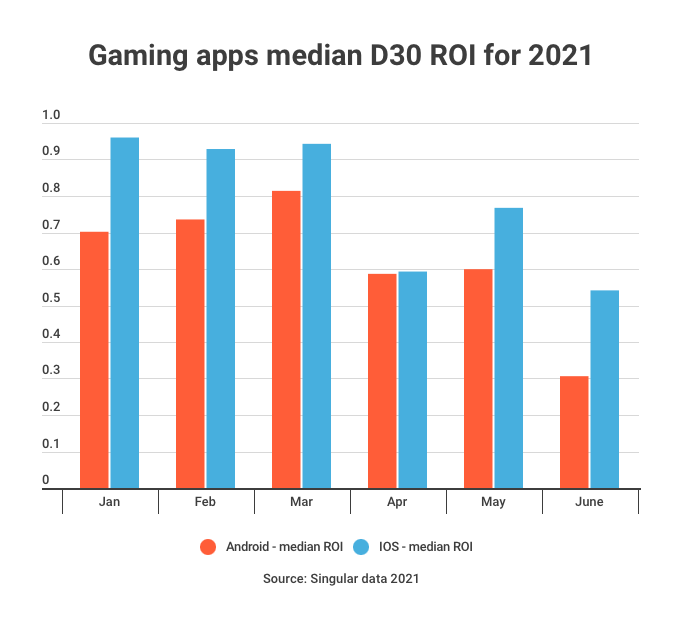
In crazy, turbulent times, it’s worth looking at whether ROI and ROAS are significantly different than before. So we pulled data on D30 media ROI for top gaming publishers.

With organic revenue included, it looks not too bad at first glance.


gaming-apps-ROI-D30-2021


However, there’s a clear dip on Android and iOS at a very interesting time: right after Apple released iOS 14.5 and SKAdNetwork became a real, functioning, must-take-action thing. Right at the time, of course, when at least hundreds of millions of dollars of ad spend — and possibly billions — left the iOS ecosystem for Android.

For the Android side of the house, that’s further evidence that more dollars were chasing the same number of app installs, depressing organic installs as a percentage of all Android installs. On iOS, while ROI bounced back somewhat in May, April was a huge drop and May isn’t back up to the typical levels of January, February, and March.

Interestingly, when you take organic revenue out of the picture, iOS looks worse than Android for return on ad spend. There’s a number of potential reasons for that, including a larger organic multiplier effect on iOS than Android and likely a few other factors … but that’s fodder for another day’s data dive.

Note:
It’s important to not take the June ROI dip too seriously: since we’re looking at D30 ROI here, close to half the installs are not completely realizing their expected ROI yet and a big percentage are not even halfway there.


Summing up: change is the only constant

Hey: it’s 2021. It’s like 2020, only even crazier.

There’s a lot of change happening in the mobile marketing ecosystem, and not every player has caught up yet. In addition, it’s clear that mobile attribution as we once knew it is dead and next-generation attribution is not just a nice-to-have anymore.

It’s essential.

There is no longer one way of generating accurate and reliable attribution truth on iOS. Instead, there’s multiple datasets from a myriad of sources, some deterministic, some probabilistic, some bottom funnel, some top funnel. All of this needs to be combined for the 20-30 different ad partners top-performing marketers are using.

And then next-gen attribution platforms also need to take into account web, offline, email, owned, and any other marketing modality that top marketers are using, whether paid, earned, or owned.

We are not in Kansas anymore.

Why Vungle bought JetFuel: surround sound marketing and programmatic influencer marketing

Vungle has now bought four companies in nine months. And, as we hear from LUMA, there have been more billion-dollar adtech acquisitions in the first quarter of 2021 than in the previous several years combined.

So what’s going on in adtech and marketing?

Obviously we’re in a period of massive change and upheaval. The third-party cookie may have lived to fight another day, but the IDFA apocalypse happened and it’s not coming back at scale. There’s new levels of competition and regulation, and that’s causing huge swings in market behavior that frankly, we haven’t seen in a decade or more. Accruing as much first-party-data as possible that isn’t subject to platform rule changes or regulatory oversight is more and more critical.

How does that all connect with Vungle buying JefFuel? And with all the other mergers and acquisitions in adtech and martech, like Digital Turbine buying Fyber?

To find out, I had a conversation with Vungle’s SVP of Revenue Scott Silverman on Growth Masterminds, Singular’s podcast for mobile marketing insight.

Vungle’s adtech acquisition strategy

Silverman says Vungle’s strategy is to buy companies that help adapt their business to a changing marketplace while building core functionalities that app developers need from game design and development to marketing and monetization.

The goal: one company that can increasingly meet all their needs. In other words, an integrated tech platform for development, growth, even retention.

Adding JetFuel, he says, is also about helping developers and marketers compete in an increasingly challenging ecosystem.

“How can we help them acquire users where those users live?” says Silverman. “The market is becoming increasingly complex. And so consolidating in that environment helps solve some of these tough problems.”

It’s certainly good timing, because influencer marketing is probably the fastest growing advertising segment right now.


Influencer marketing is (still) exploding

People are on social media in their billions, as we know. And in a lot of cases they’re blind to traditional ads: one of the reasons why rewarded ads are so popular is that they demand at least some attention. But influencers are pros at capturing attention, and what they offer, when done well, isn’t perceived as an ad.

Influencers capture the lion’s share of the attention of those billions on social, and now JetFuel owns a network for 15,000 of them with 4 billion Instagram followers, 1.5 billion TikTok followers, and 100 million daily Snapchat views.

That’s significant scale.

And scale is good, Silverman says.

“I think that having some level of scale helps give marketers confidence that the partners they’re working with are invested and capable of solving the tough problems that they have.”

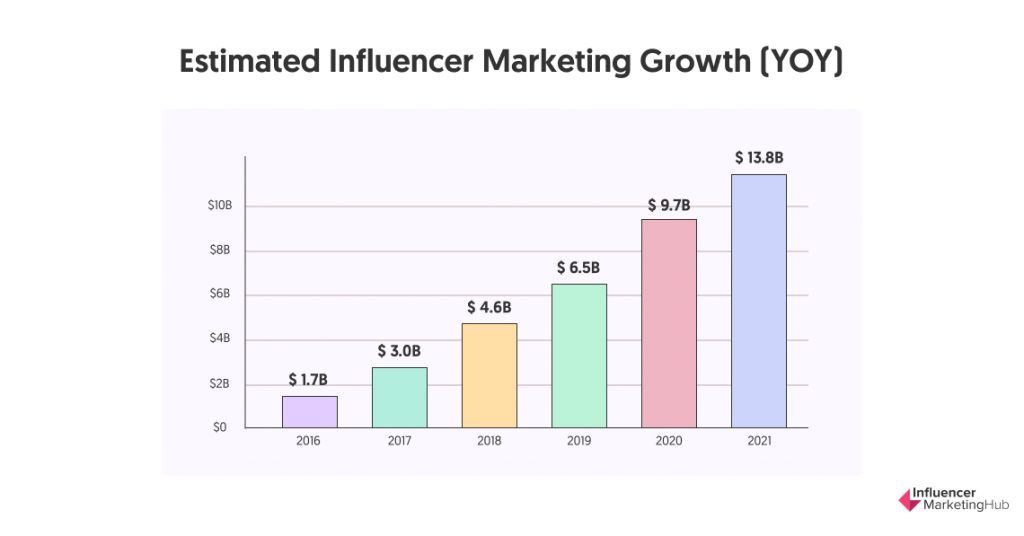
Estimated Influencer Marketing Growth YOY

It’s good timing.

Influencer marketing is still exploding, according to Influencer Marketing Hub, which says that while the category accounted for just $1.7 billion in 2016, it hit almost $10 billion last year. In full calendar 2021, influencer marketing is projected to grow to $13.8 billion. That’s impressive, and platforms like JetFuel — which hit our 2021 Singular ROI Index for superior returns on ad spend — makes it easy. Where influencer marketing used to be a one-off business per influencer, platforms like JetFuel make it programmatic.


Surround sound marketing and the Rule of 7

This kind of reach — and programmatic access to it — plays into what a Clorox direct-to-consumer marketing executive recently told me about “surround sound marketing.”

“I am a firm believer that creating a ‘surround sound’ for consumers is helpful,” says Vivan Chang, VP Growth at Clorox DTC. “[You are] leveraging influencers, brand partnerships, on top of the  traditional social and Google and affiliates, really having a lot of different places that have similar but maybe slightly different messaging for a consumer.”

That’s interesting for mobile-first companies to consider.


As mobile has become both pervasive and normal, mobile-first and mobile-only companies are starting to think of themselves less as apps and more as brands. And in an increasingly less granular, less trackable, and less deterministic marketing world, they’re starting to explore advertising avenues that previously they might have turned their noses up at. In other words, they’re looking at more traditional marketing channels … which are decidedly non-traditional for mobile gaming and fintech and retail app companies.

The surround sound idea is simple: be where people are, and ensure they encounter your brand on the web, on mobile, in apps, on social media, and in outdoor and in-venue options.

The old-school rule of thumb for marketing was the Rule of 7: people needed to see your brand and your message seven times before taking action. The exact number is of course debatable and in fact incredibly dependent on individual people. And there’s no magic to it: someone who doesn’t need what you’re offering is unlikely to bite.

But surround sound marketing including web and even potentially offline and non-digital channels are increasingly important to mobile brands.

The interesting thing about influencer marketing?

It’s increasingly cross-platform and cross-channel … a row and not a column. An influencer might have his or her strength on YouTube or TikTok or Instagram, but as the creator economy matures and influencers see others get canceled or negatively impacted by algorithm changes, most are working hard to develop one-on-one platform independent connections to their fans. That might be email, web, a creator coin (yes, they exist), an app, or a minimally-curated platform like OnlyFans (not just adult content!) or Substack.

And that means that fans see messaging from influencers in multiple places.


Content fortresses, picks and shovels, and slightly different strategies

It’s interesting to compare Vungle’s strategy to Digital Turbine, which recently bought Fyber as well as AdColony. (Interestingly, many of the acquired and acquiring companies are perennial winners on Singular’s ROI Index. Correlation isn’t causation … but there could be a connection there …)

There are two strategies that adtech and martech leaders are using separately or together, as they wish and are able, in the current rush to acquire, merge, expand, and dominate. (Or just survive.)

  • Build a verticalized tech stack to better enable the flow of demand
  • Build a content platform that enables the supply of demand

The first strategy is about the tools and the tech: creating, packaging, and offering the “picks and shovels of the gold rush” that Silverman talks about to app developers and marketers. The second strategy is about creating what Eric Seufert calls a content fortress, an entirely first-party way to both create and satisfy demand.

Digital Turbine wants to build a one-stop shop like Vungle: a “fully verticalized and fully integrated advertising stack,” as Digital Turbine’s EVP of corporate development and strategy Matt Tubergen told me. Interestingly, Digital Turbine with AdColony, Fyber, and Mobile Posse has focused on the advertising side, where Vungle has focused on the tools — the “picks and shovels” — that mobile brands need to be successful. But Digital Turbine is also trying to build a platform that embodies demand, thanks to the 600 million Android devices it ships on straight from the OEM: a content fortress.

That’s supremely valuable because it puts you in the position of being able to create the supply that you then fill with demand. Ultimately, it taps into what makes the SANs so effective at hoovering up huge percentages of advertising budgets … owning both sides of the coin. It’s a new kind of (sometimes verticalized) walled garden.

Vungle hasn’t necessarily gone there yet.

JetFuel is clearly access to billions of potential impressions over dozens of platforms. Algolift assists in user acquisition. GameRefinery helps developers and product managers refine games and improve monetization. And TreSensa is a creative production and optimization tool for marketers.

It will be interesting to see if Vungle starts acquiring companies on the content and demand side as well. Because that’s certainly possible.

Vungle was purchased for $750 million in 2019 by Blackstone, an investment company with $649 billion dollars in assets under management. It’s not shy about making acquisitions — Blackstone currently has 95 portfolio companies — and has another $39 billion in available capital to invest.

In other words … there are very smart and well-funded people behind the scenes that are likely to pull the trigger on more investments and acquisitions as the adtech and martech markets consolidate and existing players jockey to provide as much value as possible: to make themselves as indispensable as they can to their customers. And to survive the already-here and still-coming data squeeze.

“We’ve been super-active just in the last nine months,” Silverman told me. “There’s no plan to slow that down.”

“If we find something that we think is going to be the right fit for our company, our culture and our vision, we’ll continue the trajectory.”


Subscribe to Growth Masterminds

Did you even know that Singular has a podcast? Probably not … we’re pretty shy about it. Here’s an idea: subscribe to us chatting with the smartest marketing people we can find. (And maybe ping me if you want to be a guest!)

Subscribe on …


Ad spend measurement: 3 ways marketers tackle one of mobile’s biggest analytics challenges

Mobile marketers across the globe recognize the massive importance of ad spend measurement. The ability to effectively collect ad spend data from media providers directly affects a marketer’s success on mobile.

But various events can skew your ad spend data as it travels from your ad networks into your analytics, distorting metrics, destroying the ability to target your most profitable audiences, and interfering with vital activities like creative analytics. As a result, collection of accurate and detailed spend data from ad partners is a non-trivial task that trips many marketing teams up.

It is a problem that Singular set out to solve for marketers more than seven years ago. In that time we’ve pioneered numerous technologies to automate the collection of accurate and detailed ad spend data directly from media providers in just about any form imaginable: API, export, PDF, screen-scraping, and more.

As the industry matures, and other analytics platforms start to recognize the importance of ad spend and ROI analysis, the time feels right to review the various spend collection methods being utilized in the mobile marketing industry and highlight the advantages as well as the limitations of each method.

In doing so, we hope to advance the growing dialogue on ad spend collection in the analytics ecosystem and continue pushing the industry to improve the handoff of marketing data from media providers to advertisers.


Overview of spend collection methods

Currently there are three main types of methods for collecting ad spend:

  • Direct: platform integrations
  • Semi-direct: exports and reports
  • Indirect: passing spend data in tracking link parameters (i.e. cost “macros”)
  • Indirect: passing spend data in server-to-server postbacks


Platform Integrations

In this method, media providers such as mobile ad networks report rich metadata and performance information through some form of programmatic data reporting, commonly a reporting API. In many cases, networks have multiple API endpoints that may serve different granularities, breakdowns, formats, or audiences.

Advantages

  • Platform integrations give marketers the ability to accurately match the media provider numbers, including cases in which data changes retroactively
  • Platform integrations give marketers access to a wealth of information beyond ad spend, such as additional performance metrics, creative data, targeting options and more
  • Platform integrations are the only way to integrate with the self-attributing networks (SANs): Facebook, Google, Twitter, Pinterest, Apple Search Ads and others
  • Platform integrations pass sensitive data is securely,  server-to-server
  • Platform integrations provide data as quickly as it is available, and therefore quicker than any other method

Limitations

  • Platform integrations are harder to build and maintain
  • Platform integrations must map media provider identifiers to user data, requiring coordination between tracking links and data collected
  • Platform integrations can limit data update frequency – while some networks offer near real-time updates, others offer hourly or daily updates


Semi-direct

There are also cases where networks send data in email reports to complement some form of reporting that the API lacks. There are other cases in which dashboards and various types of exports (e.g., CSV via Amazon S3) complement reporting where an API is not available.

Advantages

  • Semi-direct at least gives you data … always a good thing
  • Semi-direct data is right from the ad network, so it should be accurate

Limitations

  • Semi-direct data may not be timely
  • Semi-direct data for one time period could be different in a later export as more data from extended attribution windows becomes accurate
  • Semi-direct methods can be brittle


Passing Spend Data in Tracking Link Parameters

With this method, marketers attach a few additional macros for cost data to the tracking links they create in their attribution platform (e.g., cost={...}&cost_model={...}). These links are built such that additional cost information is appended on top of every ad click (and ad impression, when view tags are supported).

While most larger networks support passing spend data through tracking links, many networks do not support this method. In addition, we’ve found that relying solely on tracking links to transmit cost data frequently leads to inaccuracies, which is why we recommend marketers complement data from tracking links with data from Platforms integrations, side-by-side, to ensure 100% accuracy and consistency.

Advantages

  • Tracking link parameters deliver a built-in capability to attach cost to individual user data
  • Tracking link parameters update data in near real-time
  • Tracking link parameters are simpler technology and relatively easy to maintain

Limitations

  • Tracking link parameters have inherent discrepancies with media providers – tracking links don’t ensure a 100% match with the network’s spend figures, and spend could differ from the actual invoices marketers receive
  • Tracking link parameters make it difficult to support cost reconciliations, retroactive data updates and discounts
  • Tracking link parameters are not applicable for self-attributing networks (like Facebook, Google, Twitter, Snap and others) as tracking links aren’t supported in these networks
  • Tracking link parameters make it challenging to support CPM & CPA campaigns:
    • CPM requires impression tags, which aren’t globally support yet, and due to sheer volume/inaccuracies will only increase discrepancies.
    • CPA is harder to support as cost is determined by a downstream metric or a set of downstream metrics, and there isn’t a clear way to define that at the link level


Passing spend data in postbacks

This method is similar to the tracking link method, however, instead of using tracking link parameters, media providers can send cost data through postbacks directly to the attribution provider. While we expect postbacks to deliver improvements over the tracking link method, other challenges (listed below) still remain unresolved.

Advantages

  • Postbacks deliver a built-in capability to attach cost to individual user data
  • Postbacks deliver data in near real-time
  • Postbacks offer support for all campaign types (as opposed to tracking link parameters)

Limitations

  • Postbacks suffer from inherent discrepancies with media providers – this method doesn’t ensure a 100% match with the network’s spend figures, and spend could differ from the actual invoices marketers receive
  • Postbacks make it difficult to support cost reconciliations, retroactive data updates, and discounts
  • Postbacks are not applicable for self-attributing networks like Facebook, Google, Twitter, Snap and others
  • Postbacks require development from the network, and not all networks have the resources, ability, or desire to change their ad server to fit these requirements, and as a result, coverage is still limited


Summary

As pioneers in this field, we are excited to see the increased awareness of the problem of marketing data collection. This is a problem we have been solving for our customers for over four years, and along the way we have seen the impact of our work: better collection techniques, new interfaces with media providers, and overall increases in granularity, speed and accuracy.

Our fundamental belief is that the best solution to the problem is the most comprehensive one: one that combines all available methods of ad spend and marketing data collection into a hybrid approach. Singular’s customers are some of the largest marketers in the world, and as such, we are held to the highest standards of delivery for accuracy, coverage, speed, and granularity.

Our promise to our customers and our ecosystem is to keep innovating, and tackling the problems to come. In fact, we have some groundbreaking innovations we are excited to share with the world in the upcoming months, and we can’t wait to tell you more about them.

To learn how Singular can solve for marketing data collection in your business, request a demo now.

SKAdNetwork impact: Android ad spend, ATT opt-in rates, ad network growth, and iOS 14.5 adoption

Mobile ad spend is in a chaotic state right now.

Android is increasingly growing mobile app install ad spend over iOS as iOS 14.5 adoption hits mainstream. Meanwhile ATT adoption is slowly increasing as the late majority updates their phones and tablets, and ad networks that took the IDFA apocalypse seriously and prepared well in advance for the massive changes that iOS 14.5 and SKAdNetwork brought are growing market share significantly.

We’ve been reporting regularly on the changes iOS 14.5 and SKAdNetwork have been driving in the mobile industry. Check the recent stories in the series if you haven’t seen them already:


Android vs iOS ad spend trend continues

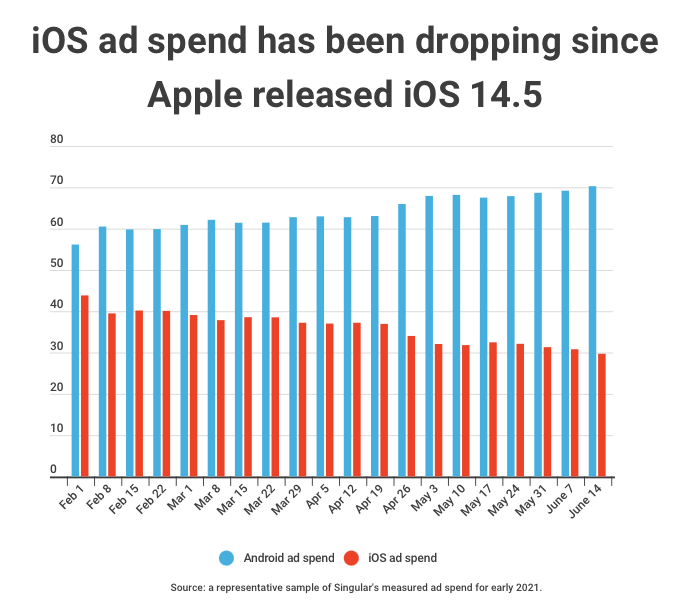
As we reported last week, the changes and uncertainties of iOS 14.5 and SKAdNetwork have driven ad spend to Android, causing spend on iOS to drop. That trend is continuing into late June.


android-vs-ios-ad-spend-skadnetwork-ios145


In the last two weeks of June, that trendline just extended. iOS has lost another percent of total ad spend to Android from June 14 to early July. The pace of change has declined, so it’s not hard to imagine this trend stopping and even reversing somewhat over the next month as mobile growth experts get their SKAdNetwork feet under their legs and reinvest in iOS.

Mobile spend is somewhat chaotic at the moment — there’s even panic in the space, according to some industry analysts — leading to fairly erratic choices that might not be 100% data driven.


iOS 14.5 adoption: now at mainstream

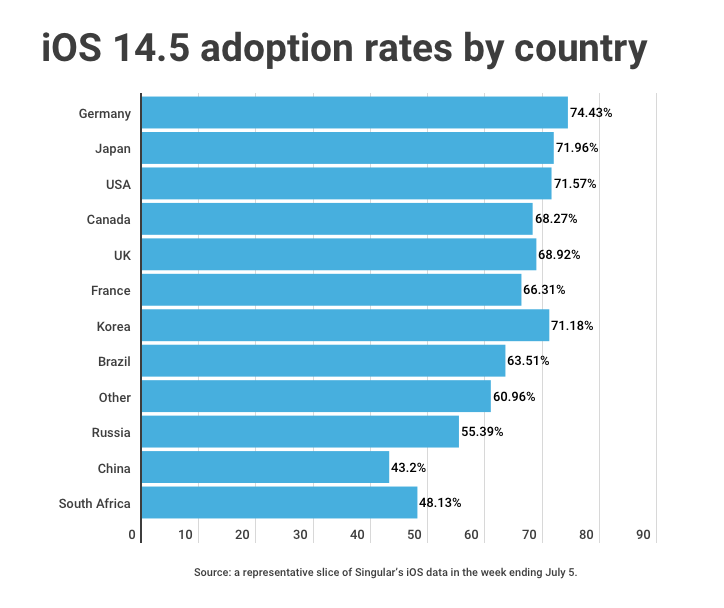
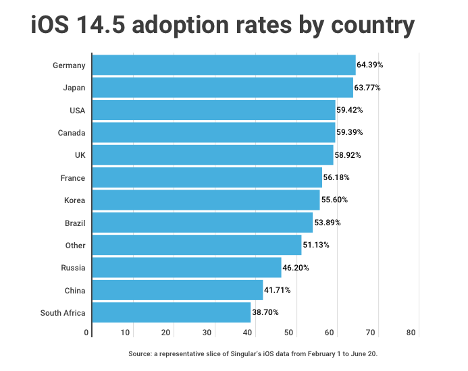
iOS 14.5 is now basically mainstream, as nearly three quarters of Apple mobile devices are updated to 14.5 or later.

And that means that most of the impact that iOS 14.5 and subsequent iOS releases will have on the industry is already happening now. While we’re not yet at the 90% level, almost 70% of people globally have updated their iOS devices to iOS 14.5 or higher.

(I’m currently on iOS 14.7 on the iOS beta program.)


iOS 145 adoption rates by country


The U.S, Germany, and Japan are all above that level, China, Russia, and South Africa are lagging a little. Some of that lag is likely due to older devices that cannot update to the latest operating system; others due to people who are specifically ignoring updates.

(One note: if you happen to notice that at just over 43% China appears to have barely progressed from the just under 42% we last reported, you’re not nuts. Since this data is based on the OS version reported during an app install, it’s possible that even in sample sizes of millions of installs per country we could get a segment that isn’t 100% representative. It’s definitely directionally close, but if early adopters don’t regularly add more apps, the data could under-report them.)


App Tracking Transparency opt-in rates: slightly up

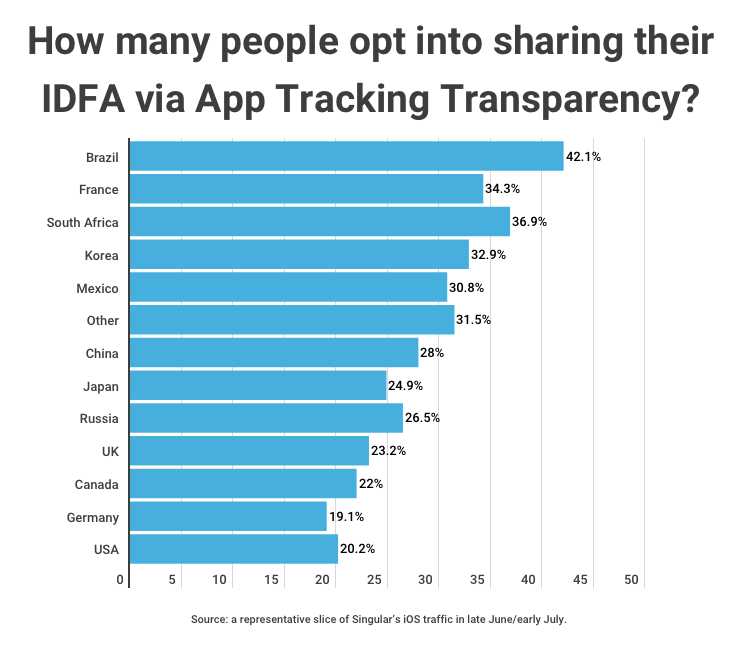
ATT acceptance rates are slightly higher in the past few weeks. Last time we reported, on June 23, App Tracking Transparency acceptance rates were at 23.64% globally, on average. This past week’s data indicates that ATT opt-in is now at 26% globally.

We’re now seeing the late majority and even laggards update their devices, so it’s not surprising to see that they might have slightly different preferences and habits. Ultimately, however, these levels are nowhere near where mobile marketers would like them to be if the IDFA was going to keep its primary position as a tracker and identifier for measurement purposes.


app-tracking-transparency-july-2021


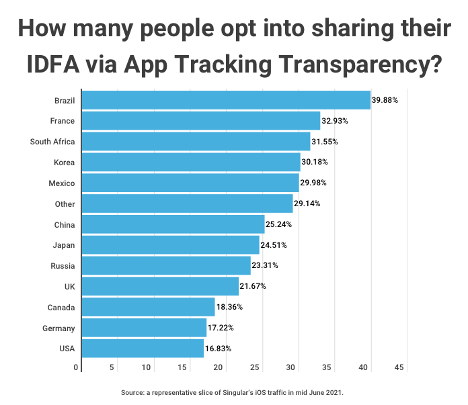
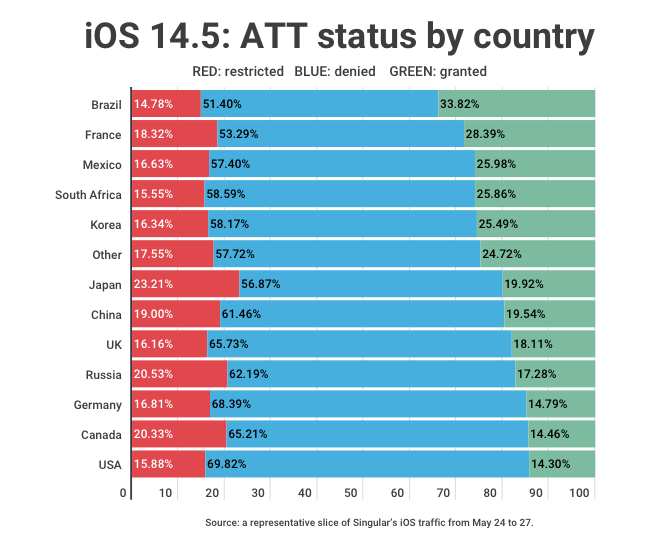
There are definitely some countries where optimizing at least some of your mobile marketing performance via IDFA is still very much an option. With 30% and up opt-in rates in South Africa, France, Korea, and over 40% in Brazil, this data can still be useful.

The U.S., Germany, and Canada, however, are in the 20% club. Given that you need IDFA opt-in from both the app advertising your app and your own app to enable full measurability, 5-10% of your installs might have IDFA. That’s nothing to sneeze at or ignore … it can be at least one indicator for optimization.

But clearly it is no longer definitive. The IDFA is now one of multiple signals in a more complex data environment that mobile growth marketers need to take into account in order to understand performance and optimize for future growth.


Ad networks with growth in SKAdNetwork

SKAdNetwork has been good for some ad networks that worked hard to prepare for the IDFA apocalypse. Among the gainers: Vungle, Liftoff, Applovin, IronSource, and Unity. Some platforms were also up, including Twitter and TikTok.

While some of that might be due to chaos in the space and spend flailing around looking for a place to land, there’s a clear correlation between ad networks that spent time and effort and money preparing for iOS 14.5 — and publicizing the fact — and those who are gaining.

One company SKAdNetwork was good for?

Apple.

Apple Search Ads saw a huge bump immediately following the launch of iOS 14.5. Its percentage of app install ad spend almost doubled week over week. But … it’s a mistake to attribute all of this to iOS 14.5, however, as Apple also released a new placement at the top of search results at nearly the same time, and advertisers probably wanted to give this a try. In about a month, however, that growth reversed itself somewhat, and in the most recent week ASA is up about 20% after adding almost two percentage points of global spend.

One thing we know: SKAdNetwork isn’t good news for all smaller players.

It is interesting and important to note that the flight to mid-tier networks didn’t — at least yet — include third-tier players: the smaller ad networks with less of a footprint and fewer clients. While we’ve often seen at Singular they produce good ROI, they’re simply not as well known or understood. And in some cases they may lack the capacity to soak up additional billions of requested ad placements in literally days or weeks.


More data coming soon: connect to get it direct

We are releasing data regularly on the impact of iOS 14.5. Sign up for updates to our blog here (scroll down to subscribe.) Then make sure you drag the email to your priority in-box to ensure you see it regularly.

And, if you need next-generation marketing measurement support, book some time with Singular. We’ll listen, learn, and suggest some options that are working well for others.

Deeplinking, iOS 15, and Android 12: what works, what breaks, and what changes

The good news is that nothing’s changing about the actual user functionality of deep links.

The bad news is that in iOS 14.5 and iOS 15, there are significant changes to how marketers can use them and what marketers get out of them. And while Android 12 is adding significant new privacy features to Google’s mobile operating system, they don’t appear to include anything around deep linking … yet.

Deep links, as mobile marketers know, allow one-click access to specific resources or sections deep within an app.

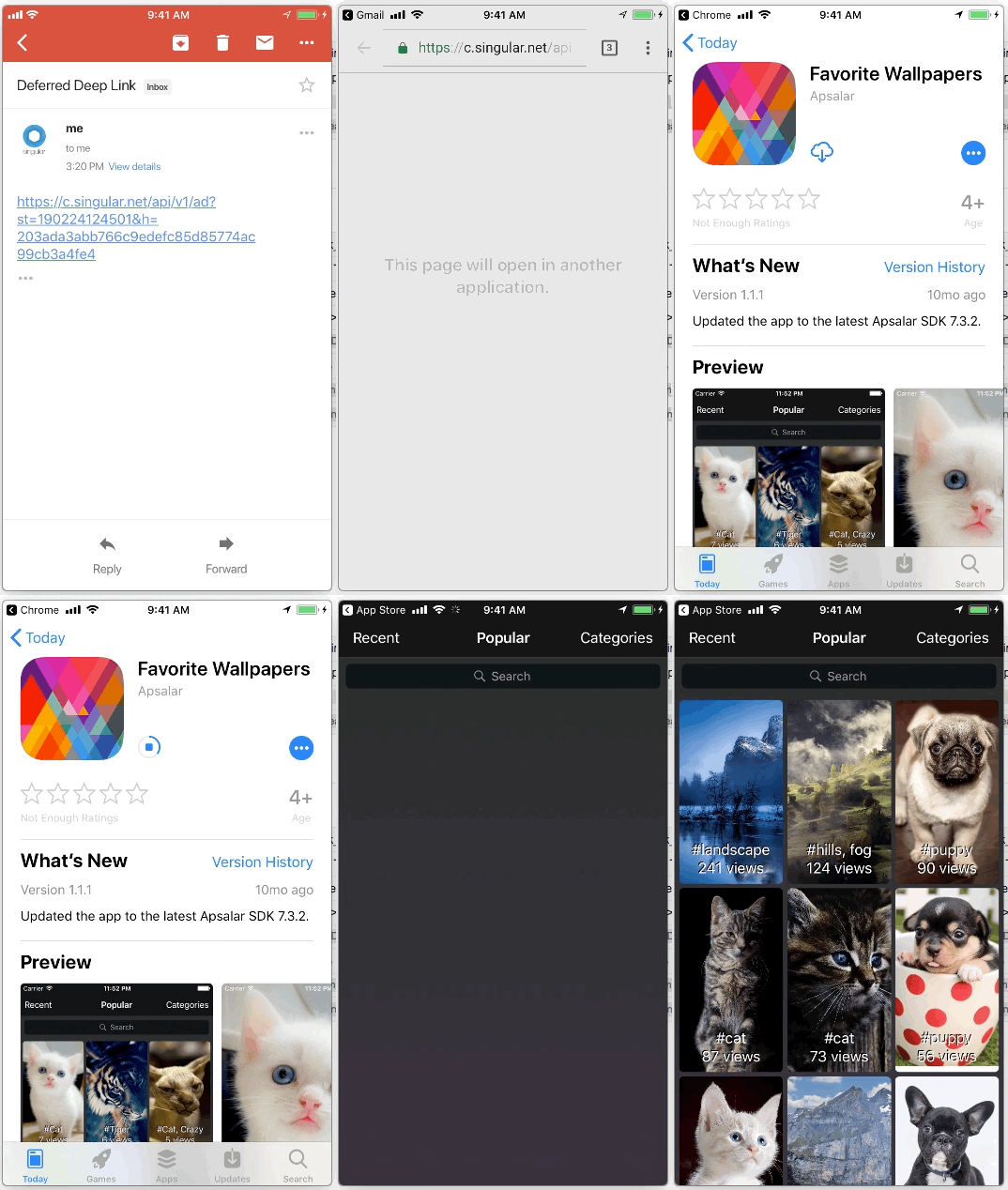
They also allow one-link access to a brand’s information and offers, whether they’re online or in an app, and can also enable directed in-app experiences for people who have not yet even downloaded your app, via deferred deep links.

On Android, that’s achieved via Android App Links, and on iOS deep links operate via the Universal Links framework. Both are supported and “just work” when developers and marketers use Singular Links.

deep links deferred singular links android app links universal links


Deep links are old …

Deep links have been around since 2006 in a web sense. There, they simply refer to linking directly to a page or resource inside a website rather than the home page itself. But deep linking as a mobile technology to enable direct access to a specific in-app location started in an incredibly kludgy and hard-to-use way as early as 2008 in “iPhone OS 2,” as Apple’s mobile operating system used to be called.

Google popularized the technology in 2012 when it added deep linking to Google+.

(Remember Google+, Google’s abortive attempt at a social networking Facebook competitor?)

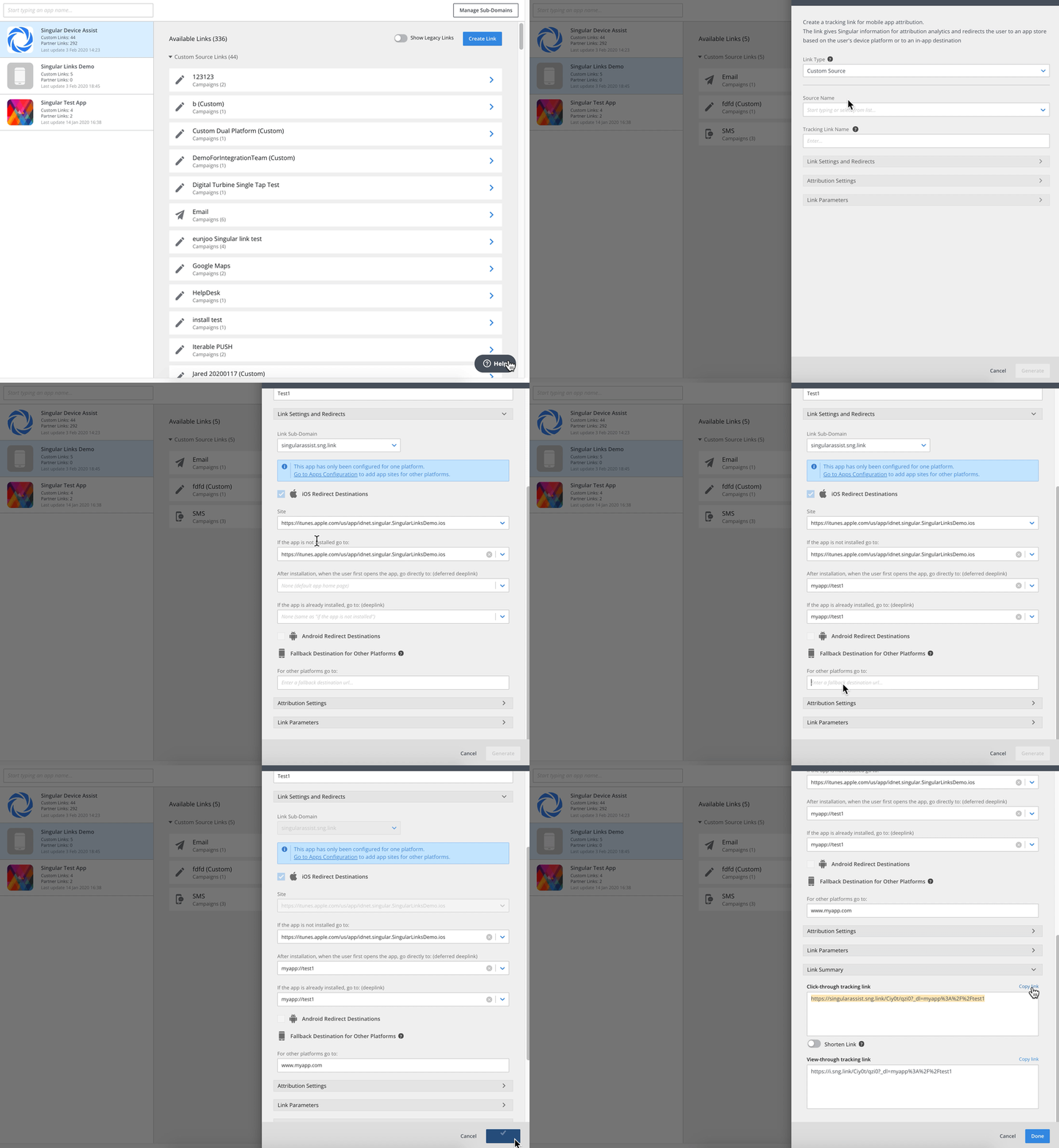
Over the years they’ve undergone significant changes. But most of the complexity of how developers need to associate web resources with app resources, how to create links, and how to measure their use and effectiveness is buried under a simple link creation interface in the Singular dashboard. One change in iOS 14: app-website associations are no longer managed by apps on devices, but by server functionality in Apple’s CDN.


Nothing’s changed for users

Marketers use deep links to get existing app users from a push notification, an email, an in-app message, or even a website to an offer, resource, information, level, or functionality within an app. Marketers also use deferred deep links to provide a custom experience to brand-new users who haven’t yet installed their apps.

If, for example, McDonald’s offers a 10% discount for mobile ordering, McDonald’s would probably like to have new mobile customers land right on a thanks-for-installing-here’s-your-10%-off-coupon page right after getting the McDonald’s app from Google Play or the iOS App Store.

That still works and works just fine. At least, from a user perspective.

Marketing measurement, however, is a different story.


Deep links and marketing measurement in iOS 14.5 and iOS 15

While the user experience part works just fine, measurement on iOS now relies on knowledge of a user’s in-app choices that the link origination point has no means of knowing.

“Generally, deep link measurement is as dead as IDFA-based measurement,” says Singular’s Jonathan Chen. “You can’t attribute unless you have consent.”

But, of course, the IDFA is not quite dead. And deep linking measurement is not quite dead either. Someone could have your app and upon completion of the deep link and entry into the app experience, you can check on ATT (App Tracking Transparency) permission. If they’ve granted it, you can attribute that user action, measure it, and record it.

But as we know … most won’t.

And those that do might be really deferred. Imagine a deferred deep link scenario for a new user or customer who does get your app, but you are only asking for the IDFA via ATT opt-in on second or fifth open, or maybe after a different event or level of engagement.

Of course, deferred deep links have their own core problem: they depend on attribution which is unknowable because it hasn’t been set yet. In the classic model, marketers knew that a device with an IDFA of 123456 saw an ad, clicked on a link, installed an app, and is now opening an app. The deferred functionality can then tell the app where to direct the new user or customer.

In other words, getting them to the 10% discount page for mobile ordering.

You don’t have that IDFA anymore in most cases, making deferred deep links hard to implement. At least for very specific use cases. The 10% discount page for new mobile users might be a blanket offer to everyone: easy to implement. A $50 off to a specific customer for a specific reason via a specific offer … not so much.

There may be a work-around, however.

iOS has a universal clipboard so that iPhone owners can copy something in one app and paste it in another (and, in fact, copy on a Mac and paste on an iPhone, or vice-versa). This is very useful for long strings of text. But it’s also dangerous, in some ways, for passwords or other sensitive information that users might copy, because other apps that are active can see what is on the universal clipboard.

So if an originating app or website or email could paste something on the clipboard and a newly downloaded app could access the clipboard … and if it all happened fairly quickly and if the user hadn’t already done something else somewhere else and copied something else … there could be a way of connecting a stimulus with an action.

The failure rate could be high with this methodology, and the longer the gap between the click, the install, and the eventual app open the higher it will get, but some use cases are quick, so it could work. Inviting someone to a private chat channel in a messaging or social app, for instance, might be something someone acts on immediately. But some use cases require certainty, like vouchers, rewards, and customer-specific discounts, and in all scenarios you’d need a backup methodology in case it fails.

(Welcome to the blast from the past: “enter this code” for your discount.)

Plus, there are likely privacy and Apple guideline risks here. It’s not hard to imagine how this could be used to break privacy rules and track devices/users even if they have not consented via ATT.

So this requires serious thought and consideration before implementing, and apps had better be able to defend what they do and how they do it to Apple during the App Store review process.


Deep links and Android 12

Android 12 is the next major leap for Google’s mobile operating system, and it will bring more personalization, more privacy, and better performance to the most popular operating system on the planet.

In terms of privacy, Android 12 will add notifications about apps using permissions — think Apple’s privacy nutrition labels — as well as visual notifications via device light-ups when the mic and/or camera are on. Android 12 also will introduce a very interesting new feature: a “private compute core” that functions as a sort of firewalled edge computing capability for potentially sensitive personal data like transcriptions.

android app links deferred deep links

The privacy features in Android 12 don’t include a Google version of App Tracking Transparency, however. But some versions of ATT will likely come to Android in some way at some point (the specificity in this sentence is shocking, I know). FLoC is delayed and third-party cookie deprecation is delayed.

But they have not been taken off the table.


Privacy-safe marketers may need a blast from the past

Deep links are still great functionality to make your apps work well and your users or customers happy. They won’t be panaceas for marketing measurement, however.

And in some cases, they never were.

Self-attributing networks like Facebook, Google, Snap, and Twitter never allowed measurement links for mobile campaigns, meaning that deep links and deferred deep links had to be set up separately per platform, if at all. Wrapped links — like those on Twitter that always start with t.co, or links from a URL shortener like bit.ly — also don’t work.

Fortunately, there’s a technology that has worked for decades: the coupon code.

The technological solution still works, and there’s likely more than can be done here. But the backup plan is as old as the very first newspapers.

$1.5B in ad spend shows iOS 14.5 is driving mobile ad spend to Android

iOS ad spend is now down 32% from its peak in 2021.

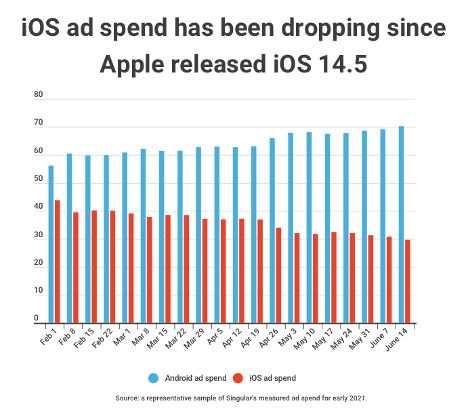
In early February, mobile advertisers that have both an Android and iOS app split their buying almost evenly between Android and iOS. Between February 2 to 7, marketers spent 56.16% of their budgets on Android app install campaigns and 43.84% on iOS.

But last week, from June 14 to June 20, the split was 70.29% to 29.71%.

That’s a massive difference in just four months.

ios ad spend


Digging into the data: iOS vs Android ad spend since iOS 14.5

There are some explanations to make and a few caveats to mention here.

The chart above is a representative sample of Singular’s global ad spend data totalling more than $1.5 billion from February to June 20. All of the sample spend is from customers who have both an Android and iOS app.

Is this all due to iOS 14.5?

Probably.

But is the iOS ad spend situation as bad as the numbers look?

Probably not quite, no.

But it is significant. We haven’t seen this kind of Android vs iOS shift in recent years, so this appears to be a real event that’s actually reflecting a shift by mobile app install ad buyers globally. However, it’s very important to note that part of this apparently massive iOS to Android shift is likely due to artificially inflated iOS spend in the weeks and months before Apple released iOS 14.5. As we know, iOS 14.5 took away a guaranteed advertising identifier while making marketing measurement harder and user data more scarce. So part of the big numbers in iOS ad spend in February and March was likely pre-buying: purchasing ad inventory in the last days of the free IDFA before Apple’s iOS 14.5 came and made the identifier for advertisers an advertiser ask and a user opt-in.

So some of this massive decrease is likely illusory.

But not all of it.

Case in point: the mobile ad spend numbers after April 26 tell a similar story.

April 26, of course, is when Apple released iOS 14.5. In almost every week since then, the percentage of total ad spend that advertisers directed to iOS has dropped, while Android keeps rising. The week before iOS 14.5 dropped, iOS ad spend was 37% of total spend on Android and iOS combined. The week after, it was 32%, and except for a minor bump in the week of May 17, the downward trajectory has continued until last week, ending (for now) on June 20 at 29.71%.

It’s not just the percentage of iOS ad spend as a proportion of all mobile app install ad spend that’s dropping.

It’s also the actual spend totals.

ios ad spend

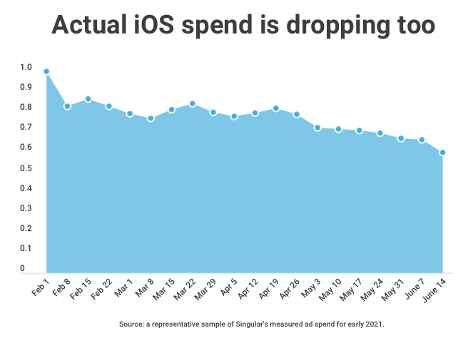
If we normalize February 1-7’s ad spend as 100%, June 14 is 59.8% of that. If we agree that the early February data is an outlier and prefer to look at February 15, the June 14-20 data is still 26 percentage points lower: 86% of early February’s spend to basically 60%.

Correlation isn’t causation, right?

But … there’s something else that has been happening at the same time.

iOS 14.5 adoption hit the turbo button

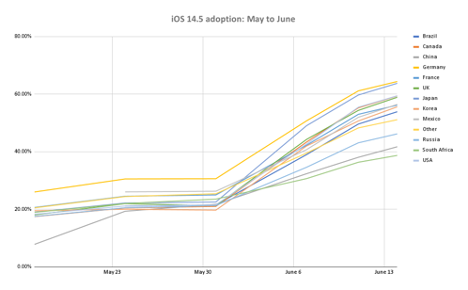
Right after May 30, Apple flipped a switch and started informing iOS users that there was an upgrade available. Adoption rates, which had been slow, immediately picked up. By June 17, the latest data I have, 52% of global iPhone owners have updated their devices to iOS 14.5.

ios 14.5 adoption

Germany leads the pack with almost two thirds having updated their devices, while South Africa is just shy of two fifths. After a slow start, Chinese users have rapidly accelerated their updates.

ios 14.5 adoption

If there’s a causal relationship between availability of ad identifiers and ad spend focus, the ad spend percentage between Android and iOS is likely to continue to change in Android’s favor. If this is a temporary phenomenon until advertisers rejig their growth stacks for SKAdNetwork and non-fingerprinting probabilistic measures of advertising effectiveness, the iOS ad spend percentage could rebound.

Time, as they say, will tell.

And … App Tracking Transparency opt-in rates?

ATT rates haven’t really changed through the iOS 14.5 adoption curve.

On May 21, when iOS 14.5 adoption was under 20% globally, ATT-restricted devices were at 19% and opt-in rates were at 19.4%. On June 4, that was only up to 24.3% globally, and opt-in rates were up a hair to 19.7%.

As of last week, we’re at 23.64%. Note: that means 23.64% of the time when iOS apps requested App Tracking Transparency authorization, they get it. More than three quarters of the time, however, they do not. As many others have written about, thanks to the dual-opt-in necessity of marketing measurement in iOS 14.5 (advertised app and ad-displaying app) these numbers mean that unless your app is an extreme outlier, the IDFA is essentially useless for what it once was: the definitive provider of attribution truth.

(One caveat here: even if your dual opt-in rate is only 10% or so, if you find that your ATT opt-in users are representative of your ATT opt-out users, you might be able to cautiously make some optimization inferences.)

Interestingly, some countries are significant outliers here:

ATT opt in


While the global rate is edging up as late adopters start to update their iPhones and iPads, regional differences are much more significant. In Brazil, almost 40% of people opt-in to tracking; in the USA, where Apple has advertised heavily about its privacy enhancements, the rate is significantly lower: 16.8%.

Subscribe for insights by mail

We’ll be updating these numbers soon, and adding more insights on different aspects of SKAdNetwork. If you don’t want to miss any, you may want to sign up for Singular’s content email newsletter.

Scroll down on the blog home page to find the “Stay up to date” sign-up spot. Then, when you get the first email, drag it into your priority mailbox to tell Gmail or whatever email app you use that it’s important.

We don’t spam. We do aim to provide a significant amount of insight and value. And we’re honored to be one of your sources of vital marketing ecosystem information.


Zeroing out the Android Limit Ad Tracking (LAT) will impact only 2% of devices globally

You’ve heard that Google’s making a big step towards mobile privacy by zeroing out the GAID, or Android advertising ID, for people who opt-out of ad personalization on Android. What you haven’t heard is how utterly minuscule the percentage of people that this impacts actually is.

So we checked.

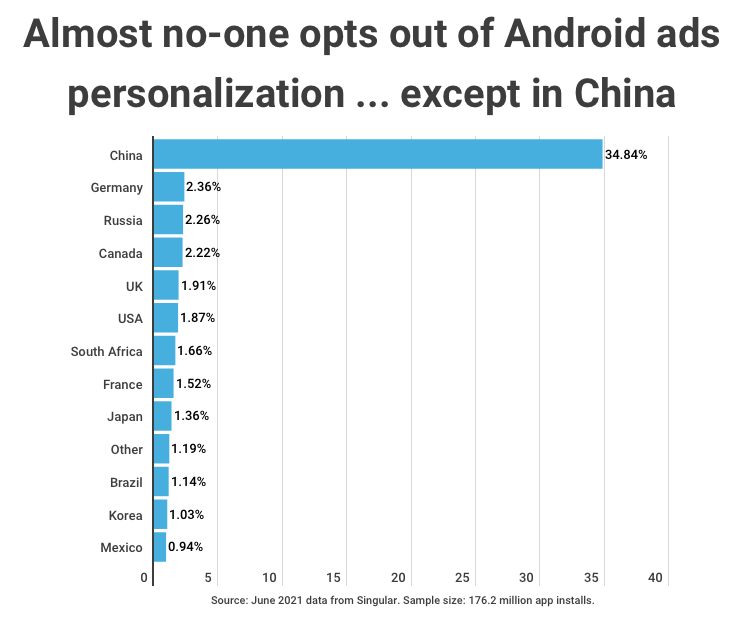
And based on a recent sample of Singular data consisting of more than 176 million Android smartphones globally, only 2.08% of Android users have tunneled down into Settings -> Privacy -> Advanced -> Ads and actually turned Ads Personalization off. Most countries are in the 1-2% range, but one country is a massive outlier.

Keep reading to see the data for 12 major nations …


Google Advertising ID: what it is and what it’s used for

The Google advertising ID or Android advertising ID identifies an Android device for advertisers. Ad networks can do rate limiting based on the GAID. They can do retargeting. Marketing measurement companies like Singular can do attribution, which helps advertisers understand how successful campaigns and partners are. And advertisers can track how valuable new users or customers that they’ve acquired from various campaigns, creatives, or sources are, giving them important information for future marketing optimization.

But when you can follow an IDFA on an iOS device or a GAID on an Android device around the world by seeing where it pops up in mobile ad auctions, you can also do some shady things.

opt out of interest-based ads Android

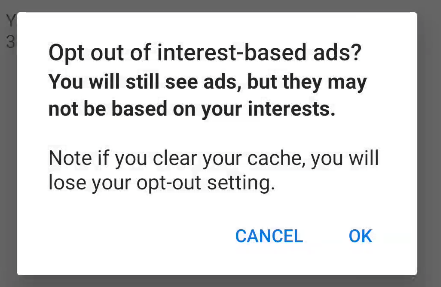
In the past, Google has essentially relied on the honor system: if an Android owner opts out of ads personalization, the advertising identifier was still available if an adtech vendor asked for it.

There’s a reason for what, on the surface, seems like an odd decision: the GAID is also used for analytics, fraud detection, and attribution. In other words, non-advertising situations. But it’s a little odd to use an advertising identifier for non-advertising purposes … and it’s even more Boy Scout to think that there are no bad actors out there who will use what’s available regardless of the guidelines and rules.

So now Google is doing what Apple has did on iOS versions pre 14.5 when people turned Limit Ad Tracking on: zeroing out the Android advertising identifier if people turn Ads Personalization off. (Note how those actions move in opposing directions but essentially do the exact same thing.)


But, very few people opt out of Ads Personalization on Android

While zeroing out the Google advertising ID is a nice gesture from Google and will increase privacy for those who care, the reality is that almost no one opts out of Android ads personalization. Literally, 98% of people globally have kept the default Android setting to personalize ads.

A couple caveats on the below data: it does not include server-to-server traffic, where Singular doesn’t see the GAID, and there are some devices where the Ads Personalization on-off setting isn’t available. Also, this particular sampling of data doesn’t include a lot of China-based data, so the massively higher opt-out rate in China isn’t impacting the global percentage very much.


opt out ads personalization global percentages android


Clearly, the Ads Personalization setting in Android is almost irrelevant, except in China.

Why China is such a massive outlier here I cannot say with certainty (ping me if you can) but I assume is likely due to some version(s) of Android from one or more Chinese manufacturers that ship with different defaults. Anyone can get Android source code from the Android Open Source Project and then fork it for their unique take or skin on Android, which is why Xiaomi has MIUI, Vivo has Funtouch OS, and Oppo has ColorOS.

Essentially, opting out from ads personalization on Android is a rounding error.

But it wasn’t always this way.


‘Limit Ad Tracking’ on Android used to be higher

I first studied Limit Ad Tracking on iOS and ads personalization on Android in 2016 as the Mobile Economist for TUNE, a former mobile measurement partner. (A lifetime ago!) Ad Age’s Kate Kaye picked up the story.

At that time, LAT was already falling. Across all mobile devices from both major platforms, limit ad tracking was down about 5% in a year:

Use of the limit-ad-tracking setting fell to 16.7% of devices in February from 22% in August 2015, according to Tune, which observed 1.3 billion mobile app installs by about 150 million people over seven months, from August 2015 to February 2016.

This is the first example of data measuring the use of the limit-ad-tracking feature, said Jules Polonetsky, ‎CEO of the Future of Privacy Forum. Limit ad tracking, he continued, “despite being this central privacy control, really doesn’t get a lot of debate or discussion.”

That year, the number of Android users who had turned ads personalization off was more than double the number of iOS users who had turned Limit Ad Tracking on. (Yes, I know the opposite direction here is confusing; both actions essentially do the same thing.)

But in 2020, when I studied the same numbers for Singular, things had changed dramatically:

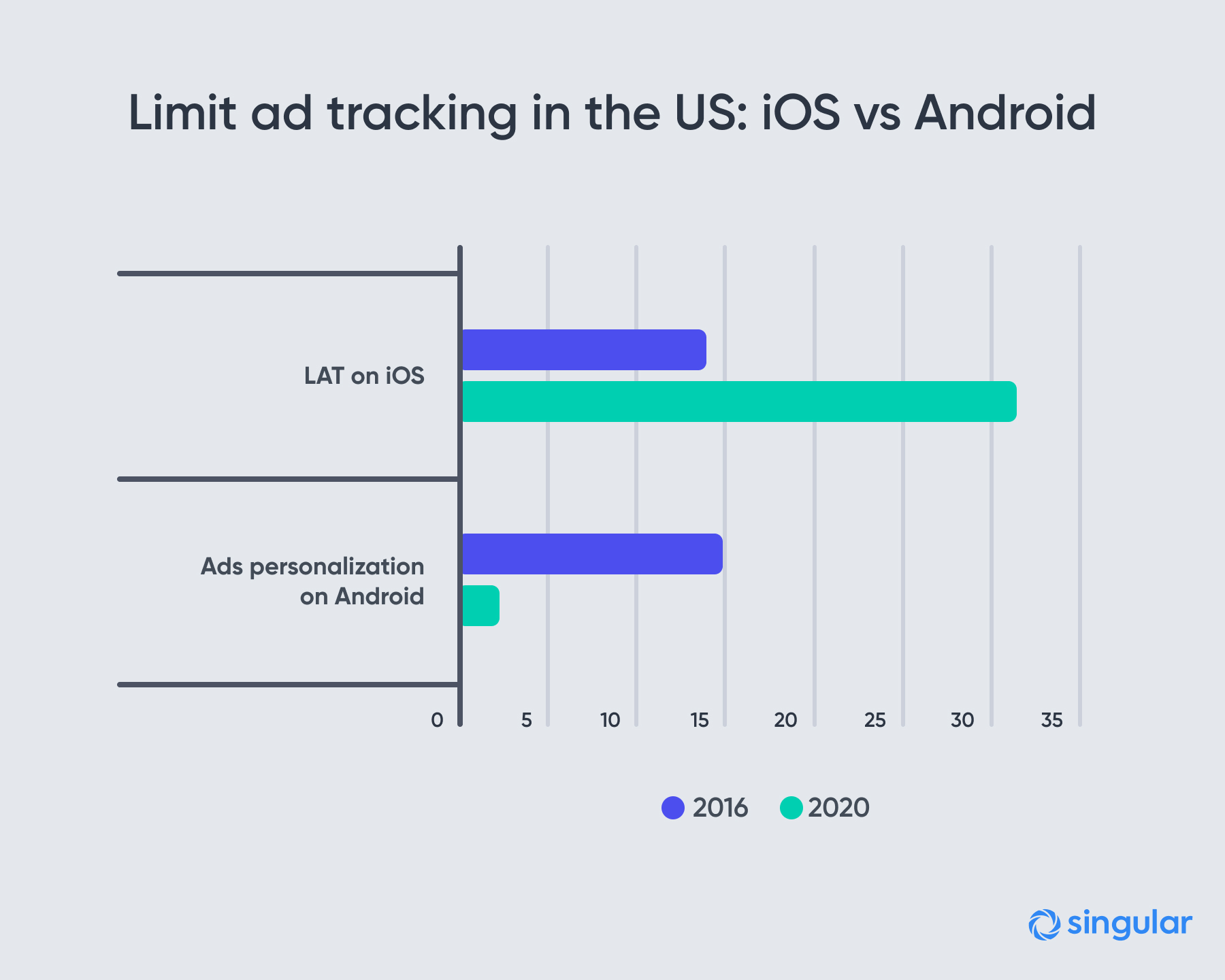
[In 2016] 11.4% of iOS users had turned LAT on, limiting the data that they provided to advertisers. On Android, 25.3% of Americans had switched off ads personalization, which accomplishes the same purpose.

But in 2020, we’re seeing significant changes in opposite directions. Now, ads personalization on Android is down to just 2.3% and Limit Ad Tracking on iOS is up to 31.5% — a massive swing in opposite directions on both major mobile platforms.

Here’s the data from early 2o20 in a chart:


Apple starting banging the privacy drum

Between 2016 and 2020, Apple started banging the privacy drum. Which of course is even louder now with iOS 14.5, SKAdNetwork, privacy-safe marketing measurement, a completely opt-in approach to ad measurement and tracking, a new App Privacy report in iOS 15, and Infinity War style TV ads with nosy people popping out of existence.

Not shockingly, we see that reflected in the data on app tracking opt-in rates:

ATT-rates-by-country-iOS145

(Check back on the Singular blog next week, by the way: we’ll be updating that report.)


The upshot for Android

The upshot for Android is pretty simple: Google’s change won’t impact much. It’s the right call, and some would argue overdue, and it signals a new Google approach to privacy along with FloC and other initiatives.

But for now: Android-focused growth marketers are essentially going to be doing business as usual.

Also, there’s good news: Google will be replacing the GAID with an alternative solution for use cases that are not ad personalization related. And it’s coming soon:

In July, we will provide an alternate solution to support essential use cases such as analytics and fraud prevention.

That’s good news for marketers, and it’s something that Apple might want to take a look at and consider. There are places that SKAdNetwork simply doesn’t work or offer a solution, and the industry needs privacy-safe replacements for what has been taken away.


Need to chat? We have a sofa

If you’re looking for experts to chat about next-generation marketing measurement in a confusing and ever-changing era of increased privacy and shifting technologies, we’re here to help. We’ll listen, learn, maybe offer a few condolences, and then share how Singular can help you with your unique challenges and requirements.

Growth is still possible. We can help.

Book some time, and we’ll chat. Sofas are optional.

Kid-safe attribution: Why SKAdNetwork is a huge boost for kids-focused apps

For everyone else in mobile marketing, the end of mobile advertising as we knew it happened just weeks ago when Apple finally released iOS 14.5. But kids-focused mobile app publishers had their privacy apocalypse way before: almost 18 months ago. Growth, measurement, and monetization in the kids category changed massively in early 2020, when Apple restricted access to the IDFA and other device and personal data in kids categories.

And back then, there was no SKAdNetwork to take the place of the IDFA.

Losing the IDFA in the iOS 14 privacy apocalypse and adapting to regular SKAdNetwork changes and updates has most mobile marketers living in a constantly changing Inception-style world.

But not publishers of kids’ apps.


SKAdNetwork: huge for kids’ apps

Because for kids apps makers, iOS 14.5 is a wonderful thing. These days are happy days. And the marketing measurement data they’re now getting — that every other marketer thinks is barely a trickle — seems like a flood to data-starved kids advertisers. And that could unleash a whole new round of investment and innovation in the children’s sections of the App Store.


Watch the interview with Kidoz co-CEO Eldad Ben Tora:

(Subscribe to Singular’s YouTube channel to get updates when we publish.)


User acquisition for kids apps slowed dramatically in January 2020 as publishers were left blind, says the co-CEO of Kidoz, the world’s largest kid-focused mobile ad network. Targeting moved to contextual, measurement meant that you got an install from somewhere by someone, but not much more. And post-install engagement and conversion data was totally nonexistent.

Now that’s all changing.

“IDFA was taken and they were … left blind,” says Eldad Ben Tora, co-CEO of Kidoz. “Many app publishers that wanted to do user acquisition stopped for about a period of a year … now [SKAdNetwork] lets publishers in an aggregated way, in a way that doesn’t harm or risk kids’ privacy, to understand the value of each source and to attribute revenue to this source.”

The result, Ben Tora says?

Smart user acquisition in the kid space is actually growing for the first time in 18 months. Publishers badly need growth … and now it’s possible in a safe and optimizable manner.


Safe attribution for kids with Singular

Which means it’s good time for Singular’s privacy-compliant child-safe attribution product, which abides by the strictest COPPA (Child Online Privacy Protection Rule) and GDPR guidelines, and is a member of the PRIVO Kids Privacy Assured Program.

“Singular specifically looked at the kids market and they understood that the need for kid-friendly attribution exists, and kid-friendly attribution wasn’t really addressed by the other players,” says Ben Tora. “No-one said: ‘we provide safe attribution for kids,’ and I’m very happy that Singular said so.”

The result, Ben Tora says, is good, usable marketing measurement: impressions, clicks, installs, and revenue … all while maintaining full user and device privacy.

Listen to the interview on Growth Masterminds, Singular’s podcast:

Today that’s more important than ever because advertisers are losing their access to kids. Kids make up more than 30% of all internet users and 40% of all new users (unsurprisingly), so they’re a critical demographic … maybe even the biggest market out there, Ben Tora says.

But how they access media is changing.


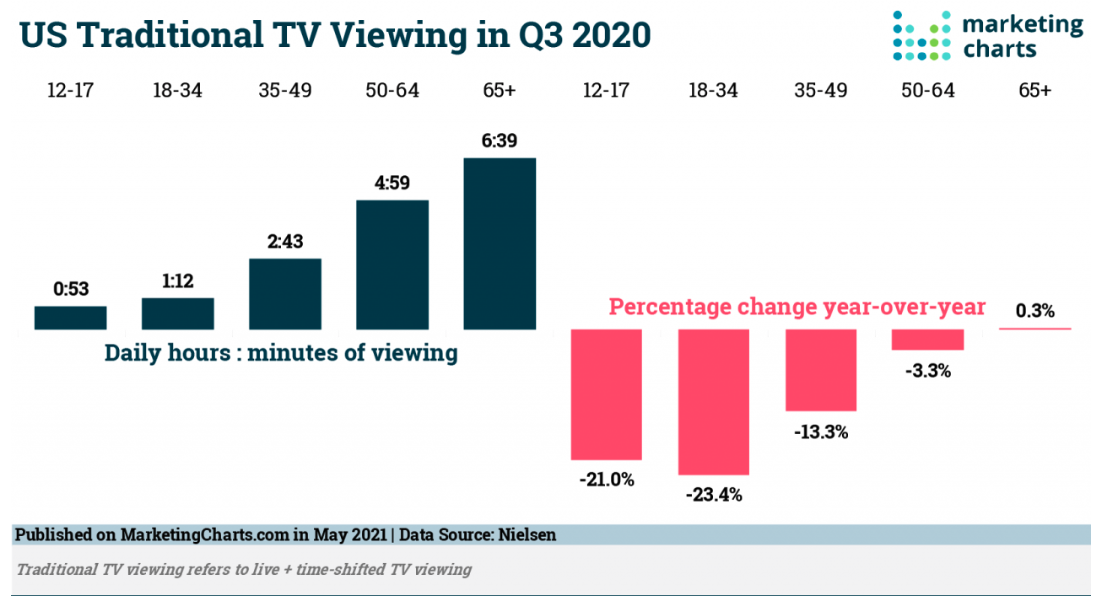
TV viewership is down
TV viewership is down, according to Nielsen and Marketing Charts


“[Advertisers] pretty much lost their number one channel, which used to be TV,” he told me. “If they do watch TV, they watch Netflix and other streaming services.”

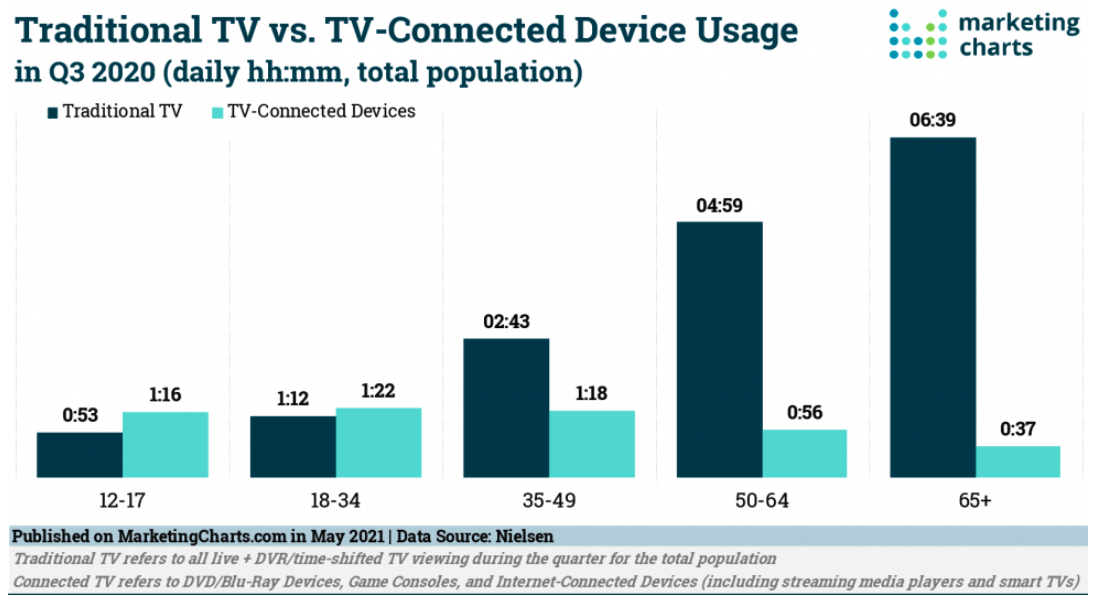
In fact, connected streaming media is now a majority of TV time for kids and young people, according to MarketingCharts and Nielsen:


traditional tv vs streaming kids usage
Traditional TV vs streaming video: kids usage has changed, according to Nielsen and MarketingCharts.


Better monetization for kids apps now

So there’s been a disconnect in the market: kids have switched from big devices on walls to small ones in hands, and advertisers have not been able to reach them effectively on those small devices. Meanwhile, kids app publishers had a different but related problem.

“We saw the frustration from advertisers on one side,” says Ben Tora. “They say ‘I want to reach kids, but I can’t really understand how,’ and we saw the publishers on the other side saying, ‘well, we have tons of kids using us, but we can’t really monetize.’ And we said okay, let’s just match those two together.”

Now with iOS 14.5 and SKAdNetwork, measuring monetization is possible. There isn’t the wealth of information that IDFA traditionally provided, no … but there’s also not a total gap. Publishers can see the revenue attached to new user acquisition, at least in the first few days, and that helps them make optimization decisions.

“So I think monetization is easier today,” says Ben Tora. “And the good side is that the budgets that are coming in from … the Lego’s and the Disney’s of the world are finally coming to mobile.”

Privacy regulations and measurement challenges actually kept significant kids’ brand budgets on TV, he adds, suggesting that they are now making the switch to where their audience is primarily moving.

“I’m a big believer in safe ads for kids and monetizing [your app with ads] and allowing your content to be free,” he says. “Because if you put up a paywall, then you’re actually saying to 90-95% of your user base: you can only enjoy a fraction of my app. And by opening it up through ads, you’re actually making it more accessible.”

Which is actually a good thing on the Android side as well, because Google sees that your engagement and retention is higher, and it gives app publishers higher Google Play store rankings.


Parents or kids: who makes the app install calls?

I had to ask Ben Tora one key question: who makes install decisions for kids? Is it the kids themselves, or the parents?

“I think the advertisers tend to understand that eventually kids decide,” he said. “The kids, they know what they want. They tell us what they want … if the parent is the one that decides on downloading the app, the usage will decrease immediately because he didn’t take the kid into account. So I think that now kid-focused advertising is becoming the norm.”

Bad news for parents? We’re not in charge anymore.

Good news for advertisers? They can safely reach the true decision makers in the family.


Learn more about kid-safe marketing measurement

Interested in learning more about Singular’s kid-safe marketing measurement and mobile attribution? Book some time with one of our experts. We’d love to chat about what you’re doing, what you need, and how we might be able to help.

And, subscribe to Growth Masterminds on your platform of choice:


Major iOS 15 attribution news: Advertiser access to SKAdNetwork postbacks, App Privacy Report, and more from WWDC

Apple has announced significant new privacy and attribution features in a massive update of developer news at WWDC.

One that’s critical for app developers, publishers, and marketers: App Privacy Reports in iOS 15. Others that are extremely interesting is a new way of aggregating postbacks in SKAdNetwork, plus new privacy updates in Safari and Mail, Apple’s native Mac apps for browsing and emailing.

But perhaps the most significant is SKAdNetwork postback aggregation, which has the ability to dramatically impact how SANs (self-attributing networks) operate.


SKAdNetwork postback aggregation in iOS 15

One thing that always seemed odd to me about SKAdNetwork: postbacks were only sent to ad networks, which would then have to find a way to get it to advertisers. Most are reputable, and many use 307 temporary redirects to get the postbacks immediately to Singular as independent third-party verification and aggregation … but it still seemed weird.

Why not send postbacks to advertisers, who can then check their media sources’ homework?

Starting in iOS 15, that’s exactly what Apple’s doing.

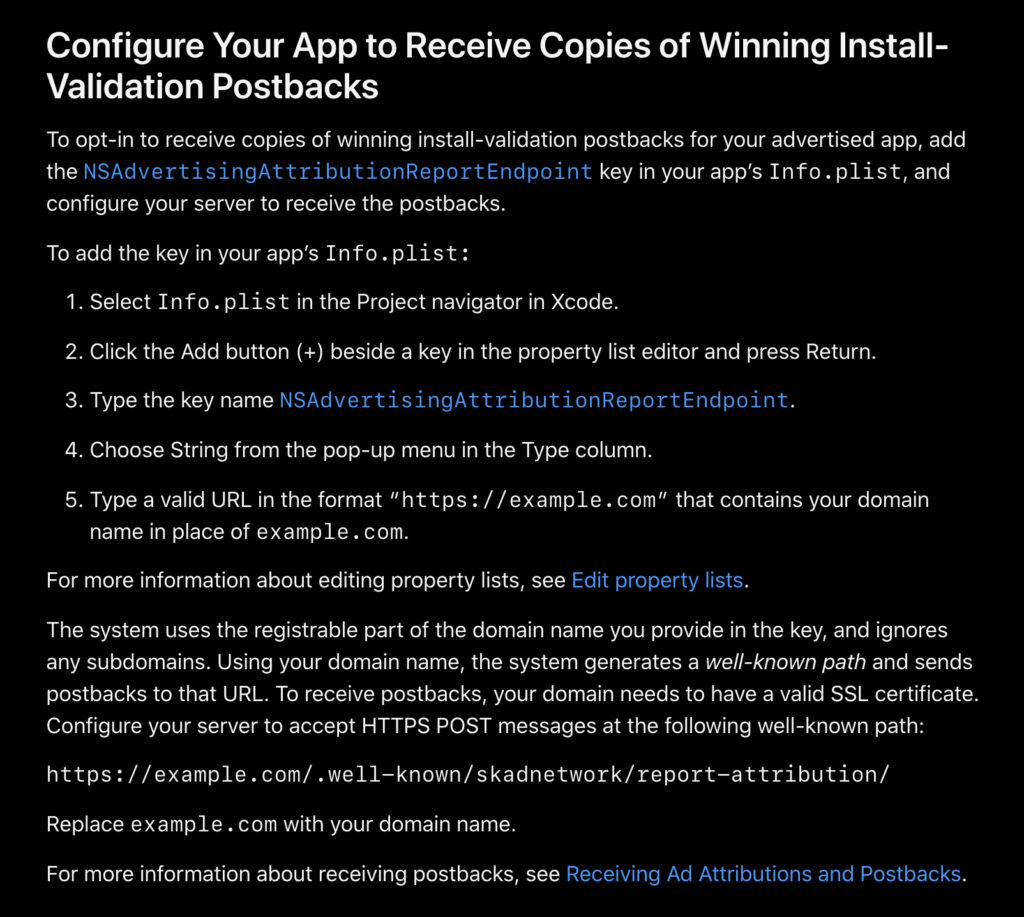
“Starting in iOS 15, devices can send a copy of the winning install-validation postback to the developer of the advertised app,” Apple says. “Developers opt-in to receive the postback by specifying a server endpoint in their app’s Info.plist.”

skadnetwork iOS 15 postback aggregation collection

App publishers and marketers can now configure a single catch-all collection point to receive “a copy” of all SKAdNetwork postbacks for your app. In other words, your ad network is still getting a postback, but you’re getting one too. Superficially, that’s great: you can check your ad networks’ and media partners’ numbers. Singular, for instance, can be the aggregation point, interpret your conversion models, aggregate all your postbacks from all your partners and all your apps, and you can see everything all in one place.

But there’s something even more significant happening here.

Getting postback copies directly from Apple allows marketers to get more direct data than ever before on the results that SANs generate.

Self-attributing networks, of course, have always held tightly to their data, and rightly so. They have deep reservoirs of data about who does what with regards to ads on their platforms, and there are significant privacy implications for sharing that data. Now, while still anonymous, advertisers can directly check SANs’ homework for the very first time. SKAdNetwork is anonymized data, but it is also deterministic data. Once privacy thresholds are met, you’ll be able to see what happened from which partner for which app, regardless of who the partner was: small indie mobile ad network, or Facebook, or Google.

One important note: advertisers will get raw SKAdNetwork postbacks in iOS 15.

That means the conversion payload still needs to be decoded and enriched with data from the relevant ad networks and then displayed effectively so that marketers know both what they achieved and what to optimize in future campaigns.

(Singular, of course, does this already, and will continue to do it in iOS 15.)


App Privacy Reports

Apple has long had a privacy report in its Safari browser on desktop Macs that tells you what trackers are trying to follow you around websites, and how many trackers each site has. Tom’s Guide, by the way, has no less than 81 — at least how Apple defines trackers — while The Wall Street Journal has 76, and Bloomberg has 65.

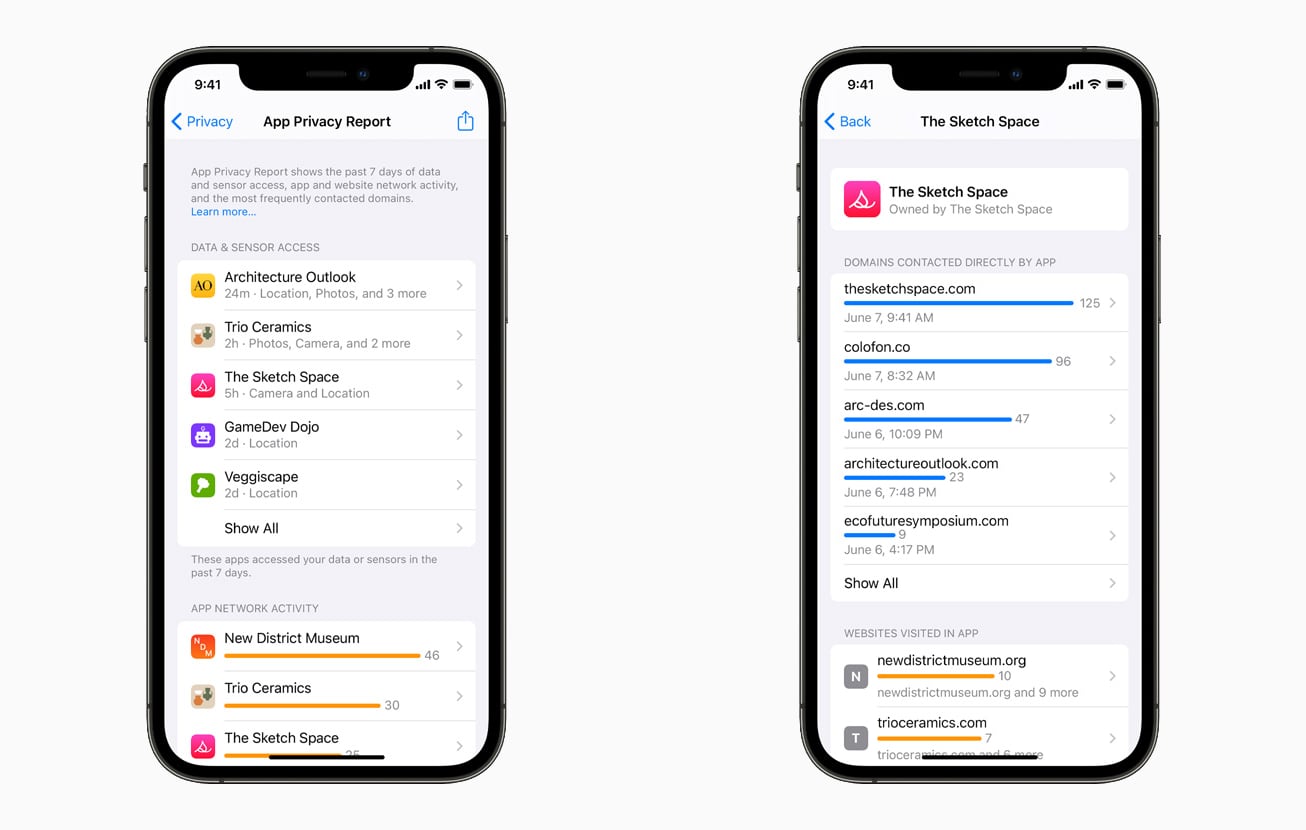
But soon iOS 15 will bring this kind of transparency to apps in an App Privacy Report:

App privacy report iOS 15

“With App Privacy Report, users can see how often each app has used the permission they’ve previously granted to access their location, photos, camera, microphone, and contacts during the past seven days,” Apple says. “Users can also find out with whom their data may be shared by seeing all the third-party domains an app is contacting.”

In other words: there’s no more room to hide.

In iOS 14, app publishers had to provide a “nutrition label” privacy report when updating their apps. In iOS 15, people are going to get the opportunity to see for themselves if the nutrition label is accurate.

While most people may never dig down into their phone’s settings to check their App Privacy Reports, I guarantee you that some will. And if they don’t like what they see, uninstalls will follow. In addition, journalists will be trolling these reports for anything that looks fishy.


And more on privacy in Apple’s ecosystem

Apple’s Mail app on iOS 15 and Mac OS Monterey will block tracking pixels, stopping companies and people from knowing if the recipient of their emails opened it, and masking their locations. Safari’s ITP, Intelligent Tracking Prevention is growing new muscles and will be blocking IP addresses from trackers, making fingerprinting harder if not impossible.

In addition, Siri will be processing data on-device, and iCloud+ will come with a built-in VPN — as long as people use Safari and Mail — meaning that web traffic and email will essentially be invisible to marketers.

(Singular’s privacy-safe web-to-app measurement functionality will continue to work regularly given it is leveraging URL parameters, which Singular is using to tell marketers where an install came from and what campaign it’s part of. We don’t use any invisible pixels or other email tracking. Plus, of course, it’s all first-party data, not shared with anyone else.)


Change is the new normal

For mobile marketers who are just settling into SKAdNetwork now: yes, more change is coming. This is the industry we’re in, and change is not just the new normal, it’s our normal.

For now, however, take a deep breath.

iOS 15 was just announced. It won’t launch until the fall, probably in September. We have time to prepare, and we’ll use it. If you’d like to have a quick chat with a Singular expert about SKAdNetwork, privacy-safe attribution, and maybe even iOS 15, book some time here.