Media mix modeling for mobile apps: a privacy-safe answer to marketing measurement?

Is media mix modeling the answer for mobile apps user acquisitions leaders who want to measure and optimize marketing and advertising?

Here’s the UA leader’s dream:

  • Immediate, accurate marketing intelligence
  • Actionable insights on channel, creatives, bids, and budgets
  • Privacy-safe, Apple compliant, GDPR-happy, CCPA-OK methodologies and mechanics
  • … all of which result in smart insights that generate massive growth

It’s a tall order for any methodology of marketing measurement. Can media mix modeling deliver that for mobile marketers?

Let’s dive in.

Media mix modeling is a senior citizen in marketing (not that that’s a bad thing)

There’s no really kind way to put it: media mix modeling is old.

Often referred to as marketing mix modeling, it’s been around since literally the 1950s and 1960s. Neil Borden, a professor at Harvard Business School, first coined the term marketing mix in 1949, and big brands used the concept in the emerging age of mass media to build statistical models of marketing effectiveness.

In that form, media mix modeling was effective at answering questions like these:

“If I spend $10 million on a TV campaign on the three big networks, what impact will it have on my sales of Cheerios?”

To build those answers, media mix modeling needed data: prior sales, ideally for years. Impacts on those sales. Seasonal trends. Competitive actions. Economic indicators like the consumer price index. Pricing comparisons. Availability data. Wider cultural movements, and so on. Marketing mix modeling typically used (and uses: it’s still in operation) intensive analysis of lots of data from lots of different sources over a long period of time. When it works, marketing executives get answers to the big “what if” questions like what will tossing $10 million at ABC, NBC, and CBS do to our bottom line?

This reliance on scale and history and long periods of time would seem to disqualify MMM as a methodology for the much faster-paced and lower-scale mobile user acquisition campaigns. And, indeed, when I recently talked to Adobe about their brand-new still-in-beta marketing AI-driven media mix modeling product, that suspicion seems to be accurate.

It works well: the system allowed one customer to cut ad spend by 50% while still growing 10%.

But there’s a big caveat: you need to be spending $50 million a year.

Well, some of the biggest mobile publishers are at that level, and beyond it. But certainly not the average mobile publisher. Most mobile marketers have much smaller budgets and need to know what’s going on with their $100,000/month spend or their $50,000/month budget.

Mobile marketing has been drunk on data

Let’s just be honest. Mobile advertising has been drunk on data: immediate data, accurate data, actionable data. Mobile growth professionals haven’t had to bother with pre-digital modes of marketing measurement … partly because they seemed ancient and inexact and cumbersome and expensive and slow.

But mostly because digital offered a dream: a pure and clean and bold dream of exact knowledge and perfect awareness and scientific marketing resulting in no wasted dollars.

(Fraudsters, of course, loved that dream.)

But despite challenges — and there are some beyond fraud — that dream required a level of tracking that 1960s marketers would be amazed at, if not shocked. It started with cookies on the web in 1994, continued with hard-coded device IDs on smartphones in the early 2010s, shifted to more user-controllable advertising IDs shortly thereafter, and is currently trending to largely disappear in the early to mid-2020s.

No data to gobs of data to much less data, all in about a quarter of a century.

But for the complete to-date lifespan of the mobile-first computing era until now, we’ve been in an era of data glut.

“We’ve had a data addiction in mobile,” says Brian Krebs, who runs MetricWorks and builds media mix models. “Because it has always been available.”

Hello again, media mix modeling (the times they are a-changin’)

Because those times are changing, driven by Apple, iOS 14.5, government regulation, and changing social attitudes, media mix modeling is coming back into the conversation. If you can’t get as much granular data via IDFA on iOS, and you’re wondering what might happen with AAID/GAID on Android, maybe there’s another way.

Maybe it doesn’t take a $50 million budget, and maybe it also doesn’t take as much crazy math and exogenous data about the surrounding world and competitor’s actions and economic shifts as we once thought.

If you pour in first-party data like day-of-week trends, vertical-specific trends like time of year seasonality, broad industry trends for app install frequency, plus specific-to-you events like getting featured by Google or Apple or having your game reviewed by GamesBeat or PocketGamer, that’s actually enough, says Krebs. Add to it the marketing activity for your app — spend and impressions — and you’ve got a good basis for MMM for mobile user acquisition.

You do need to vary spend from time to time — a steady-state drone makes efficacy hard to pinpoint — but that happens naturally with changing competition for impressions and availability of supply.

The reality might be that media mix modeling is better for mobile user acquisition than it is for its originally intended purpose: big, slow, spendy campaigns by massive national and global brands. And it may show incrementality better than traditional methods as well.

“It was surprising to us to be perfectly honest: MMM just works better in mobile,” Krebs says. “It’s simpler … you need fewer data points.”

But is it good enough?

What media mix modeling won’t give you

Look. A technique doesn’t have to be perfect to be useful. Anyone who thinks last-click attribution is a perfect measure of marketing performance is, frankly, delusional. And yet we’ve been largely using it for the last decade with, arguably, good effect.

Because it’s been good enough.

So the question is: is MMM good enough to drive decision-making?

Before we answer that, here’s what media mix modeling won’t provide.

Perhaps the three words that capture it best are immediacy, granularity, and clarity. Immediacy was of course the incomparable glory of the IDFA (which still exists, clearly, for 10-20% of iOS traffic) and still is the shining north star of GAID-based attribution. (It’s lacking — to an extent driven somewhat by your own decisions — in Apple’s SKAdNetwork framework, of course. You could reset the SKAN postback to as long as 7 days.)

Knowing what works as soon as possible is critical to quick optimization. Knowing what doesn’t work as soon as possible is critical to not wasting budget.

Media mix modeling for mobile doesn’t take the weeks and months it requires in the big brand consumer space. But it’s not quite as fast as a postback, either.

Granularity is similar: IDFA/GAID and even SKAdNetwork give you pinpoint precision data on a number of factors: source and campaign, a few configurable factors for SKAdNetwork, plus of course much more granular user-level data and cohorting for IDFA/GAID. There’s less data from SKAdNetwork, but smart customization and hybrid postbacks with encoded values for multiple events and/or timers can help.

MMM will provide less in each of these areas, including a little less clarity into helper networks, assists, and last touches, especially for mobile growth marketers who are accustomed to running with many different ad partners simultaneously. (Yes, you can argue that all those networks are casting hooks into the same river, and that’s true. But it’s hard to argue that all the hooks — and the bait on them — are of identical value, and are all cast into the very best parts of the river where fish congregate.)

Incrementality will also struggle with creative optimization, which of course you can address by manually limiting creative variations by campaign to see impact over time. And bids and budgets on individual platforms will be a little more opaque to MMM.

So … a hybrid model: next-gen attribution

Media mix modeling isn’t a silver bullet, someone who sells media mix modeling for mobile user acquisition teams told me. But it is useful. And, alongside an MMP, it adds context and insight.

The reality is that the age of tracking is ending.

IDFA is largely gone, fingerprinting is against Apple’s guidelines, and Google will be making some privacy changes over time as well.

So you do need next-gen attribution.

That means impressions, clicks, and costs, sure. Installs, when you can get them. Creative insights, as much as possible. Channel and partner-specific results, as available. Upper funnel data and lower funnel data. First-party data from within your own app: new users, engagement patterns, sign-ups, purchases. Bids and budgets, and normalization and standardization across all your data sources.

The reality is that it’s getting tougher out there. Last click on an advertising identifier was simple. Now, mobile growth professionals need a complete marketing data infrastructure, not just a mobile tracker. And you need that, by the way, across more than just mobile ads. There’s out of doors, TV, web, and other channels that are starting to matter.

Combining all that signal while simultaneously silencing the noise to generate insights for growth: that’s the next challenge. And MMM has a seat at that table as part of next-gen attribution.

Talk to us

Interested in learning more about how you can futureproof your marketing growth with next-gen analytics and attribution?

Let us know. We’ll be in touch.
13 best practices for A/B testing mobile ads

You’re kicking off a mobile ad campaign. You want crazy good results. You want massively high ROI and incredible ROAS. And you don’t want to spend 70% of your budget teaching the platforms what works to attract the best users for your app. So how do you do A/B testing to find the best ads?

Here’s 13 different (and lucky!) things to consider …

1. There are algorithms for that (but start with a clue)

You know the algorithms do a lot of the work in finding the best versions of your ads, but you also know that there needs to be a starting point for your A/B tests. And that you just might be a little bit smarter than AI, at least for a few years yet.

There’s also a financial challenge if you just rely on Facebook’s or Google’s or any other ad platform’s machine learning algorithms to find the best ad. The reality is that they can chew through a lot of budget in a short time running split tests just to find out what you already know.

This doesn’t mean they’re bad. Doesn’t mean they’re not helpful. Doesn’t mean you don’t want to use them. And it doesn’t mean that it’s impossible to find out that actually, you were completely wrong about finding the best way to get new players, customers, and people in your app.

But let’s assume you’re smart and you have a clue. Start somewhere intelligent, and let the algorithms refine your tests.

And then, yes, occasionally throw caution to the winds and try a few campaigns that are just completely out of left field, just to see if AI has a card or two up its sleeve and it can teach you a few things about how to connect with your core audience.

2. Formulate a plan

What are you going to test first? What’s the full list of things you want to test? Do you have a hypothesis? Random action may unexpectedly produce a Picasso … but it’s not likely. Start your A/B testing with at least some of the scientific rigor that you hope to harness in selecting winning campaigns, creative, and copy.

What do you expect to happen? (OK, hope will happen.)

Document, report, and iterate.

3. Pick an audience

We’d all like to appeal to everyone but we’re not all Google. (And even then some people choose DuckDuckGo or Bing.) Even the simplest hypercasual game has different groups of people who want to use it; pick which one you’re going to target with your first A/B test.

Typically you’d start with the expected highest-value players, customers, or people. As you proceed with additional tests, at some point you will want to switch targeting to next-most-valuable categories. And, be open to the possibility that some groups will be either more or less valuable than you first imagined.

4. Test one thing at a time

There’s a time and a place for starting with totally different ad sets, calls to action, brand promises, etc. As you get deeper into optimization, however, A/B tests work best with smaller, definable, quantifiable changes.

If you change two things at once you won’t know what influenced your target audiences.

(That said, yes, we can get very meta here and postulate that test A with red text and a green logo does better than test B with green text and a red logo, and so on. So: limit the changes to see impact more clearly, but use your best judgement as you go.)

Caveat:

If you have massive budget and/or lots of time, consider kicking off multivariate testing so you can change multiple things at the same time. It’s more complicated and significantly more expensive, but it will get you deeper answers faster. Be sure, however, you have enough budget to reach statistical significance: it’s going to be much harder than A/B testing.

5. Assign cohorts to those audiences

OK, I’m cheating here by calling this #5 in best practices for A/B testing because it’s technically something to do AFTER your split testing, but not toooo egregiously. (I hope.)

Keep track of the cohorts of new customers/players/users you get in your app based on the segment that you were targeting. Work with product/development/live ops to customize their onboarding and app experience.

6. Be patient

Waiting sucks.

If you can get Chipotle via delivery drone in 5 minutes flat (it’s real, I promise), why can’t you get your A/B tests just as quickly? Because they need some time to develop.

The last thing you want is to prematurely declare a victor, and make poor decisions. You could theoretically accelerate spend to burn budget faster and achieve a result quicker, but does that really prove the point? Or does it show that at this point in the morning, that point at night, people want X rather than Y?

Better to give it some time, walk away, have a coffee, play a game, do some other work, and come back a couple days later to analyze the data.

If the platform itself doesn’t offer it, Google “A/B testing significance calculator” to easily check if you have enough data to be authoritative.

7. Declare victory. Then start a new war.

Found a winner? Pop the champagne, break out the cigars, and drop the beat on the party music.

But do that all in VR, because there is no finish line, all wins are contingent, all success is temporary. Once you’ve found a great ad, start a new series of testing.

8. Test for freeeeee

A/B testing is expensive. You burn budget to find the best way to burn more budget. If you’re completely starting out, you can kick off your testing for free in person. You can do some of it for free on social.

Caveat: free doesn’t really scale, and it’s much more inductive than deductive, directional than definitive.

But it can still have value.

Another way to (somewhat) cheaply get insight is via surveys. Pop-up mobile surveys can cost you a dollar per person on Pollfish or similar tools, so you can spend $300 or $500 to get insights that might cost you $3,000 or $5,000 in real ad campaigns. Another caveat: surveys aren’t real-world ad tests. They don’t have to deal with adblindness in the way real ads in the real world do.

So be warned: YMMV. Real ads in the wild over a significant interval of time with a significant number of views and actions are the gold standard here.

9. Pick an outcome to test for that matters

It’s tempting to pick click-through rate as the determining factor in your split testing. It’s quick, obvious, and available right in the same platform you’re doing the test in. While I’m sure there’s cases where this makes sense for you, generally speaking this is a Very Bad Idea™.

Test for a variable as far down your funnel as you can. That might be app installs, but the deeper you can go — engagement, sign-ups, purchases — the more useful the results of your A/B testing will be.

Rule of thumb: test for something you care about. Ideally, a KPI that is critical to the success of your business.

10. Be honest about the results

If you get results back from your 5,000 install A/B test and version B is 1.5% better than version A … you have a problem. The “improvement” is probably well within the margin of error and therefore illusory.

It’s tempting to declare victory and move on, but be honest: you might have two awesome results (if both convert well) or two complete dogs (basically blank ads work better).

Suck it up. Restart with a blank sheet. Stickhandle the impatience of your boss.

11. Pick smart things to optimize

Look. The world is full of examples like “people from Azmenistan think purple is the color of death, so your ad was like a funeral invitation.” (Why yes, that is a fake country from The Expendables 3.)

Few things are so upfront and obvious.

Test variables that matter.

Calls to action, offers, promises, value statements probably fit the bill. Key character featured, if your app is a game, is very likely significant. Gameplay featured, particularly in a video ad, is clearly important. Font size might be, especially in the extremes.

Changing a button color from sapphire to cerulean? Maybe not quite so much.

12. BONUS: Know when not to A/B test

When VP GrowFastNowAtAllCosts tells you to put the pedal to the metal, it’s not time to spend 2-3 days on A/B testing. When you have a seriously small ad budget, live A/B testing isn’t going to be your best option.

When you work for a brand that thinks Apple is way too fast and loose with their brand guidelines and takes three weeks to approve moving a piece of punctuation … yep … not the place for A/B testing. When there’s a HIPPO in residence so that the Highest Paid Person’s Opinion matters more than anyone else’s, and more than any data … also probably not a good context for A/B testing.

13. LUCKY BONUS number 13: A/B test your Android (and now iOS!) app listings

Great, your ads are amazing. They’re driving a huge number of clicks and traffic to your app listing.

But … is it converting?

Any lack of conversion adds marketing cost, even if you only pay for installs: more impressions per click and view equals less likelihood an ad partner will show your ad, meaning your bid has to go up.

So optimize your app listing page. Google Play has enabled that for a long time; very soon iOS will be joining the party.

One more thing: Apple is releasing the ability to optimize your App Store listing for different purposes. So if people use your app in very different ways — say remittances as well as payments in your fintech app — you can optimize your marketing for one and show an App Store listing customized to that purpose, which should increase conversion rate.

Need help with next-gen marketing measurement?

If you’re looking for solutions that help you zig when the world zags — and reap the benefits — you should chat with Singular. Book some time for a chat, and one of our experts will walk you through how the platform could help you supercharge growth.

InMobi CEO Abhay Singhal on data, privacy, payment freedom on iOS, and the company’s new on-device telco solution

“Isn’t it an epic judgement?”

InMobi CEO Abhay Singhal couldn’t be happier at the court ruling handed down late last week in the Epic Games vs Apple lawsuit. Apple will be required to allow apps to offer alternate means of payment, which means competition in payments — and commission rates — for in-app purchases for the first time ever.


But first, InMobi Telco

But he’s also excited about the InMobi’s just-released telco product, which is years in the making and, absent about 500,000 additional court rulings further opening up the crown jewels of iOS, will be Android-only for the foreseeable future.

“There are over 800 telcos in the world and each one, if you talk to them today, has an ambition of becoming a large media company,” Singhal says.

Their path to doing so?

Owning the Android experience.

It’s a path with some similarities to what we’ve seen hit home runs in the Singular ROI Index. Players like ironSource Aura, AppNext, and Digital Turbine — which has been on an acquisition spree lately, picking up Appreciate, AdColony, and Fyber —  have seen great success in on-device app discovery.

From the latest ROI Index:

OEM or on-device platforms such as Digital Turbine, ironSource Aura, and AppNext are performing extremely well. They perform on-device app discovery via a persistent experience on new devices and a set-up wizard upon activation. They can tie into the home and/or lock screens, and offer live updates on new apps to try.

Digital Turbine and ironSource Aura together account for eight spots in the 2021 ROI top charts, and offer extremely impressive ROI.

InMobi Telco is the newest contestant in the on-device sweepstakes, but it already has a history. Three telcos in North America and others globally, including some of the largest in the Middle East and Latin America are already using it. The solution includes Glance, which offers lock-screen content, Swish, a “home screen concierge” that dynamically updates to users’ preferences, plus of course app discovery via advertising. All of them offer ways for telcos to monetize … and marketers to grow.

“Glance is taking over the lock screen of your device and converting the lock screen into the biggest live platform in the world where live content is getting broadcast. Live TV, live shows, live commerce, live entertainment, live interviews …” says Singhal, adding that it’s customized to different audiences.

The other is reinventing the home screen.

“Your home screen is nothing but just collection of all the icons … and that feels so yesterday to us,” adds Singhal. “For the users of today, we can totally reimagine how those surfaces can look like, which are extremely futuristic.”

In other words: on-device app discovery platforms have new competition.

And mobile app marketers on Android have new options for app promotion.


Epic vs Apple: multiple payment systems in iOS apps

But of course we couldn’t conclude our conversation without talking about the biggest news of the day. Apple actually won the lawsuit or 90% of it. U.S. District Judge Yvonne Gonzalez Rogers ruled for Apple on nine out of ten of the claims that Epic brought in the suit. But one of the most critical ones, perhaps, was the one that Epic won: Apple has to offer competing payment processing options in-app on iOS.

“It’s one of those things which I think is truly, truly good for the ecosystem, truly good for the industry, truly good for the innovation of new platforms,” Singhal says. “Can you imagine that today you are in a Chrome browser or a Safari browser, and you’re buying goods from Amazon and you’re buying goods from Macy’s and Nordstrom, and you’re only allowed to use the payment services that are offered by Google? Like … how awkward it sounds. And you know, that Google at that point in time is also going to charge 30% that it just looks so awkward … I understand that it’s your ecosystem, it’s your world, but the browser is not different than the App Store in that way.”

Given that Apple is facing similar pressure in Korea — where Epic has already applied for reinstatement to the App Store — and Japan, and likely the EU, this is likely going to change globally, and soon.


IDFA, privacy, first-party data, and customer journeys

Finally, we chatted on data privacy, the massive rush for mergers and acquisitions, and loss of the IDFA.

Ultimately, says Singhal, marketing has remained marketing. The sky didn’t actually fall.

“Last time when we were talking about the IDFA-related change, we were all extremely nervous about what’s going to happen in the ecosystem,” he says. “It came and it went away and the world is still the same … it seems like nothing changed.”

App growth marketers who tossed IDFA-based growth stacks out the window and re-engineered their BI systems might feel just a bit differently and point at InMobi’s Android-leaning business as the genesis of that comment. But fundamentally, what Singhal is saying is that mobile growth is still a thing, advertising is still a thing, and despite the fact that some of the processes changed, apps and brands can still grow on mobile.

And that’s fundamentally true.

The changes, though, have impacted InMobi’s strategy. At least to encourage it to continue in the path Singhal wanted to go.

He hinted that there’s more to come from InMobi:

“We’re an enterprise first organization … our strategy has always been enterprise first,” Singhal says. “We’re definitely working with our telco partners, our handset manufacturer partners, and making them better in terms of their consumer experiences. So any story where InMobi, data, and identity and content comes together, that includes our enterprise partners front and center into that strategy.”

That includes InMobi being able to stitch the user journey together end-to-end, he says, in a privacy-compliant way. (My guess: that means first-party data, not shared across entities, built into InMobi’s telco strategy. And the rumor mill says that InMobi is in discussion to buy AT&T’s ad unit, Xandr, which was the result of AT&T’s “$1.6 billion acquisition of AppNexus, an ad exchange, and a smaller acquisition of Clypd, a TV ad tech company.”)

But for now we have to stay tuned:

“So I don’t have anything specific to share this point in time, other than to say that it is, it is a very, very interesting space. And my view is that a lot more is going to change in that over the next two to three years, then what we have seen in the last one to two weeks.”


Subscribe to Growth Masterminds

Subscribe to Growth Masterminds on your favorite podcasting platform:

13 thoughts on payments, the App Store, Google Play, and the future of mobile growth

We are witnessing one of the biggest changes in the history of mobile in real time as we see the unraveling of the App Store payments model on a worldwide basis.

Steve Jobs launched the iOS App Store in 2008. It was, perhaps, a global first as a single, unified place to find, pay for, and install all software on a computing platform that would eventually grow to massive scale. It eventually became a key plank in Apple’s plan to evolve into a services-not-just-devices company, putting about $90 billion into Apple’s coffers while also pouring a staggering $230 billion in the pockets of app publishers over the past 13 years.


Evolution of App Store payments

The App Store is not just about revenue, of course. It’s about control.

Ensuring app experiences are good. Ensuring scammers can’t easily enter the fortress. Ensuring iPhone owners don’t get their credit cards stolen. Blocking malware. Blocking apps with racist or violent content that Apple doesn’t want on its platform, and so on.

All of this makes sense from many perspectives.

But it’s all also unprecedented. In the desktop-centric 1990s if someone told you that in the future the dominant computing platforms of the 2020s would have essentially one front door for software distribution, one payment gateway, one store, and one global overmaster who decides what software gets published and what doesn’t, you’d probably re-create Apple’s 1984 commercial in protest.

It’s not natural that computing platforms be closed. It’s natural that appliances are closed. When you’re post-appliance,  typically you have to open. Or half-open, as Jobs designed the App Store. Apps could come in, but they had to pass muster first.

And use Apple payments, and pay Apple a commission.

(Interestingly, Apple payments were an innovation in themselves: no-one knew how to take 99-cent purchases in volume without losing their shirts over processing fees.)

Just over a year ago, however, Epic Games, makers of the massive Fortnite gaming franchise, the Unreal Engine that powers thousands of games and apps, and a games store, started allowing Fortnite payments by web. Click the link in Fortnite, go to Epic’s site, buy the skin, go back to the app, and BOOM … no 30% cut for Apple. Apple booted the app from the App Store, and Epic sued.

Fast-forward to today, and the EU is investigating Apple, thanks partially to pressure from Spotify and others. Rumors abound that the U.S. Department of Justice is considering antitrust moves against Apple. Heavily Android-using home-of-Samsung South Korea passed a law requiring App Store owners like Apple and Google to allow developers to bypass on-platform payment systems. (Samsung offers the Galaxy Store, which clearly of course could not have influenced South Korean legislators at all in this decision.) Japan’s Fair Trade Commission made moves to do the same.

Add it all up, and Apple decided to make some changes.

Two weeks ago, Apple told developers it would allow them to email app users about different payment options. Last week, it changed again, and now Apple is allowing reader apps (Kindle, Netflix, etc.) to link out to external payment systems. It’s important to contextualize: these are just the latest concessions, as Apple had previously reduced commission rates for smaller developers and made other changes over the past few years in concessions to app companies.

Much of this doesn’t take the heat off from the EU or the DOJ, so most mobile analysts and experts think this will inevitably be extended to other types of apps, and ultimately all apps and games.

If so — and it looks likely, given the trajectory — what does that mean?


13 thoughts on App Store payments changes

  1. Thank you, Epic
    Adding non-compliant payments to your app and suing the most important mobile platforms (Epic also sued Google) that your customers use is a ballsy step. It might not be quite a bet-the-company move, but it’s a huge risk with, at the time, a seemingly small chance of reward. Epic, with others like Spotify, has made a huge impact here in highlighting an issue that others have now amplified.
  2. Complexity awaits
    Prison is simple: sit in your box. The army is simple: do what you’re told. Escaping, graduating, or being released is complicated, because now you have choices, decisions, options, and all of them have consequences. As mobile developers and marketers slowly get released into the wild of open payment systems, the world becomes more complicated. Publishers will have to navigate this carefully, because messing up payments is not an option … and how they are currently built is typical Apple “just works.”
  3. This won’t work for everyone
    No-one wants 12,000 tiny companies to have their credit card info. Consumers have had enough of that on the web, and it’s easier to input credit card details there. Big companies and big brands are likely to be able to get players, customers, and users on their own payment systems; others will struggle. (The solution, of course, is likely payment services, perhaps like Stripe, that manage the payment without proliferating your payment credentials all over the metaverse.)
  4. It’s time to love your customers
    Apps until now, especially post iOS 14.5, connected with customers via the Apple umbilical. Expanded payment options will allow unmediated multi-platform customer connection. With great power … comes great responsibility.
  5. If we thought subscriptions were hot before …
    Subscriptions have been incandescent for a while now. (I mean, who doesn’t like automating the process of people shipping them money on a regular basis. Sign me up, Scotty.) Now with the ability to mechanically pluck $1 or $3 or $10 from customers’ digital wallets every month and keep it all … whoa. (Repeat “with great power” statement from #4.)
  6. Antitrust, David, and Goliath
    No-one notices David, but Goliath can’t hide. Look: when you’re tiny, no-one cares what you do. When Steve Ballmer laughs at your first phone and says he likes his strategy for mobile, the DOJ winks at you and the EU doesn’t even know you exist. But when you’re literally the most valuable company on the planet … you can’t burp without 50 lawyers taking notes and analyzing the effluent for suspicious compounds.
  7. Globalization has consequences
    The US has looked at this. Korea. EU. Japan. India is making noises about opening up an investigation. Pretty soon basically every jurisdiction that matters will have their own interpretation of what a major App Store can do and can’t do. Let’s just be real: countries like their own heroes. Legislators are going to legislate ways for home-town contenders to get a seat at the table. We haven’t seen the last concession from Apple, and there may never again be a global one-rule-for-all. (And of course, we know that there really wasn’t ever one rule for Debby Developer and Netflix or Amazon.)
  8. Google, brace for impact
    Very clearly, this isn’t just about Apple. Google’s always been more open: side-loading, anyone? But there’s more impact that we’re going to see on Google as well. As in privacy, Apple first.
  9. Easy beats hard
    Just because developers can starting using their own payments processes doesn’t mean that they should. On-platform ease of use will very likely always be best with fully-native built-in Apple-controlled payment processes. So people who are worried about switching costs or friction costs should stay primarily with Apple’s systems. Note: this hits different verticals and different apps in different ways … hyper-casual and mid-core are different than a diet or fitness app, for instance. And how engaged and retained your user base is will say a lot about how successfully you can migrate payments off-platform.
  10. Percentages are going to go down
    Apple started at 30%. Now, small developers and second-year subscription businesses are at 15%. When Apple has to compete with developers having the option of taking payments off-platform, further changes will ensue. Look: grocery stores make about 5-7% profit margin. They probably do more work in selling food than Apple and Google do in building and maintaining an app discovery, installation, and payments platform. 30% has a very limited lifespan. 15% is more defensible. And it’s likely to go lower.
  11. Apple acquisitions possible in payments?
    The Apple Card works with Goldman Sachs and Mastercard’s involvement. Apple payments on iOS and Mac operate with multiple processors and credit card companies. You have to imagine Apple has considered acquiring a payments processing company and/or even a bank, and you have to wonder, as Apple considers the looming loss of both revenue and business intelligence as payments evaporate away from its control, if that might help Apple offer a price-competitive solution to taking your payments in-house.
  12. Look for preferred apps or certified apps in the future
    If Apple is forced to massively open payments up, we could see a certified or preferred apps program for apps that Apple has checked and guarantees safe … and which use Apple payments at some percentage. This would be a sweetener for publishers thinking about taking payments off platform, promising more visibility, and better ease of use in exchange for slightly higher costs of doing business.
  13. Wider app store freedom?
    As massive global conglomerates, Apple and Google are convenient targets. They accommodate a big bullseye. But will this trend to opening up app stores and marketplaces go beyond mobile app markets? Could legislators mandate that all app stores built by companies that have created a platform over a certain size (think Salesforce) might need to open up? Possibly.


These changes will impact marketing and user acquisition too

If you can save 15-20% of the costs of revenue right off the top, that enables significantly more expenditure on marketing and user acquisition. Or it makes your apps that much more profitable.

Changing where payments happen and how users/customers/players engage with your brand also changes how you acquire them. If you know you want them to pay on your website, that might make web-to-app mobile growth flows even more attractive.

Ultimately, we’re still in the process of this massive change.

How it really impacts mobile, growth, UA, engagement, retention, and monetization is something that we’ll continue to learn over the next 12 to 18 months.

Making SKAdNetwork performant without fingerprinting (and getting 80% accurate pLTV)

Can you get great performance out of SKAdNetwork? And can you make it as performant as IDFA or fingerprinting?

It’s a valid question, because as we saw in a recent Singular webinar, some parts of the mobile marketing ecosystem are still using fingerprinting whenever they can to attribute app installs … in spite of the fact that Apple has explicitly forbidden tracking without consumer opt-in.

Making SKAdNetwork performant

According to Singular CTO Eran Friedman, you can actually make SKAN performant, and the top mobile marketers at major brands are doing exactly that today. And while — let’s be honest — it’s tough to approach the IDFA-powered levels of marketing measurement mobile marketers enjoyed in iOS 13 and earlier … you can get 80% accurate predictive lifetime value, and smart marketers are learning the ropes on SKAdNetwork now.

That’s important because those who aren’t jumping on the SKAN bandwagon now run the risk of cratering their performance in a few months when iOS 15 or 15.3 or 15.6 destroys marketers’ ability to get fingerprinting-based marketing measurement even on the few places that still allow it.

“It’s not that easy for sure.

I think most of the industry today is struggling with SKAN trying to make it work.”

– Eran Friedman, CTO, Singular

Elephant in the room first: it’s tough. It’s not easy. It’s a massive change in thinking, in technology, in process, and even — in some cases — in how your mobile app experience is engineered, particularly for the onboarding and first few experience stages. But early adopters who jumped on SKAdNetwork early and have been working at it for some time have seen success, says Friedman.

Better success than some might think, in fact.

“For the marketers who could make it work … definitely they’ve been able to get comparable results [to] IDFA, without the device-level data.”

– Eran Friedman

That’s a big statement. IDFA is still the gold standard, along with AAID/GAID on the Android side, of course. Full access to a fairly persistent device identifier which allows you to see impressions, clicks, installs, and basically unlimited post-install events is powerful. It’s addictive. It’s the One Ring of mobile marketing that connects all the dots and makes everything possible.

Or, it did.

In the past.

The risk of not adopting SKAN

On iOS, that’s just simply not there anymore. While some marketers are turning to fingerprinting to solve the problem, it’s risky — Apple’s rules prohibit it — and it likely comes with an expiration date. iOS 15 will bring additional intelligent tracking prevention, HTTPS upgrades, privacy reports, Private Relay for running web traffic in a VPN, and more. Most of iOS 15’s new privacy features are focused on the web, but given that Apple continually innovates and iterates, you can safely assume they will come in app environments as well.

Apple, after all, is not unaware of the fact that people spend most of their smartphone time in apps.

So saying that top marketers who are using SKAdNetwork for mobile marketing measurement are achieving results in the same ballpark as IDFA — even if not quite as good — is a big deal. It’s surprising, even shocking.

But it’s also very, very good news.

It means that the death of mobile measurement has been greatly exaggerated.

Making it happen, Friedman says, requires work: lots of it. And time: plenty of it. And significantly good BI teams who help you generate good insights from highly predictive behaviors. Importantly, it also requires persistence: many who invested early in integrating SKAN into their growth tech and data stacks got horrible results at first. Initial models were “a complete wreck,” with data that didn’t make any sense.

pLTV is the key to making SKAN work

But the first step was building the reporting to see the data. The second step was figuring out how to make it accurate, despite privacy thresholds, timing delays, and other gaps.

While top brands with the best teams and most money are over-represented on the list of those who have now figured it out, there’s some smaller companies who have done well, Friedman says. Including some hyper-casual companies.

“If you’ve invested the time in your BI, in your prediction models, then it becomes much easier to optimize your campaigns.”

– Eran Friedman

And that’s the third stage: optimizing.

Here, pLTV, or predictive lifetime value, is absolutely essential.

“Now that you have data that you can trust, then the companies are thinking: how can I optimize and scale, which is kind of the next big challenge,” Friedman says. “And for that, you actually need the networks to optimize a lot on your campaigns … and for that, you need to give them proper signals and the best signals really are ROAS or LTV, right? If you can tell them what’s the predicted LTV of that user within the 24 hours as part of the SKAN postbacks, then the networks find it much easier to find more of these users.”

Which is challenging, of course.

But, clearly possible.

The critical component, obviously, is a pLTV model that reliably highlights your most valuable users and customers very early on in their experience with your app.

“The holy grail, the ideal, is to actually encode the conversion values in real time, based on pLTV … basically you’re already notifying to the ad networks when they get postbacks, what the predicted value of that user. That requires a bit more engineering.”

– Eran Friedman

Top marketing and product teams are able to boost reliability of those predictions to around the 80% level, Friedman says. Which is startling good: better than I ever expected in the early days of iOS 14.5. And it has the potential to get better, as Apple continues to add features and functionality to SKAdNetwork over time.

Which, potentially, shows the carrot and the stick, right?

The stick might just be iOS 15 or 15.5, where it becomes harder and harder to circumvent iOS 14.5’s privacy rules. The carrot might just be an increased ability to accurately measure mobile app install marketing in a privacy-safe way.

Subscribe to Growth Masterminds

If you’ve enjoyed this post, check out the Growth Masterminds podcast, where you can hear Eran Friedman’s full chat, plus many more marketing leaders:

We chat with top marketing leaders at companies on the publishing, advertising, marketing, and tools sides of the growth marketing space on mobile, and share their insights with you.

Monetization vs retention? This unique rewarded ad unit from Adjoe might just bridge both

Can you get paid to play games?

Actually, yes, using Adjoe’s new Playtime ad unit. Like most ads, it helps advertisers introduce new people to their games while making money for publishers. Business as usual, right? But Playtime also rewards players — sometimes with cold hard cash — and even reinforces retention in the apps that use it.

In other words, it’s a unicorn: a win-win-win solution.

And it’s about more than just games: it works in any Android app, says AppLike CEO Jonas Thiemann. (The AppLike group owns ad network AdJoe, app discovery platform justDice, mobile games publisher Sunday, and apparently treats capitalization of its company names as a IRL puzzle game.)

(Subscribe to our YouTube channel to get notified when we publish new videos, and subscribe to the audio podcast.)

Monetization that boosts retention in a $10B market

Monetization and retention can seem like the opposite ends of a continuum … a zero-sum game where focusing on monetization kills retention.

Not necessarily, says Thiemann. AdJoe’s unique Playtime ad unit earns players money for installing and playing games they’re interested in … and continuing to play the game that hosted the original ad. He says it’s the perfect balancing of incentives between users, publishers, and advertisers, and that’s why 80 out of the top 100 grossing apps on Android are using AdJoe, and users are making $20-30 a month.

It’s also lucrative for publishers, some of whom are taking home six-figure paydays daily.

That’s … not small.

“The importance of rewarded advertising for the gaming ecosystem is not talked about a lot,” says Thiemann. “But we are talking, I think by this year, about a $10 billion market.”

That’s a significant fraction of overall mobile user acquisition ad spend. The difference here is that users aren’t just getting rewarded with in-game or in-app benefits: they’re also getting actual fiat currency, at least in some cases, though rewards do differ between apps. In dating apps, for instance, they might be earning additional opportunities to message or connect with people. In gaming apps, they might be earning coins or upgrades or other advantages. In hyper-casual games that have picked ad monetization as their key revenue driver, that might be shopping vouchers.

Or PayPal credit.

“They are businesses just making money with ads, right?” says Thiemann. “So because it’s structured around the whole business model, their users in a month can easily earn $10, $15, or even more just by playing games.”

How does it work?

From a publisher’s perspective, it’s simple:

  1. People are playing your game
  2. They need in-app currency to get better
  3. They watch an ad
  4. When they install and play someone else’s game that was advertised in your app, they accumulate in-game currency in your app
  5. When they hit a reward threshold, they get a notification about the free money
  6. They jump back into your app, power up, and keep playing
  7. Rinse and repeat

Advertisers advertise, as they usually do.

Users play games, as they usually do.

Publishers collect cash, as they hope to do.

“We work with around 80% of the top hundred grossing games as mobile advertisers, and for most of them we are a top five user acquisition channel,” says Thiemann. “We have publishers that earn six digit amounts per day.”

That is impressive. And innovative.

Connecting it all together, of course, is a web of data. When people opt in to the Playtime ad unit, they agree to share insights on how much time they’re spending in various games. Adjoe’s SDK measures that, and enables age and gender targeting, based on the apps that people have installed. Advertisers measure results in ROAS, available in the Singular dashboard, and gamers are getting paid.

The result of this new rewarded ad type?

“You create an engagement loop, because once the user installs another game, you might first think I don’t want my user to churn, but as the user gets in-game currency of your game, every some minutes, it leads to the users actually returning,” Thiemann says. “We saw a user that’s engaging with Playtime in the first week has 20 additional sessions [compared] to a user that did not engage with Playtime. So it’s an ad unit creating engagement and not sending the user away.”

ARPDAUs are high too, Thiemann says, anywhere between $1-3 per user per day. That’s impressive, and it pays for a significant amount of user acquisition budget.

The downside?

This kind of rewarded ad only works on Android. An SDK that monitors gamers’ play time in other apps is not possible on iOS, and probably will never fly with Apple. (Also, it smells vaguely competitive with Apple’s Game Center, which is obviously going to be a nonstarter.)

However, Android is not small. And this is an interesting opportunity to monetize Android apps while not penalizing yourself on user retention.

Subscribe to Growth Masterminds

If you’ve enjoyed this post, check out the Growth Masterminds podcast:

We chat with top marketing leaders at companies on the publishing, advertising, marketing, and tools sides of the growth marketing space on mobile, and share their insights with you.

3 eternal truths in mobile marketing despite measurement and privacy changes, with Tinuiti’s Liz Emery

What will always be true about mobile marketing and marketing measurement, even in a time of massive change from iOS, Android, Facebook, and the entire mobile marketing ecosystem?

Find out in the latest Growth Masterminds video podcast, with Tinuiti’s Liz Emery, in a wide-ranging conversation about content fortresses, incrementality, attribution, and the future of mobile marketing measurement. We also chat about SKAdNetwork, Facebook AMM deprecation, why there are so many mergers and acquisitions in mobile marketing, and more.

(Subscribe to our YouTube channel to get notified when we publish new videos, or subscribe to the audio podcast)

As much as everything is in a constant state flux in mobile marketing (“change is constant in our industry,” Emery says) there are some things that are lasting principles for success.


1. Owned media: always important

Owned media will never go out of style, says Emery.

“The investment in owned has to increase and it has to be used properly … and I think that’s going to stay true forever.”

– Liz Emery

There’s a reason companies have blogs. There’s a reason legendary venture capital firm Andreesen Horowitz started its own standalone media property. And there’s a reason why battle games are always trying to get you to share video of your recent gameplay.

That’s especially true for brands that are promoting their mobile apps as a means of accessing the brand experience. (And more and more mobile-first companies are intentional brands in their own right.)

Owned media experiences cannot be taken away. Platforms can’t change the rules of what you post there, or how people can access them. And while of course there’s both a start-up and ongoing cost of ownership, you don’t have to pay to play every time you create something to reach out to people.

One reason this is critical?

Last week when I chatted with Pearl Servat, chief brand officer for Verizon’s mobile challenger brand Visible, she said that you need “more than five” brand impressions before people even consider becoming a customer. Having your first brand impression being paid might be necessary, but it’s an expensive way to “generate awareness,” in the traditional brand marketer terminology. Since (in my opinion) all brand marketing is performance marketing and all performance marketing is brand marketing, why not let owned media contribute at least some of those impressions?

Owned media can help you get those five quicker.

And maybe 10, or 20. Done right, more is indeed more.


2. Lifecycle marketing: increasingly important

Mobile marketers are not stupid. Over the past five years they have increasingly known that it’s not about top-line install growth: it’s about bottom-line DAU and revenue growth.

New users are great.

Retained users and increased revenue is better.

But … there are metrics. There are expectations. And there are directives from above for growth that user acquisition managers just must take into account, as we detailed recently in our post about a day in the life of a UA manager. That’s a largely crowd-sourced post, and it shows that often growth marketers engage in behavior that is required tactically for internal political reasons — or perhaps fundraising pitch deck reasons — but is not smart strategically for long-term profitable growth.

In an age of scarcer data, good old-fashioned lifecycle marketing (call it mobile user engagement, or user retention if you wish) is increasingly important. That includes live ops: building and extending your in-app experience no matter whether you’re a game or a fintech app or a mobile commerce store. It also includes creating more points of connection with your users and customers.

“It costs more to bring a new user in than to retain the users you have … no matter what kind of privacy things happen, when someone gets to your experience and opts in there in your experience, they said: “Here’s my email” … and you can reach them in the right ways.”

– Liz Emery

That’s retention marketing, and it’s also smart marketing.

One reason: it’s taking a single-platform userand making a multi-platform user or customer. In other words, all you had before was a user in an app. Now you’ve got an email address, meaning you can reach that person via an owned platform (ooohhh …. 1 + 1 = 3) and you can probably leverage that into a web user or customer, if that’s appropriate for your brand.

You can also, potentially, take that customer with you if you would ever need to prioritize different platforms.

3. And social/search/display never dies

Platforms come and go. But people have been social for essentially forever, and even in the hazy metaverse futures of Ready Player One IRL, they will still be social.

They’ll also need search, because they will still have wants, and there will be an even greater multiplicity of things/experiences/whatever in our digital omniverse to find and obtain. And as long as there are things to watch or experience, there will be sponsorship opportunities and display opportunities.

“I don’t see any investment in social going away. I don’t see any investment in search going away or in display going away because the reality is that … there are more people on their phones more often for more time … and a lot of the time they’re consuming content. So I just don’t see investment going away on these channels.”

– Liz Emery

What she does see, however, is more fluidity in budgets as the world — digital and real — gets more complex. And as we develop newer, more flexible, and hopefully both more nuanced and more robust ways of doing attribution.


But wait, there’s more …

This is a pretty packed Growth Masterminds episode, since we also chatted about iOS 14.5, SKAdNetwork, Facebook AMM (Advanced Mobile Measurement) deprecation, opportunities on Android vs iOS, first-party data, and the recent mergers and acquisitions frenzy in the mobile ecosystem.

And we share a few laughs.

Subscribe to our podcast. I think you’ll enjoy it:

A day in the life of a user acquisition manager

Note: this is a crowdsourced article on life as a user acquisition manager. Thanks to Claire Rozain at Gameloft, Nebo Radovic at Zynga, Eric Seufert at Mobile Dev Memo, Thomas Petit at almost everywhere, and many others who contributed anonymously. (If you did, let me know so I can credit you!)

What does a day in the life of a mobile user acquisition manager look like?

Mobile user acquisition managers make from $75,000 to $150,000. And up, of course: the best can make huge sums. They’re among the busiest of mobile professionals, always working on multiple campaigns, juggling dozens of datasets, making both data-driven and gut-based decisions, and answering questions from managers about why their apps aren’t growing fast enough. They run CPI campaigns, PPC campaigns, CPE campaigns. They calculate LTV and ROAS. They juggle ad partners, test hundreds of pieces of creative, and work closely with product and finance and data scientists.

In the course of all this work, user acquisition managers also spend millions of dollars annually in massive budgets that need, need, need to achieve ROI. So it can be a pretty stressful life, especially when your whole world changes as Apple or Google or Facebook announce major changes to the pillars that support your career.

I thought we’d ask dozens of UA managers to share a day in the fictitious life of a completely fictitious user acquisition manager, so I shared a link to a fully-open publicly-editable Google doc on Twitter. This is the result.

Important note:
All resemblance to your life and work … is completely coincidental. Of course.


A day in the life of a user acquisition manager

3AM: not sleeping
Roll over. Worry drowsily about those 3 campaigns that are totally sucking.

4AM: still not sleeping
Wake up thinking I messed up some budget. Grab the phone to check. Sigh with relief. Go back to sleep.

5AM: why did I buy a cat?
Wake up again. Cat on face, demanding food. Roll over and try to go back to sleep.

6AM: geos, geos, geos
Wake up to a thought: “Did I really put the Spanish text in the German campaign … or was it just a bad dream?” Pretty sure it was just a dream.

7AM: ROI positive?
Sit up. Reach for the phone to check overnight performance. Swear quietly when I see that now 5 campaigns are not trending ROI-positive, and two others are on the edge. Consolation prize: one is killing it. I need coffee.

8AM: actually working now
Open my laptop in my home office, AKA kitchen table. Review performance on all 47 current campaigns with 13 different partners. Feel like a hero when I see that 29 of them are doing well, and 7 are rock stars. Feel like a zero when I see I’m in serious danger of losing money on 7 campaigns, and that another 4 are complete, utter, horrific, nuclear wastelands.

Realize with a sinking feeling that Bob in Finance warned me that the partner I was using for 2 of them was not great quality, but that I went ahead and tried them anyway. Mentally calculate how many thousands of dollars I’m going to lose.

8:30AM: prep time
Make notes for a team meeting in an hour. Look for a way to describe complete dogs of campaigns as cute puppies that have just not quite fulfilled their potential.

9AM: HR wants something. again.
Check email. Give HR some information that they desperately need without which I won’t get paid.

9:15AM: competitive research, AKA wasting time
Play a competitor’s game, secretly hoping it sucks. Experience brief jolts of elation for every minor issue I encounter, but a lasting pall of depression when I realize it’s actually pretty good, it seems busy in the battle/team sections, and they apparently have unlimited budget for paid growth.

9:30AM: team meeting
Team meeting on Zoom. Pretend to be interested in Jodi’s new hamster. Secretly gloat that Sascha has at least one more non-performing campaign than me. Share my results, highlighting the positives.

10AM: break
Make coffee and take a second to breathe.

10:30AM: panic
Discover our new soft-launched game was immediately copycatted. Panic, then calm down. Call a meeting to accelerate our full launch before the copycat.

11AM: emails are for ignoring, right?
Reply to some emails, ignore some more. After all, if they want something badly they’ll follow up. Plus ‘Inbox 0’ is such a beautiful if only theoretical concept.

12PM: another meeting
Listen to engineering and product whining about the new insane schedule, thanks to the copycatters. Lie and tell them I’m so sorry. Reality: it is what it is.

1:30PM: dentist appointment
Apparently my wisdom teeth need to come out next week. Take painkillers and get back to work.

2:15PM: hungry
Uh oh, forgot to eat lunch. Good for the diet, I guess.

2:30PM: work work work
Ugh … new creatives again! Just got new creatives yesterday. Now I need to swap out all the creatives and update the tracking links again, because SOMEBODY saw an ad they liked last night while watching Hulu … I swear they must think I can snap my fingers and make it happen. Where are those painkillers?

3:30PM: fine I’ll listen
Sit through a demo with one of the 14 DSPs that flood my LinkedIn inbox daily.

4PM: more market research, AKA wasting time
Watching Dr Disrespect killing it on Fortnite … hmmm he can easily help us reach those download goals … how much do I have left in our 2021 budget?

5PM: beer me
The sound of a beer bottle being opened can be heard in the background.

7PM: wallow in misery
Realization sinks in that I actually completed almost nothing that I set out to do at the start of the day.

10PM: panic
VP Growth is checking stats for some nice bedtime reading and notices my overall ROAS dropped 0.0001%. Now I need to do a full list of all changes made last week by 6AM tomorrow.

11PM: relax, panic, relax
Relax: remember that everything is automated and I did nothing. Panic: why do they even need me anymore? Relax. The automated system wasted $125K last month thanks to a configuration error.

11:28PM: make a mistake
Knowing it’s stupid at this time of day, I open an email from CEO. It’s long, but essentially: the company wants to grow! So let’s put some money there! How difficult could it be? Just put the money there! Get more traffic and that’s it! Starting thinking about which high-fraud networks to use to bump the numbers next month. Also start planning that goat cheese e-commerce startup idea I’ve been dreaming about for the last 5 years.

12PM: roll over
Go back to sleep. I’ve got a long day tomorrow.


Accurate? You have our condolences

Life in the tech industry is not easy. Life in mobile growth is even harder. Most user acquisition managers, of course, don’t have it this tough. But pretty much all of them, I think, can see some elements of their own realities in this really bad horrible no good day, even if you work for one of the best companies in the mobile app space.

Singular can probably make your life a little bit easier.

Book a meeting. Have a chat. Let us show you how Singular can make data your ally, not your enemy. And maybe even buy you a coffee occasionally.

4 key changes from Google on app privacy and data, including a new ‘IDFV’ for Android

An IDFV on Android? Child and family protections? Limitations on the use of permanent device identifiers? App privacy nutrition labels? And, an Ads Personalization off switch that, like Limit Ad Tracking in the olden days of iOS 13, actually zeroes out your advertising identifier?

Yep.

Well, sort of.

Google just announced a bevy of safety and security updates that apps have 30 days to comply with or be at risk of some sort of unspecified sanction. Several of them we knew about or were rumored, but at least a couple of them are new and interesting.


1. Android’s limit ad tracking now actually limits ad tracking

We knew this one and reported on it recently. Google’s Ad Personalization on-off toggle — its version of Apple’s old Limit Ad Tracking — has until now essentially relied on the honor system. Toggling ad personalization off didn’t actually reset the identifier.

As I wrote a month ago:

In the past, Google has essentially relied on the honor system: if an Android owner opts out of ads personalization, the advertising identifier was still available if an adtech vendor asked for it.

The reason was simple: the Android ad identifier, AAID/GAID, is also used for analytics, fraud detection, attribution, and more. But it was still odd. Now, toggling personalization off will set the GAID to a string of zeroes. Meaning that you can’t use it, even if you wanted to. (By the way, we checked: this will only impact about 2% of devices globally.)

That, of course, leaves a gap. So a month ago Google promised a new identifier, and now it has delivered on that promise: App Set ID.


2. App set ID: the new Android IDFV?

We’re not saying it’s the IDFV, but the new Android device identifier App Set ID bears a remarkable resemblance to the IDFV. It’s an identifier that will be common across all apps installed by a user from the same publisher. And it’s intended to be used for non-ad-based insights from the same developer.

As Google says:

For use cases such as analytics or fraud prevention on a given device, you may need to correlate usage or actions across a set of apps owned by your organization. Google Play services offers a privacy-friendly option called app set ID.

It won’t work on sideloaded apps or apps from another app market or store. It requires Google Play services on the device, and it requires a developer account that Google Play services recognizes. It’s long-lived but not permanent: it will be reset by a factory reset of the device, and if it hasn’t been accessed in 13 months it will go poof.

But don’t get too many ideas:

App set ID cannot be used for ads personalization or ads measurement.

Google is explicitly not allowing this to be used for advertising. This is simply for analytics, fraud prevention, and — I presume — any other non-infringing use cases publishers can dream up. Note: Google says you cannot connect this with the Android Ad ID (AAID/GAID), and you cannot connect it to “any personal and sensitive data for advertising purposes.”

Also, if you use Ad Set ID, you’re on your own in terms of legalities in whatever jurisdiction you operate. Google says:

The collection and use of the app set ID and commitment to these terms must be disclosed to users in a legally adequate privacy notification, including your privacy policy. You must obtain users’ legally valid consent where required.

That might put a bit of a damper on any excitement around a new identifier on Android.


3. Privacy nutrition labels for Android, sort of, and other big privacy changes

Apple recently added privacy “nutrition labels” for apps which display in their App Store preview. Google is about to follow suit.

While there’s no complete vision on how the data will be used, Google is now asking all developers to provide information about what data their apps collect:

Developers must provide accurate information related to personal or sensitive user data their apps collect, use, or share.

All apps must have a privacy policy, and this data will go into a new data privacy and security section. The new section on Google Play will showcase each app’s safety, Google says. When this comes is uncertain, but “ultimately, all Google Play store apps will be required to share information in the safety section.”

Google’s new privacy and data policies won’t only impact app listings. Disclosures and consent must be in-app, not just in app descriptions or on a website, and must be prominent: visible in ordinary usage of the app and not buried in a settings screen, Google says, adding that you “may not access or collect any personal and sensitive data until the user consents.”

In addition, apps in fintech, payments, and security categories have additional restrictions. Apps that collect device information like IMEI (International Mobile Equipment Identity) or IMSI (international mobile subscriber identity) must be disclosed, and generally may not be linked to other identifiers.


4. Kids & family identifier restrictions

Finally, if your app is for children, there are some new rules that you need to follow. Most important: only approved SDKs may be added to your app:

Your app must not include an SDK that is not approved for use in child-directed services.

Important note: Singular has recently partnered with Kidoz to provide kid-safe attribution. We chatted with Eldad Ben Tora, the co-CEO of Kidoz, about the implications.

There are a few implications here:

First off, tracking children using an ad ID is not permitted. But secondly, Google mentions people with “unknown ages,” which would seem to indicate that if you don’t know how old a user is, you need to use only Google Play certified ad SDKs to display ads to those users.

In addition, ads cannot involve interest-based targeting based on browsing behavior, can’t be retargeted/remarketed, must be appropriate for children, must follow Google’s family ads formats, and must — as usual — comply with all local regulations.


This is a lot, but there’s more

There’s likely a lot of work to do for app publishers here, including age verification and rework on what IDs or data you do or do not collect.

There is more, such as a ban on loading interpreted languages like JavaScript at runtime, new restrictions on “sugar dating” apps, and new disclosure requirement on finance and loan apps. Google is also banning deceptive ads, sexually explicit ads, unsolicited SMS ads, and fraudulent ways of direction users to apps on Google Play without their direct intent and action.

Few if any legit publishers would use any growth tactics like these, but in any case they are no explicitly prohibited.

Many publishers have been working hard on new privacy requirements on the iOS side. Now Google has provided some for the Android side.

Just in case you were getting bored.

Apple just killed (some) app uninstall tracking in iOS 15

Uninstall tracking has been valuable for mobile app developers and marketers for years. Knowing that someone has uninstalled your app — and having some idea of when — can give you clues on what to improve in the future. And maybe, insight on changes that you’ve made that people don’t like.

Some of that is going away soon in iOS 15.

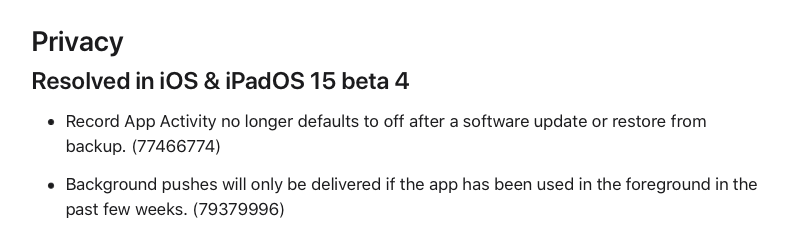
Apple just made an update to iOS 15 beta 4 that will disallow the mechanism most mobile growth services use to measure uninstalls: background pushes.

Background push notifications with empty payloads never show up on a user’s device if your app is still present and installed, but they do verify the app’s installed status via the Apple Push Notification Service. Notifications on iOS don’t go directly from your servers to a user’s device: they go to a centralized Apple service and are then distributed to the device. That’s both a security and a usability feature for iOS, so iPhone and iPad owners don’t get blitzed with messages, and so that messages can be delivered to offline devices when they come back online. The Android equivalent is Google Cloud Messaging.

But Apple’s just made a privacy change: background pushes will only be delivered if the app has been used in the foreground in the past few weeks.

apple kills iOS 15 uninstall tracking

That will kill some uninstall tracking. It won’t kill all uninstall tracking.

If someone hasn’t used your app for an unspecified number of weeks, then uninstalls it, you won’t know that exact time. And, frankly, if your app is just dormant on a device and has not been used in weeks, an empty push will not work: you’ll have to send an actual notification. On the other hand, if someone is using your app, has a strong reaction to something in or about your app, and immediately deletes it, you still have a chance to catch that uninstall, record it, and (hopefully) learn from it.

Since most uninstalls happen very soon after an app is installed, often after the first use, this may not be a huge deal. And since you can still get data for the long-term user who has a this-app-sucks-I’m-deleting-it moment, you’ve still got access to perhaps the most important uninstall measurement you need.

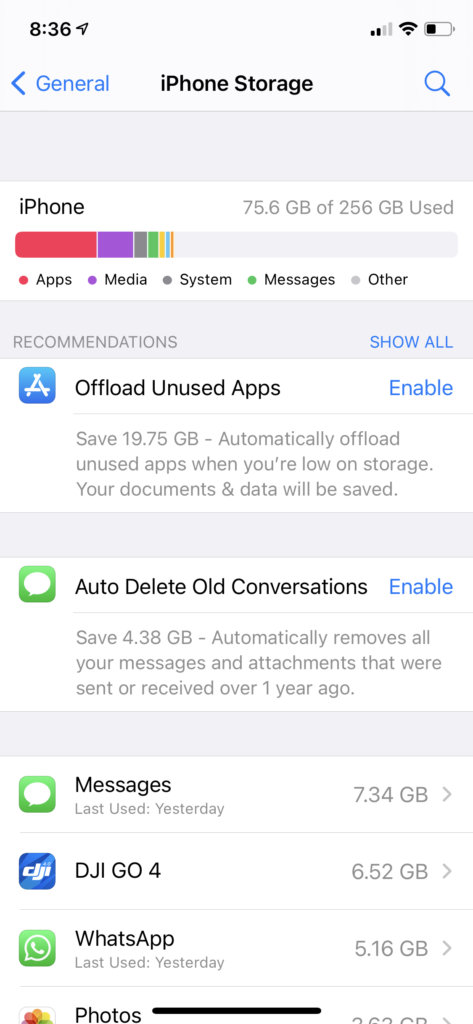
In addition, whether someone’s fully uninstalled your app or is just completely not using it — often to the point where Apple’s relatively recent Offload Unused Apps feature, which auto-deletes unused apps, deletes your app — does it really matter?


offload unused apps iOS iPhone


The key point is: they’re not using your app. Sure, it’s easier to revive a lapsed user who still has your app installed, but how often does that happen to the point where they become engaged, retained, profitable users?

And one other thought: the absence of a response is kind of a response, isn’t it?

So if you sent a payloadless notification via Apple Push Notification Service and don’t get a response, that tells you something. It may not tell you that your app is completely uninstalled, but it certainly tells you very clearly that you have a lapsed user who has not even opened your app for weeks. While for some apps in some verticals, that’s fine (think a transit app for a vacationer who always goes to the south of France, and needs the train scheduling app only for one month every year), for most apps, that’s not a great indicator.

Which means mobile marketers can probably simply redefine what uninstall tracking is, and carry on.

And, of course, on Android, nothing has changed.