


Why this guide matters now
And what it changes for your CTV strategy
CTV has moved quickly into serious growth planning. Premium inventory is easier to access programmatically, performance teams can measure cross-device outcomes, and advertiser investment continues to rise.
For mobile marketers, the opportunity is broader than attributed installs. CTV can reach audiences outside recent mobile exposure, create demand earlier in the journey, and influence the search, social, app-store, and direct activity that follows.
This playbook brings the practical pieces together. You’ll find regional CPM benchmarks, test-budget guidance, conversion timing, attribution windows, creative best practices, and a 90-day framework for getting started. The aim is to help you understand where CTV fits in your mix, what you should expect from a first campaign, and what evidence you need before scaling it.
What you will learn
1. Why CTV belongs in the mobile growth mix, and where it can create incremental demand
tvScientific by Pinterest
How early-intent audiences and second-screen behavior change the role CTV can play across the customer journey.
2. How CTV attribution actually works across screens, and how to avoid undercounting performance
Smadex
How to configure CTV measurement correctly, build for the living-room environment, and give campaigns enough room to learn and scale.
Moloco
Why attribution windows and MMP configurations need to be standardized across partners, and how attribution and incrementality work together to give you a fuller performance read.
3. What CTV creative needs to do differently to turn TV attention into mobile action
From 30-second storytelling and early branding to end cards, creative rotation, and formats that create a direct bridge from TV to phone.
4. What CTV should cost, how quickly users convert, and what good early performance looks like
YouAppi
Regional CPM planning ranges, including $8 to $10 in the US and $10 to $12 in the UK, plus how to move from broad learning toward optimization against business outcomes.
5. How to structure your first 90 days and decide whether CTV has earned more budget
Vibe
Why prospecting gives CTV a stronger first use case, how measurement setup can completely change the performance read, and how causal testing reveals the incremental revenue the channel actually created.
1. The state of CTV
For years, CTV sat in the “interesting but not yet” column of most UA budgets. It was expensive, hard to measure, and frankly easier to ignore when Meta and Google were still returning reliable results.
That’s changed. CTV has graduated from experimental to expected. It’s no longer something teams test once and abandon. It’s becoming a standard line item in serious growth budgets, and the teams running it are doing so because it’s working, not because someone told them to diversify.
The market numbers back it up. US CTV ad spend is forecast to surpass linear TV entirely by 2028, reaching nearly $46 billion, according to eMarketer. IAB’s 2026 Outlook Study has CTV growing 13.8% year over year, faster than every major channel except social. Advertiser intent points the same way: in a 2026 survey by Advertiser Perceptions and Premion, 70% of CTV advertisers said they plan to raise their CTV budgets this year, by an average of 17%.

$46B
US CTV ad spend forecast for 2028

13.8%
Growth of CTV market YOY

70%
Of companies plan to grow CTV budget next year

17%
Average budget increase rate
The investment signals point the same direction. According to Nielsen’s 2025 Annual Marketing Report, 56% of global marketers plan to increase investment in OTT and CTV. The IAB forecasts digital video ad spend, including CTV, to exceed $80 billion in 2026, growing faster than the broader ad market.
Demand-side platforms are seeing the same curve. Across the Smadex platform, CTV spend increased by more than 2,000% from 2023 to 2026, with clear acceleration beginning in mid-2025. The full Smadex playbook, including how to plan for a channel in its acceleration phase, is in Section 4.
So what actually changed? Three things, roughly in this order. Attribution caught up, meaning a living-room impression can now be tied to an actual install and downstream ROAS rather than just reach. Supply matured, with inventory becoming available programmatically instead of through private marketplace deals, which let DSPs optimize CTV like any other performance channel. And advertisers stopped treating CTV as a branding line item. Performance marketers now run it on the same KPIs as the rest of their UA mix.
That shift from “CTV as branding” to “CTV as a performance tool” is what this guide is about.

TRAP QUESTION FOR YOUR TEAM
If CTV disappeared from your media mix tomorrow, would you see it in your other channels’ numbers? If you can’t answer that, you have a measurement gap, not a CTV gap.
The money is moving. The next question is what makes this channel behave so differently from everything else in your mix.
2. What makes CTV different
CTV is not mobile on a bigger screen. The sooner you stop thinking about it that way, the faster your campaigns will improve.
On mobile, you’re fighting for attention. Users are scrolling, swiping, switching apps. Your ad has less than two seconds to stop the thumb. On CTV, the dynamic is completely different. People are sitting back. The screen is the only thing in front of them. And the ads are non-skippable.
The attention environment is real. CTV ads average a 97% completion rate. Not because viewers love ads, but because they can’t skip them and the barrier to leaving the room is high. That’s 30 seconds of uninterrupted exposure on the largest screen in the house.
97%
Average CTV ad completion rate
The ad load is much lower than mobile. Fewer ads per hour means less competition for recall. When you’re one of three ads in a break rather than one of thirty in a feed, memorability works differently.
The conversion path is cross-device by definition. Someone watches your ad on their TV, then picks up their phone and downloads your app. There is no click. There is no direct handoff. The entire journey happens across two devices, with a time delay in between. That’s not a flaw in the system. It’s just how CTV works, and your measurement needs to account for it.
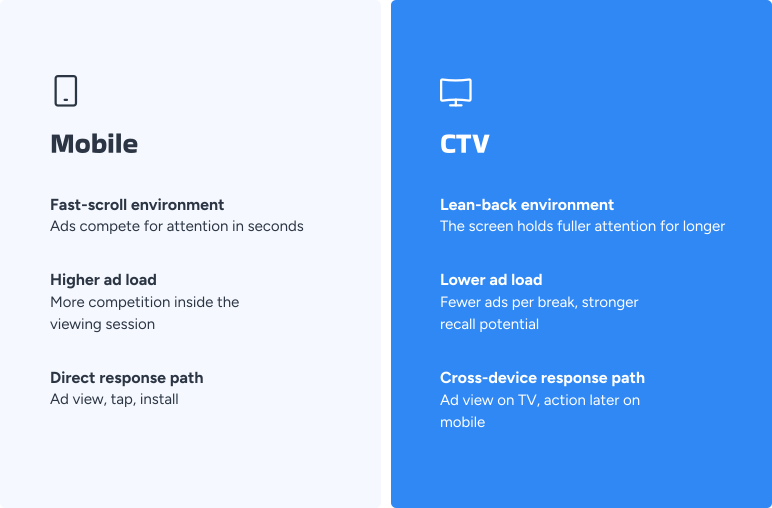
And the second screen is already in the viewer’s hands. 78% of consumers scroll social media while watching TV. The full dual-screen data, and what it means for how you plan cross-screen journeys, is in the tvScientific spotlight on the next spread.
These aren’t reasons to avoid CTV. They’re reasons to approach it differently from every other channel you run.
Different attention, different response path, different funnel role. Which is exactly where the planning conversation should start.
3. Where CTV fits in your funnel
There’s a question that kills CTV budgets before they get started: “What’s the CPI?”
It’s the wrong question. Not because cost doesn’t matter, but because CTV doesn’t work like mobile display. It doesn’t produce a click. It doesn’t produce an immediate install. What it produces is demand. And that demand shows up in your other channels.
Think of it like this. Performance marketing is picking fruit off trees that already exist. CTV is planting trees. The harvest comes later, and it shows up in your search lift, your organic installs, your social CVR. If you measure CTV by last-click CPI, it will always look bad, because last-click attribution gives CTV zero credit for anything that converted on a different device, at a different time, through a different channel.
So how do you value a channel like that? Not by what it books in isolation, but by what it moves everywhere else. The signals worth watching, branded search, direct app store traffic, conversion rates in exposed geos, all live in other reports, and Section 8 covers how to read them.
The CTV touchpoint funnel
CTV creates the demand that every touchpoint below it captures
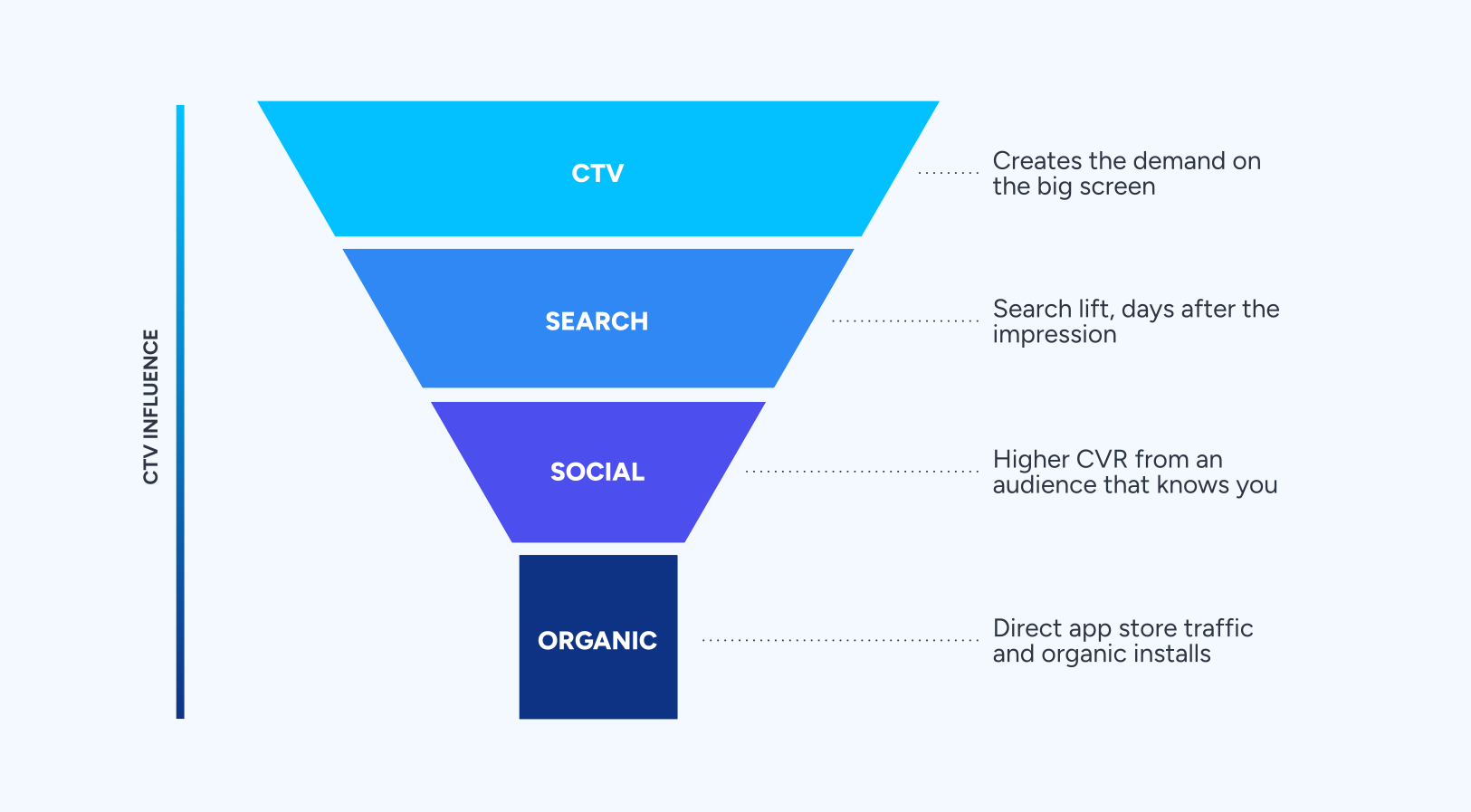
There’s a second thing CTV does that no other channel in a typical UA mix can: it reaches genuinely new people. Most mobile networks fish in the same river. The audiences overlap heavily, and adding a fourth or fifth network often just means paying to reach the same users through a different door. CTV reaches audiences at a different touchpoint entirely. Moloco’s data makes this concrete: 94% of users who installed from a CTV ad had seen no prior Moloco ad in the previous 48 hours. The full methodology and what it means for funnel expansion is in the Moloco spotlight in Section 4.

94%
Of users who installed from a CTV ad had seen no prior Moloco ad in the previous 48 hours
This is also why CTV is not a branding exercise. Framing it that way is the fastest way to lose your budget approval. The goal isn’t reach for its own sake. The goal is building the kind of awareness that makes your performance channels work harder. Those are two different things.
Where CTV earns its place in the funnel
- Reaching audiences that your mobile campaigns have saturated or can’t match
- Creating demand in high-value segments before they enter your retargeting pools
- Supporting campaigns in new geos where brand recognition is low
- Complementing paid social and search for mid-funnel users who’ve seen your ads but haven’t converted
The channel is mid-to-upper funnel. That doesn’t mean it’s soft. It means you need to measure it accordingly.
TRAP QUESTION FOR YOUR TEAM
If CTV drove a user to search your brand and install organically, which channel got the credit in your dashboard?
PARTNER CONTRIBUTION

Consumer and measurement insights from tvScientific by Pinterest
76% of marketers say it is critical to reach people before they start actively searching or comparing products
Performance marketing has become a race for the last click. But by the time someone is ready to buy, most of the real decision-making is already behind them. They have been exploring options, forming opinions, and quietly crossing brands off the list long before any retargeting pixel fired or ad appeared.
The real opportunity is to reach people earlier, while decisions are still taking shape and before demand becomes obvious to everyone else. For mobile marketers, that means expanding beyond channels built to capture existing intent and investing in channels that can help shape it.
CTV gives mobile teams a way to do that with the scale and attention of TV, plus the targeting and accountability they expect from digital. A practical place to start is audience targeting: focus on high-intent audiences based on what people are already planning, saving, and searching for, so you can reach them earlier in their shopping journey. A platform like tvScientific by Pinterest can enable marketers to activate Pinterest’s exclusive audience signals on CTV, bringing that early intent to the biggest screen in the home.
78% of consumers scroll social media while watching TV, and 69% browse online shopping while watching TV
Watching TV is no longer a single-screen experience. Consumers are seeing an ad on the biggest screen in the home, then reaching for the smallest screen to search, scroll, compare, and shop in real time. That behavior has real implications for mobile marketers, especially when 46% of consumers say they are more likely to buy if they have seen a brand on social before seeing it on TV, and 40% want TV ads personalized to their recent searches or purchases.
The takeaway is practical: CTV should not be planned as an isolated awareness channel. It should be optimized as part of a connected cross-screen journey, where creative, audience strategy, conversion landing pages, and ads all work together to drive action.
Optimization is critical to making that strategy work. It is important to choose a CTV platform that uses real-time bidding to prioritize high-converting impressions and optimizes toward the business outcome that matters most to you. Tools like tvScientific’s Creative Advisor can also help teams strengthen performance by improving ad creative before you spend a dollar in media with AI recommendations, so every aspect of your campaign is built to drive action.
56% of marketers say a lack of transparency in Performance TV reporting is one of the biggest risks to their team’s success

When marketers can see TV’s full contribution clearly, it stops looking like a black box and starts acting like a measurable growth lever.

Rebecca Miller
Director of Corporate Marketing, tvScientific by Pinterest
That is especially important for mobile marketers, because customer journeys rarely happen in one place. A viewer may discover a brand on TV, search on mobile, click through on social, and convert later in an app or on a website.
CTV measurement needs to do more than report reach. It needs to connect top-of-funnel reach to lower-funnel action and show how TV improves performance across the broader media mix. For mobile marketers launching CTV campaigns, a key step is to define the outcome you want to drive on TV, whether that’s impressions, site visits, app installs, or purchases.
To measure performance, it’s critical to work with a CTV partner that offers transparent reporting and can connect CTV to the rest of your media mix, rather than being measured in isolation. Through tvScientific’s partnership with Singular, marketers can measure outcomes across CTV campaigns, unify mobile and CTV attribution, and bring cost data into one place for a clearer view of ROAS. That kind of unified view makes it easier to compare channels, defend budget, and scale CTV with more confidence.

76%
Say reaching people before they start searching or comparing is critical

78%
Scroll social media while watching TV

69%
Browse online shopping while watching TV

46%
Are more likely to buy after seeing a brand on social before TV

56%
See a lack of Performance TV reporting transparency as a major risk
Source: tvScientific by Pinterest’s 2026 Holiday & Seasonal Shopping Trends Report, 2026 Consumer Trends Report, and 2026 State of Performance TV Report.
Reaching people earlier only pays off if you can prove what it caused. Which brings us to the machinery.
4. How CTV attribution actually works
This is the section most guides skip. They’ll tell you CTV is measurable without explaining what that actually means, or what the tradeoffs are. There are four main challenges with CTV attribution, and they’re worth naming clearly.
First: it’s cross-device. The ad plays on a TV. The conversion happens on a phone. These are two different devices with no direct connection. There’s no device ID passed from the TV to the mobile app store. Attribution has to infer the link.
Second: it’s impression-only. There’s no click. Mobile attribution is built around clicks. CTV has none. The entire attribution model runs on an impression that happened, at some point, before an install that happened later, on a different device.
Third: conversion timing is unforgiving. Users don’t click; they act on another device, minutes to hours later. Moloco’s data shows 66% of CTV conversions happen within six hours of ad exposure: fast, high-intent action, but far outside the instant feedback loop mobile marketers are used to. And a meaningful tail converts even later. Attribution windows configured for click-based channels miss much of this behavior entirely.
Fourth: CTV networks each handle things differently. Some behave like self-attributing networks. Others support MMP-based attribution. The integration setup varies by partner.
The attribution black hole (and how to avoid it)
If your first CTV report looks disappointing, check your attribution settings before you check your campaigns. There’s a good chance the installs are already there but the credit isn’t.
Here’s why. When several touchpoints could explain the same install, an attribution engine has to pick one, and it picks in order of confidence: a click ahead of a view, a known device identifier ahead of a probabilistic match. That ordering is right for most of your mix. CTV is the exception, because the channel works differently by design. It earns attention on the television while the install happens on the phone, so it produces a view rather than a click, and it matches on the household rather than the device.
Singular accounts for this, and it takes one setting. The “prioritize in attribution decision” setting gives CTV impressions a fair window to compete for credit alongside other signals. The recommended starting point is at least 8 hours. This doesn’t inflate CTV numbers. It removes a structural disadvantage that was deflating them. Before drawing any conclusions about CTV channel ROI, confirm this setting is active. Vibe’s case study in Section 8 shows exactly what happens when a team gets this right.
PARTNER CONTRIBUTION

CTV setup, creative, and scale: best practices by Smadex
Avoid the CTV attribution black hole
For mobile marketers expanding into CTV, a common pitfall is viewing the medium through the lens of traditional TV by treating it as a pure awareness layer rather than a performance channel. In reality, CTV functions as a full-funnel vehicle capable of tracking installs and post-install events, but capturing this true ROI requires a shift in mindset. Because the viewing happens on a television screen while the conversion occurs on a mobile device, standard deterministic tracking does not apply, meaning marketers must explicitly configure their MMP settings to support cross-device measurement.
The first thing to get right is your MMP configuration. Specifically, you should enable view-through attribution and ensure IP-based matching is supported for your CTV supply. Since viewers cannot click a TV ad, attribution typically relies on matching privacy-compliant household signals, most often the home IP address, to connect an impression on the TV to an install that happens on a mobile device. If those settings are not mapped correctly, performance will look artificially low, and optimization decisions will be made on incomplete data.
Additionally, marketers must carefully calibrate their attribution windows to capture the full impact of a lean-back experience. While a standard 24-hour view-through attribution window is essential for tracking baseline cross-device conversions, it is highly recommended to enable equal priority windows for campaigns with aggressive ROAS targets. This configuration treats a view with the same weight as a click for a short period, typically one to three hours. Utilizing both settings helps ensure your campaigns are fairly credited for both immediate and delayed actions, providing cleaner data to optimize effectively.
Design for the full living room experience
While there are many differences between CTV advertising and traditional television ads, one area where they are closely aligned is the premium production value of the creative experience itself. CTV is a full-screen, sound-on environment where the ad is viewed in the living room, often on the largest screen in the household. That means creative quality matters. Marketers should avoid treating CTV as a resized mobile video placement and instead build assets that feel native to the lean-back viewing experience, with strong visuals, clear branding, and a message that can land without relying on clicks.
The most effective CTV creative is designed to balance attention and action. In-stream video formats, ranging from 15 to 60 seconds in length, give advertisers the space to tell an immersive story while still supporting performance goals. Because the experience is sound-on and full-screen, these placements can drive deeper engagement than standard mobile inventory, but the creative still needs to make the next step obvious. For UA teams, that means bringing performance discipline into the production process, using concise messaging, early brand presence, and a clear app or product value proposition that viewers can understand in seconds.
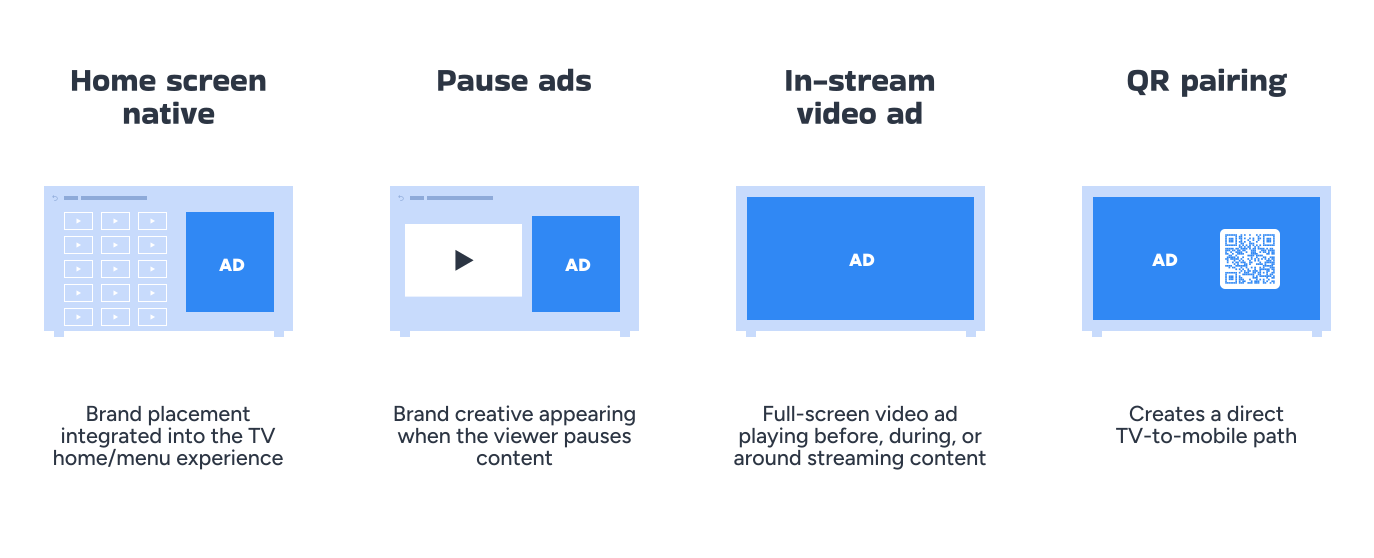
Advertisers who treat creative experiences as part of their performance strategy, not just part of the media plan, see better results. One way they are finding success is by using Home Screen Native Ads to capture high visibility at the first point of viewer interaction. Pause Ads can reach viewers during a high-attention moment without interrupting the content experience. When paired with QR codes, these placements can create a direct-response bridge from the TV to the phone, making CTV an interactive performance channel. The key is to test these creative experiences intentionally, matching the format to the moment, the message, and the desired user action.
CTV budgets have entered their acceleration era
CTV is no longer sitting on the edge of the media plan as a small experimental line item. Across the Smadex platform, CTV spend increased by more than 2,000% from 2023 to 2026, with clear acceleration beginning in mid-2025. That growth signals a larger shift in how performance advertisers are approaching the channel. CTV is being treated less like an awareness layer and more like a structured UA investment with real expectations around installs, ROAS, and measurable business outcomes.

For UA managers, the takeaway is that budget momentum changes how CTV should be planned. A limited trial can help validate the basics, but it rarely gives campaigns enough room to learn, optimize, and scale. As CTV moves into always-on planning, advertisers need to think beyond whether the channel “works” and start asking what level of budget, time, and measurement structure is required to make it work efficiently. The goal is not just to launch on CTV, but to build a repeatable performance lever that can improve as more signal is captured.
2,000%
CTV spend increased across the Smadex platform from 2023 to 2026
Source: Smadex internal CTV platform spend analysis, 2023 to 2026.
Plan CTV like a channel entering an acceleration phase, not one still waiting to prove itself. Define success metrics before launch, align attribution settings, give the campaign enough budget to generate actionable learning, and evaluate performance beyond the first few days of delivery. Advertisers that treat CTV as a planned performance investment are better positioned to understand where performance is coming from, optimize with confidence, and scale the channel without losing sight of efficiency.
Attribution tells you the ad ran; incrementality tells you it worked.

Andrew Whiteside
VP and GM Americas, Smadex
PARTNER CONTRIBUTION

Standardized CTV measurement by Moloco
There’s no single perfect way to measure CTV. The right approach depends on your goals, your channel mix, and your campaign’s KPIs. A subscription app measuring trial starts needs a different setup than a mobile gaming UA team optimizing toward CPI. But regardless of your goal, one thing is critical for all marketers: measuring every CTV partner the same way. If one partner reports on a 24-hour window and another on a 7-day window, you can’t actually compare the two. The numbers will look different even if the underlying performance is the same.
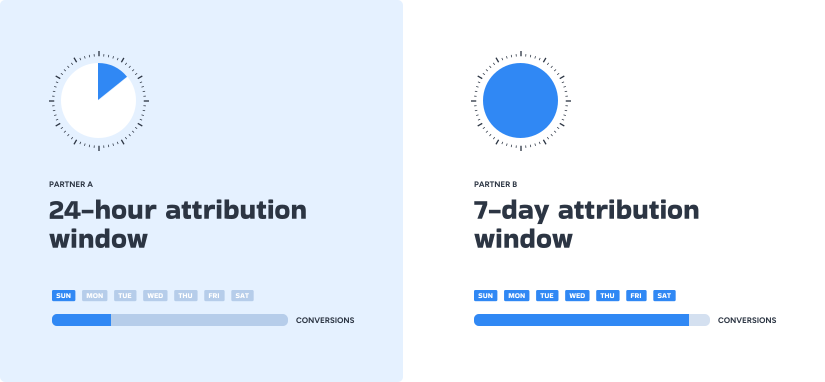
For CTV measurement, it’s important to think across two dimensions: attribution and incrementality.
Attribution is the foundation. It’s the signal loop that feeds performance data back into the optimization engine, so the algorithm can learn in real time which creative, audience, and placement are actually driving results. The system can then automatically shift delivery toward what’s working without manual intervention. Attribution also gives you a read on whether CTV is working at all: whether ads are actually driving installs, sign-ups, or purchases.
For attribution, it’s critical that every partner is measured the same way, with identical attribution windows, MMP configurations, and analysis windows. Otherwise, you’re not comparing performance; you’re comparing different measurement setups that will produce different numbers.
Incrementality sits on top of attribution, not instead of it. It answers a different question: did this ad actually cause the result, or would the user have converted anyway? The same principle applies here: run incrementality the same way across partners, the same test methodology, the same holdout rate, the same time period, so a lift number from one partner can be confidently compared to a lift number from another.
Used together, the two give you a holistic picture. Moloco’s own data shows why that combination matters: 66% of CTV conversions happen within six hours of ad exposure, and 94% of users who converted from CTV hadn’t seen a Moloco mobile ad in the prior 48 hours. Measured this way, CTV stops being a channel you’re hoping pays off and becomes one you can prove is driving real business growth.

66%
Of CTV conversions happen within six hours of ad exposure

94%
Of users who converted from CTV hadn’t seen a Moloco mobile ad in the prior 48 hours
Sources: Moloco internal analysis based on sample data from 350,000+ CTV installs.
Every CTV partner will tell you their numbers are working. But without standardized measurement, apples-to-apples across every partner, you can’t actually tell which channel is driving real performance and which one is just padding its own numbers. Standardized measurement is what turns CTV from a leap of faith into a channel that actually drives real business growth.

Dario Sheikh
Strategy & Activation Lead, CTV, Moloco
How Singular’s CTV attribution works
Singular’s CTV attribution uses IP-based household matching. When a CTV ad is served on a smart TV and a mobile app install follows from a device on the same network, Singular connects those two events. This enables marketers to measure CTV’s impact across devices, even when the ad view and install happen on different screens.
The default attribution window for CTV impressions is 24 hours, configurable from 1 to 72 hours depending on how your audience typically behaves. Longer windows capture more delayed conversions; shorter windows are more conservative. CTV touchpoints are the lowest priority in Singular’s attribution stack by default but with a single click, you can elevate CTV’s priority so it’s treated like a deterministic click for a set period, which is the fix described above.
The link setup matters: you need a view-through tracking link (not a click-through link) and a CTV-enabled partner integration. Singular supports CTV integrations with all the top partners like MNTN Performance TV, Moloco, The Trade Desk, tvScientific, Samsung Ads, Smadex, Vibe, AppLovin, Unity CTV, YouAppi, Verve, and others. Additionally, Singular is the first and only MMP recognized in the new Certified Measurement Partner Program from tvScientific by Pinterest.
PRO-TIP
Singular’s CTV attribution FAQ covers the full setup: link configuration, window settings, and priority elevation.
The methodology stack: what to use and when
Last-click: technically available, practically useless for CTV. Gives the channel almost no credit for anything that didn’t result in a direct, immediate install. Avoid as your primary measurement method.
Priority windows: the practical foundation. You configure your MMP to elevate CTV impression priority in the attribution decision, so CTV gets credit for installs it influenced even when another touchpoint came later. Better than last-click, still limited by the probabilistic nature of the match.
MTA and assists: where CTV’s real story gets told. Multi-touch attribution looks across the whole journey and gives credit in fractions, so a CTV view that came before a paid social click still gets recognized for the part it played. CTV rarely wins the last touch. It sets up the conversion someone else closes, and MTA is what makes that visible.
Incrementality and MMM: the bigger question. These answer ‘what would have happened if we hadn’t spent anything?’ rather than ‘who gets the credit.’ They take longer and cost more, but they’re the closest thing to the truth, and they’re worth running once your CTV budget is meaningful.
The honest take: for most teams, priority windows plus multi-touch attribution is the right starting point. Priority windows make sure CTV is counted fairly. MTA shows you what that spend was actually worth. As the budget grows, incrementality is how you prove it.
TRAP QUESTION FOR YOUR TEAM
Are all your CTV partners measured on the same windows and configurations, or does your best performer just have the most generous measurement setup?
Configured fairly and measured consistently, CTV can finally be judged on what it produces. Which puts the pressure back on the thing doing the producing.
5. Creative that works on CTV
CTV creative can not be a resized version of your mobile creatives. The environment is different, the attention dynamic is different, and the conversion path is different. What works is different, too.
The mental shift is this: on paid social, you test for interruption. Can you stop the scroll, win the first second, and get the tap? On CTV, the question changes. Can you hold attention? Can you make the product memorable? Can you create enough intent that the user acts later on another device? Practically, that means optimizing for hold rate rather than hook rate. Catching attention in the first 3 to 5 seconds still matters, but storytelling carries the rest.
Three things CTV creative needs to do well
Communicate quickly. The viewer needs to understand three things fast: what the app does, why it matters, and what to do next. The best CTV creative anchors the product to a recognizable use case or moment. Instead of “this app has routes, alerts, maps, personalization, and notifications,” say “before you drive, know exactly where the weather will hit.” That’s the kind of message someone can remember later when they pick up their phone.
Show the product. On mobile, you can get away with emotion-led creative because the tap-to-download is right there. On CTV, you’re asking someone to remember your app, pick up their phone, find it, and install it. If they’re not completely clear on what it does and why they’d want it, that chain breaks.
Match the environment’s production standard. Creative quality matters in the living room in a way it doesn’t in a feed. That doesn’t mean everything needs Super Bowl production value. Format should align with your brand: UGC-style creative can win decisively (one D2C brand, Hairstory, saw UGC outperform polished creative 4:1), but whatever the format, it has to feel native to lean-back viewing rather than like a resized social ad.
Format guidance
- Start with 30-second spots. Thirty seconds is the CTV standard and gives you enough room to tell a story. Test 15- and 60-second cuts once you have baseline data to compare against.
- Put the brand in the first few seconds, not the last. On CTV, there’s no second chance if someone looks away
- A/B test end card CTAs. The call to action at the end of the ad is one of the highest-leverage creative variables
- Rotate creative every 6-8 weeks at scale. CTV fatigue builds more slowly than social, but it still builds. When you rotate, test different value propositions rather than only swapping visuals
- Test bigger ideas, not micro-variations. The creative testing question on CTV is less “which hook won?” and more “which message created the most incremental demand?”
On social, you’re optimizing for a tap. On CTV, you’re optimizing for memory. Your creative has to be good enough that someone searches for you an hour later.

Lisi Gardiner
Director of Product Management, Singular
Beyond the standard video slot
The format landscape is wider than most teams assume, and the line between brand and response formats is blurring. Home Screen Native Ads capture attention before content starts. Pause Ads own the screen during a high-attention moment. Paired with QR codes, these placements create a direct-response bridge from the TV to the phone. The Smadex spotlight in Section 4 covers these formats in more depth.
Response rates: QR codes vs. Roku’s OK button
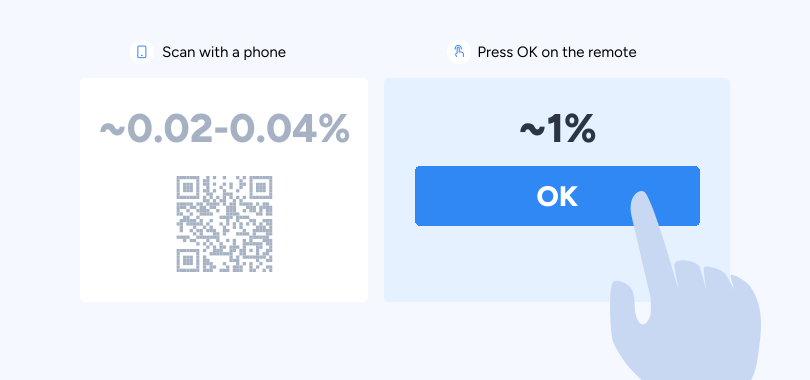
On QR codes specifically, adoption is real but modest for in-stream ads. Roku’s OK-button ad unit shows what happens when that friction disappears. Viewers respond by pressing OK on their remote: no phone, no extra steps. Peter Hamilton shared on Singular’s Growth Masterminds podcast that response rates on these units reach around 1%, against 0.02% to 0.04% for QR codes. This could eventually translate into conversion rate improvements of 400-500%.
PRO-TIP
Singular’s Creative IQ surfaces which visual and audio elements correlate with ROI across every partner in your mix, including CTV.
TRAP QUESTION FOR YOUR TEAM
Would your current CTV creative work with the sound on but the logo hidden? If a viewer can’t tell whose ad it was, memorability didn’t happen.
Good creative earns the search. Whether it earns that search efficiently is a question of what you should expect to pay.
6. Benchmarks
The honest answer on CTV benchmarks is that they vary significantly by vertical, by platform, by format, by region, and by how mature your CTV program is. Numbers that are true for gaming may be off by 2-3x for D2C. Use what follows to size expectations and pressure-test your plan, not to grade your campaigns. A CPM that looks expensive against a benchmark can still buy you the cheapest customers you acquire all quarter.
What the current data supports
- Ad completion rates average around 97% across CTV inventory, one of the strongest engagement metrics in digital advertising
- Test budget floor: most practitioners put the minimum at $25,000/month to accumulate statistically meaningful learnings
- Attribution priority window: at least 8 hours of elevated priority as a starting point, with a 24-hour default view-through window extendable to 72 hours
- Incremental ROAS reference point: a Vibe incrementality test measured 3.03x iROAS, outperforming most of the brand’s other channels (full story in Section 8)
- Conversion timing: 66% of CTV conversions happen within six hours of exposure (Moloco internal data)
PARTNER CONTRIBUTION

Global CTV benchmarks and trends by YouAppi
Regional CPM benchmarks
While campaign performance varies significantly by vertical, creative quality, optimization strategy, and business objective, the following benchmarks provide a useful starting point for planning Connected TV investment.
| Region | Typical CPM | Recommended starting approach |
|---|---|---|
| United States | $8-10 | Mature market with strong measurement capabilities and broad premium inventory |
| United Kingdom | $10-12 | Effective entry point for European campaigns with comparatively stronger attribution opportunities |
| APAC (Thailand, Malaysia, Indonesia, India) | $3-7 | Efficient CPMs make these markets well-suited for scaled testing and growth |
| Japan | $20-25 | Premium broadcaster inventory where creative quality and optimization typically outweigh CPM efficiency alone |
| LATAM | $4-6 | Strong opportunity for scalable acquisition across Brazil, Mexico, Chile, Peru, and Argentina |
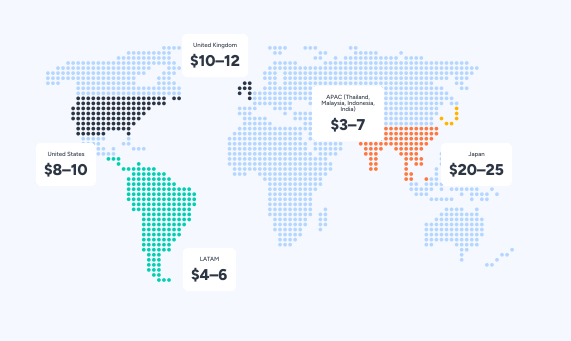
Source: YouAppi internal data.
Regional benchmarks should serve as planning guidance rather than success metrics. Ultimately, the most meaningful measure of campaign performance is the business value generated, not the cost of media alone.
Practitioner insights
Begin broadly, then optimize with confidence
One of the most common mistakes in performance CTV is over-constraining campaigns too early. Connected TV optimization relies on meaningful signal density during the learning phase. Restricting publishers, audiences, or contextual inventory before AI and machine learning models establish sufficient confidence can limit their ability to identify incremental opportunities. A broader initial approach, followed by iterative optimization as meaningful performance signals accumulate, typically provides stronger long-term efficiency and scale.
Optimize for business outcomes, not media metrics
Since there are no clicks on TV, performance can’t be evaluated there; that’s not how TV is measured. Instead, advertisers should optimize toward business outcomes that reflect long-term value, including registrations, subscriptions, purchases, retention, and customer lifetime value. The strongest-performing campaigns are those optimized for customer value, not simply impressions, clicks, or CPM.
Treat creative as an ongoing optimization strategy
Creative should evolve throughout the life of a campaign. Launching with multiple creative variants enables advertisers to evaluate messaging, pacing, branding, and calls-to-action across different audience segments. Rather than asking which creative generates the most completed views, marketers should identify which creative characteristics consistently contribute to stronger downstream customer behavior.
Measure across devices
Consumers rarely complete their journey on the television itself. A Connected TV impression may ultimately influence activity on a mobile phone, tablet, or desktop device hours or even days later. Performance measurement should therefore reflect the reality of cross-device consumer behavior, combining view-through attribution with broader incrementality analysis to understand television’s role within the complete customer journey.
CTV myths vs. reality
| Myth | Reality |
|---|---|
| CTV is primarily a branding channel | CTV supports both branding and measurable performance outcomes. Modern measurement enables advertisers to evaluate upper- and lower-funnel impact through attribution, incrementality, and conversion analysis |
| Lower CPMs always produce stronger results | Campaign success should be measured by quality, efficiency, and incremental value, not media cost alone |
| More targeting leads to better performance | Smarter targeting often outperforms narrower targeting. AI-powered optimization and broader audience exploration frequently discover high-value users manual targeting would miss |
| Creative is finalized before launch | Creative optimization is an ongoing process. Continuous testing, localization, audience insights, and AI-assisted iteration improve performance throughout the campaign lifecycle |
| CTV performance should be judged by clicks | View-through attribution, incrementality testing, and downstream conversion measurement provide meaningful visibility into CTV performance |
AI across the campaign lifecycle
| Campaign stage | AI’s role |
|---|---|
| Creative development | Accelerates asset creation, localization, creative testing, and fatigue detection through generative AI and creative intelligence |
| Audience discovery | Uses predictive models to identify audiences with the highest likelihood of delivering meaningful business outcomes |
| Campaign optimization | Continuously refines bidding, budget allocation, inventory selection, and pacing as new performance signals become available |
| Measurement | Strengthens cross-device attribution, incrementality analysis, and customer quality modeling while supporting privacy-conscious measurement |
| Operational intelligence | Forecasts pacing, identifies anomalies, recommends optimizations, and lets campaign managers focus on strategic decisions |
The YouAppi perspective: Connected TV has reached an important inflection point. The convergence of premium streaming environments, AI-driven optimization, privacy-conscious measurement, and cross-device attribution has expanded the role CTV can play within a modern performance marketing strategy. The question is no longer whether CTV can drive measurable business outcomes; it has repeatedly demonstrated that it can. The greater challenge is understanding how CTV should be optimized within the broader media mix: identifying the right balance between scale and efficiency, measuring its incremental contribution, and ensuring it creates value both as a standalone performance channel and as a driver of stronger outcomes across other acquisition channels.
The next stage of CTV maturity will be defined by optimization rather than adoption.

Michal Schwartz
Director of Growth, YouAppi
Expectations set. Now the practical part: getting a first campaign live without burning the budget.
7. Getting started
A first CTV test asks for a little more patience than most channels do.
If you come from mobile UA, search, or paid social, you’re used to a fast feedback loop: someone clicked, someone installed, someone bought. CTV works differently. You pay higher CPMs, there’s no click to read, and the early dashboard stays quiet while the channel does its work somewhere you aren’t looking yet.
It’s worth knowing that going in, because the natural reaction is to start hunting for cheaper inventory, and that’s usually where the money actually gets wasted. A first test isn’t about buying cheap impressions. It’s there to answer one question: did quality exposure, to the right audience, create growth you wouldn’t have had otherwise?
Keep the first test clean
One clear audience. One clear outcome. A realistic budget. A measurement plan that compares exposed versus non-exposed behavior. Don’t test six audiences, five creative directions, and three buying strategies simultaneously and then wonder what drove the result.
The question a first test should answer is not “did we get cheap impressions?” It’s “did we buy quality exposure, to the right audience, and did that exposure create incremental growth?” That growth might show up as installs, trials, branded search, app store visits, or stronger performance in other channels. Design the test to detect it.
One practical preparation step: scale your search campaigns before starting the CTV trial. This gives you a stable baseline, so if branded search lifts when CTV goes live, you can read the change with confidence.
And lead with prospecting rather than re-engagement. The reasoning and the measurement bonus that comes with it are covered in the Vibe spotlight in Section 8.
Audience strategy
Start broad. CTV optimization relies on signal density during the learning phase, and restricting publishers, audiences, or contextual inventory before the models establish confidence limits their ability to find incremental opportunities. Let AI-driven optimization establish a learning foundation first, then introduce manual refinements as meaningful performance signals accumulate. YouAppi’s practitioner insights in Section 6 cover this in their own words.
As the program matures, first-party data becomes the durable targeting advantage. Activating CRM records, first-party audiences, app events, and loyalty signals strengthens CTV targeting while reducing dependence on third-party identifiers that are steadily losing reach. Platforms are also opening new intent-signal sources; tvScientific by Pinterest, for example, lets marketers activate Pinterest’s audience signals on CTV.
Partner selection
Don’t test five CTV platforms simultaneously. The more fragmented your strategy, the harder it is to understand what’s working, and frequency capping across fragmented inventory is genuinely difficult. Start with one partner. Learn. Expand.
Look for partners that support MMP-based attribution, offer transparent data access, and can share impression-level data with your MMP. Supply quality matters more than CPM: who are you buying from, where are you actually appearing, and can you understand what was delivered and what happened afterwards?
Campaign setup
Define your goal before you set up the campaign. CPA? Branded search lift? Each implies different bidding, creative, and measurement. The teams that struggle with CTV are usually the ones that didn’t define success before starting.
The most common mistakes, in rough order of damage: measuring CTV with the wrong mental model (judge it like a last-click mobile channel and you’ll undervalue it; judge it like old-school TV and you’ll overvalue it), not setting up incrementality properly, underfunding the test to the point where results are just noise, and resizing a social ad instead of building for the living room.
On bidding: dynamic ML-driven bidding is the standard on CTV platforms. Let the algorithm work and give it time. Moving too fast, pausing or adjusting before attribution cohorts complete, is one of the most common early mistakes.
TRAP QUESTION FOR YOUR TEAM
Is your CTV test budget big enough to produce an answer, or just big enough to produce noise?
What good looks like in the first 90 days
CTV rewards patience in a way mobile UA does not. Conversions are delayed, the learning phase is real, and the proof comes from a causal test, not a dashboard on day two. Here is the shape of a disciplined first quarter.
| DAYS | 1–30 | 31–60 | 61–90 |
|---|---|---|---|
| PHASE | Launch and learn | Optimize on signal | Prove and decide |
| What you’re doing | Go broad on targeting and let the algorithm find pockets of performance. Run several genuinely different creative directions, not variations of one. Confirm view-through attribution and priority windows are live before spend starts. | Let differences between audiences and creatives separate, then act on them. Tighten frequency caps into the 3 to 7 per week range as fatigue appears. Scale spend on clear winners at roughly 20 to 30 percent per week, not in one jump. | Run a geo or holdout incrementality test with a pre-set duration. CTV needs 4 to 6 weeks of active flight plus a 2 to 4 week post-treatment window, because a meaningful share of CTV conversions land after exposure ends. |
| What to watch | Delivery health only: completion rate, frequency, and early CPI. First read-outs land around day 3 to 5. | Segment and creative separation, frequency, and branded-search or app-store lift measured against your pre-launch baseline. | Incremental ROAS and cost per incremental install, read against caused revenue rather than attributed installs alone. |
| What not to do | Don’t judge ROAS yet, and don’t narrow targeting. You’re buying signal, not outcomes. Cutting early starves the model of the data it needs. | Don’t over-optimize on vanity metrics like impressions or raw completions, and don’t scale everything at once. Chasing week-one noise locks in the wrong winners. | Don’t stop the test early because results look good; that’s the most common way to manufacture a false positive. Decide scale, restructure, or stop on the causal read. |
Launching well is half the job. Proving it worked is the other half, and it’s where most CTV programs are won or lost.
8. Measuring what matters
The right question isn’t “how much revenue did CTV attribute?” It’s “how much revenue did CTV cause?”
Those sound similar. They’re not. Fixing your attribution priority window stops CTV from being written off, but it changes how credit is assigned, not whether revenue was caused. What your MMP attributes to CTV and what a causal experiment reveals are rarely the same number. They measure different things. Drawing conclusions from only one source leads to wrong reads and wrong budget decisions.
PARTNER CONTRIBUTION

CTV best practices for mobile marketers by Vibe
Fix your attribution baseline first
Most mobile marketers who say CTV didn’t work were measuring it wrong, not running it wrong.
One mobile gaming app we worked with ran into exactly this. When they launched CTV campaigns on Vibe, initial results looked soft. Once they properly configured impression-level postback data from Vibe campaigns, the picture changed: D7 and D30 ROAS consistently doubled their benchmarks, and overall ROAS tripled. The campaigns hadn’t changed. The measurement had.
Available in Singular, the “prioritize in attribution decision” setting gives CTV impressions a fair window to compete for credit alongside other signals. Singular recommends setting it to at least 8 hours. It doesn’t inflate CTV numbers. It removes a structural disadvantage that was deflating them. Before drawing any conclusions about CTV channel ROI, confirm that this setting is active.
Lead with prospecting
For mobile marketers, the natural instinct is to start CTV with re-engagement: target lapsed users, show a familiar product, and measure reinstalls. The problem is that CTV audience construction works differently from mobile retargeting. Mobile re-engagement relies on device identifiers to reconnect with known users. CTV campaigns use behavioral intent signals, content-type targeting, and lookalike audiences. The targeting infrastructure is different, and CTV’s advantages show most clearly in prospecting.
In practice, that means building your first CTV campaigns around users who fit your acquisition profile but aren’t yet in your install base: in-category interest clusters (users streaming content adjacent to your app’s vertical) and behavioral segments. You can run re-engagement and prospecting campaigns simultaneously, but prospecting is where CTV reaches audiences no other channel in your mix can efficiently find.
The measurement implication matters for interpreting results. Prospecting campaigns generate a cleaner signal for the incrementality test (more on that below). When the exposed audience has little or no overlap with your existing retargeting pools, the lift you measure is less contaminated by users who were likely to convert anyway. Build your initial CTV business case around prospecting; that’s where CTV can drive installs that would have been unlikely through your existing channels, which is what justifies the budget allocation.
If you also run re-engagement campaigns, configure your attribution to capture both reinstalls and new installs so you have a complete picture of what CTV is recovering versus acquiring net-new. But don’t build your CTV thesis around re-engagement. Build it around net-new reach.
The right question isn’t “how much revenue did CTV attribute?”; it’s “how much revenue did CTV cause?”
Fixing your attribution priority window stops CTV from being written off. But it changes how credit is assigned, not whether revenue was caused. Most teams evaluate CTV the same way they evaluate every other channel: platform-reported installs, platform-reported ROAS. The problem is that CTV doesn’t play cleanly inside any single attribution system. What your MMP attributes to CTV and what a causal experiment reveals are rarely the same number. They measure different things. Drawing conclusions from only one source, without testing those conclusions against reality, leads to wrong reads and wrong budget decisions.
We ran an incrementality test with one brand that came back at a 3.03x incremental ROAS. Their hypothesis going in was that CTV would over-index on net new customers. Most of the incremental revenue came from existing customers instead. They were disappointed. That was the wrong read. CTV was driving exceptional incremental revenue from their existing base, at an iROAS that outperformed most of their other channels. The test didn’t fail. It surfaced exactly the insight needed to plan and budget the channel correctly.
3.03x
Incremental ROAS measured in Vibe’s causal test, outperforming most of the brand’s other channels
Source: Vibe internal data.
The winning motion is this: compare results across multiple data sources to form a hypothesis, then validate or disprove it through a causal experiment. Incrementality analysis, causal experiments, and MMM frameworks that treat CTV as a first-class channel in your measurement stack, not a line item you reconcile after the fact.
The brands that get the most out of CTV stop asking ‘did CTV get credit?’ and start asking ‘did CTV move the number?’ Those are very different questions. Only one of them tells you what to do next.

Jacob Sailer
Technical Account Manager, Vibe
The signals worth watching
⚠️ Branded search lift
If branded search volume ticks up in geos or windows where CTV is running, that’s signal. It won’t show up in your MMP dashboard; look at your search data separately
⚠️ Direct app store traffic
Track direct and organic search installs in the windows and geos where CTV is active
⚠️ CVR improvement in paid social
Teams allocating 10-15% of budget to CTV often report a halo effect on conversion rates across other channels
⚠️ Geo-lift tests
The gold standard for teams that treat incrementality as their source of truth. One global fintech advertiser buys CTV media by state, province, or DMA specifically because it makes clean test and control groups possible, and runs power analysis before launch so the test is big enough to produce a real answer
⚠️ Assisted installs in MTA
Look at CTV as an assist, not a last-touch credit. That’s where its contribution shows up most clearly
Building a CTV measurement framework
The practical starting point: use Singular’s advanced CTV attribution for install-level data, with the priority window set the way Section 4 describes. Read CTV through multi-touch rather than last touch, so its assists actually show up. Then, as the budget grows, prove the lift with an incrementality test. Counted, understood, proven, in that order.
The ad plays on one screen and the conversion happens on another. If your attribution can’t connect those two events, you aren’t measuring CTV, you’re guessing at it. Cross-device is not an edge case in this channel. It is the channel.

Eran Friedman
Co-Founder and CTO, Singular
CTV won’t always be the channel that gets credit. That’s fine. The goal is growth, not just attribution credit. If CTV is making your other channels more efficient, and you can prove that, you have a defensible budget.
The big takeaways
01
CTV can create demand that shows up across search, app-store activity, paid social, and direct traffic
02
Lead your first test with prospecting and give broad targeting enough time to build signal
03
Build CTV creative for recall and a clear second-screen action
04
$25K/month is the practitioner floor cited for accumulating meaningful test learning
05
Standardize attribution windows and MMP configurations before comparing CTV partners
06
Use causal measurement to decide whether CTV has earned more
tvScientific by Pinterest
78% scroll social while watching TV and 69% browse online shopping. Build the journey across screens.
Smadex
CTV spend on Smadex grew more than 2,000% from 2023 to 2026. Plan the channel with enough budget and time to learn.
Moloco
66% of Moloco CTV installs happen within six hours. CTV can deliver fast action from audiences outside recent mobile exposure.
YouAppi
Use regional CPMs to size the plan, then optimize around the business value the campaign creates.
Vibe
Fix the measurement baseline, lead with prospecting, then validate CTV with incrementality.
About Singular
Singular is the #1-rated MMP on G2 and the only end-to-end marketing attribution and analytics platform that uncovers true ROI across all marketing channels. We transform complex marketing data into actionable insights by unifying campaign data from thousands of channels with cross-device attribution data. Leading brands like LinkedIn, Nike, WB Games, Airbnb, and Rovio rely on Singular to maximize every marketing dollar, eliminate wasted spend, and drive higher user retention. With superior ROI reporting, advanced fraud prevention, user engagement capabilities, and unmatched data accessibility, marketers can finally drive faster growth with smarter insights.
Ready to give Singular a try? Contact us today.