Marketing technology predictions 2021: 350 CMOs on holistic digital marketing

2021 is about the death of hype in marketing technology.

Maybe, because 2020 is when everything became all too real.
For about five years now I’ve done semi-regular annual reports on CMO strategy. Usually, these are at the end of one year, looking forward to the next. I ask marketing leaders: what are the big technology changes that will impact marketing and drive initiatives for the coming year? Often, the answers include hype technologies: augmented reality. Artificial intelligence. Influencer marketing. They’re frequently insightful, as in 2018 when 200 CMOs identified actionable data as a core priority for 2019. Or when, at the beginning of the COVID-19 pandemic, marketers said 2020 was a year to shift and to serve.

The hype answers aren’t necessarily wrong.

And, human nature being what it is, hype probably isn’t going anywhere. But what CMOs are excited about this year is markedly different from years prior.

Asking 350 CMOs: what’s the next big trend in marketing?

As every CMO will tell you after a few beers, no single technology is going to reinvent marketing. 2020 has been a year unlike any other in history where we further digitized almost all aspects of our work, entertainment, shopping, relationships … essentially, our lives. Our work is a Zoom call. Our grocery store is an app. Our movie theaters are Disney+ and Netflix. Our mall is Amazon. Our entertainment is Angry Birds. Our coffee with friends is Facebook. Our news is online …

And as our lives have become increasingly digital, so has marketing.

And what this annus horribilis has taught us is that a holistic and integrated focus on digital marketing is the key to unlocking connection in 2021. Digital marketing is not new. But too often it has been applied haphazardly.

For 2021, that’s about to change, CMOs say.

“Fusion is the new ecosystem,” says Suzanne Kounkel, Chief Marketing Officer for Deloitte. “Fusion is the art of bringing together new business partnerships, customer insights, and digital platforms to create ecosystems that more holistically address human needs.”


“We’ve learned during this pandemic that we can communicate over digital platforms better than we thought,” says Penry Price, VP of Marketing at LinkedIn.

It’s not about AR, but it includes AR. It’s also not about VR, but could include VR. It’s not all about AI, but artificial intelligence plays a big role. Influencer marketing isn’t a silver bullet that will let you drop all other channels. Video is huge, no doubt, but it’s not all you need. Big data is important. Podcasts are a rising medium. Voice interaction and voice search are important. Email marketing will seemingly never stop being huge. SEO and search is incredibly important. Newsletters are seeing a resurgence. Social media is the fabric of our digital lives. ABM is significant. User-generated content still matters.

But the biggest lesson for 2021?

The magic of marketing materializes when the science of marketing matures.

It’s not about one or two or three hype cycle technologies. It’s about welding meaningful core technologies together to grow a holistic digital marketing strategy. Let’s be realistic: there’s always going to be some spot-welding here or there. But the tighter the connection and the more stable the core — data that forms a single source of marketing truth — the better.

The goal: better marketing, sure. Consistent marketing, absolutely. But ultimately: strong and lasting customer relationships.

All of this goes hand-in-hand with complete organizational digital transformation. And 2020 has provided the organization-wide burning platform to make it a priority.

“Finally, all the sacred cows are dead,” says Openpath CMO Kieran Hannon. “Now meaningful customer-centric digital transformation can accelerate.”

The three horsemen of modern digital marketing

When I ask marketing leaders for their input on the future of marketing, I don’t give them a survey or ask them to pick from a series of pre-selected choices. I ask for free-form responses, and then I do the dirty work of data science: consolidating what for 2020 turned out to be 17,870 words and 112,752 characters of unstructured data into insight.

(There’s a reason why data scientists are sometimes called data janitors.)

The big question: where is marketing technology going?

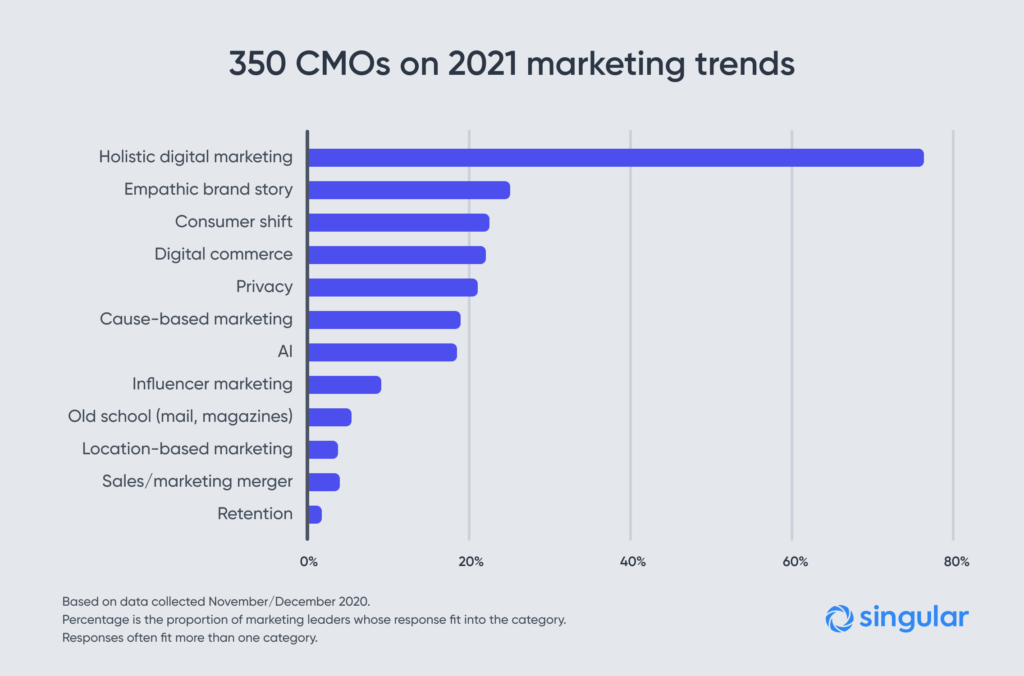
If you look closely at the chart headlining this report, you see 12 different sets of answers. Those are derived from 791 distinct responses from the 350 CMOs and marketing leaders who replied: many gave multiple insights. But really, there’s a number of converging supersets of answers. Three, in fact.

And those are the supertrends: the big picture focus points for marketing leaders. I’ve added all the subtrends together, which is why the numbers below are higher than 350:
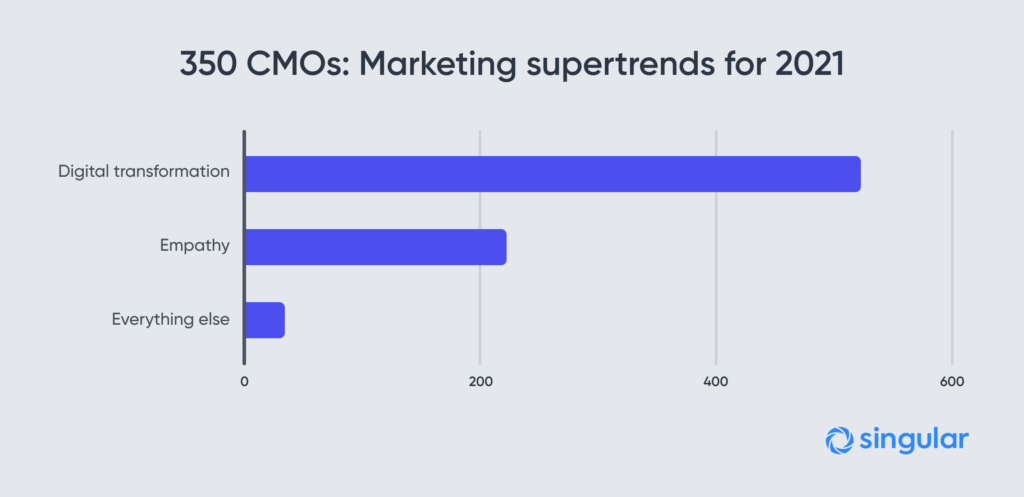
One is how: digital transformation.

The second, empathy, is a combo-pack of both what and why.

The third is odd bits and pieces that should really get subsumed into number one.

One: digital transformation

To form the digital transformation supertrend, I combined answers in six different categories. Here are the categories, along with the percentage of responses that fit into each. (Responses total more than 100%, because many CMOs and marketing leaders offered multiple answers.)

  • 76%: Holistic digital marketing
  • 22%: Consumer shift
  • 22%: Digital commerce
  • 18%: AI
  • 9%: Influencer marketing
  • 3%: Location-based marketing

We’ve been talking about digital transformation for more than a decade, and its roots literally extend to the 1940s. There’s a reason for that: many organizations have been able to skate past the hard work of making every process smart, digital, and connected.

COVID-19 changed all of that.

Not only did Coronavirus accelerate e-commerce by four to six years in just a few months, it forced us to recognize the need for change. What executives couldn’t force themselves to do, consumers essentially mandated: they voted with their dollars.

“Consumers are setting trends which are followed by the brands,” says Andrei Vasilescu, CEO of DontPayFull. “Consumers all over the world have ignored every single preset trend.”


“With significant changes to the economy and the way people live and work, what has been successful in the past may no longer be relevant for the new reality of 2021,” says Carly Brantz, CMO at DigitalOcean.

And don’t assume that this is temporary. Sure, we now have multiple vaccines, but they won’t instantly be administered to the entire population. Some parts of the population will actively avoid them, and others will wait in line for months, and still more will retain the habits they’ve learned in the last year.

“A large part of this shift will be permanent as consumers have incorporated new behaviors into their altered lifestyles,” says Michel Wedel, PepsiCo Chair in Consumer Science at the University of Maryland.

While I’ve combined answers here, some key sub-themes emerged. They include:

  1. Data
    Data is useless if it’s not actionable. Today, in fact, it might even be a liability. (See “privacy” in the next section.)
  2. Automation
    If fusion is the new ecosystem, brands need a way of bringing together all their experience and inputs. Automation is one big driver of that.
  3. Owned channels
    Without investing in owned channels like email, apps, Slack channels, push notifications, or others, brands risk having to cross a toll gate every time they want to communicate with their customers.
  4. Content and Video
    Video is clearly huge: TikTok, YouTube, Zoom, streaming entertainment … it’s where we spend our time. Brands are creating more content than ever before, and video is a big part of that.
  5. Omnichannel
    It’s an old buzzword but it still has meaning. If your customers get your email and visit your site and buy your product and have your app … can you serve them wherever they happen to contact you?

What’s become imminently clear based on the insights of hundreds of marketing professionals is that in some ways, 2020 was the practice run. 2021 will be the real deal: if you don’t have your digital marketing transformation down pat in the coming year, you are going to be in serious trouble.

With that said, there’s not a single path. There’s a lot of uncertainty ahead, and that means marketers need to be agile and plan for multiple scenarios, with a tech stack that lends itself to rapid shifts as needed.

“This is an extremely uncertain period of time, and CMOs shouldn’t have one roadmap – they should have multiple,” says Abhay Singhal, co-founder and CEO, InMobi Marketing Cloud.


“2020 has ushered in the era of the Agile Marketer,” says Carly Brantz, CMO, DigitalOcean. “We have all seen the need to pivot and adapt to rapidly changing social and commercial dynamics this year. It’s the marketers who can rapidly adapt, recognize opportunities, and execute quickly who are driving growth and momentum for their brands.”


“Fear and anxiety ruled consumers this year, which had an immediate impact on purchasing decisions,” says Hetal Thaker Patel, EVP for SmartAudio Insights and Analytics at iHeartMedia. “At iHeartMedia, we recalibrated what we call the three C’s, which are consumers, clients, and core offerings. As consumer and client needs change, we adjust our core offerings. Willingness to pivot quickly and swiftly is a trend we can expect to see bleed into 2021.”

Two: empathy

The second supertrend is composed of three combinations of answers that I’ve summed up in one word: empathy. Here are those three categories, along with the percentage of respondents who mentioned something in each of them.

  • 25%: Empathic brand story
  • 21%: Privacy
  • 19%: Cause-based marketing

If there’s one thing we learned about marketing in 2020, it’s that brands need to meet people where they are. And over the past year, we’ve all been in some pretty dark places.

“Empathy … coming off of a year like 2020, we know every consumer has more to their story,” says Joanna Milliken, head of SAP Marketing Cloud at SAP. “They aren’t shopping for a mountain bike or the right flour for a sourdough starter, they are looking for solace in a confusing and unpredictable world.”


“It is without a doubt crucial to recognize how COVID-19 has ushered in a strong sense of empathy as a driving force within the marketing industry,” says Tristan Dion Chen, CMO of University Credit Union. “It would not be surprising to see that empathy will continue as one of the big trends in 2021.”


“Ohana – Hawaiian for family – has been at the core of our values,” says Andrea Pirrotti-Dranchak, Chief Marketing and Development Officer at Office Evolution. “We drew upon the power of our Ohana in 2020, wrapping our arms virtually around our member base, franchisees and team members … to provide hope, security and inspiration. Brands that can truly connect by tapping into what really matters for its target audience will come out on top in 2021.”


“2021 will call on brands to authentically infuse empathy and emotion into their brand strategy, and I cannot think of a more appropriate time to build those emotional connections with customers and cultivate relationships,” says Jennifer Chase, SVP and Head of Marketing at SAS. “A brand strategy with heart and humanity will inevitably lead to stronger emotional customer connections, especially when customers recognize that a brand aligns with their values — in good or bad times.”

That empathy can connect with cause-based marketing, which we’ve had more than enough reason to engage in during 2020. Only 19% of marketers mentioned this, however, and that’s likely due to the almost unprecedented fracturing of so many communities over politics, health, and economic issues. Brands that have the courage to take a stand and the willingness to pay the price if it backfires, however, have something to offer.

“Consumers are in a search of their beacon of hope … something they can truly stand behind,” says Natasa Djukanovic, CMO at Domain.ME. “What does this mean? Brands need to prove their values with actions.

One of the reasons why less than a fifth of marketers selected cause-based marketing as a key driver in 2021 is fear. As Sara Spivey, CMO at Braze notes, some brands are choosing to be apolitical and explicitly take no stance on social or political issues. No matter which direction brands take, Spivey says however, they’ll need to stay committed to their decision and communicate it clearly to employees. While also understanding the potential risks or gains, of course.

Though many issues were polarizing in 2020 and might continue to be partisan in 2021, some have both wide applicability and acceptance levels.

“A quarter of consumers said that they would drop a brand if they were polluting the environment,” says Sara Spivey, CMO at Braze.


“With the craziness of this year, companies will continue to create diverse visuals and inclusive messaging,” says Michelle Ngome, President of the African-American Marketing Association. “While brand authenticity remains true, the commitment to diversity and inclusion will remain at the forefront with brands hoping to reach new audiences.”

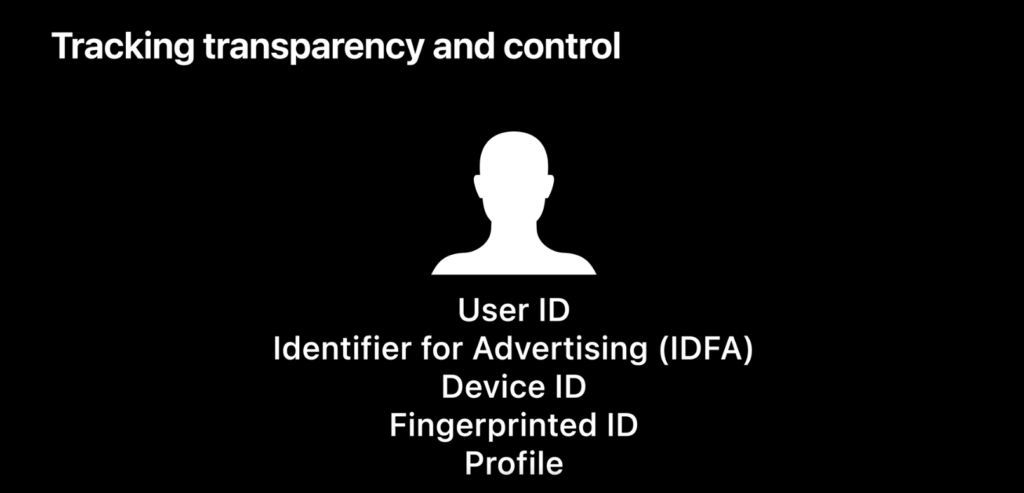
The core reason I’ve included privacy in this supertrend is that for many marketers, consumer privacy steps are a reflection of what they want for themselves. And, for many, what they’ve seen and are worried about in major documentaries like The Social Dilemma. Privacy came to the forefront in 2020 not just because of data collection policies and use in social media, but also because Apple, one of the most powerful companies in mobile, decided to make its Identifier for Advertisers (IDFA) explicitly opt-in. In the past, it’s simply been a silent and default bit of shared data for most people. Plus, of course, California approved Proposition 24 by a 56% to 44% margin, expanding the state’s consumer data privacy laws.

“2021 will mark the beginning of a significant shift in the tug of war between consumer privacy and advertising,” says Jalal Nasir, CEO of Pixalate. “Advertisers will begin to employ ‘Compliance Officers’ and special attention will be given to where app publishers are located, what kind of consumer data is collected, and how that data is used as part of the digital ad supply chain.”


“Organizations will need to ask themselves: do we really need to know someone’s mother’s maiden name?” says Stephen Cavey, cofounder of Ground Labs. “What types of form fields are on marketing materials? Do you need all of it? What personal data fields are you marking compulsory for your customers to complete and which are optional, and why? If you don’t need it, why are you collecting it?”

And that will have an impact on how brands market and connect with both prospects and customers. Earned and owned channels will get even more important — especially owned — because brands don’t have to depend on third parties to access their customers, and they can keep any shared data in a private first-party relationship. That means channels like apps and email (yes, still email!) are crucial for marketers.

“A major trend in 2021 is a shift towards owned channels,” says Ruben Ugarte,
author of the upcoming book Data Mirage: Why Companies Fail to Actually Use Their Data. “Privacy regulations and political pressure will keep limiting the data that companies can get from Google/Facebook/Apple.”


Three: everything else

The third supertrend is really a conglomeration of just about everything else that people mentioned. And most of it, as I mentioned before, really belongs in the first: digital transformation.

So when CMOs mentioned AI or big data or account-based marketing, they generally did so in context of a broader marketing strategy. And when the leading edge talked about augmented reality and virtual reality, live video on social media, podcasts, or influencer marketing, they generally didn’t hype it as the one and only strategy, or the silver bullet that solves everything.

You still have, of course, the direct mail vendor who says that a return to old school marketing is the big trend of 2021. Or the location-based marketing vendor who, in defiance of a global pandemic that might not be over anytime soon, says location based marketing is where it’s at. Or the PR reps who isolate public relations as the next big thing, and my personal favorite, the otpimistic event organizers who are wistfully prognosticating that in-person events will be back big time, baby, in 2021.

But most marketers are consistent: getting all their digital ducks in a row is the key to success in 2021.

The only answer that some might consider hype-based that survived solo is AI. As mentioned above, I grouped that in with digital transformation since it’s so key to making sense of the data that brands collect, personalizing messaging to customers, and reacting at internet speed.

“Brands will use AI to solve customer problems in real time,” says Dee Anna McPherson, CMO at Invoca. “AI, machine learning, and automation enable brands to answer questions before they’re asked or to serve up solutions the minute the customer calls.”

So now what: 4 paths forward

If the three supertrends are digital transformation, empathy, and everything else, what’s the path forward for a brand? Based on the 17,870 words and 112,752 characters of insights from marketers, here’s what I’m seeing.

  1. Change will continue; agility is not optional
    I won’t belabor this point: it’s obvious to all who are paying attention. COVID-19 has had an enormous impact on the global economy. While we’re starting to see a glimmer of hope on the horizon in nations that have gone through hard shutdowns and emerged out the other side, or in vaccines that are extremely promising, virtually no-one expects to flip a switch in 2021 and return to the good old days of 2019. Therefore: smart brands will be light-footed and quick to adjust to change.
  2. Death of hype
    When everything gets incredibly real, like in a global pandemic that shuts down millions of businesses and impacts nearly every human being on the planet, most of us drop two things: the sacred cows that we hold so dear, and the hype trends that promise so much but must be integrated into a holistic long-term strategy to really deliver on their promise. Smart brands will get their data houses in order, building a foundation on which they can build any necessary infrastructure for digital marketing.
  3. Brands need global digital transformation
    If you can’t make data-driven decisions quickly, you lose agility and flexibility. If you can’t harness data to make real-time customer-facing decisions, you can’t serve clients quickly. If you don’t know how customers are using or abandoning your products, or can’t bring that data into your marketing systems of engagement, you’re losing more customers than you should and you’re mis-messaging others. If marketing is digital but product or service or support or sales is analog and disconnected, your Ferrari has a Model-T under the hood.
  4. Empathy is critical
    Getting the data right is table stakes. Getting the digital infrastructure in place is foundational. But putting the wrong messaging through very sophisticated pipes doesn’t magically transform it into gold. The science of marketing matters. The art of marketing is probably even more important, because the tool must be aimed. It must be employed. And it must drive the right direction. In 2021, brands that win will build empathic, connected, insightful stories that inspire.

And … so many great quotes!

There were just too many great quotes to leave on the cutting room floor. Here, in alphabetical order based on the trends I categorized them into, are some of the best quotes the survey yielded.

AI for customer experience

Dee Anna McPherson, CMO at Invoca
“Brands will use AI to solve customer problems in real time: Today, customers expect brands to understand who they are. In fact, according to a recent survey by Accenture, 87% of consumers say it’s important to buy from a brand or retailer that understands their real self. Knowing who the customer is, if they’ve shopped with you before, and serving up the right information is, frankly, becoming table stakes. Looking forward to 2021, I expect — and hope — we see brands take this intel to the next level. Brands can also use this data to solve customer problems in real time. AI, machine learning, and automation enable brands to answer questions before they’re asked or to serve up solutions the minute the customer calls. Imagine if a sales rep could see that a promotion code wasn’t applied to an order and have the refund ready to go before they answered a customer call; or if a service rep knew a customer dropped off the website and picked up the phone to call when there was a breakdown in the purchase processing. That’s future-proofing the customer experience.”

Richard Jones, CMO of Cheetah Digital
“If Content is King, then Context is the Queen of the marketing chess board. Having a more detailed understanding of your customer, from zero-party based interests to a more detailed view on customer interactions makes next generation personalization all the rage. Applying machine learning and analytics to your personalization strategy will allow marketers to drive efficiency, effectiveness, automation, and optimization.”

Juliette Rizkallah, CMO at SailPoint
“Standard marketing models will begin to emulate more aggressive and digitally focused B2C marketing approaches, where companies leverage a variety of digital touchpoints to target an individual buyer. B2B marketing will need to adjust the B2C approaches to handle the multi-personae account buying committee and will leverage artificial intelligence and machine learning to measure the progression of accounts along the top of the funnel.”

Cause-based marketing

Kristin McHugh, VP of Brand Development at Verizon
“With all of the uncertainties and stresses brought on throughout 2020, there was a need for brands to be truthful and helpful in their marketing. I think you’ll see even more of that in 2021, with brands doubling down on not only messaging around being forces for good, but taking actions tied to responsible business. You’ll also continue to see emerging technologies like 5G take center stage when it comes to both virtual and in-person events and the creation of content that will have a huge impact on the industry.”

Jennifer Lawrence, Vice President at Vye
“It is critically important to understand the pain, problems, and challenges your audiences face and directly address those problems and clearly offer solutions.”

Kent Lewis, President & Founder at Anvil
“Racial inequality protests in 2020 inspired us to change our own behaviors and advise our clients on content strategy. We predict brands will make significant efforts to clean up business practices and adjust messaging to appeal to enlightened consumers that care deeply about a company’s purpose and commitment to social and environmental sustainability. Research has shown that ethical businesses will be more successful in the long-term, so we expect to see many businesses to join in the movement in 2021.”

Consumer shift requires marketing shift

Leena Iyar, Chief Brand Officer at Moxtra
“The reality is that on-demand service isn’t going away post-pandemic.”

Susan Vobejda, CMO at The Trade Desk
“2020 has ushered in the era of the Agile Marketer. We have all seen the need to pivot and adapt to rapidly changing social and commercial dynamics this year. It’s the marketers who can rapidly adapt, recognize opportunities, and execute quickly who are driving growth and momentum for their brands. We see this among our clients every day as The Trade Desk’s media buying capability helps brands initiate campaigns quickly and optimize in real time. The successful marketing leader of the future will have a broad range of skills that can be relied upon when change and agility are needed, including an understanding of data activation, media, and technology and the power of storytelling. My advice to marketers in 2021 is to break out of your comfort zone …”

Norman Guadagno, CMO at Acoustic
“As consumers have had so much of their trust eroded in all types of media, marketers will continue a shift to become more reliable sources of truth.”

Michael Stahl, CMO at SERVPRO
“The past year has both amplified and accelerated getting the customer what they want, when they want it and by what means [they want it].”

Alexis Sheehy, Director of Growth at MediaCrossing
“Agile Marketing is not simply going to be a buzzword. 2020 taught us the necessity of having a marketing organization that can quickly pivot, test and evaluate all aspects of strategy from messaging to platform engagement. We are entering the new era of agility in marketing, meaning, marketers must take a page from the technology space to adopt a framework that prioritizes innovation, optimization and fluid execution.”

Krista Neher, CEO of Boot Camp Digital
“Agile becomes mandatory … agile working is about being more flexible and reacting quickly. Brands are starting to realize that long-term planning and post-mortem analysis don’t translate into maximizing results in digital. The marketplace is more dynamic, and brands that aren’t able to quickly respond to data and changes will lose market share to more responsive competitors. Agile working allows businesses to respond quickly – and invest more in what is working while limiting investments in what isn’t working.”

Holistic digital commerce

Andy Mecs, Vice President of Marketing and Innovation at StarKist
“Brands will shift a larger percentage of marketing budgets to digital and e-commerce. Advertising will become more personalized and focus not only on demographics and psychographics, but also in purchasing behavior. Inflation will be significant, as retailers need to offset COVID-related costs and infrastructure investments to establish greater e-commerce presence.”

Brian Roizen, Cofounder of Feedonomics
“We’re seeing major brands move away from retailers and adopt a direct-to-consumer approach. Nike has been trending this way already, but the pandemic forced them to make a big push. Lots of businesses saw the benefit of having a strong eCommerce presence this year, whereas others with no online presence suddenly found themselves without a revenue stream.”

Matt Erickson, Marketing Director at National Positions
“With so many more customers becoming accustomed to new levels of ecommerce access to their products — from selection and discovery to delivery and pick-up options — many will continue to embrace these changes. Brands that can provide more friction-free ways for customers to use ecommerce purchasing avenues are likely to see a very fruitful 2021.”

John McCrea, CMO at Amplify.ai
“Given how the pandemic has super-charged e-commerce in 2020, every brand, including brick-and-mortar ones, is under pressure to up their ‘digital game.’ But I predict 2021 will be a year of great opportunity …”

Nitzan Shaer, Co-founder and CEO of WEVO
“Millions of people that have rarely shopped online are now doing their groceries, banking, entertainment, apparel, transportation and all other forms of shopping online.”

Myles Kleeger, President and Chief Customer Officer, Braze
“This year, retail was flipped on its head. Now, e-commerce is the leading star, with physical experiences relegated to a supporting cast role. This will only accelerate in 2021 and beyond. In fact, 83% of consumers said that they planned to shop online as much or more as during the height of the pandemic. The desire for a physical shopping experience will never fully go away, but the majority of today’s customers prioritize shopping from brands that provide an easy-to-use, on-demand experience from the comfort of their homes. The retailers that will emerge as winners will continue to lead with personalized digital shopping experiences, while reimagining how physical shopping experiences can supplement a digital offering.”

Holistic digital marketing

Patrick Kehoe, Chief Marketing and Strategy Officer at Coalfire
“Digital, digital, digital. We know it’s the imperative for 2021 and beyond.”

Paul French, CMO at Axway
“The next big trend is uncovering the value locked up in your martech stack.”

Suzanne Kounkel, principal, Deloitte Consulting LLP and chief marketing officer, Deloitte US
“Fusion is the new ecosystem … fusion is the art of bringing together new business partnerships, customer insights, and digital platforms to create ecosystems that more holistically address human needs. While partnerships were important ingredients to growth before the pandemic, an overwhelming majority of C-suite executives (78%) agreed that new relationships forged during COVID-19 will continue to be part of a long-term strategy after the pandemic subsides. And although executives are still operating with a defensive mindset – 42% of respondents are looking at digital investments as a way to improve efficiency while very few (17%) are looking to grow revenues — through pioneering partnerships that address customer needs beyond what their organization does today, companies can establish a new, proactive mindset focused on growth, differentiation and disruption.”

Cynthia Gumbert, CMO at SmartBear
“In 2021, customer experience means the quality of digital, app, and mobile experience. Whether your app works to expectations or not will make or break many companies more than ever. Accelerated Digital Transformation will quickly become that was so 2020, where every business scrambled to become digital- and mobile-first. That’s quickly becoming old news, and the biggest thing differentiating businesses is how well these digital experiences now operate for their customers. This is everything from how quickly a page loads, to how easy is the purchase experience, to how well businesses handle support if something goes wrong. This end-to-end quality is not a given, without a purposeful strategy to get there.”

Shawn Rogers, VP Analytics Strategy and Corporate Marketing at TIBCO
“If all companies have equal access to modern marketing automation systems, how do you out-market your competition? The strategy for 2021 needs to be an alignment of all platforms and initiatives, and in many cases, an increased focus on centralizing and utilizing the data each of these programs is producing to better drive execution. Just having the newest tool isn’t the answer either — it’s a challenge to bring the data together in a way that drives innovation. Better utilization of data to drive automated interactions, automate decisions, and influence propensity models is the key to competitive differentiation. Your data is yours; and that makes it unique and highly valuable.”

Marcy Massura, EVP of Marketing Consulting Services at Hotwire
“2020 took several tools out of the marketers’ toolbox — no live events, no tradeshows and no “lets meet over coffee” to drive MQLs. We’re seeing a huge and rapid shift to move those dollars to digital marketing to drive demand. Additionally, the infamous practice of cold calling to prospects has gone dry as employees moved home. Now, Social Selling has been pushed to the front of many sales programs — driving an even greater need for brands and their executives to have buttoned up social platforms and associated social content. Sales and marketing teams will continue to invest in digital and quickly move from a ‘test and see’ state in 2021 as they focus in on which new programs and tactics implemented this year continue to help them reach their goals.”

Scott Anderson, CMO, Intermedia
“Digital marketing is, of course, nothing new but in 2020 when most of the world sheltered in place, the already ubiquitous internet gained even higher reach as a marketing channel. With so many continuing to self-isolate at home, expect to see a similar trend in 2021. This year eCommerce increased 44.5% from 2019 while US brick and mortar retail square footage dropped by 60%. The indicator for marketers is clear – a much larger proportion of our audience is living online and we’ll see that reflected by commensurate shifts in marketing investments in 2021.”

Claire Brunner, Partner at Enilon
“Moving into 2021 all marketing teams will have digital transformation on their mind. This stems from all of the changes that have occurred to every single one of us during the pandemic, and will continue into next year.”

Penry Price, VP of Marketing Solutions at LinkedIn
“Industry conferences will be online-offline hybrids in 2021 and years after, serving people who don’t want to travel away from home as well as those who wish to attend in person. We’ve learned during this pandemic that we can communicate over digital platforms better than we thought. Whether it’s been colleagues and clients working from home, friends and family socializing during off-hours or public figures chatting it up, this once-in-a-century pandemic has inadvertently proven live video can achieve intimacy even when we cannot be together. And companies that have hosted large events in the past can be much more cost-effective and achieve better ROI because digital entails less overhead.”

Amy Vale, CMO at Dosh
“Marketers must be ready to delight the ‘new’ post-pandemic customer. Shopping behavior was forced to change because of the pandemic, but once it’s over (and it will be over at some point) habits will not return to the same ‘normal.’ The pandemic accelerated on-demand consumer expectations, with merchants of all sizes expanding options for delivery and curbside pickup, online grocery finally surged, and months at home reinforced that there’s nothing wrong with browsing warm, cozy clothes in the summer. In 2021, marketers need to throw out their old playbook and develop ways of building customer loyalty, taking into consideration the surge in digital-first businesses and how that impacts consumer expectations.”

Privacy

Jalal Nasir, CEO of Pixalate
“As consumer privacy protection laws like California Prop 24 are passed, 2021 will mark the beginning of a significant shift in the tug of war between consumer privacy and advertising. Advertisers will begin to employ ‘Compliance Officers’ and special attention will be given to where app publishers are located, what kind of consumer data is collected, and how that data is used as part of the digital ad supply chain.”

Bill Magnuson, co-founder and CEO, Braze
“Privacy has been absent from any meaningful discussion this year, and big initiatives like Apple’s guidance on kids’ apps have been postponed. However, we will see a refocus on privacy in 2021 that will bring attention back to the customer. Apple and Google will drive industry-wide privacy change that results in more companies being stricter with what data they collect, less reliance on cookies and identifiers, and a call for IDFA and AAID to be removed completely from any apps that involve children or wellness. While Apple has implemented some restrictions in an effort to protect children, these additional changes could help set a new industry-wide standard for putting consumer data privacy first.”

Brian Jackson, Research Director at Info-Tech Research Group
“Consumer privacy has become more scrutinized and the advertising industry is facing pressure from regulators to earn meaningful consent before scraping data, cookies have been crunched. As marketers face a world without cookies in 2021, suddenly what was once an ‘opt-out’ system has become ‘opt-in.’ Several of the most-used browsers, including Google Chrome, have adopted a new “do not track” policy that prevents cookies from being stored on users’ computers by default. Since most consumers never change the default settings, it will become increasingly harder to track them with cookies. Expect companies like Facebook and Google to find ways to keep you signed in to their web services, as that is one highly effective way to track you across the web. Also expect other digital players that are reliant on advertising revenue to push their users to sign in more often.”

Viral Bajaria, CTO and Co-founder at 6sense
“We’re quickly approaching Google’s decision to phase out third-party cookies, and I believe many brands will scramble to accommodate the changes in 2021. We’ll continue witnessing the rise of “opt-in” pop-ups, but I predict that brands adjusting to the end of cookies will operate from two sides of a spectrum. Some brands will present a “known profile” to prospects, seeking confirmation of their data insights, while others will lockout prospects unless they provide their identity. One method involves transparency and accountability, while the other is likely too forceful to be beneficial and accurate. Brands that win will embrace the former.”

Michael Schoen, SVP/GM, Marketing Solutions at Neustar
“In 2021, we still start to see a seismic shift in marketers starting to leverage differential privacy algorithms as a way to provide highly accurate multi-touch attribution without requiring individual-level advertising impression data. Advances in privacy like this are needed because traditional privacy safeguards, such as anonymization (the removal of identifiable attributes, such as names, addresses, social security numbers) have been found to be ineffective. Furthermore, this advanced data science approach ensures brands can measure advertising performance across closed media platforms in a privacy-centric way without relying on third-party cookies and MAIDs.”
From ‘hello world’ to Clash of Clans: The components of marketing analytics

How do you get from “hello world” to Clash of Clans? In other words, what marketing analytics tools can help, and which ones do you need at all the different stages from just starting with your first app to becoming a global success story?

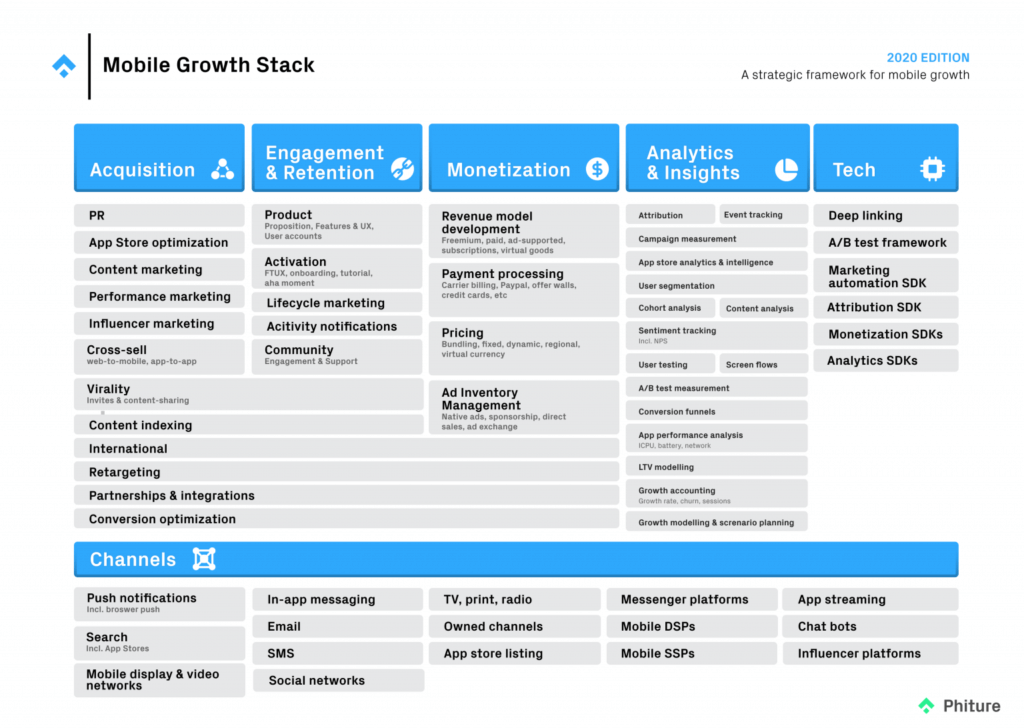
It’s an important question, because if you look at what you can buy — versus what you should buy — it’s an intimidating stack. I mean … just like at the Mobile Growth Stack:

If you’re going to have all the right tools in all the right places, there’s probably more categories than you have dollars or euros in the bank. Acquisition, engagement, monetization: each of these have ten or more subcategories of platforms and tools for growth.

You can’t boil the ocean, and you can’t start with more tools than users.

So where do you start?

To answer this question, I chatted with Clair Rozain. She’s been on Singular webinars before and currently leads user acquisition at Product Madness, a leader in the social casino and slots space. She also has a long history in mobile marketing, including a stint at Match, among other brands. She’s grown apps from the basement, and she’s grown apps in the stratosphere.

The result: another Growth Masterminds podcast.

And among the insights she shared: surprising suggestions that shattered my expectations and provided new insight into what marketing analytics you need, especially in the very beginning of your journey to dominate global app install markets.

My first question: does a total beginner need marketing analytics at all?

“Well, I would say yes,” Rozain says. “I began my passion with digital marketing creating websites … it began all with analytics … what is magic with digital marketing is that you can measure everything … you need to understand your market.”

In other words, bring in analytics right from the beginning. You can get something free, like Firebase, so it’s not taking money you don’t have, but it is providing a lot of data. That helps you understand how to make your app better, how to make your user experience better, and ultimately how to grow. It’s true that in the beginning, that growth should be organic, Rozain says, utilizing social and the App Store and Google Play.

Then: pay close attention to your metrics and you fail fast, learning all the time.

There will be a tipping point at which you need to bring in attribution as a core part of your marketing analytics.

“Once you really understand what works … when you’re sure that it’s going to work, you invest in your project and you pay attention to each dollar,” Rozain says. “It’s like your baby, you want to count everything. And you need an attribution solution, basically, because without it, you’re just going to lose your money.”

When you’re starting out, you don’t have a lot of spare cash. Testing tools takes a lot of time — which you also don’t have — and buying them is too expensive. Which means that you need to focus on the most critical elements.

For Rozain, those include attribution:

“If you don’t have attribution during your campaigns, you can’t learn,” Rozain says. “Attribution is really important because you need to understand where you’re going to … make your business grow even more … and without this it’s impossible.”

The other role that marketing analytics plays in growth is that as your app becomes more successful and your team gets bigger, you start having additional people to satisfy. That means financial analysts, of course, but it also means talent that you want to acquire and add to the team. They need to understand the metrics of your business before coming on board: tangible, accurate data that shows you’re building something successful.

Plus, of course, investors. At least at the right time.

As your app starts to grow, that’s when engagement and retention tools become more critical. Monetization becomes important as the team grows and you look to fuel new campaigns in the future, and you start looking for solutions to optimize user journeys and boost virality.

Another big jump comes between hundreds of thousands or even low millions of dollars or euros in revenue and the major mobile publishers who are making eight, nine, or even ten figures in annual revenue.

Everything just scales higher, Rozain says.

Including reporting and specifically cost aggregation.

“We use Singular, which is one of the best, I think, in cost aggregation,” Rozain says, (unsolicited, scout’s honor). “And we use it everyday because everyone is a team … [and they are] going to ask us: what’s going on? What happened today? Why did you have this spike? And you need to be accountable.”

Retargeting enters the marketing analytics picture. App Store optimization becomes more important. User segmentation and cohort analysis ramps up, as does A/B or multivariate testing. LTV modeling is critical, and conversion optimization becomes a focus. At this scale, most publishers have extensive internal BI capabilities that their marketing analytics systems need to feed, often via ETL. Set up properly, this is real-time data showing evolution of your growth.

“Even if it seems like something pricey, it’s something that is at the center of the business to make people smarter,” Rozain says.

The bigger you get, the most holistic a picture you need. That means tools beyond paid attribution including engagement tools, live ops tools, and other tools to help you understand user journeys at a deeper and deeper level. The best marketers, Rozain says, don’t stop at acquisition and don’t stop at the top of the funnel, but always work with the rest of the team to understand the full life cycle of people using their apps.

And all of this is changing, of course all the time.

(This is mobile: it’s always changing.)

With the updates Apple is making to iOS 14 and IDFA, Rozain is working hard to open up new avenues to user acquisition, including influencer marketing.

“We are going to watch the performance more holistically,” she says. “We are going to find new ways to be where the user is and where they are looking for us.”

All of which adds new complexities to measurement and marketing analytics, including web to app and app to web to app user acquisition flows, which all need to be supported at a high level of data integrity by attribution and marketing analytics companies. These are new challenges, in a sense, but build on capabilities that Singular has been working on for years.

All of which keeps life interesting.

“It’s super challenging and super interesting … because it’s something new and there are so many new channels,” Rozain says. “It’s always this cycle to test fast, learn fast, fail fast.”

10 ways to get your app kicked off the App Store

Few businesses in history have erupted like those on mobile.

TikTok is an obvious example. Pokemon Go was the poster child for overnight success a couple of years ago and while we don’t hear about it anymore, it is still raking in dumpster-loads of cash: $193 million in the last three months, according to Apptopia.

So it’s critical to be on Google Play and the iOS App Store. But, as developers know, it’s harder to get on the App Store, and there are more guardrails about what you can and cannot do in your iOS app.

So I thought I’d put together an iOS 14-flavored list of the ways to get kicked off the App Store. Some of these have been around for a while. Others are brand-new with iOS 14.

1. Tell people to go buy IAPs on your website

Option number one to get kicked off the App Store (and Google Play, by the way) is to offer purchases that will be valuable in your app, but ask people to buy them on your website so you can avoid the 30% platform fee.

Obviously, this is what got Epic’s Fortnite booted. And it’s now the focus on a major lawsuit, as well as antitrust attention.

This is a bit murky, however.

Guideline 3.1.3 allows some types of apps to access purchases made outside of the app, like reader apps, multiplatform services, enterprise services, or person-to-person sales. But you still can’t explicitly tell people to go elsewhere to buy things in your app. Nor can you use “points of contact obtained from account registration within the app (like email or text) to encourage users to use a purchasing method other than in-app purchase.”

2. Hide functionality in your app to reveal later with a cloud-based change

Hiding functionality in your app is also a good way to get kicked off the App Store. There’s an obvious reason for it — apps with hidden code could execute serious privacy and security breaches on unsuspecting users — but it’s also tough on good developers, who might want to build functionality that they will reveal later.

Updated rule 2.3.1 says “Don’t include any hidden, dormant, or undocumented features in your app; your app’s functionality should be clear to end users and App Review.”

The flip side is: don’t say your app does something it does not actually do. Guideline 2.3.1 states that ”you should not market your app on the App Store or offline as including content or services that it does not actually offer … egregious or repeated behavior is grounds for removal from the Developer Program.”

One target of that guideline: VPN apps that claim to make your browsing experience private and safe, but actually collect, store, and sell data about where you’re going. This has happened multiple times, including recently.

3. Include ads in push notifications and widgets

Marketers advertise, right? Sure, but good marketers know when and where to advertise, and how to do it ethically. Apple has decided that ads should not be presented in notifications and other areas of iOS mobile operating system.

But there is a loophole.

Guideline 3.2.2 says that “monetizing built-in capabilities provided by the hardware or operating system, such as Push Notifications,” is unacceptable. The loophole is in another guideline, 4.5.4, where Apple says that “push Notifications should not be used for promotions or direct marketing purposes unless customers have explicitly opted in to receive them.”

In other words: get your permissions squared away.

4. Include third-party analytics in your kids-focused app

Most developers know this by now, but if you’re publishing apps just for kids, third-party analytics solutions are problematic.

Guideline 1.3 says “apps in the Kids Category should not include third-party analytics or third-party advertising.”

Again, there’s a loophole, however.

“In limited cases, third-party analytics may be permitted provided that the services do not collect or transmit the IDFA or any identifiable information about children (such as name, date of birth, email address), their location, or their devices,” Apple says. “This includes any device, network, or other information that could be used directly or combined with other information to identify users and their devices.”

If you’re including third-party analytics, be prepared to show Apple exactly how they’re working, what they’re collecting, how you’re ensuring they’re not collecting any banned data, and how you’ll make sure that situation persists over time.

5. Collect unauthorized data from your users

There’s a clear directionality to Apple’s evolving guidelines over the past years: more privacy, less risk. At the heart of that is data minimization in guideline 5.1.1(iii): “Apps should only request access to data relevant to the core functionality of the app and should only collect and use data that is required to accomplish the relevant task.”

This is a very sensitive area and it’s not just about what you collect.

It’s also about what any third-party software in your app might be collecting. For instance, a fraudulent ad network SDK could be collecting data to steal credit for other ad networks’ efforts, as we saw in the recent fraud incident (which Singular protects clients from, by the way). And you don’t even necessarily have to add the ad network’s SDK to your app manually: it could be embedded in your mediation platform.

So it might not even be your fault, which is why you need to vet your partners very, very carefully.

And, of course, you need to not be a bad guy yourself. As Apple says, “developers that use their apps to surreptitiously discover passwords or other private data will be removed from the Developer Program.”

6. Make people enable tracking to unlock features

Some publishers floated this idea in the early days of iOS 14’s release: can we ask people to enable IDFA-based tracking in exchange for access to features and functionality, or in-app rewards?

Apple’s response: “Nuh-uh.”

See the highlighted part of App Store guideline 3.2.2(vi):

“Apps should not require users to rate the app, review the app, watch videos, download other apps, tap on advertisements, enable tracking, or take other similar actions in order to access functionality, content, use the app, or receive monetary or other compensation, including but not limited to gift cards and codes.”

7. Use fingerprinting in place of IDFA for tracking purposes

The other fond dream of mobile marketers — or ecosystem players with extensive device graphs — was that if IDFA was out, fingerprinting was in.

Fingerprinting is identifying a device by its characteristics: location, device data, language, and more. This has been easier on desktop web and Android than on iOS, thanks to a more limited array of data available from iPhones, and while it decays rapidly over time, can still approach from 80% to high 90% accuracy.

However, Apple considers it simply another form of tracking (probably because it is) and says that if you have not obtained tracking consent, you cannot use it.

8. Offer a controversial and/or potentially dangerous product

You might think this goes without saying, but not always. Clearly some dangerous content is not going to fly on the App Store, but there are things that are OK one year, and not OK the next.

Vaping is a good example.

As the medical dangers of vaping grew more and more obvious, Apple made a decision to remove all vaping apps from the App Store.

“Recently, experts ranging from the CDC to the American Heart Association have attributed a variety of lung injuries and fatalities to e-cigarette and vaping products, going so far as to call the spread of these devices a public health crisis and a youth epidemic,” Apple told Axios. “We agree, and we’ve updated our App Store Review Guidelines to reflect that apps encouraging or facilitating the use of these products are not permitted. As of today, these apps are no longer available to download.”

That’s guideline 1.4.3, and it covers “tobacco and vape products, illegal drugs, or excessive amounts of alcohol.”

There’s not much you can do as a developer here, except try to avoid categories that could have negative legal, ethical, or medical consequences.

9. Poke the bear (and offer insane pricing)

As much as you’re an independent company or publisher, you’re accessing the market via another company that controls your ability to do so.

So bad-mouthing Apple is probably not a great strategy for long-term financial stability, as the developer of the Zits & Giggles app discovered recently. Apple probably won’t kick a developer out for simply badmouthing them, but it won’t help … and when paired with an odd and excessively expensive pricing strategy — up to $400 for a simple casual game — you should not be shocked to get the boot.

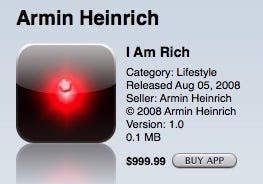
Of course that’s not the first time we’ve seen insane app pricing: you might remember the I Am Rich app from 2008, the dawn of the App Store.

Developer Armin Heinrich decided to play around with app pricing and eventually hit on the idea of offering a $999 app that did nothing but display a diamond. Apple, in turn, decided that this was ridiculous and banned the app for not providing any utility.

(Interestingly, the app is back on the App Store now with some calculation capabilities for just $8.99. Given that pricing, you might argue that perhaps the app name is now misleading.)

10. Use a private API

There are few things Apple dislikes more than a developer using a private API, which is why this app that enabled cloud gaming in Google Stadia got tossed out of the App Store for a few weeks.

App Store guideline 2.5.1 is pretty clear: “Apps may only use public APIs and must run on the currently shipping OS.”

You could potentially run afoul of this guideline unintentionally, because APIs do get deprecated. So Apple says “keep your apps up-to-date and make sure you phase out any deprecated features, frameworks, or technologies that will no longer be supported in future versions of an OS.”


How to calculate ROAS in iOS 14 with SKAdNetwork

ROAS is perhaps the most foundational KPI in mobile marketing. The big question for 2021 is: can you still calculate ROAS in iOS 14?

“First and foremost, I think we should recognize that there is still … IDFA, because users might opt-in,” says Singular VP of product Alon Nafta. “But if we go to SKAdNetwork — which let’s assume is the common case — it’s not like you don’t have anything. The SKAdNetwork framework does give you a few elements that if used correctly … advertisers can expect to get something sensible.”

Short version: yes.

Slightly longer version: there are some challenges.

Listen to the full interview on the Growth Masterminds podcast:

The elements Nafta is referring to include campaign ID, and publisher, plus inferred data like channel (via the publisher) and geo (via the IP). Cohorts, however, are a different story: not included by default. But they’re still possible: with the right partners and set-up, advertisers can get cohort data for iOS 14.

“That’s pretty much up to you,” Nafta says. “If you’re able to leverage the framework … that allows you to encode the date of install into the conversion value.”

Roughly, of course. This is iOS 14, and there won’t be a timestamp. The SKAdNetwork framework introduces essentially random delays, and theoretically if you wanted to keep updating conversion values, it’s possible that you would not see post-install conversion data for more than two months. But done correctly — and relatively quickly — it will give you a reasonable sense of cohort timing, Nafta says.

As long as you don’t expect too much.

“Real-time is pretty much gone,” he says.

The critical part is defining the most meaningful events that happen in your app and when they happen. For most mobile marketers, getting those in the first three days seems optimal, but you’ll have to test that assumption for your own app and your own business. A purchase would be great — of course — but any leading indicator of likelihood to purchase or otherwise convert is good enough.

It won’t be perfect. And, frankly, it won’t be as good from a marketer’s perspective as IDFA-based ROAS and cohorts. But it will work.

It’ll be good enough to optimize campaigns, Nafta says … and even creatives. (More on that later, in another podcast and blog post!)

Ultimately, that’s the best that marketers are going to get. Simply put: the world has changed, and without user-level and/or device-level data, Singular’s SKAdNetwork solution will provide what you need to grow intelligently.

Here’s the hard part: what if you want to optimize your marketing efforts for events that happen quite late in the user or customer journey? In other words, 30 days after install or even longer.

“I think that’s one of the questions that neither me nor others can answer in a perfect way,” Nafta says. “I would challenge you on some elements in the questions itself … you kind of assume that, ‘Hey, I can not change anything in the user behavior,’ but a 30-day trial, maybe I will challenge you a bit and say that … maybe now in this new reality, you have to change it to a seven day trial.”

In other words, your app experience and customer journey might need to change.

And marketers will have to work closely with designers, developers, and data scientists.

You don’t need a user transaction within that first seven days, but you’re likely going to see at least some user behavior that will be predictive for future activity, engagement, and conversion. App marketers who win will develop sophisticated models around those specific user behaviors that turn out to be good indicators of future monetization.

“The main thing to understand about SKAdNetwork is that conversion management is super important,” Nafta says. “Probably the most important thing. Sure, it’s still quite limited but we know that sophisticated advertisers are already planning to utilize smart techniques to try and leverage as much as they can from SKAdNetwork. And our goal with Singular SKAN is to have them do as little work as possible, and have Singular do most of the heavy lifting.”

Get more details on Singular SKAN here.

Or, request a demo.

Mobile ad monetization: challenges, trends, and future for this multi-billion dollar segment

Pizza and wine are good. But perhaps not quite as good as massive ad monetization.

At least that’s the impression I got from Lisi Gardiner, who’s Singular’s Senior Product Manager for analytics and focuses on ad monetization. Singular did a webinar on mobile app ad monetization in October, featuring Gardiner and experts from Game Hive, Neon Play, Voodoo, and Mopub.

Lisi’s talking “ad mon” late at night on the last day of a long week as we prepare for the session. With the weekend — and pizza and wine — beckoning. I’m the one keeping her from the pizza and the wine, but she’s cool with it.

“Well, I would rather talk about ad mon than eat pizza and wine,” she says, unconvincingly.

Listen to the interview behind this story on the Growth Masterminds podcast:

Ad monetization is one of those deceptively simple things. The concept is facepalm obvious: publish app. Put ads in app. Make money. The execution, however, has nuance. And not a small quantity of it.

“It gets more complex,” Gardiner says. “Which ads do you want to show? Which networks do you want to work with? What mediation platforms do you want to work with? When do you show an ad? What is the value you expect to get for showing that ad? Which countries are you optimizing?”

It’s not just hyper casual games that are monetizing via ads. Bigger, longer games are diving into mobile ad monetization as well. News apps have long monetized via ads. Utility apps are monetizing via ads. Pretty much any kind of app category that is capturing user attention can use ads, and publishers who want to maximize revenue know that paying app users are few and far between, statistically speaking. Ads make every mobile user monetizable whether they’re willing to pay or not, and given single-digit payer percentages in most app categories, that’s a valuable thing.

The tech matters here.

It’s obvious: you can’t set optimal bid ranges for new mobile users if you don’t know how valuable your users are. And while there are dozens of options for understanding how to value in-app purchase users, calculating the true ROI of non-payers is significantly more challenging.

The tech includes your app (of course), a mediation platform (usually one, but sometimes two), your MMP (Singular), something Lisi calls “Network Revenue Collection”, user-level revenue recognition, and a unified view that puts the ad revenue and IAP revenue together.

Which is, frankly, what Singular’s Ad Monetization Attribution & Analytics does.

But it’s not just about the data. It’s also about how the most successful publishers are structuring their teams for successful ad monetization.

“You’ve had two different teams,” Lisi said. “You have the UA team focusing on user acquisition and then you have the supply side.”

Working together, those teams — or even a single product manager — is constantly trying to harmonize things that are intrinsically competitive. More ads might bring more revenue in the short-term, but hurt retention in the long term. Ads in one position might fit right into the app experience, but never generate any revenue; ads in another position might harm gameplay.

“So there’s kind of like finding a balance between … annoying my users with so many ads that it’s like total spam and they don’t want to log back,” Gardiner says. “And also making sure that … the user enjoys the experience, and that they’re watching more ads, and that it’s a good place to load the ad, and that they’re engaging with it.”

It’s a complex dance informed by data: user-level revenue data as much as possible that supports decisions on placements, ad frequency, setting bid floors, and more. Most are doing in-app bidding, but some are still managing waterfall auctions.

In smaller studios, these teams might be the same group, or even the same person, providing a very holistic view of what’s happening in their apps. In a fairly mercenary sense, users are the coin: acquiring them is one side, monetizing them is another.

Putting it all together, app publishers can optimize engagement, retention, and monetization.

But it’s not easy.

That’s one of the reasons why Singular brought together experts from Game Hive, Neon Play, Voodoo, and Mopub to talk through all the challenges and opportunities in mobile app ad monetization.

There are major insights from leaders in ad monetization. There are major takeaways on scaling revenue and growing your app, as well as mixing IAPs and ad monetization together in a hybrid revenue model. And: how to structure your team, and what tech you need.

The one thing we can’t promise? Pizza and wine.

But, as Gardiner said … ad mon is more interesting.

SKAdNetwork plus everything else: Building a single source of mobile marketing truth

How do you build a single source of truth for mobile marketing data that includes a major new set of attribution and conversion data from Apple SKAdNetwork?

Mobile marketers who wanted a simple life might be forgiven for wondering lately if they should dust off their buy-a-house-in-the-country-and-make-goat-cheese plans. After all, it is 2020. And Apple’s planned IDFA opt-in changes are still coming. However, Singular’s Director of Product Marketing, Saadi Muslu, has some good news: Singular’s got your back.

And yes, it can be simple. No farm, house in the country, or goat cheese required.

Listen to the interview behind this story:

The core questions most mobile marketers have when they’re thinking about SKAdNetwork are the obvious ones: how will I measure marketing on iOS? How will I set up my conversion protocols? Do I need to change my app behavior to get better signals? Is SKAdNetwork data guaranteed accurate and fraud-free because it’s cryptographically signed by Apple? If I ask, will people opt-in to sharing their IDFA?

But there’s a whole other set of questions to think about too:

  • How do I build a single source of truth with SKAdNetwork data included?
  • How can I aggregate all of Apple’s postbacks?
  • How do I get a unified view of attribution when I have device-level data via GAID (the Google ad ID) and IDFA (from people who opt-in), plus aggregate data from SKAdNetwork, plus, potentially, data from web-to-app marketing flows that preserve both privacy and granularity?

Granted, this is a lot of questions. But don’t run off to the goat farm just yet: there is a simple solution, Muslu says. Here’s a brief, shortened version of our conversation, which you can hear in full at the top of this blog.

John Koetsier: Before we even talk about SKAdNetwork or iOS 14 or anything like that, why is centralized marketing data so critical?

Saadi Muslu: Historically — and today more so — marketing data has been really fragmented. So whether that is upper funnel data like ad spend and creatives that marketers need to collect and standardize across channels and ad networks, or conversion data that typically comes from attribution.

So data is essentially scattered all over the place. And it can be time-consuming to collect all that data, transform it, make sense of it, and really get a clear view of which ads and campaigns are driving the most growth for marketers.

Koetsier: It’s also challenging to see your ROI in that case, right? Or what all your costs are or where you’re getting the best LTV … all those sorts of things, correct?

Muslu: In particular upper funnel data — like cost, impressions, and creatives that you get from publishers and ad networks like Facebook or ironSource — need to be tied to attribution, the bottom funnel data, in order to understand what type of business impact you are driving. Marketing inputs and associated business outcomes.

Understanding ROI and LTV is definitely challenging.

Koetsier: So we’re in a scenario where a lot of marketers have fragmented data: data in different systems. How has that been impacted by iOS 14 and SKAdNetwork?

Muslu: We’ve always seen a lot of fragmentation in the upper funnel data. Particularly as marketers are scaling, they’re probably using different channels and scaling the number of ad partners that they’re working with to get incremental reach.

And each ad partner reports with their own nomenclature … and they might have different kinds of ways for you to collect that data from them. Attribution for the most part historically — mobile attribution in particular — was centralized with your mobile attribution provider. And now there’s going to be a few different types of data sets for attribution that you really need to make sense of.

So it’s definitely a lot more fragmented in iOS 14 and beyond.

Koetsier: If you can’t bring that together … if you can’t, as a marketer, understand both that top of funnel data that you’re talking about and that lower-funnel attribution data where SKAdNetwork comes into play … what are the implications of that?

Muslu: The biggest problem that we see would be partial and incomplete views of marketing performance. It’s all about accurate, granular, and timely insights. For that, you need the ability to combine different data sets.

As we mentioned, upper-funnel data is reported in aggregate. IDFA-based attribution data is user-level, and now the SKAdNetwork attribution data is also aggregated. So you need a way not only to standardize amongst each of the data sets, but then to interpolate and combine in order to understand what’s working and not. And if you’re not doing those interpolations correctly, or if the schema that you’re using to standardize isn’t really optimized, then you’ve got problems.

First, you’re not going to be able to get accurate data. And that’s just like navigating a boat with a broken compass … not being certain is a problem, especially when you’re scaling.

Second, the other issue would be speed to insights.

We are dealing with a lot of tough times with the global pandemic and economies are up and down and fluctuating … things change quickly! You need to be able to have the speed to insights or what we call near-real-time reporting available at your fingertips. You need to quickly react to shifts in performance and make sure you’re not missing out on any optimization opportunities to see better performance.

Or to squeeze more growth out of your growth lemon, as well as to know when to cut your losses.

Koetsier: Once data is centralized, what can you do with it?

Muslu: There are a few things to think about here.

First, thinking about high-level reporting or the kind of big picture view that you need is really critical: understanding what channels are working for you … what budget allocation decisions you’re going to have to make. Maybe you need to shift some budgets from network A to network B in order to really get the performance that you’re trying to get to.

But also across campaigns: instead of logging into Facebook separately, or your other ad networks’ reporting platforms separately, you want to be able to see that all in one reporting table. And another thing: being able to learn from the different platforms you’re using. Also, app developers have different apps. So they might want to be able to visualize and report on performance across their apps in one given report.

Koetsier: So there’s a lot of dislocated data in a lot of different places that need to be brought together so you can squeeze that growth lemon and get the growth. How does Singular help solve for that?

Muslu: We have a full end-to-end attribution and analytics platform that combines what used to be fragmented or siloed data into one unified view of performance.

One, I’m going to start with cost aggregation. When we kicked off Singular, that was a big challenge that we saw. And it’s really more than cost aggregation … it’s all about connecting that upper funnel data that’s coming from the different ad networks.

So it’s cost, it’s creative, it’s bid data.

Our cost aggregation solution is able to, no matter what source you choose to work with — whether they have an API or they’re able to push data via CSVs even — collect that data quickly, and standardize it. And then the second piece we talked about — the conversion data needs to connected to the cost data. We partnered up with mobile attribution providers to pull in the attribution data and then combine that with your standardized campaign data so you can join costs and revenue to understand marketing ROI.

And what we really realized was that if our customers could control and report on attribution data in such a way that it would be much easier to combine with the upper funnel campaign data, we could actually unlock ROI at very granular levels, which is really important for scaling. So we built our attribution solution with that foresight to fill in the gaps. And that attribution portion of our product has grown over the years. And this year as well with our first-to-market SKAdNetwork attribution support!

Plus of course, if someone decides to provide consent, you’re still going to have that IDFA-based attribution. But there’s also GAID on Android, and SKAdNetwork conversions … and we have a web attribution product and a cross-device attribution product, which, you know, takes mobile attribution data and web data and de-duplicates it.

So you can measure marketing performance across platforms, like web to app measurement to understand those different user journeys.

Koetsier: That is really quite challenging, right? I mean, because on a certain level … attribution for iOS 13 and previous versions had a certain simplicity. You could get the IDFA for, let’s say 70% of devices, you could get the Google Ad ID for almost 95% of Android devices, so you had really, really granular vision to interpret what was happening. Now you have a lot of different data sources that you have to put together in a holistic picture for marketers.

This doesn’t sound like an easy challenge.

Muslu: It’s not easy by any means!

And that has implications for having a solution that’s either partial or in-house. Quite frankly, the implications are going to be misreporting, inaccurate optimizations, speed to insights, and keeping up with those many, many marketing data pipelines and continually managing them all.

Koetsier: So, as a marketer you’re going to lose some granularity when you go to SKAdNetwork. How does this work with what Singular is offering?

Muslu: Going back to our core mission, which is being dedicated to providing really good ROI — marketing ROI analysis — one of the key challenges with SKAdNetwork out of the box is the inability to understand return on ad spend and the inability to look at those bottom-funnel metrics.

So that’s what we tried to solve for first.

And we have built a solution which provides up to seven-day cohorted ROAS. This goes back to our strengths in interpolating and combining and joining those fragmented data sets. We have our iOS 14 compatible SDK as well as our server-to-server solutions, and that’s going to call and collect all of the postbacks across the different ad networks that you’re working with.

That’s going to make the postback collection with your ad networks fully managed and automated. And it goes a step further: validating all the postbacks for fraud.

Koetsier: Saadi, there are huge challenges and complexities here. You are simplifying them for marketers. How can they get that? How do they get started?

Muslu: Well, we tried to make it pretty simple! Navigate to singular.net and check our solutions: there’s a specific page for SKAdNetwork analytics and attribution.

There’s even a demo video there for you to see for yourself what the reporting will look like within Singular’s native reporting. It talks a bit about our ETL functionality too, since folks like to pull that data to make it available in internal warehouses like Redshift and BigQuery as well as internal visualization tools like Looker and Tableau.

You can also schedule a demo … we’re quick to get back to you. Not only are we going to demo the solution for you, but we’re always open to chat about your specific setup and needs, whether or not you’re ready to make a purchase.

And then the one other thing that I will kind of plug shamelessly here is we have a Slack group: the MAP Slack group. It’s an open community for discussing mobile attribution privacy … there are ad networks there, other MMPs, lots of advertisers, and we’re actively surfacing learnings that we’re seeing with SKAdNetwork or with iOS 14 measurement in general. So join that Slack group, ask questions, and we’d love to chat with you.

Koetsier: Thanks!

3 sources of SKAdNetwork fraud advertisers need to prep for

What does fraud look like in iOS14, with SKAdNetwork? Is it even possible, given the fact that Apple is cryptographically signing app installs?

Smart mobile marketers are using the time between now and early 2021, when Apple will fully implement all of iOS 14’s privacy features, to test out SKAdNetwork. The goal: getting your IDFA-less marketing optimization capability as good as or better than your standard iOS 13-style attribution analytics.

But what about fraud?

Do you need to worry about fraud in iOS 14 when SKAdNetwork is fully operational?

The short answer is … absolutely. The longer answer is that there are at least three different ways fraudsters could fake conversions, mess up attributions, waste your money, and trash your data. We dive in to all three of them in this edition of Growth Masterminds, with Singular’s head of fraud prevention efforts, Yonatan Komornik.

John Koetsier: Briefly, what are the three potential problems?

Yonatan Komornik: So SKAdNetwork 2.0 includes the cryptographic signature that enables validation of the data and basically prevents fraudulent actors from forging or faking SKAdNetwork notifications, but there are still some problems.

First and foremost, the post-install conversion values are not included in that signed data. On top of that, country and geolocation isn’t encoded in there. And finally, just validating the signature isn’t as straightforward as you might think.

Koetsier: Let’s go into each of those challenges, starting with post-install conversions.

We’re talking about somebody who’s installed an app and they’ve maybe purchased something, they’ve engaged, they’ve completed a level, whatever. What’s the challenge here?

Komornik: Let’s take a step back. SKAdNetwork 2.0 includes a six bit value, which is called the conversion value.

And that value can be updated by the advertiser app to reflect the value of the user incoming from the specific ad network or specific campaign. And that’s embedded into the SKAdNetwork notification. So you can get a notification saying an install coming from this ad network in this campaign, and even from a specific publisher, got in a user with a score of 100, for example.

And those scores could be what advertisers basically optimize to. So the higher the score, the better the user, for example.

Now this specific conversion value is not signed in the SKAdNetwork notification, which means that, even if they are changed, the authentication of the SKAdNetwork postback would still go through. It’s still valid. And since SKAdNetwork notifications arrive first at the ad network and only after are being shared with advertisers or MMPs, a fraudulent actor could possibly change those values without anyone knowing.

Koetsier: The second thing you mentioned was country codes, right? Maybe you’re looking for users in the United Kingdom and you get Uzbekistan or something like that. What’s the problem here?

Komornik: So SKAdNetwork notifications are coming from the device itself, which means that the metadata itself incorporates some very unique values that are worth quite a bit to advertisers. Such as geolocation, which can be derived from the IP address.

But since the SKAdNetwork notifications go to the network first, the network could basically report whatever geolocation it wants to report. Again, it’s not a part of the data that’s been signed and validated.

Koetsier: So that’s the post-install conversion values and the country codes. But I think as we were chatting earlier, you also mentioned that validating signatures isn’t enough, right? Somebody could just replay the same postback over and over again.

Is that correct?

Komornik: It is.

So, let’s try to simplify it and maybe give an example. Let’s say that you want to incentivize your kid to do well in exams at school. And you’ve told them that you would give them some sort of prize for each exam that they get an A for. Now, the school doesn’t put any date on those exams. They just stamp them with an A … and you know that your kid can fake that specific stamp. So they would bring you an A-graded test.

And you would obviously be happy. And you would give them whatever prize you promised them.

But then they can basically bring the same test back again. And — let’s be honest — you didn’t really read the first test. Plus, it’s not dated, so you would give them the prize again, and they can repeat it as many times as you want.

So, obviously your memory is not that short, so maybe that wouldn’t specifically work, but maybe they brought you an exam from six months ago or maybe from a year or two back. And they could still use the same exam because the stamp, the A is still an A, it’s still a correctly graded exam. Only it’s not dated … you have no way to know that it’s recent.

And SKAdNetwork is exactly the same.

Apple basically gives the ad network — the student — a notification saying they received an install and it provides you a signature that enables you to validate that.

And as an advertiser, if you wanted to double-check your ad network, you would ask them for the notifications … but that ad network could provide the same notification over and over again. Maybe they would not do it as blatantly … maybe these would just replace those six months later. Or maybe used some old ones to augment their new ones.

And so you have to check every new notification and signature that you get against everything you’ve received in the past.

Koetsier: What about fake traffic, fake users, device farms, or maybe even fake devices simulated in software. Are those still issues as well?

Komornik: So this is a great question.

I think that one thing worth considering is that even when we’re starting to run with SKAdNetwork, it’s not like everything is going to be SKAdNetwork-based. Some advertisers might try to measure their ad networks and channels by doing some incrementality testing or maybe just checking the lift when running a specific campaign.

And those would still be open to the more traditional types of ad fraud.

So, for example, bots and fake installs. Another type of fraud we might run into is incentivized ad campaigns that register against SKAdNetwork endpoints at Apple, but aren’t really driving users … so basically they’re trying to get credit for organic users.

Koetsier: So … what’s the solution? You’ve got Singular SKAN and what you call Secure-SKAN … how do they work?

Komornik: So Singular will validate the signatures of all of the SKAdNetwork notifications for its customers. But as we’ve said, some of this data can be changed and we wouldn’t have a good way of knowing if we just receive the postbacks from the networks. That means that we want to be closer to the source … we want to be closer to the device that sends out the postbacks, because the closer we are to the device, the fewer opportunities there are for networks to change that.

The problem is that SKAdNetwork notifications can only be sent to one destination, which is the network.

So that’s the challenge that we’ve been facing, and I think one of the very innovative solutions that we came up with is to actually use an HTTP 307 redirect … a way for an endpoint, for example an ad network endpoint to tell a device: Actually send that postback to someplace else as well.

Now networks that support that integration can redirect the postbacks that they receive for SKAdNetwork and ask them to be sent to Singular as well? That means that Singular would get the postback directly from the device, without the information being changed along the way.

There are some challenges there as well, and we are working with ad networks and partners to implement that. But we do believe that this solution will provide better security and better trust in SKAdNetwork for advertisers.

Koetsier: When iOS 14 is fully implemented and Apple has fully transitioned the IDFA to being opt-in, do you expect more fraud? Less fraud?

Komornik: So … I’m not an oracle. I can’t predict the future.

You’d expect lower amounts of fraud coming in 202. But still, we do know that fraudsters are very capable and they will look for new ways to abuse and hijack the system. And we need to stay vigilant and we need to find those cases.

Just as an example, about a month ago Snyk.io, a security company, unraveled a new ad install fraud campaign that was supposed to be impossible in iOS. So I wouldn’t say fraud is impossible right now. I would say that it will become significantly tougher and harder to perform.

Koetsier: So what do advertisers need to do to be as safe as possible?

Komornik: Singular is taking care of most of it, but make sure to integrate our latest SDK and make sure to ask your partners to support Secure-SKAN.

Koetsier: And for non-clients?

Komornik: Feel free to pop into our website and ask for a demo. We can walk you through the different features and talk to you in depth about them.

Koetsier: Thank you very much for your time.

Subscribe to Growth Masterminds on the podcasting platform of your choice here.

Singular SKAN: How to manage, monitor, and optimize conversions in iOS 14 with SKAdNetwork

The more things change, the more they stay the same. Or so someone once said. With iOS 14 what’s changing (eventually) will be the loss of device-level data … and therefore some of mobile marketers’ existing ability to manage, monitor, and optimize conversions.

But not all. Not by a long shot.

What’s staying the same, of course, is that to stay competitive in mobile, you’ve got to learn, adapt, grow, and use new tools in new ways.

That’s why we’re starting a new blog mini-series that we’re calling Pillars of SKAdNetwork. Each episode will focus on different aspects of Singular SKAN, Singular’s mobile measurement solution for iOS 14. As you know, Apple’s new mobile attribution framework is here, it’s going to be fully implemented in every way in a few months, and growth marketers need tools and insights on how to do their jobs in a new world. In that new world, IDFAs are probably going to be scarce. In that new world, optimizing for conversions will be very different.

But: still very possible. And, along with some smart new software from Singular, still very powerful.

In this first post we’re chatting with Singular’s chief architect, Ron Konigsberg, about the challenges, the solution Singular built, the benefits it offers, and how to start getting those benefits now.

Listen to the interview behind this story in the Growth Masterminds podcast:

Setting the stage: SKAdNetwork basics

John Koetsier: Let’s start super-basic: when we talk about mobile marketing and conversion models … what are we talking about?

Ron Konigsberg: Up to this date, and of course until IDFA will be fully opt-in sometime in 2021, mobile marketing measurement is based on accurate user-level attribution. That means marketers can measure the value of campaigns by how many events or how much revenue was generated by people who installed the app as a result to each campaign.

Fully implemented as Apple conceives it, iOS 14 eliminates the model of user-level attribution.

When that happens, conversion models are the new method as part of SKAdNetwork to uncover the utility of marketing campaigns driving app installs.

John Koetsier:  What’s tough about conversion models in SKAdNetwork? How are they different than iOS 13 and an IDFA-based marketing model?

Ron Konigsberg: SKAdNetwork creates a fundamental change in the way marketers measure. The main differences are:

  1. First, no user-level attribution
    Insights are based on aggregate data rather than bottom-up from user-level data.
  2. Second, the way conversion events work
    Conversion events are limited to one conversion event per install. So you only have one shot to relay all the data you need. On top of that, this event is limited to six bits, which are merely 64 values.
  3. Third, time limits
    Also, no there is a time limit to report this conversion. If you don’t increment the value for over 24 hours, that’s it: it’ll be sent.

Challenge: what happens if marketers don’t adapt?

John Koetsier: OK … if you can’t solve conversion optimization with SKAdNetwork … what are the consequences? What happens?

Ron Konigsberg: Once IDFA will be deprecated at some point during 2021, the only compliant way to get wide visibility into performance (knowing if a campaign was successful, and if it generated new users) is going to be conversion optimization with SKAN. So, if you aren’t implementing it in a way that represents your business, you will just run blind and lose the ability to properly run performance marketing.

Solution: what is Singular SKAN … Singular’s solution for optimizing marketing in SKAdNetwork?

John Koetsier: Singular has a solution for this you call Smart Conversion Management. What does that mean? How does it work?

Ron Konigsberg: Singular’s solution provides a platform for controlling conversion values end-to-end. It provides an easy set-up allowing you to identify the method that models your KPIs best and implement it within your app.

The way it works is really simple.

You implement our SDK and send us events and revenue events, just as you have been doing up to now. On our web app, you can then analyze which model is the best for your KPIs, whatever they are. Once that it’s done, you can just configure it from our app and we will automatically report SKAdNetwork conversion values based on that.

John Koetsier: What are the conversion models that Singular supports?

Ron Konigsberg: We support multiple different models …

  1. Conversion events
    Conversion events indicate if specific meaningful events have occurred (things like sign ups, purchases, etc.)
  2. Engagement
    When using engagement models, you are measuring how many occurrences a specific event had, and you can count this in different buckets for different events.
  3. Revenue
    Here you’re simply measuring how much revenue was generated by your users. Again, you’re using different buckets ($0, $0-10, $10-50, or $50+)
  4. Retention
    How long users are staying in your app
  5. Time
    And lastly, we are also able to add the dimension of time, adding cohorts and allowing you to extend the measurement period up to 7 days.

Another important factor to add, for the more advanced companies out there, is that all these models don’t have to use events that have actually occurred. They can also include events that you predict might happen, based on your machine learning models … which provides even better ability to model your real KPIs.

John Koetsier: So … you can change your measurement methodology without touching a line of code?

Ron Konigsberg: That’s correct, you just set it up via our dashboard and we are able to signal back to our SDK when to update the conversion value and what’s the new value to be set based on that.

John Koetsier: Can you use this capability to simulate different conversion models?

Ron Konigsberg: That’s actually one of the coolest properties. In the end, the conversion value exposes six bits of data that you can use, but you can decide to use every set of bits independently for a different model. So you might decide to do something like two bits for time (which gives you 4 days), two bits for meaningful conversion events, and your final two bits for revenue buckets.

Or whatever you want.

In engineering, we call it a composite of models, and it’s a great method of mixing multiple types of information so that what is on the surface reporting only one conversion event can actually be much, much more powerful.

John Koetsier: This sounds pretty advanced … is it better than what you could do pre-iOS 14?

Ron Konigsberg: To be honest, not really. In the end, you could do all this and more with attribution based on user-level data. But the important thing is that with creative solutions, you can still have meaningful insights and run smart performance marketing.

Benefits: what will Singular SKAN do for marketers?

John Koetsier: How do you see mobile marketers using this?

Ron Konigsberg: We see mobile marketers first testing it out: that’s the real benefit of Apple’s grace period extending IDFA deprecation. Once marketers test it side-by-side with their existing marketing measurement methodologies — and gain confidence in their new models — we see them using it as their core way to optimize and analyze performance for iOS in the future.

John Koetsier: What do you expect as results?

Ron Konigsberg: I think the adaptation period will vary based on the properties of each customer, how long it takes for them today to measure their KPIs, and how complex it is for them.

But, after this initial learning and adaptation period, I expect marketers to get good visibility to performance. The ultimate goal: marketers will still be able to run smart user acquisition and be able to drive growth for their companies.

Ultimately, that’s what it’s all about.

Action: what do marketers need to do?

John Koetsier: How do they get started?

Ron Konigsberg: Our SDK is ready for marketers to implement, and our platform is ready for them to start working. Just shoot us a message and our team will help you set it up.

Tracking and optimizing mobile app installs: The newcomer’s guide to mobile app attribution

How do you measure mobile app marketing?

Mobile is now the default way we consume information. We’re spending an average of 4.3 hours a day on our smartphones, and that means we’re installing apps to access the information, services, messaging, products, and tools we need. That also means even now, a full 12 years after the launch of the first modern mobile app store, thousands of new apps are launched every single day on Google Play and the iOS App Store, joining the more than five million apps already published.

That means new games. New stores. New travel services (yes, someday we’ll be traveling again!). New on-demand services. And much, much more.

It also means a lot of competition. And that means publishers of mobile apps need what we used to call mobile app tracking, and now call mobile attribution, to understand and optimize the results of their mobile marketing campaigns.

The first thing you’ll want to know is that mobile attribution, or mobile app tracking, is very different than web-based marketing attribution. Because web marketers are adding mobile marketing skills to their toolsets, there are always smart, strategic marketers who need an introduction to mobile measurement. One of the key differences: while web attribution relies on cookies and pixel tags, mobile app attribution for Android and iOS apps works very differently.

This post is designed to help you if you’re new to mobile attribution and mobile app marketing to understand how mobile app attribution works, and how it differs from other forms of digital attribution.

——————————————————
See Singular’s mobile app attribution solution
——————————————————

Quick summary: You’re not in Kansas anymore!

Sophisticated data-centric app marketers use third-party mobile device app attribution systems for mobile app tracking, or mobile attribution. They are looking to track and attribute installs and remarketing events like re-engagements, just like web-based marketers might use an ad server like DoubleClick to track and attribute display ad campaigns on the desktop web.

Because Singular focuses on Android and iPhone app tracking or attribution for enterprise marketers, I’ll confine this explanation for how large app publishers get the breadth and depth of information necessary for attribution and campaign optimization at scale.

Web-Based Tracking Versus Mobile App Tracking

If you’ve been active in digital marketing for at least a few years, you’re familiar with both third-party cookies and pixel tags, and how they are used for marketing attribution. Third-party cookies are used by ad servers to anonymously identify users across a variety of touchpoints.

When a user’s browser requests a web page that will contain an advertiser’s promotional creative, the server places a cookie on their device and assigns it a unique user ID. When the user’s browser requests other pages containing ads from the advertiser, the cookie on the device delivers the unique ID to the server, so that the various ad views can be associated to the same user. And, when a purchase or sign-up or other conversion event happens, you can attribute the result to the ad campaign.

In this way, a third-party cookie is designed to associate all of a user’s exposure and actions in that browser to one ID. When a user converts, the completion action is tied back to specific marketing activity through the cookie ID.

Cookies are the go-to technology for most web tracking, but they have serious shortcomings because:

  • Many consumers clear their cookies or set their browsers to block them
  • Most cookies expire — often 28 or 30 days after they are initially placed
  • In addition, many people use multiple browser instances, like one on a home and another on a work PC (plus their mobile phone too)
  • A cookie ID by itself can only track a user’s activity within one browser instance
  • Modern web browsers already deny third-party cookies (Safari, Firefox) or will soon do so (Chrome)

Mobile app attribution (or mobile app tracking)

Many web marketers who transition to the app industry assume that cookies and pixel tags will also play a central role in these mobile analytics use cases. But cookies are problematic in mobile: they don’t work in apps.

Both Google and Apple have deliberately designed their respective iOS and Android device app ecosystems to limit tracking with cookies. So if you want accurate information for attribution and optimization, you need an entirely different system.

That includes brand and performance mobile marketing in apps, and it specifically includes mobile marketing designed to increase app installs or downloads.

App downloads, app installs, and attribution

When a user installs a mobile application, they must first download the software. Once downloaded, it is installed on the device automatically. But an install can only be counted — and can only be confirmed and attributed — at the moment of first launch.

Think of all this as a multistep process:

  1. A user clicks an ad
  2. They visit the app’s page in the appropriate app store
  3. They click to download the app in the app store
  4. The app automatically installs on the device
  5. The user then opens the app for the first time

An iOS or Android install can be counted only after step five is completed. Thus, when advertisers refer to installs, what they really mean are apps that are installed AND THEN used once. This might sound like a pedantic nuance, but it’s important to understand this to get the full value from the rest of this post.

This additional step adds further complexity to an already complex and opaque system.

——————————————————
Get a personal demo of Singular’s mobile attribution tools
——————————————————

Let’s dig a little deeper into the steps and the way that desirable consumer actions like installs can be attributed to specific marketing activity. To do that, we need to draw some distinctions between the processes for Android and iOS, the two dominant operating systems. For both operating systems, the key task is to connect activity that occurs post-app-store with marketing activity that drove the visit to the app store. But beyond that basic similarity, there are some significant differences.

Google Play versus the iOS App Store

There are some process differences between iOS and Android app tracking that require explanation.

First, there is no measurement standard common across both systems. Google Play has been designed to enable a limited amount of tracking through Google’s sister product, Google Analytics. Google offers an SDK, or software development kit, which enables a referrer url and parameter to be passed to Google Analytics when a user clicks on an ad. If the user installs, the marketing activity can be easily credited. Using the referral parameter, you can track back all post-install activity to the referral source.

WIth Apple, things are a little more complicated. The App Store does not permit activity tracking within its walled garden. To connect specific installs to the marketing activity that drove them, you need a separate measurement solution that can trace the device ID to specific marketing activity.

Enter third-party mobile attribution, or mobile app tracking

Brands, of course, want to trace desirable marketing outcomes to the marketing activity that drove them. Third-party mobile attribution, or app tracking, like that offered as part of the Singular Unified Analytics solution, makes it possible to connect paid installs across Android and iOS back to the marketing programs that drove them.

To overcome the measurement issues discussed above — the multi-state app install process — most third-party mobile app tracking is delivered using a small piece of software called an SDK that is installed within the publisher’s app.

The SDK (Software Development Kit) connects the marketing activity to the desirable action like an install by matching the device advertising ID, which is a semi-permanent device identifier specifically developed to enable advertisers to measure marketing effectiveness.

There are two leading device IDs you will hear about a lot.

IDFA

For iOS (Apple) devices, the ID is called the device identifier for advertisers, or the IDFA. IDFAs help an advertiser identify the specific phone where the ad action takes place. The Apple IDFA doesn’t change unless a user decides to change it in their phone settings. Few consumers feel a need to take this action, so IDFAs can offer a great foundation for a persistent and anonymized consumer profile.

Apple introduced IDFA to offer consumers a choice when it comes to interest-based advertising and tracking. IDFA is the only ID that Apple allows advertisers to use to understand the advertising actions on its phones, replacing the Universal Device ID, or UDID.

Note that as of iOS 14, the IDFA is going opt-in on a per-app basis, which means that it will be less available for mobile app attribution. Apple is providing the SKAdNetwork framework for privacy-safe attribution. Singular was the first mobile measurement company to declare support for SKAdNetwork, and has the leading solution for powerful mobile marketing measurement with SKAdNetwork.

Google Advertising ID (GAID)

The Android or Google equivalent to the IDFA is called a Google Advertising ID or GAID. It was previously referred to as the Android Advertising ID. These IDs share critical characteristics with IDFAs, in that they are persistent unless or until the user decides to change them. Before the Google Advertising ID, advertisers could track actions on Android phones using a device identifier called Android ID (or ANDI.) Users have the option to opt out of Android Advertising ID tracking, or to change their ID periodically.

That said, few consumers feel the need to take such action.

With most mobile app tracking, these advertising IDs are the means through which pre-app-store activity like ad clicks are connected to post-app-store activity like first launches.

Sometimes, though, it is not possible to link ad activity to an install with a device advertising ID.

This can be because the consumer has changed their advertising settings by choosing to Limit Ad Tracking on their device (iOS), or turn off ads personalization (Android). In those situations, a second attribution method called fingerprinting was historically deployed. Fingerprinting uses other signals to match marketing activity to an install. Such signals are collected by using non-personally identifiable information like IP addresses to infer a connection between an ad click and an install. The accuracy of matching through fingerprinting varies based on the signals available and utilized by the attribution provider, but such matching can often approach the level of accuracy available by matching device IDs.

Note that as of iOS 14.5, Apple does not allow the use of  fingerprinting.

Attributing credit for an install

Advertisers want to know if their paid marketing programs are driving desirable customer actions like installs. Not every install, after all, is driven by advertising. Some installs will occur naturally, without advertising. Others will occur after a user clicks (or views) an ad. By connecting installs and ad clicks to the same device ID, you can identify which of your installs were driven by marketing activity.

But advertisers want to know more than just whether an install was driven by paid marketing.

They also want to know which programs, partners, and creatives were responsible for the install. When a user clicks only one ad prior to an install, it is very straightforward to connect that install to a specific campaign, media vendor, and execution.

But many installs occur after a user has taken multiple ad actions. For those instances, attribution providers play a critical role in pinpointing which marketing program and partner was ultimately responsible.

To attribute credit, attribution providers usually leverage last-click attribution, which attributes 100% of the credit for an install to the last partner that drove a click. Think of it as an assumption that the last click is the one that got the user to install.

Last-click attribution is the generally accepted model for attribution even though most people in the industry recognize that it has some shortcomings. It’s almost certain, for example, that clicks other than the last click prior to an install deserve some of the credit for that install. That said, last-click is viewed as the best available option given the complex measurement dynamics. And, in iOS 14 with SKAdNetwork, last-click attribution will literally be the only option for most devices.

One key issue is that many of the largest vendors are “self-attributing” ad networks. In fact, self-attributing networks make up 80% or more of ad spend across the industry.

Here’s how a third-party attribution provider can capture necessary information from a self-attributing network.

A self-attributing network must be queried after an install has occurred to determine whether they drove an ad click. By contrast, most partners automatically report all ad clicks immediately after they occur. Here is a simplified version of the steps for querying a self-attributing partner:

  • The attribution provider captures the device ID when a user first launches a new app
  • The attribution platform queries all self-attributing partners, asking whether the device ID was influenced by marketing activity on their platforms
  • Any self-attributing partner responds by telling the attribution provider about the last click that occurred in their networks for a given app’s advertising, and when it occurred
  • The attribution provider compares the timestamps from those self-attributing networks to the timing of installs recorded by other partners
  • The most recent click prior to an install is credited with the install
  • Since self-attributing networks do not report every click — only the most recent one, there would be no way to attribute installs using a method other than last-click

All partners accept last-click attribution as the accepted attribution method.

Third-party attribution tools for mobile app tracking

Without a third-party attribution platform, it would be impossible for marketers to understand which program and partner drove an install. Further, attribution partners ensure that an install is credited only once. This is so that an app publisher doesn’t double-pay or triple-pay multiple vendors for the same install.

To properly credit every paid install to a marketing program, your attribution provider must have visibility into activity across all your media partners. While many media partners will integrate with any attribution provider, some strictly limit such integrations to a small number of partners.

——————————————————
Attribution on iOS is changing. Find out more here …
——————————————————

Facebook, for example, limits access to attribution information, including timestamps, to a handful of companies that they have identified as high quality partners that adhere to stringent data and privacy regulations. Since Facebook often represents 20% to 40% of an advertiser’s spend, visibility into this leading platform is a critical component of a robust attribution offering.

These partners are called Facebook Mobile Measurement Partners, or MMPs.

Similarly, other self-attributing networks choose a select set of partners for attribution. Singular is very proud to offer its clients universal visibility into all of their app media providers, including Facebook, Google, Apple, Snap, Twitter, Pinterest, and more.

In addition to tracking installs, attribution providers also track post-install events like registrations, purchases, and the like. These can also be tracked back to the last-click media partner.

Re-engagement tracking

Marketers are increasingly investing time and ad spend to drive desirable consumer actions other than installs. For example, many brands now use advertising to drive incremental purchases or to get cart abandoners to return and purchase items that they added to a shopping cart but did not immediately buy.

Mobile app attribution or tracking providers can also be used to track in-app actions like purchases to the media partner that drove them.

Mobile app attribution or tracking without an SDK

Some brands do not want or permit the addition of SDKs into their apps. For these companies, server-to-server-based mobile app tracking offers a viable measurement alternative. In such cases, mobile app attribution tasks are still executed by the attribution provider, but the transmission of information becomes the responsibility of the advertiser.

Server to server integrations are fairly uncommon. For Singular, SDK-based attribution accounts for more than 70% of our client business.

View-through attribution

An increasing number of advertisers are now measuring view-through attribution when no clicks precede an install. View-through identifies the media partner or campaign that displayed an ad to the user, even if there were no clicks. View-through measurement is generally only used when no click precedes the install.

Get in touch with Singular to learn more about our attribution services and our unified mobile analytics platform.

User acquisition in iOS14 with SKAN, Singular’s open source framework for SKAdNetwork

How do you transition between tracking links and postbacks to SKAdNetwork?

How do you manage multiple attribution modes simultaneously?

How do you combine SKAdNetwork data from all your ad partners seamlessly?

There are hundreds of questions in marketers’ minds about iOS 14, mobile marketing, and the future of user acquisition. We’ve answered many of them in a recent webinar, and the mobile marketing community is answering hundreds more in the Mobile Attribution Privacy group on Slack, but there’s more to learn about SKAN.

SKAN is Singular’s open suggestion to the marketing industry on how to implement SKAdNetwork while keeping interoperability between ad partners, managing data in a central place,  enabling compatibility with other attribution methods, solving for fraud risk on unsigned post-install event postbacks, and defining a standard implementation for SKAdNetwork’s conversion values.

Singular chief technology officer Eran Friedman announced SKAN almost a month ago. Now we’d like to go deeper.

SKAN proposes role definitions for advertisers, publishers, ad networks, and MMPs. It centralizes and manages SKAdNetwork postbacks. It ensures MMPs can validate postbacks and post-install events so bad actors can’t pollute the advertising ecosystem. It maps SKAdNetwork campaign IDs to human readable factors and rationalizes conversion values returned by SKAdNetwork in a variety of models … and so much more.

So much more, in fact, that we had to get Friedman talking about it in a podcast. Here’s the audio, video and full transcript of our discussion so you can get the insight you need, any way you want it.

Listen: UA in iOS14 via SKAN

(And don’t forget to subscribe to the Singular podcast, Growth Masterminds, on Apple, Spotify, Google, or multiple other platforms.)

Watch: UA in iOS14 vis SKAN

(Suggestion: subscribe to our YouTube channel here.)

Read: UA in iOS14 via SKAN

John Koetsier: How will mobile user acquisition work in iOS 14?

Welcome to Growth Masterminds, the podcast where smart mobile marketers get even smarter. iOS 14 is just around the corner, and everything we thought we knew about mobile marketing is changing. Well, maybe not everything.

Today, we’re chatting with the CTO of Singular, Eran Friedman. Singular recently released SKAN, an open source framework for how the mobile marketing industry can operate with Apple’s privacy-safe attribution framework, SKAdNetwork.

Welcome, Eran!

Eran Friedman: Hi, John. Great to be here.

John Koetsier: Excellent, glad to have you on the show, that’s awesome. You’re the CTO of Singular, first time on the Singular podcast.

Eran Friedman: Ah yes, I believe it’s my first time. Yeah, excited to be here.

John Koetsier: Excellent. Well, so we know user acquisition on iOS is changing, probably forever, with iOS 14. Maybe give us a broad overview of how UA user acquisition and attribution currently work in iOS 13 and previous.

user acquisition or performance marketing is the science of understanding exactly how to acquire the best users for your app or business

Eran Friedman: Right. Yeah, sure. So, you know, user acquisition or performance marketing as sometimes it’s termed, is kind of the science of understanding exactly how to acquire the best users for basically your app or business in a way, and get the best results for the marketing budget that you’re running. Then attribution, specifically, is kind of the technology that helps you do performance marketing in the way, and it does it by connecting your actions and your results.

Basically: tying between the upper funnel sometimes we call it, kind of the campaigns you’re running, the actions you’re making, the creatives you’re managing, the bids that you’re changing, with their lower funnel than results that you’re getting. How many installs you got, how many quality users did you get, how many purchases did you get from these? So kind of tying it together, so basically you will be able to make decisions, right? So when you’re saying what are the next action items that you need to make.

John Koetsier: Mm-hmm.

Eran Friedman: Yeah. Basically today, in terms of how it works, there’s like a variety of methods that operate attribution. So there’s the IDFA-based attribution based on strong identifiers, connecting routine clicks and installs. There is universal links for re-engagement, for example.

So definitely a lot of ways to think about tying between those actions and the results, and it really depends on the use case in the scenario that you’re covering.

John Koetsier: So a lot of things are changing in iOS 14 and a lot of that has to do with an Apple framework SKAdNetwork. What’s basically going to be changing with SKAdNetwork?

Eran Friedman: Right. So yeah, big topic, probably an hour on its own.

So, historically speaking, attribution always relied on matching basically ad clicks or ad touch points, in a way, to app installs at the user level or the device level.

And the idea was that a common method was to base it on a stronger identifier like an IDFA in iOS, and basically a lot of the infrastructure in the mobile ecosystem is basically built on that notion and those technologies. But now in iOS 14, obviously everything changes dramatically, because it’s going to be very easy for a user to say they don’t want to be tracked at that level. It’s just not going to be, either not going to be possible technically based on just not having access to IDFA, or Apple just makes it clear that any other magical solution that helps you tie in between an install and a click will just be forbidden because the user didn’t give you consent to do that.

So that’s just the general change for iOS 14.

SKAdNetwork in itself is kind of super interesting because it’s a different approach to the situation.

Basically, it’s a framework, it allows you to do attribution but just not based on a specific device that made the action. So it still gives you measurement, the ability to tie between the upper funnel and lower funnel as I described it earlier, just not at the device level in a sense.

John Koetsier: Yeah. So we’re going to talk about SKAN, which is kind of the framework that you built to solve some of the challenges that SKAdNetwork brings out, but maybe at first at a high level, what are some of the challenges?

Apple’s introduced this SKAdNetwork. There’s some good things there, attribution is still possible, you can still tell if a campaign is successful and good things are happening, so that’s a good thing.

User-level attribution, granular attribution is no longer possible as you talked about, but what are some of the open challenges with the SKAdNetwork?

Eran Friedman: Right. Yeah, so obviously there are a lot of challenges with SKAdNetwork, but I think the basic thing here is that it’s a shift in doing things or thinking about how to analyze the results. You can still definitely analyze results and do performance marketing, it’s just different from what everyone’s used to. And you know, as a technology person, I always look at that kind of on the positive side.

I feel that it’s interesting because it creates a lot of room for innovation on top of it, not just based on the tools, but also in terms of the practices themselves.

Like how people would think about optimizing using SKAdNetwork, which to me is just a fascinating topic on its own.

But basically just having the aggregated solution, which is a privacy-oriented measurement method, but just different than what we’re used to, is a challenge on its own. First of all, you know, we’ve covered the aggregated piece. People are used to work with the user level, you just can’t do it with SKAdNetwork.

John Koetsier: Yeah.

Eran Friedman: No access to user level at any way, and if you would have found a way, then it would be forbidden by Apple. That’s the whole point of the SKAdNetwork, right?

So first of all, we need to change our mindset and our infrastructure — and to be honest, across the entire ecosystem — to think about aggregated can be still granular, but aggregated versus a specific device ID.

John Koetsier: Yeah.

Eran Friedman: Second, then you need to think about post-install KPIs which, again, works very differently in SKAdNetwork. There is like this you still get a post-install KPI, but those are based on this complex timer mechanism. There’s like this six bit value that you can send, only a single postback with that value.

So there’s a lot of challenges there just working with those limitations, definitely possible, but you need to think really hard about how to work with that.

And of course, there’s the issue of SKAdNetwork basically distributes the results directly to the ad networks themselves. So the advertiser isn’t even like a part of that conversation once they track those conversions or those installs, basically the ad network will get the results.

And then the next challenge is basically on collecting everything and actually making decisions by the advertiser, which is a challenge on its own.

John Koetsier: Well exactly, and especially if you work with multiple advertisers. Maybe you work with 10 different platforms or 20, and it’s not unknown that people work with 50 or 100.

Eran Friedman: Yeah, definitely. If you’ve worked with 50 or 100 different ad channels, then it becomes a mess, not just collecting the data, but how do you standardize all the data, right?

How do you make sure that you’re basically, you have like this single point in which you’re tracking those conversions or those insights from your app. And it’s like spread around, each one of them have their own ways to provide the data. And now, how do you manage all that? That’s pretty tough, yeah.

John Koetsier: So let’s get into specifics then and talk about SKAN, and we’ll go in kind of point by point. Let’s say you’re an advertiser, you currently have, let’s say hundreds of campaigns. It’s possible, it’s not even a theoretical thing, it’s certainly possible that you’re large, you’re global and you might have thousands right now.

And now in SKAdNetwork you have to fit them into 100 campaign ID values. How do you do that?

Eran Friedman: Yeah. So, you know, SKAN was a bid to kind of provide like a set of ideas of implementation suggestions on how to tackle these challenges, and this area of the campaign it is definitely a challenge on the granularity level that we’ve tried to take, and we call it the campaign ID management kind of a system.

So the thing is that these campaign IDs like 1 to 100 are still very flexible, you can still choose to use these in the appropriate granularity level that you want. So we can think about that.

So for example, geolevel data, the country level of statistics — today, you can basically already deduce it in SKAdNetwork based on where the postback was sent from, because postbacks are still sent directly from the device.

John Koetsier: Yeah.

Eran Friedman: So essentially you don’t have to encode the countries and the campaign IDs as you used to do, right? So you can remove that from the equation if you would kind of try to save those precious IDs.

A different kind of question is around publisher level data, you’re already getting transparent publisher IDs from SKAdNetwork if you have enough installs per publisher. So you don’t have to separate between campaigns on different publishers that you’re targeting, you’re going to get the data anyway.

What’s more interesting is like, and that’s what SKAN also tries to cover, is on mapping different granularities with those campaign IDs.

Say, for example, you have a specific campaign running in a specific country and specific publishers. Maybe you can use those campaign IDs to encode those sub campaigns details, like the different ad groups, ad sets, or even creative ideas, depending on obviously the operation that you’re running.

But basically it provides suggestions how to map these IDs to meaningful objects that a third party or the advertiser could basically connect with the ad network to map these IDs to relevant creative names, or these are campaign details, and eventually get all the data in one place.

John Koetsier: Yeah, yeah. Very interesting. I mean, it’s a tough challenge, right? I mean, because you’ve got obviously the advertiser who understands his or her campaigns, however they do: name them, however they do.

You’ve got the ad network who translates that into whatever makes sense for them in terms of what they’re doing, how they’re working, what their systems are.

And then, of course, you’ve got an MMP like Singular, which is saying, ‘Okay, I need to translate all those different things, map them together across multiple advertisers’ — sorry, ‘ad networks per advertiser.’ So there’s some significant challenge and that’s what SKAN helps with?

… when we released SKAN about a month ago, we wanted it to be vendor agnostic and to create this standard across all the advertisers, MMPs, publishers, ad networks

Eran Friedman: Exactly. Yes, and that’s also why when we released SKAN about a month ago, we wanted it to be vendor agnostic, basically, and to create this standard across all the advertisers, MMPs, publishers, ad networks, just to have a common language in which they can basically integrate together, because it is going to be a challenging environment. So it provides suggestions for those definitions to allow everyone to talk in the same language and be able to connect with them.

John Koetsier: Interesting. And talk about who, I don’t know if you can give names right now or anything like that, but you know, who’s starting to think about adopting this.

It’s an open source solution, right? Anybody can grab it and use it, and there’s more partners joining. Can you talk about some of that?

Eran Friedman: Yeah, definitely. I think, you know, to me it’s a very exciting kind of work because we’ve released it about two weeks from the announcement in WWDC basically. And it’s interesting to see how it developed because we’ve received so many feedbacks and requests to kind of work together and build on top of it, which is super fascinating.

In the beginning when we released it, SKAdNetwork was still kind of … the entire industry wasn’t sure exactly how to treat it, right?

There was like we still saw feedback from a vendor saying, ‘SKAdNetwork is crap, you can’t work with it. We need to push back on Apple.’

They went out of their minds and obviously that’s a — you know, SKAN when we released it we called it a practical solution to build basic attribution on top of SKAdNetwork. So we tried to take the practical approach. And I think in the beginning, again, some vendors were kind of hesitant about it. But a lot of partners and advertisers were really advocates of the idea, and by now, you basically see everyone talking about those sets of solutions.

John Koetsier: That’s wonderful.

Eran Friedman: Some of them don’t even necessarily call it SKAN, but definitely they’re implementing various ideas from it, whether it’s the campaign ID management, the conversion value management, the secure setup. And we’re basically talking with all the top kind of media channels, ad networks, about various solutions there and how to implement these things to make it easier for advertisers and publishers to work honestly.

John Koetsier: Very, very interesting. Okay. Let’s get into post-install conversions. We’ve talked about that a little bit. Obviously you want to measure the results of those app installs you get, you’re not just happy with the install. You need to do some conversion management.

In SKAdNetwork you get 64 numeric values. I guess first question is how do you make those values or those numbers mean something?

Eran Friedman: Yeah, that’s a very good question. It is a pretty big change of SKAdNetwork. So the problem there is that Apple provides you only, again, six bit value as they call the conversion value to send those ad networks. And then it means that you have to encode your KPIs essentially, in this value, and in SKAN we had like this entire topic, one of the bigger topics, they’re actually talking about the conversion management systems, basically.

John Koetsier: Yeah.

Eran Friedman: The solution is to work with this value. And the idea is that it allows you to choose, as the advertisers, the UA team basically choose what are the important KPIs that you have right now to test them even, and to use them essentially from the server side — basically from a dashboard or something — to exactly encode what are the KPIs you want to send through these conversions to see those results?

And the idea here is to provide you the flexibility, right, to basically be able to customize exactly which KPIs you want to encode in those numeric values.

And basically any third party can then automatically encode and decode these values, and then use this for experimentation. So basically learning as fast as possible exactly which types of conversion models, as we call it, are the most suitable for your type of business essentially.

John Koetsier: Yes, yeah. So a lot of ad networks … they optimize based on conversions, which are fairly understood these days, but now that it’s some numeric value — you have 64 numeric values and of course there’s a timer on that, which we’ll get into as well — how do ad networks and advertisers get agreement, get on the same page about what they mean?

Eran Friedman: Yup. So that ties again to the area of standardization, right? If the ad network wants to optimize on, again, the KPIs of the business, then they need to understand exactly from the details that they’re getting those conversion values exactly. But the remaining, you know, when they get like the number 15, exactly what does 15 mean, right? So, yes …

John Koetsier: Well, it’s one more than 14.

Eran Friedman: Exactly.

So, definitely part of what SKAN is trying to, the conversion management system is trying to propose is the idea to again encode those values and then decode them for the ad network.

So essentially when the ad networks would get the results or pass the results, they would know exactly what’s the meaning behind it, and would be able to optimize accordingly. So that’s an important part of this solution.

John Koetsier: Excellent. And then hopefully the ad network would also know, hey, be able to correlate with other users that they might have, or other people they might be advertising to, and say, ’Okay, these types of users are going to be more interested in doing that sort of thing,’ and actually then better target your ads.

A question that a lot of marketers are going to ask and be asking themselves — and they’re going to obviously do a lot of testing on this as well — should you send conversion values as soon as possible? Do you want that data back as soon as possible? Or should you let it sit a little bit and accumulate a few more events and send it back a bit later? Any thoughts on that?

Eran Friedman: Yeah. So yeah, there’s definitely this complex timer mechanism that allows you to delay the postback by kind of accommodating more data and sending it in a single time, and sending the best value that you can provide the ad network. And there are some dilemmas that we see across the board from talking with advertisers and exactly what should be their approach.

And first of all, I think it’s not a one-size-fit-all. I think each one of the businesses can have like their own practices.

I would say that the guideline for me is to think about what’s the data that you need to make decisions, basically right, to understand if the install that you got is a quality level user. Some advertisers that we talk with, some of the more sophisticated ones that haven’t invested a ton in their BI have have an existing predictive LTV model, for example, that they can build on top of the first interaction, the first day of the user in that, right?

John Koetsier: Mm-hmm.

Eran Friedman: So that can definitely be, if you have that, then that’s great.

The conversion value management system can help you encode those predicted LTV values into those conversion values and then, you know, already optimized by the first day.

Others might need like a couple of days, three days or so, to get a bit more data based on that user. Again, to funnel into their predicted LTV models or just optimize on the kind of standard KPIs they get through these, like the retention, the level of engagement of those users, those specific events that they need to pass, like a registration or a login. So again, it all depends on the specific business I would say, but that’s why the conversion management system we’ve defined to be very customizable, right? I think that the important thing is to be very flexible and to try a lot of things and see what works.

John Koetsier: That’s a good segue actually, because now you’re starting to get data and you need to optimize based on the data. You built something into SKAN so you can kind of update or change your optimization method kind of on the fly, which is pretty interesting. Can you talk about how that works?

Eran Friedman: Yeah, sure. So I think there are a few elements here. First thing that I think is critical when using SKAdNetwork in general, and I think it’s a practice that all advertisers should consider is, there’s going to be a learning stage, right, for everyone to understand exactly how to use these conversions.

So our best recommendation is to make sure that you’re fit for fast learning, right?

If you would need to prioritize engineer development for the next release of the app to make a change in those conversion and codings, it’s going to be a nightmare. Like making changes to check your optimizations, that’s just going to take too long. So one of the ideas that again this conversion management system proposes, is to have it all live in the backend, right?

So basically communicate with an SDK, we’re supported of course built into our SDK, but with your app for that matter and communicating to the app from the server side exactly what conversion they want to optimize in. That allows basically [providing] the flexibility to understand exactly what type of changes we want to do with the conversions, have fast feedback loops based on their performance and make changes accordingly.

Then there’s also another piece in terms of if you want to make the learning even faster. If you think about it, you can basically simulate the results of those conversions already based on your existing data.

You don’t even have to already start sending those conversions to the ad networks. Essentially you could run queries based on the user level [data] that you’re getting to understand when, if you would use that type of model, what would be the conversion results, right? And then you could potentially compare between those different models and understand what is the best, the most accurate one to predict the user quality. So, you know, when we’re thinking in SKAN, we’re trying to propose different solutions and tools for you to experiment, test them side by side, choose the conversion values and iterate, right, to see what works best with time, because we feel it’s going to be a critical tool, a critical infrastructure for you to be able to optimize your campaigns.

John Koetsier: That’s super interesting because obviously with SKAdNetwork and iOS 14 just basically being imposed on the industry, you know, it’s tempting as you kind of mentioned off the top to go, ‘Oh wow, what are we going to do? This is horrible. This is awful. Everything is changing, everything we wanted, everything we needed is gone.’

And yet kind of what you’ve done here is, in this case and in several other cases, found a silver lining and said, ‘Hey, actually that helped us think at a different level and now we’re actually going to make it, you know, you can do virtual experiments on the data you already have and know what’s going on. And I bet I wouldn’t be surprised — I’m not going to ask you to commit to future product development here — I bet you you’ll kind of automate something like that in the future, which would be interesting.

And maybe even add some sort of like switch and let the machine decide, and it will switch to the most effective optimization method. But I won’t ask you to answer that.

Eran Friedman: Yeah, definitely a lot of room for innovation I think, based on this new infrastructure and definitely there’s a lot of ways you can kind of continue with that and do automation there and optimization. Super fascinating topic.

John Koetsier: Yeah, yeah. So you’re getting some data back. You got the install, you’re getting some post-install data. Now the initial install is cryptographically signed by Apple. So, you know, obviously Singular has pretty impressive fraud detection already and iOS hasn’t been historically as bad in terms of fraud as Android, so that’s a good thing on installs and knowing that, hey, I got an install and it’s a real install. I can check that cryptographically.

What about post-install events?

Eran Friedman: Yeah. So basically again, for every install that you’re going to get in SKAdNetwork that the ad network is going to get, there is only going to be a single postback that would say either an install or a conversion value if you’ve passed conversions.

And the big gap in SKAdNetwork today is that the conversion value isn’t signed by Apple, it’s not included in their cryptographic signature, which is a huge problem for fraud basically.

Think about it, the advertiser doesn’t get the data directly from the devices, data is sent directly to the ad networks. Then the ad networks show you or provide you the results but then the conversion values can easily be changed, and you know, the thing is the ad networks can basically — a bad actor could say like, ‘All of my conversions are just huge whales’ and you don’t have a way to validate it by default, right?

John Koetsier: Mm-hmm.

Eran Friedman: So definitely a huge issue. So obviously there’s ways to mitigate this and one of the proposed solutions in SKAN is, we call it kind of the secure setup or the secure SKAdNetwork solution, which it proposes the idea of the MMPs and the ad networks registering together to enable the MMP to get those conversions directly from the device and validate them, and basically pass them directly to the ad networks later on and to the advertiser.

And you know already, I don’t imagine that necessarily all of the ad networks would use that kind of setup, like a self attributing network. We probably use the same mechanism that they use today of obviously like self attributing the results.

John Koetsier: Yes, just trust us.

Eran Friedman: Right? But for everyone else if you want to experiment with other channels in the ecosystem, having this secure setup basically ensures that you have an unbiased third party which validates those conversions and ensures that you have data that’s protected from fraud.

John Koetsier: Yes.

Eran Friedman: So it also establishes the trust that’s needed to rely on these numbers essentially.

John Koetsier: That makes a ton of sense. I mean, I could tell all my teachers I got a 100% on everything, straight A every time, but yeah, without some proof, obviously some challenges.

So that’s quite a bit about SKAN and SKAdNetwork, and obviously iOS 14, but you know we’re talking about the whole entire ecosystem. iOS isn’t the only game in town. SKAdNetwork isn’t the only thing. There’s still Android around there, you still have the chance of getting an IDFA, and in some cases — we’ll talk about that, there’s a webinar coming out from Singular very soon where somebody is talking about getting IDFA in 70 to 80% of circumstances, which sounds crazy, but we’re going to hear more about that shortly.

Some also might do fingerprinting, even though that’s not kosher, and get caught and face repercussions for that. But you’re going to have a lot of data from a lot of sources across iOS and Android, and also within iOS from different types of sources.

How do you combine all that data together and make sense of it holistically?

Eran Friedman: Yeah, that’s a great question. And I think that’s kind of the last topic that SKAN also tried to provide solutions for it.

So definitely you need compatibility between the different methods, like you have today.

You need like still a single place to see all of your results and still work with the ad networks and that’s the same language. So SKAN proposes the same mechanism. So basically standardizing the integrations with the ad networks and relying on the existing integrations so you would have that SKAN-based data desk and it will base data side by side with everything else. So essentially for the end results, we’ll basically have an additional report, a new data set basically that you can get, again just in addition to everything else.

You don’t need to change anything right now in your existing setup.

You can add a new data set based on SKAdNetwork to try on side by side with everything else, and actually compare the results, like start learning about the new practices for this new world and think SKAN would allow you to do it in the most streamlined way, in a sense.

John Koetsier: Interesting, interesting. Okay. So that sounds great, that’s wonderful. Now you’re a high volume advertiser and you’ve got your own tech stack that you built internally for monitoring, for optimization, for decisioning, all that other stuff.

And this tech stack is built around IDFA granular data, existing vendors. What changes now?

Eran Friedman: Yeah. So definitely first of all, IDFA is still gonna remain maybe, you know, in a certain percentage or so I wouldn’t say delete everything and start from scratch. Definitely a tech stack is going to still be important, but my recommendation is start planning and building actually the internal infrastructure to be able to analyze and digest also aggregated level data based on SKAdNetwork.

And definitely I don’t feel that you need to build everything from scratch around SKAdNetwork because there’s definitely going to be tools. Obviously we’re working on some things and there’s various vendors that are working out there. So I won’t recommend like, you know, again, rebuilding everything from scratch.

But I would suggest start thinking about first of all analyzing aggregated SKAdNetwork data in your tech stack, and also figuring out what would be the best KPIs, and basically the best predicting indicators for you to pass in those conversion value management systems. And of course, obviously we’ll provide some tools to help you in that process, but yeah, that would be my first recommendations.

John Koetsier: Excellent, excellent. Well, we’ve pretty much covered everything. Anything else that you wanted to add about SKAN, not SKAdNetwork, but SKAN?

Eran Friedman: Right. So I think we covered the basics. The only thing maybe to add is that we’ve, Singular just released the SKAdNetwork-based SDK which supports all the capabilities we’ve been talking about in SKAN, basically as the standard.

So, and we definitely have some cool things to show just to demonstrate exactly how the results look like, right, when you, once you’ve bid on that. So if anyone is interested, we’d love to hear feedbacks from people and, you know, people can feel free to reach out to me personally or anyone in our team.

I’m eran@singular.net and I’d love to share some cool tricks.

John Koetsier: Wow, giving the full email out, that’s amazing. Well, thank you so much for your time. I really do appreciate it.

Eran Friedman: Awesome. Yeah, thank you for your time too, John.

John Koetsier: Excellent. Everybody else who’s watching, maybe on YouTube or you’re listening on your favorite audio podcasting platform. Thank you so much for being along. Have a wonderful day!