Singular ROI Index 2022: the world’s best ad networks

How do you seek out the world’s best ad networks? You look at a lot of data.

We’re releasing the Singular ROI Index for 2022, and there’s a lot to digest in it. We looked at 300 top ad networks. 5,000 of the world’s most-downloaded apps. Literally billions of app installs. And over $20 billion in in-app revenue.

All with one goal:

Find the world’s best ad networks so you don’t have to spend months and millions trying to accomplish the same thing. And, of course, as per usual, we’re giving away all of that insight: get the 2022 Singular ROI Index right here.

New this year: M&A activity included

As everyone in adtech knows, there has been a ton of consolidation in the mobile user acquisition adtech space. ironSource, Liftoff+Vungle, AppLovin, and Digital Turbine have all been busy buying companies, products, and capabilities, and they’re not the only ones.

So we totaled up winners — companies that occupy the most slots in the various ROI Index regional, vertical, and platform top lists — by individual company but also, for the first time ever, by parent company. And that means while you’ll still see the traditional top dogs like Google and Facebook, there are some brand-new winners in the most-mentions contest.

In fact, with their acquisitions, two of the emerging titans of adtech scored more mentions than either Facebook or Google.

Top ad networks by vertical, region, and platform

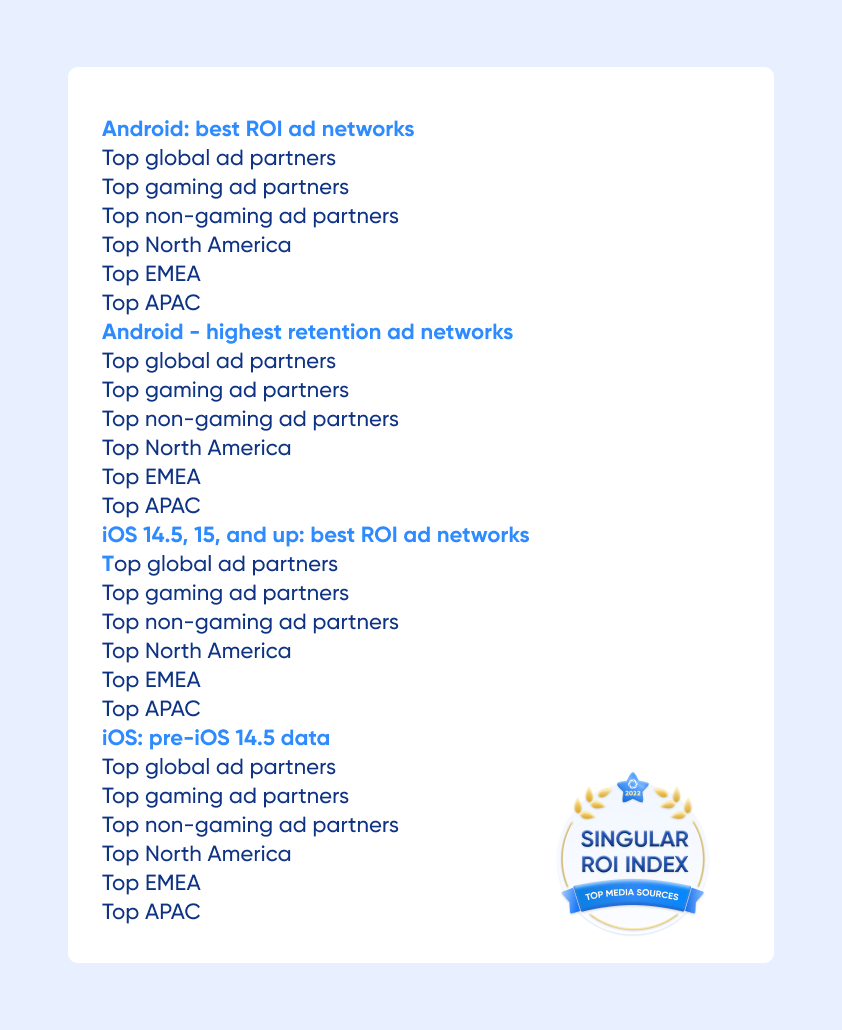
The 2022 Index includes top lists for best ROI on Android, best retention on Android, best ad networks on iOS pre-iOS 14.5, and best ad networks on iOS post iOS 14.5.

 Top ad networks by vertical, region, and platform

Plus more insight on what’s happening in mobile adtech

In addition to all the top lists for ROI, retention, and revenue, we’ve jammed the report full of insight on some of the biggest changes in mobile user acquisition marketing over the past year, including:

  • Adtech M&A impact
    Apple’s iOS privacy changes made device identifiers, which enable third-party targeting data for advertisers, hard to acquire and use. First-party data, however, is less impacted, meaning more bigger ecosystem players with more consumer touches can both target and deliver ads better. Now we’re seeing the impact: fewer names in the top echelon of advertising success.
  • Growth of intent/search
    As device identifiers grew rare on iOS, search-based ad networks including Apple Search Ads and Google Ads grew their share of the market 15-20% over the year. Without device identifiers, behavioral targeting is hard, leaving only contextual targeting and search-based targeting. Search has always been a high-intent form of ad targeting, driving outsized returns over contextual targeting, and so search-based networks grew.
  • Apple Search Ads dominated iOS
    ASA grew a staggering 33% in a year, driven by its triple-threat targeting capability.
  • 6 emerging titans of adtech
    Thanks to massive M&A activity, we’re seeing a clear emergence of a second tier of ad networks below Google and Facebook:

    • Apple Search Ads
    • AppLovin
    • ironSource
    • Liftoff+Vungle
    • TikTok
    • Unity
  • And even more:
    • Which ad networks have made the transition to post-IDFA SKAdNetwork methodologies best
    • TikTok’s big jump and still-available opportunity
    • What’s happening with intent, display, and social ad inventory in the privacy era
    • The emergence of Unity Ads
    • Why acquisition-hungry heavyweight champions such as AppLovin and ironSource, Liftoff+Vungle, and Digital Turbine are the new titans of adtech
    • Which emerging contenders who didn’t make the ROI Index, but are worth watching
    • Why Facebook and Google are still top of the heap

Get the full report today

The full Singular ROI Index report for 2022 is available here.

Google Topics API: 11 things I learned from the documentation

FLoC is dead. Long live Google Topics API.

Google has replaced its much-hated Federated Learning of Crowds privacy-safe ad targeting proposal with the new Topics API. Google Topics are intended to enable relevant advertising without invasive tracking.

There are four key types of data marketers use to try to deliver relevant ads:

  1. Contextual data: an ad is like the content that surrounds it in some way, so people who have sought out that content are likely to be also interested in the ad. (Sometimes tangential insights play here, like scuba divers may tend to take beach vacations, or bikers may tend to like dive bars.)
  2. Intent data: an ad is relevant to a search query that a person has recently entered, which means it should theoretically be something that they are interested in.
  3. Behavioral data: an ad is relevant to things a person has recently done and places (virtual places likes apps and websites included) that they have been, so it should be relevant to things they might also like.
  4. Demographic data: an ad is broadly relevant to to a particular demographic based on location, age, socioeconomic factors, and is therefore hopefully relevant to a person viewing it.

The new Topics API essentially is trying to achieve privacy-safe behavioral data. Traditionally, behavioral data has been privacy-invasive via device identifiers like IDFA/GAID/cookies that build third-party graphs for ad targeting. Topics API, however, is inherently probabilistic and decentralized: it runs in your browser and does not aggregate up to a massive database in the cloud.

Why does this web-centric new ad targeting methodology matter to mobile marketers, who are trying to build apps via mobile user acquisition?

Simple: it matters for mobile marketers because web-to-app is increasingly a valid, inexpensive, and successful user-acquisition vector. And, who knows … something like this or built together with this could hit a privacy-safe version of mobile app marketing on Android at some point, if it’s successful and gets implemented.

And, it’s from Google.

Any new policy or proposal for marketing and advertising by Google is inherently interesting and relevant to marketers, given Google’s massive position as one of the two biggest global players in adtech.

So: I’m going to go through the API, and I’m going to do this piece by piece: bits of text from the API documentation with commentary. (By the way, if I’m an idiot and said something stupid, let me know! We’re smarter together.)

Topics API is interest-based

“With the upcoming removal of third-party cookies on the web, key use cases that browsers want to support will need to be addressed with new APIs. One of those use cases is interest-based advertising.”

The focus here is interest-based advertising. That has usually been inferred from context or devised via digital stalking. But this is better than context, because context is a point-in-time snapshot with a limited perspective. Interests are longer-term, and the Topics API will offer more than just one interest over time.

Important note: this is not intent, and that’s a big deal.

Intent grew significantly in 2021 in response to the deprecation of the IDFA and the ongoing prevalence of privacy, because it’s highly predictive of future activity, including economic activity. That’s still the province, mainly, of search engines.

But Topics API is not very granular

“The intent of the Topics API is to provide callers (including third-party ad-tech or advertising providers on the page that run script) with coarse-grained advertising topics that the page visitor might currently be interested in. These topics will supplement the contextual signals from the current page and can be combined to help find an appropriate advertisement for the visitor.”

This is not granular at all. In fact, it’s very coarse-grained.

We’re talking 350 topics initially, which is tiny. For reference, the IAB Taxonomy is 1500 terms, and even that is really, really limited compared to a somewhat-complete taxonomy which might have hundreds of thousands of terms.

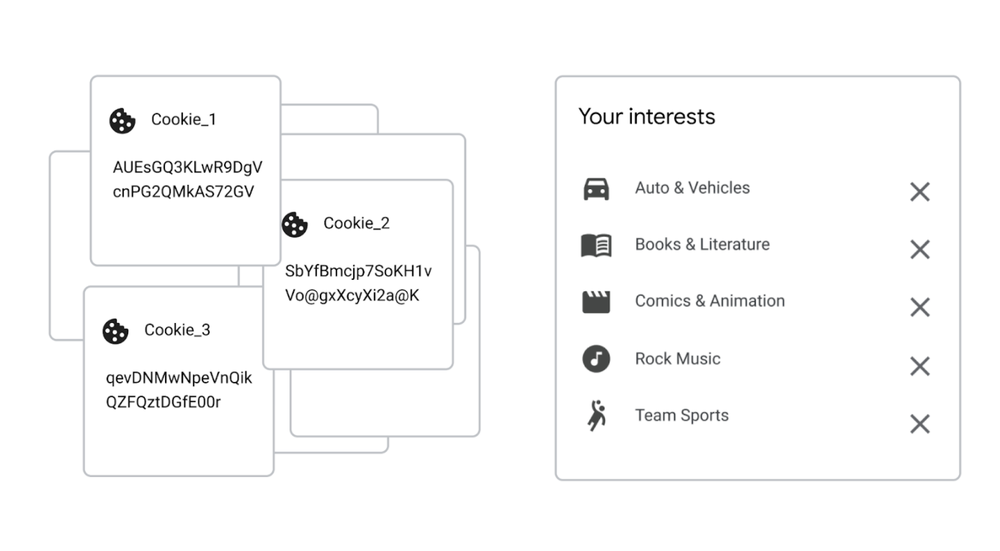
Here’s Google’s comparison of cookies versus topics:

Google’s comparison of cookies versus topics

All of those topics are entire worlds in and of themselves. Such as sports: which one? Baseball, hockey, rugby? How about toe wrestling (yes, it exists)? Or ostrich racing? And even if you can narrow a sports topic down to baseball, marketers need to know which teams matter to a person to get really actionable.

In short: we need a lot more refinement here to be useful for marketers. Interestingly, FLoC had more options and more precision …

There could be public mapping of websites to topics

“The topics will be inferred by the browser. The browser will leverage a classifier model to map site hostnames to topics. The classifier weights will be public, perhaps built by an external partner, and will improve over time. It may make sense for sites to provide their own topics …”

There’s a classifier model which will either be built by Google or a third party to tell a browser, and therefore also the Topics API, what a website is about. Those weights are public, and some sites will weigh heavier in the Topics algorithm?

But … weights being public doesn’t mean the model is.

There will be limited learning

“document.browsingTopics() returns an array of up to three topics, one from each of the preceding three epochs (weeks). The returned array is in random order. By providing three topics, infrequently visited sites will have enough topics to find relevant ads, but sites visited weekly will learn at most one new topic per week.”

Third-party cookies are going away, and for good reason. But from a marketer’s perspective you could get a significant amount of data for ad targeting from them. Google’s Topics API, if implemented, will not provide a whole series of interests to a website, just one new topic a week.

And, by the way, topics are only kept for three weeks.

Plus, Google will introduce noise into the signal

“For each week, the user’s top 5 topics are calculated using browsing information local to the browser. One additional topic, chosen uniformly at random, is appended for a total of 6 topics associated with the user for that week/epoch. When document.browsingTopics() is called, the topic for each week is chosen from the 6 available topics as follows: There is a 5% chance that the random topic is returned.”

There’s now a chance of getting spurious data. One in five of the top five topics is randomly generated, and it has a 5% chance of being the one you get when you call the Topics API. In other words, if you’re building your own device graph of some sort, it won’t have super-clean data.

That said … a 5% chance of random data is not much randomization.

Targeting data will be repetitive

“Whatever topic is returned, will continue to be returned for any caller on that site for the remainder of the three weeks.”

You got “sports” on day one? You get “sports” on day 21.

It’s kind of Henry Ford-esque: you can get any color you want as long as it’s the one you got before.

Networks of sites won’t be super-effective at fingerprinting

“The reason that each site gets one of several topics is to ensure that different sites often get different topics, making it harder for sites to cross-correlate the same user.”

You won’t be able to own 35 different websites and build out a deterministic identity graph of your visitors across all of them. Having the ability to actually own 35 websites is not, of course, the reality of most brands or websites, but this essentially means that third-party plugins designed to create device or identity graphs across thousands or even millions of websites will fail.

Or at least have a significantly harder job.

Ouch: you can only learn what you already know (unless you’re an ad network)

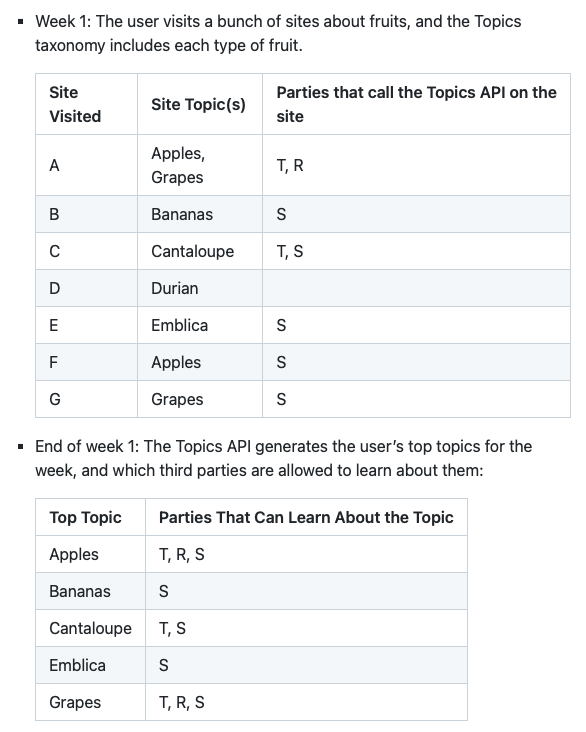
Not every API caller will receive a topic. Only callers that observed the user visit a site about the topic in question within the past three weeks can receive the topic. If the caller (specifically the site of the calling context) did not call the API in the past for that user on a site about that topic, then the topic will not be included in the array returned by the API.

Google’s example on this says that the only parties that can get a topic back from the Topics API are those that have previously called the Topics API on a site with a pre-defined and matching site topic.

(If you think that’s confusing, I think you’re right.)

Here’s how Google explains it:

Google's Topics API

So if in a theoretical week one the Topics API does not fire on a site with a listed topic of X, that site can’t get topic X back from a repeat visitor in week 2.

I guess this means publishers and adtech vendors need to fire the Topics API as much as possible on as many topics as possible in order to get as much targeting data as possible. Clearly, this also means that for frequent and returning users that you track in any other way (account, fingerprinting, magic) you can only learn from Topics API what you already know from other sources.

There is one other twist: in the Topics API ecosystem, you can legally and ethically share those topics with third parties like ad networks and exchanges, which is likely more privacy safe than any other internal methodology. Which one person I’ve chatted with characterizes as by design: publishers don’t know much, if anything, about their users … but the adtech tools for targeting/buy/selling/delivering ads do.

(Remember first-party data? Work to be attractive enough that users become logged-in members, signing up and signing in.)

Big sites with lots of topics will suffer

“We propose choosing topics of interest based only on website hostnames, rather than additional information like the full URL or contents of visited websites.For example, “tennis.example.com” might have a tennis topic whereas example.com/tennis would only have topics related to the more general example.com.”

Wikipedia will rank for … Wikipedia, I suppose, and ESPN will rank for … ESPN. Alternatively, publishers will have to redo their site structures and URL schemas to be able to fully buy into and benefit from the Topics API, which will be interesting at scale and potentially break many other things.

This is a very odd decision that Google says is justified by privacy considerations. SEO specialists who have observed the ever-increasing trend of zero-click searches might beg to differ.

Google will decide what your site is about

“The mapping of sites to topics is not a secret, and can be called by others just as Chrome does. It would be good if a site could learn what its topics are as well via some external tooling …”

Read the second part of that paragraph: it would be good if you could learn what your topics are. That indicates you are not providing that information in the first place … so Google must be.

Fear not.

Google says later: “The mapping of sites to topics will not always be accurate” but it will have “iterative improvements over time.”

And, to be fair, I guess Google already does determine what your site is about during both web search and ad targeting activities.

Of course, privacy is paramount

“The API must not only significantly reduce the amount of information provided in comparison to cookies, it would also be better to ensure that it doesn’t reveal the information to more interested parties than third-party cookies would.”

And …

“The topics revealed by the API should be significantly less personally sensitive for a user than what could be derived using existing tracking methods.”

Google’s goal is to enable targeting while protecting privacy. The most a site or network could learn about a user would be 15 topics per week, Google says, which is significantly less data than third-party cookies currently reveal.

Great in theory … but we’ll have to see if it actually succeeds at either in practice.

One thing the Topics API will do that third-party cookies don’t is tell you that a topic you get for a person is one of their top five browsing topics for the week. In addition, sites that have a persistent relationship with someone will get more data. “As a site calls the API for the same user on the same site over time, they will develop a list of topics that are relevant to that user,” Google says. “That list of topics may have unintended correlations to sensitive topics.”

However it is probabilistic and generic: both significant differences from third-party cookies.

And, it’s important to note, there is transparency: we can all see what topics we’ve been assigned, we can remove ones we don’t like, and we can completely opt out if we so choose. That kind of individual, personal control is refreshing.

Summing up: Topics API is coming

FLoC is dead. Topics API is the new plan, and I can’t see Google killing two proposals in a row. So I assume they’re pretty serious about this one. But … making it feasible will require a lot of work from the adtech and publisher communities, not just Google. And even then, there will be major challenges with ad targeting, marketing measurement, and ad monetization.

We’ve seen this story before: iOS 14.5.

Essentially, almost no-one takes it seriously until it happens, then everyone panics. Spend flees to more targetable and measurable ecosystems (how happy do you think Facebook is about this?) while everyone works it out and builds new tech (or old tech, like fingerprinting) to try to circumvent the new privacy-centric features.

After six to nine months of arms race, we’re back to life as somewhat normal.

We can help

Working on marketing measurement? Web to app? Mobile-first? Need a full suite of data from cost to attribution to modeling to probabilistic? Singular can help.

Book some time to chat today.

11 massive opportunities for Microsoft in gaming and beyond, thanks to the Activision Blizzard deal

At $68 billion, Microsoft’s pending purchase of Blizzard is the biggest gaming acquisition in history. That’s 2.6X what Microsoft paid for LinkedIn, almost 10X what Microsoft paid for the carcass of Nokia in 2013, and almost 9X what Microsoft paid for Skype.

Why?

And what benefits does Microsoft get from Activision Blizzard that could possibly repay that king’s ransom?

There are at least 11 massive opportunities that I see here.


1. Revenue for Game Pass as Microsoft builds a Netflix for games

You know how it seems everyone is all-in for subscription revenue in mobile gaming? Well, not just in mobile.

Microsoft’s subscription gaming service, Xbox Game Pass, has over 25 million subscribers.
At $10-$15 per month per subscriber, Microsoft is bringing in a minimum of a quarter billion dollars every month. With no growth, that’s $4 billion in 2022, but with significant growth thanks to massive numbers of tentpole game franchises, Xbox Game Pass could start to bring in some really serious revenue.

Is that on Microsoft’s agenda for 2022?

“We will offer as many Activision Blizzard games as we can within Xbox Game Pass and PC Game Pass, both new titles and games from Activision Blizzard’s incredible catalog.”

– Phil Spencer, CEO, Xbox

You bet it is.

2. Protecting future growth space as the gaming land-grab continues

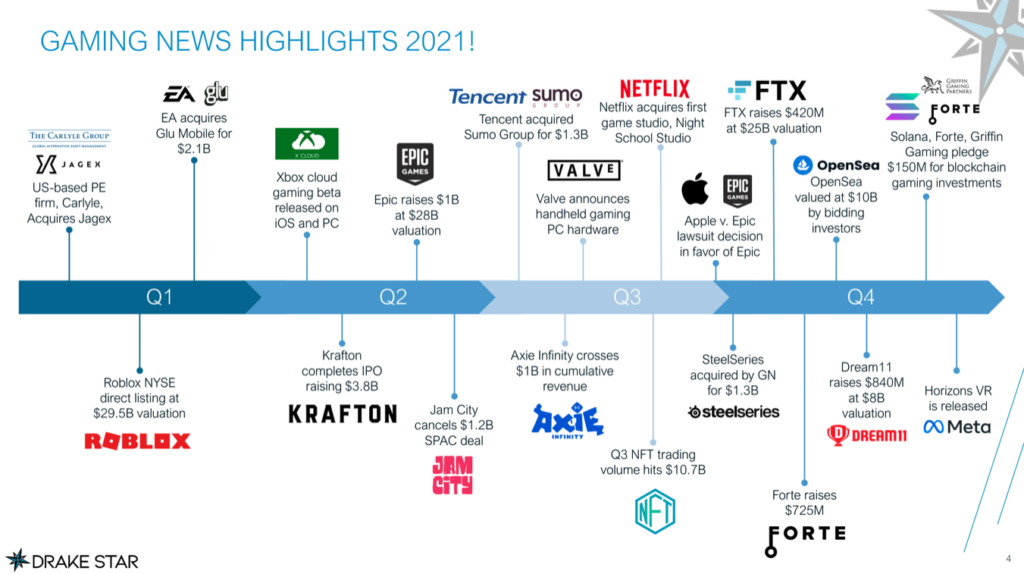
There were 1,159 gaming acquisitions, mergers, IPOs, and fundraises in 2021 worth a combined total of $85 billion, according to Drake Star. That’s triple what we saw in 2020 and includes familiar names like Zynga and Epic and JamCity and ByteDance.

Mobile games alone reached $15.5 billion.

At the same time, M&A was up 82% year over year in the newly highly-adjacent space of marketing, adtech, and media, according to LUMA’s 2021 market report. (We recently covered some of that in the case of Chartboost and Zynga.) And the majority of this activity falls into the buckets of “mobile apps, data and identity, commerce media, audio, the ongoing maturation of the programmatic ecosystem and … convergent TV,” says Allison Schiff in AdExchanger.

Clearly, if you’re a tech giant with any interest at all in the gaming space, it’s time to move now or forget about it, because a giant acquisition spree for games, IP, and players is completely and totally in hurry-up offense mode.


3. Defensive move on metaverse hype

Look: we’ve been in the metaverse since before Tim Berners-Lee invented the world wide web. Maybe it was .000001% in at that point, and maybe it’s 5% or 13% in at this point.

Either way: we’re partially immersed in a digital reality already. And a fully-immersive Ready Player One version isn’t happening tomorrow.

But there’s a lot of hype. There’s a lot of noise. And it seems like the best on-ramp to Ready Player One is the immersive, social, and hyper-engaged three-dimensional spaces we call AAA games. So yes, Activision Blizzard makes some sense as a defensive move to complement what Microsoft has already been working on for years with Hololens.

And Microsoft CEO Satya Nadella paid some homage to that in a conference call discussing the acquisition:

“When we think about our vision for what a metaverse can be, we believe there won’t be a single, centralized metaverse and there shouldn’t be. We need to support many metaverse platforms, as well as a robust ecosystem of content, commerce and applications. In gaming, we see the metaverse as a collection of communities and individual identities anchored in strong content franchises, accessible on every device.”

– Satya Nadella, CEO, Microsoft

Why this matters is that what devices we use and where we spend our digital time are tightly interconnected, and no tech giant — Facebook and Google and Apple, I’m looking at you — wants the future of computing to be invented and owned by someone else and be looking in from the outside on the future of digital reality. Or have missed out on owning the gate-keeping toll booths to get there.

(Like anyone who didn’t invent the App Store or Google Play has for the past decade and probably the next five years.)


4. Building and extending an ad empire

Microsoft Ads says it reaches 689 million monthly unique searchers on the Microsoft Search Network plus another 271 million unique users elsewhere through “native advertising on brand-safe experiences.”

It’s not Google or Facebook, but it’s nothing to sneeze at.

King, the mobile gaming part of Activision Blizzard, has 200 apps and is on potentially billions of devices, with just one, its top Candy Crush Saga game, installed on over one billion Android smartphones alone, according to Google Play statistics. And Activision Blizzard Media, which offers “in-game advertising” boasts the ability to get in front of 245 million monthly active mobile game players, 91% of whom are multi-platform Blizzard “customers,” and many of whom are esports watchers.

And yes, they know how valuable that is.

“The ads team have organically built our own advertising technology platform, and this is really made to enable both the demand and the supply management … this approach has actually served us really well and enabled us to differentiate versus others in the industry through a much higher-quality player experience both in terms of ad formats and then also how seamlessly ads are integrated into our games.

And I’d say that this goes beyond just King as we launch more mobile experiences … and across the company, where we’re continuing to invest in our technology platform, and that’s just to make sure that we have the capabilities to power ads monetization and cross-promotional activities across our mobile titles.”

– Daniel I. Alegre, president & COO, Activision Blizzard

Content, experiences, cross-promotion, monetization, commerce, and full control within a massive and lucrative ecosystem … it’s kind of a platform to envy, no?


5. Platform supremacy by going beyond platform

Sure, Microsoft wants to beat Sony by ensuring more games are available on Xbox than on PlayStation. And yes, Xbox is a platform. But the bigger goal is developing a stronger and stronger multi-platform strategy on console, PC, mobile (King is part of the deal), and emerging platforms for augmented reality and virtual reality.

“This acquisition will accelerate the growth in Microsoft’s gaming business across mobile, PC, console and cloud and will provide building blocks for the metaverse,” the company’s press release says.

The new platform is every platform.

And when you’re multi-platform, you are less dependent on Google and Apple, the modern gatekeepers of most of the world’s software today. Oh, and don’t forget cloud gaming, which is another threat to specific hardware platform moats by being accessible — theoretically — on all platforms.

Owning access to the customer is critical to capturing a greater percentage of gaming revenue, says Microsoft’s CEO:

“Today, we face strong global competition from companies that generate more revenue from game distribution than we do from our share of games sales and subscriptions. We need more innovation and investment in content creation and fewer constraints on distribution.”

– Satya Nadella, CEO, Microsoft


6. Identity graph, leading to multiple synergies and opportunities

The simplest opportunity is still a powerful one: 1 + 1 = 3.

Sure, that’s cross-promotion between different games, platforms, and products, which is huge. But it’s also an increasing ability to create an identity graph across both owned and tenant platforms that is independent of rivals or their platforms.

That’s valuable for advertising and monetization, clearly. It’s also valuable for the ability to present and sell whatever the individual components of the vast Microsoft empire might want to.

And it contributes to cementing Microsoft’s place among the very small, very select group of big tech companies that can credibly claim to own an identity graph encompassing a significant proportion of the people on the planet.


7. IP licensing franchises bonanza

Imagine how much money Marvel has made in the last decade licensing its IP for movies, games, and more.

Now think of what Microsoft has inside its big tent:

  • Call of Duty
  • Candy Crush
  • Guitar Hero
  • Crash Bandicoot
  • Spyro the Dragon
  • World of Warcraft 
  • The rights to Tony Hawk games
  • Skylanders
  • Elder Scrolls
  • The Fallout Series
  • Doom
  • Rage
  • Prey
  • Candy Crush
  • Farm Heroes
  • And much more …

There’s movies there. Game franchises that can last decades. Merch opportunities. Communities and spaces and playgrounds in the metaverse. Put a good marketing and IP management capability behind all of it and there’s gold in these hills.


8. Big beachhead in the fast-growing segment of gaming: mobile

I think I’ve mentioned it a few times already … King is part of the Activision acquisition. Microsoft wasn’t a massive player in terms of mobile gaming pre-Blizzard, but King is massive and significant, with a billion-plus installs of its top game and hundreds of millions of monthly active uniques.

The important thing here is that gaming is the fastest-growing segment of gaming.

We spent $116 billion on mobile games in 2021, and that’s forecast to hit over $130 billion in 2022. That was around 60% of all revenue spent on gaming in 2020, and growing fast. It’s critical for Microsoft to have a growing presence in this increasingly lucrative market that is also the driving force behind a ton of innovation in devices that could supplant mobile as the global default computing platform.


9. Creator economy

Streamers matter. Ask YouTube (Google) and Twitch (Amazon).

This deal brings Microsoft millions of players who are potentially creating livestreams and other gaming content. Microsoft has dabbled in the creator economy with some of the new features that LinkedIn is bringing in, but has nothing in the younger gaming space. All in, the creator economy could be worth around $100 billion, with a big chunk of it on YouTube. Now Microsoft has the opportunity to become part of it.

With the professional community on LinkedIn and developers on Github, there’s a number of interesting possibilities for Microsoft in the future.


10. eSports opportunities

eSports is a $2-4 billion space that has the potential to be bigger than many of the biggest traditional sports leagues in the world. Remember that list in #7? Many of those have big opportunities in eSports, setting up Microsoft well for future years.


11. Relevance to the masses

Finally, let’s be honest: Office and Windows are still massive, money-making enterprises, but the tech world has changed significantly in the past decades.

The next major release of a Microsoft operating system used to be an absolutely huge event. (Can you even imagine buying a Rolling Stones song nowadays for a point release of a desktop operating system?) But Apple is now the most valuable company in world territory to Apple and Google makes — but doesn’t fully control — the most popular operating system on the planet. The reality is that Microsoft is doing just fine in enterprise and cloud, with massive revenue and profits — they paid for the $68 billion Activision Blizzard acquisition with cash — and good prospects for the future.

This acquisition, however, will help keep the brand front and center more broadly with consumers. And that will be a big part of allowing Microsoft to continue to have an outsized impact on the tech world. Bringing in a number of massively successful gaming franchises essentially future-proofs Microsoft as a brand that matters.

You may not be able to add that up on a balance sheet easily, but it has an impact.


All in: expensive but worth it

As a friend and colleague told me, this acquisition was not cheap, but it’s not like Microsoft can’t afford it. And, given the opportunity it unlocks, there’s plenty of upside.

Welcome to mobile gaming, Microsoft!

Why a gaming company would want to own an ad network

Imagine that some huge proportion of your business success relied on factors largely out of your control.

Wouldn’t you do whatever you could to get as much control over as many of those factors as you could?

Exactly.

Now you know one of the key reasons why a gaming company like Zynga wanted to buy an ad network like Chartboost. Another two: maximizing first-party data and maximizing revenue share of every ad dollar spent on Zynga (and now Take-Two) properties.

I had the opportunity recently to chat with Zynga’s chief product officer Scott Koenigsberg and Chartboost CEO Rich Izzo on my TechFirst podcast, and just cross-posted the conversation to Growth Masterminds, Singular’s growth marketing-focused podcast. One of the very clear take-aways: a key driver of mobile adtech acquisition is gaining more control over your own destiny as a mobile publishing company.

And, of course, being able to increase monetization efficiency via vertical integration.

“One of the things that drove us to do this acquisition was we were looking for ways to take more control over our ability to monetize players and our ability to acquire players …

We’re also looking to vertically integrate into these channels, where, quite honestly, there’s a loss of data and obviously there’s a lot of dollars that get taken along the way by intermediaries.”

– Scott Koenigsberg, chief product officer, Zynga

Titans of adtech

I didn’t mention Zynga, of course, in my new titans of adtech post a few months ago.

That was focused on players like Unity, ironSource, AppLovin, Liftoff+Vungle, and Digital Turbine. But many of the same market mechanics driving consolidation in mobile-focused adtech companies are also driving app publishing studios and ad networks together.

(And of course both ironSource (Lion Studios, Supersonic Studios) and AppLovin (Machine Zone) of course, have bought, own, or have invested in studios and apps.)

Ad networks buy apps for data, among other things.

Game publishers buy ad networks for control. Plus data, sure, and revenue. And probably a few other reasons — particularly when they want to be acquisition targets, or to go public — but primarily for a degree of control over one of the hardest and most crucial parts of their businesses that they cannot otherwise really own: user acquisition.

3 big problems, and becoming the master of your own destiny

Growth marketers see a lot of data as they promote and advertise their apps. Ad networks see much, much more as they participate in the auctions.

Even if the mobile marketers are very, very sophisticated and have extreme volume.

“We have a very sophisticated ad stack, right? We actually built our own ad server … we have one of the largest inventories in mobile gaming … we have banners, we have interstitials, we have rewarded video … we’ve been doing this for a long time and we have one of the more sophisticated waterfalls, I think, of anyone in the market …

“But we’ve never seen kind of the underbelly … of what really happens in the background … and if we can combine that data — our first-party data and behavioral stuff and contextual stuff — with what Chartboost does on the monetization side, we can theoretically get to better ad yields and provide better experiences for our players.”

– Scott Koenigsberg

Owning an ad network obviously helps app publishers with user/player/customer acquisition. Seeing more and knowing more makes you smarter.

There are three big problems in mobile game publishing, and they’re pretty much the same problems as any app or, for that matter, any business:

  1. Make something awesome
  2. Entice people to engage with it
  3. Derive value either directly from them or indirectly via their usage

Combining an app publishing empire with an ad network actually helps in all three phases: directly in the second and third, and indirectly in the first. The second and third are most obvious, of course: acquiring users or players, and monetizing them.

But there are some subtleties: it’s not just about owning the means of selling ads for acquisition, it’s also the data that you can combine with in-app player data to get smarter. Apple Search Ads, for instance, is having a moment right now not only because it is intent, and intent is a powerful indicator of motivation, and not only because it’s built right on top of the only machine for installing iOS apps on the planet. It’s also been the biggest success story in mobile advertising because Apple combines first-party data — using differential privacy methodologies — from in-app usage of Apple News and Apple Stocks and Apple Music and combines that with both search and contextual data when deciding which ads to show you in the App Store.

(The new Singular ROI Index will be coming out shortly; you’ll see some interesting data in there about how big and how important Apple Search Ads has become.)

Owning the whole stack means that you can optimize for exactly what you need, because you can optimize the algorithms rather than just use someone else’s.

“Now we actually have the ability to use our machine learning and data science capabilities to work directly with Chartboost and their teams to say, ‘Okay this is the type of user we want to acquire and this are the behaviors we look for, and by the way, this is how they may or may not act in our game.’ And then we’re looking for more of these people or a diverse set. And so it gives us a lot more capabilities.”

– Scott Koenigsberg

And that de-risks, Koenigsberg says, one of the hardest and riskiest parts of mobile gaming: user acquisition and scaling.

It’s a slightly different story on the monetization side.

In terms of monetizing users in owned apps via other company’s ads, it’s not like copying and pasting in a mediation network and optimizing yield. Because each dollar of advertising in mobile adtech gets split up in a lot of different ways and significant parts of them don’t make it to the game or app that attracts the audience and generates the impression in the first place.

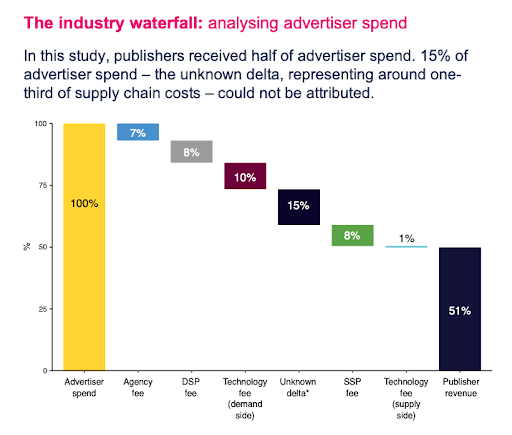
In fact, according to an ISBA study, publishers only receive about 51% of advertiser spend.

But if you own more of the adtech stack … maybe you can increase that to 70%, or 80%, or even higher. And that in turn changes your user acquisition dynamics: more expensive users are still LTV-positive, because you’re making more money from them. (Oh, and by the way, even though they’re more expensive, you’re buying via your own platform, so knock off 10-20% for internal accounting because you make money even when you’re spending it.)

Better apps via advertising data

There’s even a benefit for the part of an app or game publishing giant’s business that seems least likely to be enhanced by owning an ad network.

And that’s #1 above: making great games.

Any game publisher can run pre-development ads for an idea they have about a game or an app. No game or app exists yet, but a few thousand dollars might provide good insight into whether or not it would be successful, and what user acquisition costs might be. Owning an ad network doesn’t change that, but it does provide more and richer data about how potential users are reacting to the idea.

Plus, of course, all the existing data you accumulate as a game studio and ad network combined about what types of games and ads generate profitable growth can be used in your product development phases, or in your app acceptance phases as you decide whether or not to publish some other development studio’s game.

So it’s all about platform?

Everyone wants to own a platform, because the value of a true platform increases exponentially over time because others build on it. Think Windows. iOS. Android. Amazon’s AWS. Salesforce. You name it.

Whether combining acquisition with monetization with a species of content fortress — all the games that you own and publish, and all the games that you don’t own but enter into a publishing agreement for — is a true platform or not is debatable. But the extra value unlocked via vertical integration and making that available for every app you publish is pretty clear.

And control, of course:

“Being able to control that experience from end to end and access all of the data, that’s — this is the concept of a platform and creating efficient marketplaces, and changing the very fragmented ad landscape that exists today.”

– Scott Koenigsberg

And yet more control:

“It goes back to that platform that I spoke of where we have full visibility and control over the experiences that we’re providing our players and we’re not necessarily beholden on third parties for success.

– Scott Koenigsberg

And more scale:

“I think there’s also a move toward the consolidation of buying power, meaning the more inventory that you’re able to offer to buyers at scale will be really meaningful for them and will make sort of not necessarily a one-stop shop, to Scottie’s point, but a really meaningful shop that folks in this space that are looking to do user acquisition need to stop into and participate.”

– Rich Izzo, CEO of Chartboost

Which is interesting and natural: any gaming publisher, like any other kind of business, is going to do those kinds of things that trend to them having more control over the factors that make up whether or not they will be successful. And, of course, to those things that enable them to have more ability to maximize their ability to compete, and to maximize revenue.

Right now, after decades of explosion in adtech innovation and fragmentation, that’s where we are. And that’s why we’re seeing ad networks owned by gaming studios and gaming studios owned by ad networks.

Subscribe to insight

We talk to smart people so you can listen in and learn. Subscribe to Growth Masterminds to get those insights right in your favorite podcast app or in your YouTube feed.

Marketing technology 2022: 616 predictions from 463 CMOs

There’s an old joke about how to make God laugh.

To make God laugh, the story goes, tell him your plans.

Since fools go where angels fear to tread … here we go. At least for predictions, which are not exactly plans but (work with me here) are close enough.

Here’s a quick guide to the 2022 edition of CMO marketing predictions:


First, a glance back at our 2021 predictions


Before asking almost 500 chief marketing officers, executives, and leaders about their marketing technology predictions for 2022, I took a quick look back to the 2021 predictions from a year ago. 

And wow … how naive and innocent we were about the massive changes there were in store for the mobile marketing industry over this past year. 

We foresaw holistic digital marketing as the keystone for 2021, mostly in response to massive and ongoing consumer shift. Everything, after all, was going digital with remote work, online ordering, video dating, and Zoom weddings, and the modern marketing organization needed to go all digital along with everything else. The focus: bringing tremendous amounts of prospect and customer data together in one place to understand and influence the customer journey.

We weren’t entirely wrong.

But we also thought Covid would be a word from our distant past.

The problem was, we didn’t really understand how much impact one event in 2021 would have. Privacy was already a big deal, but it was fifth on the list of predictions, with fewer than 20% of marketers considering it the primary change to anticipate for 2021. iOS 14.5, however, followed on the heels of GDPR, California regulations, and Cambridge Analytica. And it harmonized with years of a broad and growing desire for digital privacy, plus suspicion of big tech with big data, and hit us much harder than we anticipated.

So we kinda missed the boat on the most important technology for last year, which turned out to be privacy.


The most important technology, topic, or space for marketers in 2022


For 2022, this was the question I asked almost 500 marketing technologists: what one topic, technology, or space will be the most important for marketing, and why? The most popular predictions are all centered around the idea of privacy and the execution of marketing campaigns in privacy-centric ways.

Here are their answers, in aggregate:
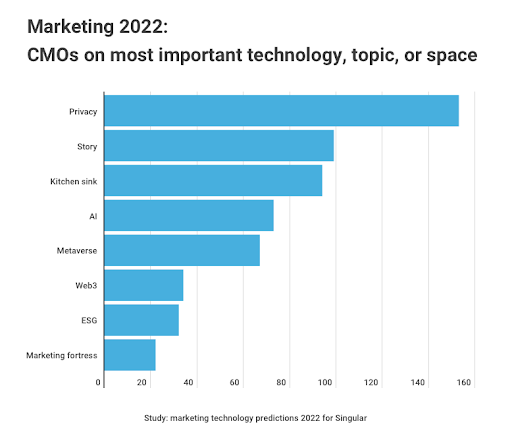
marketing 2022 - CMO predictions


Let’s dive into each one separately.


Marketing 2022 prediction 1: privacy


It turns out that it’s much easier to predict the past than foretell the future.

(Odd, that.)

After the year that was, privacy and all of its permutations is the clear winner. Which goes to show even our industry can learn when it is dragged, kicking and screaming, to school.

But “privacy” is a big word with plenty of meanings.

What CMOs mean here is two-fold: first, that in the pre-customer or pre-user advertising and marketing stages of the customer journey, device-level data and person-level data that deliver granular insights on behavior that have traditionally been acquired via IDFA on iOS, GAID on Android, and cookies on the web is going away. And second, that in the post-customer or post-user stage — in other words, when someone has installed or signed up or purchased — brands are working harder to win customers’ trust in order to access permissioned data and use it to improve service.

In other words: first-party data.

Marketers must be prepared to invest and get the right tech in place to develop its first party data,” says Walgreens SVP and CMO Pat McLean. “This is exactly how Walgreens has differentiated in marketing via our mass personalization strategy and myWalgreens platform as we know this is core to our future growth.”

Perhaps, in retrospect, we weren’t so wrong in 2020 about holistic digital marketing bringing together all our data. Except that the precise data we can use is very different than, perhaps, many of us imagined.

And it comes with new challenges:

All of us have to be mini data scientists in today’s tech-driven world.”

 – Susan Somersille Johnson, CMO, Prudential Financial

The transition in outside-the-castle-walls data from granular to aggregate is a seismic shift, says Arun Kumar, chief data and technology officer at Interpublic Group, the brand umbrella over Axciom, McCann, Weber Shandwick, and dozens of other marketing agencies. The reality that we’ve seen in Singular data over 2021 suggests some marketers are having trouble making that shift. And things may get harder before they get easier, says LinkedIn’s senior director of product Abhishek Shrivastava.

We’ve talked about the future of attribution and the future of marketing measurement in this new reality somewhat ad nauseum.

Adjust’s Joshua Grandy puts it succinctly:

The future of measurement will leverage aggregated data driven by machine learning, and built on transparency and trust.”

 – Joshua Grandy, director of global communications, Adjust

Increasingly, as we see more government regulation, more fines for breaches, more bad press for real or perceived issues, and more tech companies restricting data collection and access, we can expect marketers to continue to shift away from “unverified data that they do not own or govern, focusing instead on first-party data acquisition and contextual advertising,” says DoorLoop CMO David Bitton.

“As we move to a more privacy-first future and away from third-party data, we’ll see marketers double down on building their own audiences and communities, and embrace new types of data like intent-based solutions. We’ll see more of an emphasis on actions and signals versus personal information like demographics and interests. Marketers will have no choice but to test new strategies to prepare for the future, which will lead to a lot of experimentation and testing.”

That means business not as usual, according to G2 CMO Amanda Malko.


Marketing 2022 prediction 2: the power of story and content


The dichotomy between brand and performance marketing is largely false, but it’s not surprising that in an era where we’re leading with privacy, marketers highlight the power of brand via story.

That’s story-telling in video, story-telling by influencer, story-telling with thought leadership backed up by search engine optimization (SEO), story-telling by social audio in Twitter Spaces, and more.

“Consumers now spend 1/3 of their media time with audio … audio is now the most accessible medium,” says iHeartMedia CMO Gayle Troberman. “And marketers are waking up to the massive potential of audio to deliver highly engaged, targetable audiences at scale.”

(And guess what: that targeting is contextual, thanks to the fact that podcasts have topics. And it’s therefore privacy-safe.)

Content still means the written word, too. What are you doing right now, after all?

Make continued investments in content marketing, suggests DigitalOcean’s Carly Brantz, adding that “content is a way that marketers can keep their brand top of mind.” That works in B2B, for sure — Digital Ocean is a cloud service with 600,000 customers — but it also works for mobile games or fintech apps or retail storefronts. Influencers might be a channel, but how they work best is essentially content marketing: showing, sharing, speaking, endorsing, and not just putting the prototypical “link in bio.”

We’re also seeing retail move in very interesting ways with China-influenced live shopping trends: the creator economy version of Home Shopping Network.

Social shopping is coming to all platforms: Facebook, Instagram, TikTok, Pinterest (among others),” says Plant Mother CEO Jena Joyce, who says she’s seen 100% increase in revenue from social shopping and a huge 1300% increase in Instagram referral traffic to her website. “Instagram shopping is becoming a profitable alternative to paid ads.”

A lot of content marketing happens on your website or in your app where — guess what — you control the vertical and the horizontal (bonus points if you get that Outer Limits reference). It’s an owned property, and just like in web-to-app mobile app install journeys that have become so popular in 2021, you can add whatever you like to the page, and collect permissioned data that your user or customer wishes to provide.


Marketing 2022 prediction 3: AI


Acute observers of graphical data will note that AI is actually the fourth-most cited area in the chart above, but there’s a caveat: the third-most is elegantly titled “kitchen sink” because it is a grab-bag of uncategorized and uncategorizable topics.

(Including some very funny ones.)

See more about that below.

But for artificial intelligence, this is a jump up from the 2021 predictions, where AI landed in seventh spot. Marketers are going all-in on AI and machine learning as an essential element in multiple areas: ad targeting, insight generation, communications delivery, creative optimization, data modeling, predictive analytics, message and offer optimization, conversion rate optimization, and more.

It’s especially important when there seems to always be more work to do and always be fewer hands to accomplish it.

“As The Great Resignation has shown us, teams  are overwhelmed and overworked: desperate for some sort of pressure valve,” says David Council, CEO and co-founder of Drift. “For digital marketers, AI can provide some much-needed relief, and become the workforce in driving revenue, developing relationships, and eliminating gaps in customer technology … without putting added pressure on teams. This means marketing teams can now get some breathing room, extra time, and energy to focus on what matters most.”

How?

By streamlining tasks. Analyzing data. Automating repetitive work. 

“Through an automation platform, marketers can automate core activities including behavioral tracking, personalization, email marketing, lead generation, lead management, analytics, content marketing, CRM and more, saving employees up to 3 hours per day,” says Monday.com product manager Noa Kind. “Marketers can better create and understand relatively complex models and more effectively use artificial intelligence to increase ROI.”

That’s currently at work in Singular’s platform to model data, predict outcomes, and optimize processes. It’s in most platforms marketers use. And you’ll see AI be an increasingly active part of the marketing technology toolbox in 2022.


Marketing 2022 prediction 4: Metaverse, VR, AR


Ask the same question of top technologies for marketers six months earlier and metaverse wouldn’t have gotten even one vote, in my (very) humble opinion. But marketers jump on bandwagons as fast as anyone else, and the metaverse is a big, noisy, and hard-to-ignore wagon.

Look: we’ve just gone through two years of doing all our work virtually, along with much of our shopping and socializing.

Is it any shock — especially given Facebook’s … sorry, Meta’s multi-billion-dollar pivot to the metaverse — that marketers, like many others, think virtuality has a big future alongside physicality?

It starts with something as simple as virtual events. Or placing a sofa in a living room via augmented reality. 

Or even just fun, like what Snap and Viber are doing with AR faceswaps and filters. And that fun can have commercial or marketing implications.

“Businesses are looking for ways to boost engagement with users and increase visibility among a wide audience” says Viber’s chief growth officer Anna Znamenskaya. “We’ll start seeing AR masks and filters as engagement options … as well as masks with a complete transformation of the object, geo-targeted elements tied to specific locations, and complex 3D effects.”

The World Wildlife Fund, FC Barcelona, and the Davis Cup have already done so.

There’s a practical reason for all this focus on metaverse and virtual reality, says Expand.io CMO Sharon van Donkelaar: “The pandemic isn’t over yet and we’re most likely to face a new lockdown. VR and AR will help bring the products to the customer while keeping them safe.”

Plus, with Facebook investing literally billions of dollars into metaverse and multiple other platforms and technologists following suit, there’s bound to be opportunities for marketers.

Just a word of caution:

“It might take up to 10 more years before we see the first metaverse mass adoption come to life,” Viber’s Znamenskaya says.

So yes, explore, but my personal advice is not to bet the farm on metaverse just yet. The leading edge is often the bleeding edge, and while it’s great to capture early adopters, they’re as yet few in number. And early adopters, by virtue of being early adopters, are often fickle.

You are going to see more advice like this in the coming months and years:

If you’re not considering metaverse as part of your marketing mix in 2022, you’re already behind.”

And:

Companies should be able to demonstrate through their marketing campaigns that they are not closing their doors on this new technology if they are not yet ready to engage in it.”

I’m deliberately not citing the authors of those quotes to protect people. The first is a you’re-a-clueless-idiot-if-you-don’t-hop-on-the-newest-fad-immediately type of comment, and is rarely true of anything in the first flush of new technology creation. The second is a it-might-not-be-there-yet-but-try-not-to-look-clueless caution, and is at least somewhat worthwhile. Be aware, look for early adoption opportunities, but unless you are a very niche application specifically connected to AR/VR/metaverse, don’t spend the whole budget here.

That said:

25% of our customers are already strategizing about the best ways to leverage Metaverse and create captivating content and experiences for their customers.”

 – Nishant Patel, CTO, Contentstack

YMMV.


Marketing 2022 prediction 5: Web3, crypto, blockchain


Metaverse is hot and shiny and exciting, so it got a lot of votes. Web3 is also hot and shiny and exciting, and it has the additional added thrill of making a lot of brands and a lot of people a lot of money.

Web3 is essentially a loosely-joined conglomeration of technologies that at their root are aimed at decentralizing a technology world that has coalesced around the giants of big tech: Facebook, Google, Amazon, Apple, Microsoft, and more. While there are some doubts about the reality of that consolidation, the technologies include:

  • Blockchain
  • Cryptocurrencies
  • Smart contracts
  • NFTs
  • DAOs (distributed autonomous organizations)

The core idea is one of moving from web1 (read) and web2 (read/write) to web3 (read/write/own).

Taco Bell, Charmin, Nike, and Warner Music Group have created NFTs. Tesla, after supporting Bitcoin for purchasing cars and backing off that plan due to volatility, has promised to allow people to buy Teslas with DogeCoin. The Web3 foundation is building messaging, courseware, and more on decentralized foundations. DAOs are trying (and failing) to purchase copies of the U.S. constitution, de-carbonize the environment, re-wild developed land, and much more, generally fueled by tokens (altcoins) based on Ethereum. And decentralized art projects like the Billion Zombie Club are selling thousands of pieces of art and raising millions of dollars. (In crypto, of course.)

Is it too early for marketers to jump in?

Not according to Yahoo president Joanna Lambert:

2022 will be the year of everyday crypto for businesses and consumers … as people and enterprises invest in cryptocurrencies, seek expert advice, and conduct research to ensure that they’re making wise investment decisions, crypto is set to impact everyday businesses and everyday people alike.” – Joanna Lambert, president and GM, Yahoo

Tread lightly, suggests fractional CMO Atif Kazmi.

“Balenciaga, Adidas, and a host of luxury brands have already started experimenting with Web 3.0, but it remains to be seen how these virtual interactions can become more immersive, more sticky, and how they potentially translate to sales,” Kazmi says. “How it blends with social commerce will be something we’ll all need to wrap our heads around.”

But NFTs aren’t just silly scratches on paper that look like something your third-grader took home but were executed on an airplane napkin by Gary Vaynerchuk and sell for $98,000 or more.

They can be digital contracts. Tickets. Gateways to experiences.

“Brands will stop using NFTs for silly limited edition tokens of corporate greed cashing in on hype, and, instead, start using them for their real use-case: authenticating ownership of a brand’s digital assets,” says Perch marketing manager Nathan Sieminski. “It’s digital asset insurance.”

If that doesn’t strike your fancy, perhaps you want to use the concept of collectibles, which includes the area of NFTs, as a monetization mechanic in your new game.

At the intersection between crypto and gaming we see early signs of a new business model of play-2-earn and on-chain virtual asset ownership,” says Keith Kawahata, head of games for AppLovin. “Non-fungible tokens (NFTs) will grow bigger in gaming, becoming a mainstream alternative to centralized and custodial ownership of virtual assets.”

It’s still very early for these new business models, Kawahata cautions, but he notes that they’re growing exponentially (which is always exciting for a marketer to hear). People spend more than $2 billion on NFTs in the first quarter of the year alone … a 2,100% increase from the fourth quarter of 2020. 

If that trend continues … wow.

Independent growth consultant in mobile user acquisition Matej Lancaric is interested, but also labels the current frenzy a “hypetrain,” and suggests some caution.


Marketing 2022 prediction 6: ESG


For 2021 an empathic brand story for pandemic-bruised customers and cause-based marketing as a means of aligning with the people brands serve ranked second and sixth, respectively. For 2022, environmental, social, and corporate governance takes their collective place.

“Businesses are under increasing pressure to measure, improve, and disclose their ESG performance to investors, to consumers, and to regulators, and their efforts are reaching into every area of their operations, as are the risks and opportunities that follow,” says the Chicago Board of Trade’s Kirsten Opsahl.

It’s one of the reasons for the shift to virtual meetings and the metaverse, says another marketer.

And in an exceedingly contentious environment that has seen some companies ban discussions on social justice, others believe it’s critical to cover.

In 2022, we will see an increase in the number of companies and organizations taking a stand on social justice issues,” says RoverPass CEO Ravi Parikh. “The businesses that don’t take a stand will likely fall behind those that do.”

“In 2022 and beyond we will find buyers that are less focused on buying a specific product and more so looking to invest their dollars in a brand they trust, believe in, and that 

aligns with their core values,” says LinkedIn VP Penry Price.

Social for Good Co. founder and CEO Kara Hoholik agrees.

“Over the last 5 years, we’ve seen an increase in the consumer demand for sustainable products and social awareness from brands and companies. This trend has only accelerated in the last 2 years due to the pandemic, #metoo, Black Lives Matter, and the increasing buying power of Gen Z and millennials.”

And that extends to where brands buy advertising.


Marketing 2022 prediction 7: Marketing fortresses


Eric Seufert coined the term “content fortress” to refer to an increasingly common model of a platform that generates its own supply (inventory of available ad impressions) and fulfills that with its own advertising machinery for demand satisfaction (sales of that inventory). Reddit, Snap, Twitter, Facebook, and Google are examples.

I like the term and have used it, but I’m amending it to “marketing fortress” here because what we’re seeing is not just platforms with content as we’ve traditionally defined it but also retail and ordering platforms building advertiser access to themselves, creating in some cases very verticalized marketing fortresses. 

Doordash and its on-platform ad network is a good example. 

Who would have thought that an on-demand delivery service would create an in-house ad network five years ago? (Anyone, I guess, who looked at grocery stores and the advertising they sold via shopping carts, and had an uncommon amount of imagination.)

Combine this with the on-platform retail purchase capability that Facebook, TikTok, Snap, and who knows which other platforms would like to have and you have the full meal deal: all the ingredients for a modern re-creation of the walled garden:

  • Content
  • Audience
  • Advertising
  • Sales
  • Delivery

FatTail CEO and co-founder Doug Huntington sees impending competition between social and commerce platforms.

Social sites continue to grow and multiply. A high and increasing percentage of buying decisions are made on them. Their commerce capabilities are getting stronger. Consumers who cut their teeth buying on Amazon now expect to be able to buy anything, anywhere, and anytime.”

 – Doug Huntingdon, CEO, FatTail

That sword cuts both ways. Media companies sell, retail companies advertise. Brick and mortar retailers, who lost billions of dollars during the pandemic, sit on treasure troves of first party data, says Huntingdon. That means “retail media spend” will balloon.

It’s another “big smush.”

An ongoing collapse of everything into everything.

A reinvention of the Chinese-style superapp into new mega-apps with Western characteristics. In other words, a social app (Facebook) that offers classifieds (Facebook Marketplace) along with ads (Facebook Ads) and entertainment (Facebook Watch) and gaming (Facebook Gaming) plus employment services (Facebook Jobs) and retail (Facebook Shops) and … and … and …

Not all the western platforms are as advanced, of course, and not all will choose to offer so many services.

But all with the ingredient for a marketing fortress could, if they choose, do exactly this.

The result of this rapidly increased digitalization has been a merging of digital environments, as evidenced by tech giants like Facebook and Instagram launching shopping capabilities, and social platforms like TikTok rolling out their own marketplaces,” says Payoneer director Irina Marciano. “In this super-app, omni-channel, omni-device environment, marketers who focus on user experience will find themselves able to push ahead of competition.”

A merging of digital environments?

Exactly: everyone offers everything. Every platform becomes a marketing fortress. And finding ways for marketers to access all of the scalably becomes a new challenge for adtech and martech.


Marketing 2022 prediction 8, just for fun: Kitchen sink


Any time you ask hundreds of people a question with limited context and arcane implications, you’re going to get some odd responses.

Why should I have all the fun?

Here are some of the oddest responses to the question: what technology, space, or area will be most critical in 2022? Naturally, I am not attributing these.

In no particular order:

  • Product reviews (good to have … most important?)
  • PR (pretty sure this was from a PR agency)
  • Memes (where’s lost John Travolta when you need him)
  • QR codes (reinvigorated thanks to the pandemic … but …)
  • Conversational marketing (I like it, but no)
  • Targeting the anti-work crowd (hmmmm)
  • Selling to the limbic system (have I got a neuron for you!)
  • Email marketing (sure, still important. Most important? Nope.)
  • AMP (yes, accelerated mobile pages!)
  • Face-to-face in-person marketing
  • Push notifications (!!)
  • Pricing (?)
  • Synthetic data (needed for AI, not sure critical for marketing)
  • Green energy (I like it to, but …)
  • Joyful company culture (hey, better than the alternative)
  • Recruiting (hmmmm)
  • Making excuses business (I analyzed this one a bit. It seemed to be about providing customers who do not buy a valid excuse for not buying so they did not feel bad and have a negative brand opinion which would depress future buying intent)
  • LinkedIn (okay)
  • Influencers will be sued (maybe, but not sure how this fits …)


Summing up: marketing predictions 2022


2020 sucked. 

2021 wasn’t much better.

Omicron doesn’t want us to have any fun either.

However, hope springs eternal. 

Here’s to a great 2021 in spite of the struggles for our mobile marketing community. Here’s to you for making it through. Here’s to you for sharing your insight. Here’s to you for spreading your light. Here’s to you for getting up, every single day. For doing your job. For writing those words, designing those graphics, buying those ads, crunching those numbers.

May we all have a better 2022.

Here’s to you!
Titans of adtech # 2: is consolidation good or bad for marketers?

All other things being equal, the best number of ad partners you can have is one.

One partner to manage, one dashboard to review, one set of campaigns to manage, one ML model for your ad budget to train up into the highest possible peaks of efficiency, one bill to pay, one set of numbers to inject into your CAC and LTV calculations, and only one thing to occupy perhaps the most precious resource of all: your mental desktop.

But, of course … not all other things are equal.

One ad network does video better. Another offers influencers. Another captures high-intent customers near the point of purchase. Another shares your name, logo, brand, and story to the 95% of people who are not actively looking for what you offer, but will need it in the future. Yet another hits a particular geo stronger, or a demographic that you can’t efficiently access elsewhere. One or two are obvious choices, but create a single point of failure and make your business entirely dependent on them.

So what is the right number?

And, is adtech consolidation good for you? Is the ongoing flood of acquisition in mobile adtech good for marketers?


New titans of adtech: billion-dollar buying sprees

We laid out the details recently: the emerging titans of adtech are on massive multi-billion buying sprees.

ironSource has collected Upopa, Supersonic Ads, Soomla, Luna Labs, Tapjoy, Bidalgo, Supersonic Games, and Aura. Liftoff and Vungle are being smushed together by their common owner, private equity firm Blackstone. Vungle had already acquired AlgoLift, GameRefinery, JetFuel, and TreSensa. AppLovin has perhaps been the most significant Monopoly gameplayer of all, lining up Lion Studios, MAX, SafeDK, Machine Zone, Adjust (which previously bought Acquired.io), and MoPub in its trophy case of capabilities. Digital Turbine bought AdColony, Fyber, and Appreciate. Even Unity, whose ad business, though growing, is a sideshow to its core business of enabling digital creativity, has collected Applifier (GameAds), Playnomics, and DeltaDNA. And InMobi, which I didn’t profile in my initial Titans of Adtech post, has acquired Appsumer, Pinsight Media, AerServ, plus Roposo, and — a little farther back — companies like Metaflow Solutions and MMTG and Sprout.

This massive buying fest isn’t going to stop any time soon.

Why?

Simple: the emerging titans are still on the acquisition train. Liftoff CEO Mark Ellis told me recently it’s about consolidating capability:

“Customers really are going to want to have fewer, more scaled partners that can do a range of things for them, from helping to identify and build their audiences; keep them engaged; monetize them depending on what that mobile experience is; providing real time analytical feedback so they understand how to tune both campaigns and the mobile experience itself. And so I think there’s going to be a growing desire to have more solutions underneath one partner’s overall platform offering.”

– Mark Ellis, CEO, Liftoff+Vungle

Another factor that the entire industry has been aware of since iOS 14.5 dropped in mid-2021: aggregating more and more first-party data under one roof to build audience targeting capability. And that’s only going to accelerate. InMobi CEO Abhay Singhal says we’re going to see more change in the identity, data, and content space over the next period than we’ve seen over the last one to two years, which is a big statement for those of us who have lived through this recent period of massive upheaval.

Part of that change is continuing to seek more first-party data to boost ad yield, according to what Zynga chief product officer Scott Koenigsberg told me in an as-yet-unpublished interview for my TechFirst podcast. Zynga, of course, bought Chartboost for that very purpose, among others.

“If we can combine that data — our first-party data and behavioral stuff and contextual stuff — with what Chartboost does on the monetization side … we can theoretically get to better ad yields and provide better experiences for our players.”

– Scott Koenigsberg, CPO, Zynga

Ad yield is good for all publishers that monetize via ads: it’s essentially the amount of revenue you earn from ad placements.

But is that all there is to it?


Adtech consolidation: the positives and negatives

The bottom line question is this: what’s good (or bad) about mobile adtech consolidation from the point of view of a marketer?

Here’s a quick overview of my current thinking, which I’ll follow with some more detailed thoughts.

What’s good about adtech consolidation?

  • Fewer vendors, potentially
    Again, all other things being equal, fewer is better.
  • Better products
    Theoretically fewer, larger, and wealthier adtech vendors can invest more in top-notch products. (For the downside, see ‘Slower innovation’ below.)
  • Better support
    There’s a law of diminishing returns here, clearly (telcos, I’m talking to you) but scaled companies can provide better support for a large number of clients than tiny startups.
  • More products/functionality under one roof
    If you need mediation and a DSP and creative support and maybe an exchange and you get them all in one place … there’s some value in that. (Plus some dangers: see ‘Coopetition’ below.)
  • Cleaner tech stack
    If you can get more products in one place and if they are well-integrated, you might have a simpler, cleaner tech stack for growth and monetization.
  • Fewer SDKs
    Fewer SDKs is de facto better for faster, slimmer, safer apps. (That safer part is increasingly important in the age of privacy, leaks, and cybersecurity.) Again, there’s an if here about products being well integrated and high-quality, but assuming that, fewer SDKs in your app is a potential benefit.
  • Transparency as compared to SANs (although iOS 15 also provides some of that)
    Self-attributing networks don’t provide a lot of transparency into what happens dep within their black boxes of targeting, creative optimization, and attribution. Some of the emerging adtech titans provide more in certain areas — including probabilistic tracking technologies that Apple has yet to really enforce (at least as long as they only sum up to aggregated data). One caveat on transparency: with iOS 15 and configurable postback destinations, iOS attribution decisions are getting more daylight everywhere, including SANs.

What’s bad about adtech consolidation?

  • Slower innovation initially
    More resources for larger companies should mean more opportunity to develop great products. However, the bane of all mergers and acquisitions is integration time and cost. I know for a fact that some of the adtech M&A that has happened three years ago has literally resulted in side-by-side tech stacks running for multiple years (and possibly still to this day). That’s inefficient, and time spent fixing that inefficiency is time not spent building better product.
  • Less competition
    Less competition is much more of a potential problem than a real problem right now. Not only do the emerging titans still have to contend with the existing titans (Google, Facebook, and perhaps we should add Apple Search Ads on iOS) they also have to compete with each other. And there are still many, many more adtech startups and contenders in virtually every category. But it’s a potential problem in specific areas and for the future.
  • Less innovation over time
    Again: a potential rather than future problem, simply based on integration tech debt and the fact that, generally speaking, companies typically get less innovative as they grow larger.
  • Bigger companies can be harder to deal with
    Big companies usually act big. They’re not as flexible as small companies. They have market clout and power, they generally know it, and they sometimes use it. That can mean tougher negotiations, higher prices, or suboptimal product/need fits.
  • Coopetition, frenemies, and the house always wins
    Some of the emerging titans of adtech own families of apps that potentially compete with you, or functionality that offers inherent opportunities for profiteering based on unequal access to information. (This is not just an emerging titans of adtech problem: 16 U.S. states are currently suing Google, for instance, claiming that Google manipulates auctions, uses insider information such as maximum bids to influence exchange rates. All allegations are disputed by Google, and have yet to be proven in a court of law.) Some of the emerging titans have multiple functionalities that should be walled off from each other, and theoretically are, but there’s always the suspicion that, for instance, mediation or measurement or some other kind of functionality could potentially, at least, be used to tilt the playing field somewhat. I’m not suggesting that this is happening — and in fact I think that it is not — but it remains a theoretical possibility. (Some of the big competing players are certainly using that against each other).


On balance: positive?

On balance, it seems that mobile user acquisition focused adtech consolidation is a net positive. Most of the what’s-good-about-it are actual, known benefits. Most of the what’s-bad-about-it are theoretical, potential, and nebulous.

(Did I miss something? Ping me with your thoughts.)

The reality is that mobile marketers need multiple ad partners. Most need to use the default choices: Facebook, Google, and for iOS, increasingly, Apple Search Ads. But the industry needs strong counterpoints to those true giants of adtech, and that can’t happen without significant industry consolidation.

In addition, one area where I hope that adtech consolidation can really help is by improving the efficiency of what is currently an insanely complicated task of matching an ad with a human eyeball across the open ad buying ecosystem. You’d think it’d be fairly easy, but in many cases, it’s the exact opposite, as ad fraud specialist Augustine Fou shared recently on Twitter in an image representing the auctions and transactions that occur before a typical ad impression.


adtech consolidation


The number of auctions, exchanges, bids, and steps an ad impression goes through before it actually gets sold and delivered is frankly shocking. It’s theoretically much simpler on a platform or content fortress like Facebook or Google or Reddit, but there are complexities there as well.

(Sometimes I wonder whether knowing the cost of the electricity that adtech as an ecosystem uses would induce a similar outcry to the one we’ve seen in opposition to the cost of running cryptocurrencies, blockchain, and web3 applications.)

My hope is that consolidation could solve some of this as well.

One of the perennial challenges of a complex and fragmented ad ecosystem is the death by a thousand cuts that each advertiser’s dollar faces when running this gauntlet. According to a 2020 study by ISBA (the Incorporated Society of British Advertisers), only 51 cents out of every advertising dollar reaches the publisher who shows an ad to a human being (you hope!). The rest is eaten by agency fees, DSPs, SSPs, and a variety of other adtech bits of flotsam and jetsam that we’ve decided are essential to running a modern marketing campaign.


adtech industry advertiser spend


It’s very likely that all those bits and pieces contribute value. It’s also very critical that every advertiser’s dollar does the work it has been deployed to do.

One of the hopes I have for adtech consolidation is that fewer of those dimes, nickels, and pennies will be siphoned from advertisers’ budgets as larger companies build more efficiencies into products and components of the targeting, bidding, and placement processes. That might be a fool’s dream: more efficient titans of adtech might simply choose the better-for-them alternative eat up those extra pennies themselves, adding to their profit margins.

Still, hope springs eternal.

And competition will limit this.

Finally, while complexity exists and it impacts how growth professionals drive results, at least marketers can create simplicity where none exists. Singular basically emerged from the need to create a consolidated view of all campaigns, all spend, all results, all in one place, from the massive complexity of the mobile ad stack. That’s a single pane of glass for performance data and ROI across all your channels, which does help alleviate significant pain points and complexity in managing growth campaigns.

If you need some help with that, book some time.


Also: stay tuned for more insight, data, and questions worth asking

If you’re getting something worth thinking about on the Singular blog, why not subscribe to our newsletter?

Just click through to the Singular blog home page, enter your email address, and click Subscribe.

Mobile game economies: in praise of simplicity

Can a game economy be too complicated? Is simpler always better? Or, can a game economy be too simple?

(Yes.)

As usual in a complex world with few obvious completely right versus obviously wrong answers, it depends. However, I would argue that all other things being equal, simple wins. Example: I would like to spend more money in a mobile game I’ve been playing for a couple of years, but I almost literally can’t. I have spent maybe $100 in the game, and would be willing to spend more. I almost have, in fact.

But …

In this case, I would argue that the game economy is just way too complex. In other words, in their feverish attempts to monetize their players, the developers and publishers have shot themselves, figuratively speaking, in the digital foot. Or the digital wallet.

(Yes, I usually write here about mobile marketing, titans of adtech, growth benchmarks, privacy, and top apps in fintech or gaming. But my casual games scene has gotten so frustrating over the past few weeks that I’ve been literally been playing Subway Surfers again. Surfers is a complete blast from the past and I’m pretty sure I installed it soon after its launch date in 2012. It’s literally been on at least five of my phones over the years. It’s always fun, always a nice break from the day, and — unlike my main game right now, Galaxy Attack: Alien Shooter — I don’t have to think very hard about how to get better. So welcome to my post on casual game economies, which I am writing for pure personal therapy. My main point: simple is good.)

OK.

Let’s dive in.


Galaxy Attack


A challenging game economy

I have been playing Galaxy Attack: Alien Shooter for a couple years, and I still have no real idea how the game economy works. This is probably embarrassing to admit, but I am hard to embarrass.

Briefly, this game is one of hundreds if not thousands of spiritual descendants of Galaga: you have a ship, aliens are invading, you shoot them, they shoot back. It’s nice guilt-free virtual violence because it’s just ships, only aliens, and no humans are involved. You can play individual levels at varying levels of difficulty, and you can play 1-on-1 and multiplayer games. Better ships cost gold, gems, and require evolve stones, levels at which they become available, and other complexities.

A very simple game economy, of course, would probably have just one way of improving your ships: buying them with a single currency that you either purchase or earn in-app via gameplay or watching ads. A slightly more complicated game economy might have two currencies: one you earn, and one you buy.

For this particular game, I can buy:

  1. Gold
  2. Gems
  3. Chests
  4. Battle passes
  5. Subscriptions
  6. Evolve stones (required to improve ships
  7. Energy (required to play)

I think that’s it. There could be more because there’s no one central store; all of these things are available for purchase in multiple different spaces. Only gold and gems are strictly speaking currencies and can be used to buy the others. But you can buy the others directly with fiat currency (USD, Euros), and there are restrictions. Despite all the money in the world, if you don’t have evolve stones or aren’t at a certain level, you simply cannot buy the best ships or the most powerful weapons.

That’s good, of course: few want a game where a rich dweeb can simply buy success.

“I feel the old model pay to win is outdated. Nowadays the competition is really tough and users get bored with this kind of package and usually too-hard levels affect your store ranking as lot of users go in-store to say openly they saw it was a pay to win game … it can even affect your K [virality] factor.”

– Claire Rozain, Rovio

Rozain is right. Galaxy Attack: Alien Shooter veers dangerously close to this line, and one of the recent reviews says exactly that: “Fun game except you do have to spend money to get anywhere.” (I swear every time I pay, I do better for about a week, after which I get lined up against tougher competition and start to suck. Then I invent quiet conspiracy theories about this.) Another, a 1-star review, says “you get to a certain level and ‘you have to start over’ … you [pay for] ships and you never win.”

Having some restrictions on what you can buy by level, evolve stones, or other in-game mechanisms is, however, a good real-world analog. After all, even if you’re a web3-NFT-crypto billionaire at 14, you can’t simply buy a Lambo with your ill-gotten gains and drive it to middle school. You just don’t have your license yet.

But let’s be honest: it does add complexity. And the important question here is: how much complexity is good for your game?


Too much complexity kills (in the wrong kind of game)

There are some games that people play in teams for decades. They may be console or PC games with massive communities, or they may be mobile games like Clash of Clans that is still pulling in not too far from $100 million/month despite the fact that it is almost ten years old. (Think about that for a moment. It’s literally shocking.) These games may work with a complex economy. In fact, they may even benefit from it, as gamers spend literally years embedded in the fabric of their gameplay and economy.

That is not (most likely) your game.

And that is not a casual game.


Clash of Clans VIP level 5
VIP level 5, baby (and a pitiable 50% PvP win rate)


A minimum of currency complexity is good: virtual currency that you earn in-game engages non-spenders. Being able to buy that currency or another one via in-app purchases is also good: engaging spenders and (hopefully) whales. Creating complexity in how people can spend their currency and what it takes to get to the next level, however, can be a massive mistake. If the collection of materials required to level up is core to the game mechanic, perhaps like a MMORPG guild game where players and groups can buy and sell goods in the process of enjoying their gameplay, all well and good. Gamers spend hours-long sessions playing, leveling up, socializing, battling.

But a casual game and particularly a hyper casual game is not really about spending hours. It’s about killing time measured in seconds and minutes.

“All games are not the same,” says Rozain. “It is OK to have something simple in some games that monetises fast, then churns … and more sophisticated in some others … [like] story driven games where the progression is totally different and you get lot of LiveOps and better retention so more opportunities to show offers at correct times.”

Average session length for Galaxy Attack: Alien Shooter is 550 seconds, according to Apptopia. Average number of sessions per day is two. (I am, at least in this respect, distressingly average.) In other words, this is a casual game that people jump into for the modern digital equivalent of a quick smoke break. As such, complex leveling up that includes must-be-certain-level and must-have-certain-evolve-stones and must-do-X-first strewn throughout your app might not be the best option ever.

Certainly it isn’t for me.

When I think of games that I play over long periods of time, the ones that have staying power adhere to two main paradigms:

  • No instructions/tutorials: the game play is intuitive
  • The mechanic is simple and easy to understand:earning through in game achievements, watching ads, and buying in game currency

When a game follows these paradigms, I’m more likely to play more frequently over a longer period of time and when it makes sense, I’m willing to spend if it helps to speed up the gameplay. Some standout examples include Wordscapes (Peoplefun), Yahtzee (Scopely), and Clash Royale (SuperCell).

– Brett Bauer, Appfluencer

In this case, I’m a payer, and I want to pay more. However, I don’t want to spend three hours analyzing how the game economy works which evolve stones I need to buy first in order to utilize the gold that I need in order to upgrade my ships.

I just wanna play.

The key, as per usual, is knowing your game.


All of that might just be moot (or not)

It’s important to note that I’m saying all of this from the outside. And that the developers and publishers of Galaxy Attack: Alien Shooter know much more about their payer profiles and their whales. And if it’s working for them … more power to them.

The risk, however, is prioritizing existing players and existing revenue over future players and future revenue.

Two years ago, Galaxy Attack: Alien Shooter had 3.22 million daily average users. Today, the game has 3.47 million DAU and about $1 million in revenue per month. Something’s working, to a certain level. Only experimentation would tell, however, if simplifying the game will bring in millions of new DAUs and with them millions more in monthly average revenues.

9 steps to make SKAN predictive (and yes, it’s possible)

Apple’s SKAN framework has been a key part of mobile growth professional’s daily working life for eight months now. But 90% of mobile marketers still struggle to make it useful, to make it helpful, to make it as good as the good old days of IDFA.

In short, to make SKAN predictive.

Apparently, it is possible.

In fact, sophisticated marketers are finding ways to make SKAdNetwork as good as IDFA in terms of predictive power. That might sound insane to those who are still struggling to make it work at all, but it’s something that Singular CTO Eran Friedman has personally witnessed and in fact helped brands achieve.

If IDFA was a 10 for predictive capacity, I asked him, what’s SKAN?

“When I work with the more sophisticated companies who really made the effort to try to figure it out, I’ve seen this score increasing further and further,” he says. “We see cases in which companies are saying: ‘We’ve got to the same level of scale that we had with IDFA, happy about the performance, and we’re happy about the data that we get.’ So it did require some iteration and work to get there. But I would say that you can definitely get to the comparable level of what you used to have.”

Which, I guess, is basically a 10.

That doesn’t mean SKAN gives you everything you used to have. IDFA remains the gold standard, because it was (and remains, if you get permission via ATT):

  • Instant
  • Deterministic
  • Granular
  • Rich in data
  • Straightforward

So the question then is: how can you make SKAN predictive? What precisely do you have to do to generate the kind of marketing campaign optimization value from SKAdNetwork that you once got from IDFA?

According to Friedman, there’s at least nine things you need to make happen.


9 steps to making SKAN predictive

1. Get the basics right
The first hurdle is to get the basics right. Ensure the wires are connected, the tubes are hooked up, and you are actually getting data back from SKAdNetwork. This may seem simple, even simplistic, but many marketers have had serious issues right at this very initial stage.

2. Utilize modeled data: conversions
Apple’s privacy thresholds mean you only see part of the data. With the right data science and machine learning, however, you can get high quality modeled SKAN data that tells you with a high degree of confidence what’s actually happening.

3. Create modeled data: cohorts
Once you have your missing data, you can build predictive models for cohorts as well, which you have to estimate since you don’t have precise data on specific install times. That helps build predicted LTV and helps you understand what you’re actually getting from campaigns measured with SKAN.

4. Optimize your conversion models
You might start with a revenue model, and then try an engagement model or a retention model. Ultimately, you want to find which model works best for you and your app. The good news: you can update SKAdNetwork conversion models on the fly, in the cloud, using the Singular dashboard.

5. Build in multiple signals to your SKAN postback
You only get one postback and it’s only 6 bits. But you can encode multiple things into that one postback, such as data on cohort, revenue, behavior, registration, sign-up, or more. (Check a primer on how to optimize your postbacks in SKAN.)

6. Adapt to your vertical and app
Most gaming apps, especially hyper-casual, need almost instant feedback for ad campaign optimization. Fintech might work with longer feedback cycles. Adapt your strategies to your specifica app and and your vertical, because your LTV and customer lifecycle calculations are likely very different than someone else’s.

7. Play some trial & error
Don’t expect to get it right on the first try. Expect to have some weeks of figuring it all out. Invest that time, because SKAN is not a fad. It’s essentially the one thing you can be sure of having to measure iOS campaigns. (Think you’ll always have fingerprinting? Don’t be so sure …)

8. Get operational datasets perfect: installs, ROI, cohorts, LTV
Your first priority is to get operational datasets running and functioning well. That means basic data like cost, installs, cohorts, LTV, and ROI. You need this for daily/weekly optimization and reporting. The good news is that you can get this with SKAN.

9. Consider high-level strategic insights: incrementality, media mix modeling
Once you have the basics in place and if you have additional resources in data science and engineering, look into sophisticated techniques like incrementality and media mix modeling for strategic-level insights over longer-term periods. This will give you insight on splitting your budget between channels, the overall blending impact of all your marketing efforts and spend, and more.


Subscribe to Growth Masterminds

Subscribe to Growth Masterminds on your favorite podcasting platform:


Industry-first: Singular launches Singular Private Cloud for marketing measurement

Singular is launching Singular Private Cloud for marketing measurement after 18 months of private beta with leading mobile games companies.

This new capability, an industry-first in the mobile measurement partner space, allows major mobile brands to maintain complete control over their growth stack, marketing measurement, and sensitive user data in an environment that they own and manage themselves. Singular Private Cloud provides a data clean room where brands can manage the collection, hosting, processing, and enriching of sensitive marketing data in a safe environment.

“We were the first to launch support for privacy-safe marketing measurement via SKAdNetwork because we believe the future of attribution is safe, secure, and privacy-compliant,” says Singular CEO Gadi Eliashiv. “We’ve been working on Singular Private Cloud for almost as long to give major mobile brands full access and control to the best marketing measurement capability in the industry in their own environments and under their own supervision.”

It enables complete and verifiable compliance with all data privacy regulations from governments (e.g. GDPR), from platforms (e.g. Apple’s iOS), and media platforms (e.g. Facebook, Google, TikTok), and empowers privacy teams to create their own set of privacy rules, for example on how long user data is retained.

“Singular Private Cloud allows us to truly cater to a brand’s specific privacy needs and establish complete trust on how data is collected, stored, and shared. One company may want its user data to have a shorter lifespan, and another company may want all IPs and User IDs hashed. This allows us to do it all,” says Alon Nafta, Singular’s VP of Product.

Using Singular Private Cloud, advertisers and media partners can share and access datasets safely without relinquishing control and jurisdiction over them.

In addition, they can perform all marketing analytics, cost aggregation, mobile attribution, and fraud prevention in a clean, managed, and private environment. Singular Private Cloud works natively with all major platforms’ privacy and data retention constraints, including Facebook, Google, Snap, Twitter, Apple, and others.

“Private cloud brings the potential to empower app publishers with full control of their growth stack and marketing data, allowing them to enrich their data and improve advertising performance while ensuring complete safety, security, and privacy,” says Warren Woodward, CGO and co-founder at Upptic.

Singular Private Cloud is immediately available for clients who wish to run the world’s best holistic marketing attribution and analytics solution on their own managed cloud, or who need a data clean room for appropriate, managed, and bounded data access.

About Singular
Singular is the next-gen marketing attribution and analytics platform, empowering marketers with actionable insights from previously siloed data. Marketing, BI and Analytics teams from Lyft, Doordash, LinkedIn, WB Games, Warby Parker, Truebill, Twitter and more choose Singular to unify their siloed data, apply attribution, and expose insights to make faster decisions. With thousands of integrations, easy set-up, accurate and flexible analytics, plus automatic loading directly into your BI tools, we’re the one solution your team needs to gain a complete and real-time view into marketing performance.

Visit www.singular.net to learn more!

iOS 15 is the delayed detonation of the iOS 14.5 privacy bomb

If your jungle becomes a desert, your city becomes ground zero for a bomb cyclone, or your seaside getaway becomes the next centuries’ scuba diving expedition hot spot, that’s kind of a big deal. Just as big a deal, according to Apple CEO Tim Cook, as privacy.

Cook rates privacy at nearly the same level as climate change:

In terms of privacy—I think it is one of the top issues of the century,” Cook told Fast Company earlier this year. “We’ve got climate change—that is huge. We’ve got privacy—that is huge. . . . And they should be weighted like that and we should put our deep thinking into that and to decide how can we make these things better and how do we leave something for the next generation that is a lot better than the current situation.

You probably didn’t need that quote to know that Apple is all-in on privacy. It’s a core part of the company’s marketing messaging, it’s a key peg in Apple product strategy, and it’s the main reason for both the recent delivery of iOS 14.5 with App Tracking Transparency and SKAdNetwork, plus the messaging Apple has recently implemented to alert iPhone owners when they’re the target of sophisticated nation-state hackers.

Privacy and iOS 14.5

But ensuring privacy is not simple.

iOS 14.5 does boost iPhone owners’ privacy and protect them from internet tracking if they choose. Only about 20% of people allow tracking in App Tracking Transparency, and that has an impact on what adtech companies do, what they see, and what data gets shared.

But there’s more that could be done, according to an independent investigation by a former Apple employee. There are still a lot of players trying to track people.

App Tracking Transparency made no difference in the total number of active third-party trackers, and had a minimal impact on the total number of third-party tracking connection attempts.

How are they attempting to track devices and people? Via probabilistic identification of devices — and by extension people — via collection of datapoints like IP address, location, software version, language, currency, carrier name, and even relatively obscure details such as battery level, screen brightness, last restart time, and total storage space.

That’s fingerprinting, and it’s explicitly against Apple’s guidelines.

And that’s one of the reasons that the number of ad networks that still allow probabilistic tracking on mobile today is extremely limited. Already, most of the mobile ad ecosystem is not technically measurable this way. Large platforms such as Facebook, Google, Snap, Twitter, Pinterest and others simply do not release the required data, which limits the scope of potential probabilistic tracking on iOS to about 25% of the ecosystem.

ios 15

The challenge, however, when you’re talking about an adtech ecosystem that delivers trillions of ad impressions — and therefore device touches — and hundreds of billions of clicks and tens of billions of app installs plus many other different kinds of ad conversions … even 25% of an industry matters.

Because, of course, people don’t just go to Facebook or Google or Snap or Twitter: they visit websites on mobile web, they use a unique set of hundreds of on-device apps with dozens in regular use. Most of the big emerging titans of mobile adtech touch billions of devices monthly. Many of them are compliant with Apple’s regulations, but how can you police an entire industry?

Clearly, compliance can be a challenge. What’s the solution?

Privacy in iOS 15 with Private Relay

An Apple-branded VPN is what’s going to happen, in my opinion.

A I wrote a few months ago about Apple’s new Private Relay, which arrived in iOS 15:

Private Relay achieves [privacy] by separating your requests for the stuff you want on mobile web from the place that request goes, essentially by putting in two proxy servers. The inbound proxy gets your request. The outbound proxy relays it to the server, and they shake hands on the way back with your web page or resources. You’re invisible to the server, and even Apple doesn’t have the full end-to-end picture.

Right now it’s only mobile web. It’s brand-new, and it’s still somewhat unstable: I’ve received several notifications on my iPhone 13 Pro that “Private Relay is temporarily unavailable due to a technical problem” and that “it will resume working automatically when the problem is resolved.” At least one of those outages was over 6 hours long.

private relay

So it’s kind of a baby VPN right now.

But remember, Apple has a privacy imperative. Privacy is in all of their marketing, and Apple has defined privacy as part of their DNA as a big tech company and a key differentiating factor from the main competitor to its critical and massive iPhone cash cow: Android phones.

So I see Apple extending Private Relay to mobile app traffic in addition to mobile web traffic. Private Relay is in public beta right now in iOS 15, but is certainly under significant development, and will likely see major improvements in the various point releases coming over the next year: iOS 15.2, iOS 15.5, and so on.

Too expensive for Apple?

Some have said that’s too expensive, but Apple has a staggering 700 million people paying for a monthly subscription service, and most of those are guaranteed to be iCloud+ accounts, where the base paid level of subscription starts at just 99 cents/month and ramps to $10/month for 2 terabytes of storage.

An enhanced iCloud+ with a permanent always-on VPN could be a new option, or included at higher price points. And it’s not out of reach.

Currently, the price of VPNs on iOS ranges from $0 to not-quite $10 per month on an annual subscription:

  • $7/month for ExpressVPN
  • $6.50 for Surfshark
  • $5/month for NordVPN
  • $3/month for Private Internet Access
  • $2/month for VyprVPN
  • $0/month for Cloudflare’s 1.1.1.1. service (or $7/month for WARP+, a faster VPN)

Insight one: cost
If no-name VPN companies can do it for a couple bucks a month, Apple can certainly do it.

An important point here: getting just any VPN for “improved privacy” is a horrible idea. The number of VPNs that have been exposed as actually doing the opposite of what they’re supposed to do and tracking you for profit is not small.

MSN puts it this way:

Many VPN companies will employ trackers in their apps regardless of how much they say they care about your privacy. Those VPNs put users’ privacy at risk so they can make as much money as possible. And what some of these VPN apps track and share with third parties is actually quite alarming. This is the biggest reason we advise you to avoid using free VPNs.

Remember, if it’s free, you … are … the … customer.

Insight two: liability
Increasing privacy is one reason Apple will likely expand Private Relay in subsequent versions of iOS 15. Another is to limit liability. Cheaper or no-name VPNs can be fairly scuzzy. They are literally perfectly positioned to totally screw you, as they have access to everything you send and receive to and from the internet, and some certainly have abused that responsibility. Depending on the VPN, your data could even be going directly to a country’s security services, or straight to commercial clients.

Clearly, Apple would have a reason to ensure that does not happen.

Growth marketers should get ready

If I’m right about all of this, it will be a massive change.

There’s somewhere north of a billion active iPhone users, and Apple says 700 million of them are subscription-paying customers. If a new fully-fledged version of Private Relay handles both mobile web and app traffic and is included with iCloud+, Apple’s massive subscription service, marketers are going to lose whatever fingerprinting-based probabilistic measurability they thought they had.

For some, that will be incredibly challenging: a 64% drop in trackability via unauthorized and not privacy-safe measurement.

marketing measurements

You already have 20-30% who have completely turned App Tracking Transparency off device-wide for all apps. That only leaves something like 825 million you can even ask for IDFA accessibility. Marketers and adtech players who are counting on fingerprinting to see them through the lack of old-school deterministic and granular measurement would lose more than half of their device visibility.

And that would essentially kill by technology what Apple has already mandated by fiat.

(Oh, and by the way, Apple wouldn’t even need to make Private Relay as big as I’ve speculated above. Apple may simply turn off unapproved access to dozens of device parameters that 99.9% of websites and apps don’t really need, and/or obfuscate those details when reporting them. Either would make fingerprinting dependent on far fewer necessary parameters, making it significantly less accurate and probably unworthy of the privacy exposure risk.)

So: whether it’s in iOS 15.something or iOS 16, an expanded Private Relay is almost certainly coming. When it’s in place, privacy-safe marketing measurement is all you’ll have:

  • Apple-created and approved SKAN
  • Privacy safe probabilistic measurement methodologies such as Incrementality and media mix modeling

Which means mobile marketers have a finite amount of time to get good at new techniques. The bad news here is that even today, months after SKAN’s introduction, nine out of ten marketers we surveyed in one of our recent SKAN webinars said they were still not confident about using the data they currently get for managing and optimizing their marketing campaigns.

My suggestion: now would be a very good time to get good at SKAN.

Get some help with SKAN?

If you’d like some help with SKAN, we’d be happy to help. After all, leaders like Rovio use Singular’s SKAdNetwork implementation incredibly successfully. We were the first to offer SKAN support, and we’d be happy to help.

Book some time, and let’s chat.