Personalized ads: how valuable compared to generic ads?

Exactly how valuable are personalized ads? 

Intuitively we think personalized ads have to be of great value: much more likely to convert than random or generic ads. But personalized ads are also something that can creep people out. And, personalizing advertising can just be flat out wrong, like when we google something for a parent or a spouse and floral dresses follow us around the internet for the next 3 months. 

(This is totally NOT a personal story.)

So are personalized ads better than generic ones? And if so, by how much?

Personalized ads: gold-standard research

Fortunately, we can answer this question with gold-standard research from just last year that I just ran into at a conference a couple of weeks ago. The study by Malika Korganbekova of Northwestern University’s Kellogg School of Management was massive: 2 years, data on 30 million e-commerce customers, experiments seen by 9 million consumers, 320,000 products, and an unknown number — but probably in the tens of millions at minimum — of ad impressions.

The results?

Personalized ads:

  • Lead to 10% lower post-purchase product returns
  • Increase repeat purchase probability by 2.3%
  • Boost the likelihood that small sellers’ products get featured by 15%

On the flip side, generic ads:

  • Decrease consumer welfare by 30% (costing them more money)
  • Reduce small and niche sellers’ revenue by 8.6%

Interestingly, sellers earn up to 87% more revenue from personalized impressions compared to bestseller rankings. In other words, in an e-commerce scenario, having your product show up in a bestseller list might sound great, but it’s actually far worse than showing up in a personalized list of products tailored to a website visitor or app user.

The study

In the study Korganbekova tracked consumer interactions on the Wayfair platform, including viewing, clicking, scrolling, and purchasing actions. She and her co-author Cole Zuber used pixel-level data to observe which products each consumer viewed and clicked on over multiple sessions. Then she evaluated how different privacy policies (such as those found in the Safari and Chrome browsers) affected the personalization algorithms. And she created counterfactual scenarios by retraining personalization algorithms with fragmented data to simulate privacy restrictions.

Those privacy restrictions, like Safari’s deletion of first-party cookies after 7 days of inactivity, lead to a nearly 50% reduction in prediction accuracy, the study says. And that accuracy loss translates directly to less seller revenue.

Google’s Chrome isn’t as privacy-focused as Apple’s Safari, of course, but the Chrome policy that blocks cross-website tracking impacts people who have clicked on an ad — which in Wayfair’s case was 26% of the traffic — had “qualitatively similar” effects.

Korganbekova finds that these kinds of privacy features have 2 problematic impacts that were probably unforeseen by either regulators or policy makers at big tech companies:

  1. They impact poor people more
    “Privacy policies disproportionately affect consumers who are more price responsive and have high search costs.”
  2. They impact smaller companies more
    “The personalization algorithm tends to switch to emphasizing the popular products due to lack of data on smaller sellers.”

In other words, there’s a winner-take-all impact. The big get bigger, while the smaller brands have a harder — read: more expensive — path to market.

Personalized ads without identifiers?

Interestingly, there’s a path to recapturing some of that lost data for personalization, and it’ll sound fairly familiar to most marketers: probabilistic tracking

Korganbekova says that by “using IP address information as well as consumers’ detailed behavioral data to probabilistically recognize consumers even when the exact user identity is unknown,” marketers can recover as much as 73% of revenue lost to privacy policies … even the smaller brands that have very limited data.

This study, of course, is done on the web and therefore focused on Safari’s ITP (Intelligent Tracking Prevention), which blocks third-party cookies by default and first-party cookies if not refreshed within 7 days. Firefox has similar privacy protections, but Google’s Chrome, which was scheduled to lose the third-party cookie in 2024, has delayed that deletion.

The concept, however, of personalization boosting conversion is likely generalizable to mobile and mobile ads in the context of ATT on iOS and Privacy Sandbox, if it ever comes on Android.

And a better solution …

While marketers and platforms can improve their odds of matching the right ad for the right product with the right consumer via probabilistic means, there’s a more sure-fire solution that works every time and isn’t blocked by any browser or mobile operating system.

And that, of course is logging in.

“Notably, when consumers voluntarily log in during each visit, the platform can recognize them, without relying on cookies,” the study says. 

But there’s an issue:

“Our data reveal that approximately 37% of consumers choose to log in.”

I suspect that number might be higher in mobile games, where up to 70% of users play with friends or family, according to a 2020 report by Limelight Networks. Playing with others they know, of course, suggests that they log in to enable that functionality.

Whatever the actual number is, nothing beats opted-in, first-party. Of course, it’s mostly of use on-platform and still would require probabilistic extrapolations if marketers wanted to target those users off-platform.

Ultimately, the main point here is that personalized ads boost advertising conversions, in addition to helping smaller brands compete. And that’s credibly backed up by research on millions of people, not just a few A/B tests here or there.

Which is pretty good news for marketers.

10 tips for creative that wins in 2025

It’s a billion-dollar question. Maybe a trillion-dollar question, since that’s what the ad market will apparently hit in 2025: how do you win with creative? We recently gathered 5 experts to talk about creative that wins … and what’s going to be hot in 2025.

We talked about creative strategies that break through the noise in September. In November, we moved on to creative formats that win. That means about formats & placements, better ways to create, test, measure, and optimize your creative, plus insights into holiday season creative. And we even took out our crystal ball and predicted some of the big trends for 2025.

The expert panelists:

  • Philip Buerger, Cofounder, TubeScience
  • Sol Panella, Art Director, Appvertiser
  • Emmanuel Bergman, Creative Studio Manager, Unity 
  • Deanna Nguyen Ulrich, Senior Manager, Creative Strategy, Liftoff
  • Saadi Muslu, VP Marketing @ Singular 

Watch the whole webinar on-demand right here, and keep scrolling for just a few of the highlights: 10 tips for creative that wins in 2025.

10 tips for creative success in 2025

What’s working? What’s going to work in the coming year?

Here’s some of the best insight from people who build, measure, and analyze creative every single day.

1. Don’t build ads, build portfolios

Unless you get super lucky with a unicorn creative that just goes complete bananas, 1 ad here or there isn’t going to make or break your growth strategy.

Rather, think about groups of ads in multiple formats and categories.

“When we think about formats, we actually think mostly in terms of ad portfolios, not just individual ads,” says Philip Buerger, Cofounder of TubeScience. “It’s because we are thinking about how we can increase auction liquidity. And you do this by having a portfolio that can participate and win in as many relevant auctions as possible.”

You need a broad mix of ads to compete in many auctions, not just the ones everything thinks about.
 

creative that wins


In other words, you can’t just go UGC and static: you’ll miss out on hitting audiences earlier in the consideration stage. As 1 marketer told me: you can’t just always be picking apples. Sometimes you actually need to plant a few trees.

2. Vary the length of your videos

Creative that wins isn’t the same across the board. In non-gaming, 15-second videos used to be standard, but now even 6-second UGC videos are working. In gaming, however, longer often works better says Appvertiser’s Sol Panella.

Liftoff’s Deanna Nguyen Ulrich agrees:

“In non-gaming we’re seeing actually a shorter form video still performing quite well. We’ll see if that trend changes. But again, it depends on the sub-vertical of those apps. So with social, we’re seeing a bit of a longer video performing well.”

Something that’s also doing well: sort of a choose-your-own-adventure style of ads with both a video and a playable, and users can choose to skip the video to play the playable, Ulrich says.

3. Tiktok and reels: 2 video styles that are killing it

Video now represents more than 60% of time spent on Facebook and Instagram, says Buerger. And of course it’s almost 100% of time spent on Tiktok.

So what’s working?

Character-led stories and useful information.

“We’ve seen particularly two concepts or strategies working really well, which are character-led stories, which are great formats because they’re easy to integrate problem/solution/sales formulas in it in a very authentic way, while you still can create emotional connection with the character and make it entertaining while still having a selling ad,” he says.

“And the other part is useful information. And that makes sense because if you think of making concepts for a specific placement platform, you need to understand why people come to that, what they’re looking for. And people come to TikTok or Reels because they want to get either entertainment or they want to find or learn something new.”

4. Don’t forget good old-fashioned banners!

In our rush for video ads and rewarded ads and playable ads, sometimes we forget good old-fashioned banner ads. 

And yet they can be tremendously successful.

On Google, horizontal banners are actually among the top performers, says Panella.

They have other uses too. As Marcus Burke explained on the Growth Masterminds podcast recently, static ads such as banners can actually be a very strong component of your retargeting strategy, even when technically you can’t retarget because you don’t have an IDFA.

Especially, he says, when you tailor the ad creative to different stages of the customer/player/user journey.

5. Go seasonal, but go seasonal light

Yep, it’s the holiday season in a lot of places around the planet. Yes, you should consider adding some seasonal flavor to your ads and maybe even your App Store or Google Play listing, or app icon.

But don’t go overboard in your search for creative that wins.

 

creative insights 2025


“With the holiday season upon us I would definitely say we try to be as authentic to the core evergreen brand as possible … [your] evergreen narrative but still incorporating some seasonal elements,” says Ulrich. “So not to be too overbearing with your seasonal visuals … and make sure whatever you’re doing is true to your core brand storytelling.”

6. Sometimes, be late … intentionally

I’ve seen Super Bowl creative come out the week after the big game, and thought it was an error that reflected poorly on the marketers behind a certain brand.

Wrong!

Sometimes, being late is more performant than being on time.

“Holiday creatives definitely perform really well,” says Unity’s Emmanuel Bergman. “And the interesting thing is actually for us, we see that they continue over performing better than other creatives months later … I even saw [holiday] creatives still outperforming other creatives in April!”

That might be an extreme example, but the reality is that people notice the incongruous. 

Having your ad blend in with everything else falls right into our tendency towards adblindness, so standing out, being unusual, even if it’s for a nominally wrong reason, could be a very good thing indeed.

7. Don’t fall into the trap of just demanding attention

I get it: if you don’t get attention, you can’t convert. You need that first bit of attention in order to earn the right to tell your story and get a shot at converting to a click, then an install, and finally a profitable, engaged user.

But just going to attention is a long-term losing strategy.

“It’s not all about just capturing attention in your openers,” says Buerger. “If you’re only focused on attention grabbing in your openers it can very easily feel like a bait and switch in the ad. And so you will end up making an ad that might get people to watch, but not really to buy.”

In other words, creative that wins is creative that drives hard ROI, not just clicks.
 

best creative strategies for 2025


Shock-value creative might get you upper funnel high-fives, but lower funnel uh ohs.

Which, of course, is tremendously uncool.

8. Creative that wins is localized creative

You can’t just plaster Main Street America everywhere. And you can’t just deliver the same message to teens as you do to boomers. 

Creative needs to be localized and targeted to specific audiences and subcultures.

“It’s a rule of thumb that ads should feel native and should feel local,” says Singular’s Saadi Muslu. “That’s not just the language of the country, but also lingo and slang, which really varies based on countries and even maybe city-based.”

Otherwise, it just sounds like this:


And that’s not likely to be performant. (Although, as per holiday creatives in April, you might want to try even something like that and pass it off as irony. Hey, you never know!)

9. Calculate your cost of testing

If you make a million creatives, your cost of testing is likely to skyrocket. Yes, AI can help you make a thousand variations of this 1 image, but do you need a thousand? Can you afford to test a thousand?

The answer is a solid maybe, and it depends on your cost of waste.

“So one thing that we are trying to educate our clients into is not only looking at a fixed percentage [of budget for testing], but actually looking at what we call cost of waste,” says Buerger. “So basically, measure how inefficient your tests are, how much money you are wasting in terms of inefficiency, in terms of your CAC is higher on the test than your account average by test.”

“So it could be that your cost of waste is very low, and as a result, you could not only spend 30%, you could spend 50% or 80% of your budget. Because you don’t really pay for it in terms of inefficiency.”

That’s smart.

But it could also be that your cost of testing, or of waste, is high, because you’re just throwing more brown stuff against the wall to see what sticks. That’s a high-risk strategy at scale, because testing becomes so much less efficient and so much more costly, both in actual cost of ad placements but also opportunity cost versus better ads.

So calculate your cost of testing in order to make not just creative that wins, but a creative strategy that wins.

10. Use AI to make/monitor/improve creative that wins

If you don’t know what’s in your images and videos, it’s hard to know what themes, icons, colors, or messages perform. So you have to tag all your creative and employ proper data governance to ensure that all your money and time spent optimizing creative doesn’t go to waste.

Or you could let AI carry some of the load.

“A Singular product that we’re now in beta with is automatically tagging your ads based on different languages,” says Muslu. “When you have that automation, you can actually measure the impact of localized ads versus non-localized ads and see the additional return that you’re making for the investment.”

Other uses of AI, says Ulrich, include managing all the administration of creative creation and testing, managing localization, translations, captions, and voiceovers, and exploration of new concepts.

So much more in the full webinar

This is just a taste of the insight from the full webinar. There’s a ton more insight and information that will help you win with creative in 2025.

Watch the whole webinar on-demand right here.

Q3 2024 Quarterly Trends Report: web2app up, casual games growing, non-traditional ad networks expanding, and more

Singular’s newest Quarterly Trends Report is here, and the name of the game is change. Of immediate concern are CPIs, CTRs, and IPMs, plus how the U.S. election impacted ad costs. We’re seeing web2app continue to grow, as well as non-traditional ad networks in areas like CTV, podcasts, and out of home.

Longer range changes that we’ll see impacting the ecosystem over time include government pressures on how Apple and Google operate at increasingly fundamental levels.

In spite of all that change, mobile monetization continues to grow:

  • $1 billion daily in in-app ads
  • $600 million/day in in-app purchases
  • $330 million/day in subscriptions

And that doesn’t even include $2.2 trillion in annual e-commerce sales via mobile, or all the off-store monetization that big apps are doing on the web to avoid App Store or Google Play fees.

All in: there’s tons of change, but still loads of opportunity.

In the Singular’s Q3 2024 Quarterly Trends report you’ll find:

  • ATT opt-in rates
  • CPI, CTR, and IPM rates for verticals in Android and iOS
  • Regional CPI, CTR, and CVR rates for hundreds of countries
  • Ad networks: top gainers
  • Ad spend: top gainers and loser by country
  • Hottest verticals: downloads by genre for iOS and Android
  • Platform ad spend share: web, iOS, Android
  • The rise of web versus mobile ad spend
  • Paid versus organic installs for iOS and Android


Q3 2024 quarterly trends report


In addition, we also have third-party contributions from great organizations like Digital Turbine, the Mobile Growth Association, RevX, and yellowHEAD, plus insights from individuals like Sara El Bachri (Shamsco) and Marcus Burke:

  • Digital Turbine
    How direct-to-device UA can insulate against holiday ad price spikes
  • Mobile Growth Association
    Analysis of how personalization boosts revenue by 40%
  • RevX
    Top performing ad formats by app category
  • yellowHEAD
    How the right Google Play keywords can boost acquisitions (up to 700%!) 
  • Shamsco
    Why iteration is better for finding creative winners than simple A/B testing
  • Marcus Burke
    Why web2app is making a comeback

All of that is available here.


Q3 2024 quarterly trends report


5 languages for broader reach

This now marks 12 months since Singular began creating Quarterly Trend Reports. As always, we analyzed trillions of ad impressions, billions of clicks, and app installs to help you optimize your growth strategy with the latest insights.

And now, for the second quarter in a row, the Q3 2024 Quarterly Trends Report is available in 5 languages: English, Chinese, Korean, Portuguese, and Spanish.

Helping you navigate mobile growth

The challenges to growth are immense, and you face them every day. Singular is your partner for growth in that battle, and we help everyone from the smallest startups on our totally free plan to literally the largest corporations and biggest game publishers on the planet.

Find out how we can help you grow faster.

Google antitrust: here’s what the states and DOJ say they want

What’s going to happen in the Google antitrust case? This summer, an American court found Google liable of operating an illegal monopoly in search and search advertising. Alongside the federal Department of Justice, 51 states and territories have joined the legal action that threatens Google’s existence as we know it, making it likely the biggest antitrust case in the United States since the 2001 conviction of Microsoft.

Like the Microsoft case, this current Google situation will take years to finalize.

But it’s worth looking a bit deeper into what the states and DOJ are looking for from the presiding judge as remedies.

What the states want from Google

Ultimately, they want 5 things in the Google antitrust case:

  1. Search distribution and revenue sharing
    The states suggest limits or bans on Google’s contracts that establish its default status in browsers and devices, aiming to prevent Google from monopolizing new distribution channels.
  2. Accumulation and use of data
    They also recommend that the judge finds that Google should share some of its data (such as search indexes and models) to level the playing field for competitors, while respecting user privacy.
  3. Generation and display of search results
    To counter Google’s control over content sources, they propose giving websites an option to exclude their content from Google’s AI training and products, thus reducing Google’s dominance in search-based AI.
  4. Advertising scale and monetization
    The DOJ is calling for measures to reduce Google’s dominance in search advertising by allowing competitors more access to ad data and by giving advertisers more transparency and control over ad placement.
  5. Administrative and compliance measures
    To ensure compliance of whatever the judge decides, they propose the appointment of a technical committee, regular reporting, and employee training on compliance, plus instantiating several anti-circumvention and anti-retaliation provisions.

All in all, what the DOJ and the 38 states want from the judge is significant. It’s about the past, and it’s also about the future. It’s punitive and preventative.

“Plaintiffs have a duty to seek — and the Court has the authority to impose — an order that not only addresses the harms that already exist as a result of Google’s illegal conduct, but also prevents and restrains recurrence of the same offense of illegal monopoly maintenance going forward,” their remedy list says.

Google antitrust: what this looks like in the real world

Imagine Google-free devices … it’s a little challenging, isn’t it? It’s almost impossible, too.

Most mobile devices come preloaded with Google in 1 way or another. On Android, that’s often Google Play and core Google apps such as YouTube and Gmail, but it’s also visible on iOS, where Google has purchased the right to be the default search engine.

“The starting point for addressing Google’s unlawful conduct is undoing its effects on search distribution,” the plaintiffs are telling the court.

(Apple can’t be happy about this: it makes billions of dollars annually for no work by selling that default search position to Google.)

Another thing this hits is Chrome, which is by far the most-used browser in the world — it’s not even close — and has, of course, Google as the default search engine.


Google antitrust


The DOJ and states want Google to share search index data

Search engines, like LLMs, get better when they have more data. So the DOJ and states want Google to be forced to share a huge amount of data with competitors.

That data includes:

  • Indexes, data, feeds, and models used for Google search
  • Google search results, features, and ads, including the underlying ranking signals, especially on mobile

This would be nothing short of mind-blowing if it actually did happen: Google would be forced by law to give away not just the underlying raw material that it grinds to feed its search engine, and not just the algorithms that power it, but also the very product Google search generates itself: search results.

I can’t imagine this actually happening, honestly. And I marvel that the states and the DOJ are actually asking for it.

But there’s no telling what a judge might agree with.

Addressing Google’s scale and massive product portfolio

For the DOJ and states, the Google antitrust case is also about scale. They want to address Google’s sheer scale and massive product portfolio, which enable Google to have visibility on the ad ecosystem from multiple vantage points and therefore, potentially, to have an edge on competitors.

They’re pretty hazy on what they’d like to see as remedies for this, however.

One thing they do suggest would be music to the ears of performance marketers: more campaign data.

“Plaintiffs are considering remedies that would allow Google search advertisers to receive transparent and detailed information (e.g., Search Query Reports and other information related to its search text ads auction and ad monetization) consistent with user privacy and to opt out of Google search features (e.g., keyword-expansion, broad match).”

Where this will all go

Google has appealed the ruling, and sees the proposals as radical (they are) and excessive (maybe). A more detailed proposal of remedies is expected some time this month, but all of this could be impacted by the federal election as well.

All in all, a final decision on the remedies should come sometime in spring of 2025. In other words, the wheels of justice — or injustice, depending on your view of the legal action against Google — turn slowly.

As in the Microsoft antitrust case, it’ll take years of appeals and judgements to settle everything, by which time most of the issues might be outdated already.

States that have joined the Google antitrust case

Here’s the list of 51 U.S. states and territories involved in the antitrust case against Google:

1. Alaska

2. Arizona

3. Arkansas

4. California

5. Colorado

6. Connecticut

7. Delaware

8. District of Columbia

9. Florida

10. Georgia

11. Hawaii

12. Idaho

13. Illinois

14. Indiana

15. Iowa

16. Kansas

17. Kentucky

18. Louisiana

19. Maine

20. Maryland

21. Massachusetts

22. Michigan

23. Minnesota

24. Mississippi

25. Missouri

26. Montana

27. Nebraska

28. Nevada

29. New Hampshire

30. New Jersey

31. New Mexico

32. New York

33. North Carolina

34. North Dakota

35. Ohio

36. Oklahoma

37. Oregon

38. Pennsylvania

39. Puerto Rico

40. Rhode Island

41. South Carolina

42. South Dakota

43. Tennessee

44. Texas

45. Utah

46. Vermont

47. Virginia

48. Washington

49. West Virginia

50. Wisconsin

51. Wyoming

Programmatic mobile advertising: USA vs UK, Germany, India, Brazil, Japan, and more

Programmatic mobile advertising is 1 of the most competitive and fastest evolving marketplaces on the planet. It’s also fascinating because peeking behind the curtain reveals cool insights about different nations and the cultural character of the people that live there … all of which is super-relevant for mobile marketers who want to grow globally.

I recently had a chat with Kayzen’s Tomas Yacachury about his latest Mobile Programmatic Inventory Index, and the result was dozens of super interesting insights about mobile advertising. Which makes sense: the report is based on over 140 billion bid requests in 630,000 apps used by over 1.1 billion people.

Hit play and keep scrolling …

Programmatic mobile advertising stats: buyer beware?

Any Growth Masterminds guest who shares insights on statistics and averages like “the average human has 1 testicle” is pretty awesome in my mind. (The clear message: stats and averages are wonderful, but they need to be taken with a grain of salt, or maybe a handful.)

That said, the report reveals the median prices of different ad formats in 9 different countries. In the USA, for example, you’d pay the following, on average:

  • Rewarded ads
    • iOS: $10.65
    • Android: $10.49
  • Interstitial ads
    • iOS: $3.83
    • Android: $5.37
  • Banner ads
    • iOS: $0.20
    • Android: $0.25
  • Native ads
    • iOS: $0.23
    • Android: $0.41

But precisely because averages — even medians — aren’t super-helpful when guiding specific decisions for specific apps in specific verticals, Kayzen also includes a percentile chart that shows what percentage of programmatic mobile advertising inventory is accessible at a given price point.

For example, rewarded ads are often the most expensive to buy. A CPM of about $3.50 will allow you to access just 25% of American ad impressions, but at $17-20, you’re hitting 75% of the market.

Expanding reach in programmatic mobile advertising

Clearly, it’s expensive to run rewarded ads. Interstitials are expensive too, because both formats demand full attention and get access to the full screen to pitch people on downloading an app.

Since they often have great ROAS, you kinda get what you pay for.

But if your budgets aren’t vast, or you can’t instantly deploy tens of millions in ad dollars because your payback period is long and you need to get some return before you re-up and redeploy, there are other options. They can even lead to more success with higher click-through and conversion rates.

“Let’s say you are running a campaign where you want to really maximize reach, right, and get as many users as possible with a limited budget,” says Yacachury. “I think you probably want to go with the cheapest ad formats and more frequency, which are usually banners and sometimes native, depending on the country.”

The engagement rate is low, but the cumulative brand impact can boost the performance of your more expensive direct response ad units.


programmatic mobil advertising


Insights on 6 key countries

Watch the full video for more, but we chatted about programmatic mobile advertising in 7 specific countries. 

Here’s what I learned …

United States: money, money, money

Advertisers know that the U.S. is the most competitive and expensive ad market globally across all ad formats. And that’s precisely the biggest challenge for marketers: paying attention to pricing, finding pockets of affordability while not sacrificing performance.

Banners, interstitials, and rewarded all work well, but Yacachury has seen native work also, even in gaming.

UK: no to native

Like the U.S., the UK is heavily iOS-centric.

Unlike the U.S., native advertising doesn’t work amazingly well. Something about the British character, perhaps? But that’s not a hard-and-fast rule: the clothing marketplace Vinted, which is big in the UK, requires a native strategy.

Interestingly, the UK as well as Germany are 2 countries where it’s not just iOS device IDs that are in short supply. About half of Android device traffic also lacks device IDs, so you have to pay attention to price distributions for no-ID traffic. 

Germany: shopping & weather

Apparently Germans are obsessed with checking the weather.

“Clearly the weather is not good in Germany, right?” says Yacachury. “Because everyone’s using weather apps.”

Along with weather apps, shopping and e-commerce apps are huge in Germany.

Banner ads work well here — makes sense, given those app categories — and native ads work well in Germany. (Which is interesting: why would the British not respond well to native but Germans would? Just another mystery in programmatic mobile advertising!)

India: 97% Android

Either the most populous country in the world or soon to be, 97% of the programmatic mobile advertising bid requests in India are from Android devices.

TrueCaller, the massive caller ID and blocking app, is huge here, and there’s a reason for that. India is often ranked among the top countries for spam and scam calls. Also, streaming and video apps are hugely popular: the phone is the TV and the computer and everything else.

“Banner and native are a must-have, if you’re running campaigns in India,” says Yacchury. “The other thing is entertainment apps … especially streaming apps such as video player apps … instream video is actually very relevant as well.”

CTV isn’t that massive in India, but TV and movies on mobile are huge.

Brazil: samba, baby, samba

Spotify is 1 of the biggest sources of programmatic mobile advertising bid requests in Brazil, with massive penetration. But Brazil also has a very broad range of apps and verticals that are big in mobile, so advertisers need a well-rounded ad format strategy in the country.

In other words: use all the formats.

One other interesting fact: in Brazil, many more iOS users opt into ATT, thereby providing their IDFA for ad measurement, tracking, and retargeting.

Japan: manga magic

Japan is unique among nations, and has been for some time.

“Japan is probably my favorite country when I look at this report because as you mentioned, it’s just so different,” Yacachury says.

One key thing: manga.

Japan’s love for manga drives its unique advertising landscape. Interestingly, that means rewarded formats have huge traction here, because the manga and anime mags offer additional reading in return for watching ads. And, as you’d think, native strategies tap into how Japanese people use tech really well.

One other fun fact: Japan is 1 of the biggest Twitter-oh-yeah-X using nations on the planet. So that’s an option here too.

So much more in the full conversation!

Yeah, you kinda have to check the full convo to get all the rich nuggety chunks of data-driven goodness in this episode. Watch it above (and subscribe to our YouTube) or get connected to the Growth Masterminds podcast on any major podcasting platform: get the links here.

A bit of an overview:

  • 00:00 Introduction and Welcome
  • 01:30 Overview of the Programmatic Inventory Index
  • 05:09 Deep Dive into Ad Formats and Categories
  • 14:17 Country-Specific Insights
  • 14:25 Ad Pricing Segmentation and Strategy
  • 26:57 Conclusion and Final Thoughts

Enjoy!

Snap’s big quarter: seeing its growth in Singular data

Snap just announced a big quarter with significantly improved revenue, users, earnings, and more. What’s interesting is that we can see that growth in Singular data.

Snap’s big quarter, the TLDR

So Snap improved in most metrics that big social platforms want to improve in:

  • DAUs were up 9%
  • Time spent watching content on platforms was up 25%
  • Subscribers more than doubled
  • Revenue was up 15%
  • ARPU was up 5.8%
  • Cash flow was up almost 800% (!!!)


snap big quarter


All of that is great, though it’s also true that daily active users did not grow in North America, Snap’s most profitable region. Most user growth was in “rest of world,” which is not North America and not Europe. ARPU did grow pretty much everywhere, but it varies vastly across the globe:

  • North America: $8.54
  • Europe: $2.52
  • Rest of world: $1.09

Revenue growth at Snap: we can see it too

At a high level, revenue growth for a platform like Snap, Meta, TikTok, or YouTube is a pretty simple equation, right? There’s generally only 4 things that matter:

  1. Number of users
  2. Amount of time they spend on-platform
  3. Ad load during that time
  4. Price of ads

There’s subscription revenue, potential e-commerce revenue as the big platforms diversify into retail or shopping experiences, but that’s pretty much it.

Snap is clearly growing in number of users, and even where users are flat — like North America — it’s growing time on platform, which increases addressable ad supply.


snap revenue by geography


Price of ads, however, is a function of advertiser demand.

That’s something we see in Singular’s Quarterly Trends Report, due out next week. (But yeah, as the author, I kinda know what’s in there.)

1 of the indicators we check on regularly is the number of advertisers each platform adds or loses in a given quarter. We’re seeing growth there for Snap, and the company says that the number of advertisers on the platform doubled year-over-year.

But the big number we’re seeing for Snap is 3.

Or, more specifically, third.

And that’s third place globally for increased ad spend growth quarter over quarter, Q2 to Q3. I’m not revealing who was first or second — you’ll have to wait next week until we release the Q3 2024 Quarterly Trends Report for that — but Snap added more revenue from Singular customers than TikTok, Amazon, Reddit, and almost any other ad network or platform you can name. 

Other than 2, of course.

(1 of which will be a surprise, I guarantee it.)

What’s growing revenue at Snap?

We know the challenges Snap had around ATT and SKAdNetwork. Those ecosystem-level changes cost Snap multiple down quarters that had the company’s stock leaking badly.

Big platforms have largely adapted to ATT and SKAN, however, in a couple of different ways.

  1. Conversion APIs, or CAPIs
  2. Platform probabilistic, or roll-your-own modeled measurement like Meta’s Advanced AEM, TikTok’s Advanced SAN, or even Snap’s own Advanced Conversions, Google’s Modeled Conversions, or similar offerings from X and Pinterest

What we saw in Snap’s previous earnings (Q2 this year), which were also positive, is that CAPIs had become a super-big deal for the company. CAPI integrations grew approximately 300% year-over-year at Snap, the company said. 

That’s indicative of a growing direct response or performance advertising focus. And that’s what we find in Snap’s newest earnings report:

“Ongoing momentum with our direct response products and growth in small- and medium-size businesses contributed to total active advertisers more than doubling year-over-year in Q3,” the company says.

So measurement is getting better, which is helping Snap justify ad prices.

And all the other parts of the growth equation are surging as well: users, time spent, and even ad load. Snap stated in its earnings report today that it has both recently launched 2 new ad slots and is experimenting with 2 new ad formats.

From Snap’s press release:

  • We are in the early stages of experimenting with two new ad formats, Sponsored Snaps and Promoted Places, to help businesses reach Snapchatters in engaging ways across our differentiated service.
  • We launched First Lens Unlimited, which offers advertisers the first impression of the day in the first slot of the Lens Carousel, allowing them to reach our community at greater scale.
  • We launched State-specific First Story, which allows US advertisers to target First Story takeover campaigns to individual states or to reach the entire country with different creative for each state, as selected by the advertiser.

In other words, the flywheel seems to be pointed in the right direction at Snap.

Still a long way to go

Of course, there’s still a long way to go. Plus formidable adversaries in the other platforms, who all want growth in advertisers and revenue as well.

Snap still had a net loss this past quarter, though it improved 58% year-over-year.

Snap reported a quarterly profit back in 2021, but generally for the first 5 years of its existence prior to that and the years subsequent the platform has invested in growth more than designed for profitability. At some point even Amazon had to finally turn a profit, and I suspect the same is true for Snap.

That seems much more likely now than it did just a few short quarters ago.

The lesson from Snap: grow your measurement capabilities, and advertisers will follow.

If, of course, the audience they want is there too.

Marcus Burke on web2app, Meta, SKAN, and why free trials suck so freakishly hard

Are free trials for subscription products the worst possible idea ever? Does Meta have so much diversity in ad placements you pretty much have to spend as much time choosing which to target as which ad partners to use? And is web2app hitting the sweet spot right now? All this and more in the latest Growth Masterminds with none other than Marcus Burke.

Hit play; keep scrolling. 

(Unless you want to see our pretty faces.)

Who is Marcus Burke?

Welcome to the potpourri episode of Growth Masterminds where we talk about everything. Or at least everything we can think on the spur of the moment.

If you don’t know Marcus Burke, you’ve missed out. He’s a long-time growth marketer who started in web browser gaming (!!!), did UA for the big German game publisher InnoGames, switched to subscription apps like Blinkist, the book-summarizing startup with over 24 million subscribers, and helped grow Rapchat, the music creation platform with over 10 million artists. 

In 2022 he hung up a shingle as a UA and monetization consultant, and ever since he’s been helping apps grow while sharing a wealth of free insights on LinkedIn.

Why free trials suck so much

Look, your mileage may vary and they may work in your app, but free trials can be a massive problem for growth marketers who want to scale fast and have the cash to throw at it.

The reason: bad data back to ad platforms’ optimization algorithms.

Marcus Burke explains why:

“Especially for apps that are driven heavily by paid user acquisition, if you want to spend on Meta or Google, then you will be running campaigns that are targeted and optimized based on a machine learning algorithm. So in the end, if you want these campaigns to succeed for you and to make good business decisions, they need to be fed with signals that allow them to get a good understanding of your business. 

And a trial for many, many businesses is not that signal because as you start out, your trial conversion might be as low as like 30%. Everyone working in subscription apps knows there is this cohort which will kind of start a trial and then switch it off right away because they don’t want it to renew into a paid subscription, so they never really have the intent of even paying, they just want to check out the paid version of the app.

“We did some testing with that when I was at Blinkist and we saw that that cohort … we couldn’t convert them: if we sent them discounts, if we sent them anything they didn’t want to pay. They’re not payers. 

So in the end, that’s the signal you’re sending to Meta when you’re optimizing for that trial.”

Again, your mileage may vary — Burke concedes that this is a bit of a “hot take” — but for many apps, especially new apps and just-starting-to-grow apps, this is the experience. Bigger, more established apps from massive brands might (repeat: might) operate differently.

This challenge is, of course, exacerbated by SKAN: partial, late, slow data for ad optimization. It’s partially solved by platform probabilistic tools like Advanced AEM on Meta and Advanced SAN on TikTok, but not as completely or as well as the pre-ATT world of endless IDFAs.

The lesson: help ad partners optimize ad campaigns for payers by building for that immediate outcome … AKA a sale. Especially when you’re small and don’t want to waste all your ad budget optimizing for people who don’t convert.

Meta is so meta, it’s multiple ad partners all in 1

Everyone knows Meta is Facebook and Instagram and WhatsApp and Messenger (and don’t forget Threads, although Meta is so rich it doesn’t need to monetize this 200-million-user platform yet).

And everyone knows Reels is very different than in-feed static or video ads on Facebook.

But Meta has at least 23 different ad placements across its owned properties as well as the Meta Audience Network. So you have to treat Meta as multiple opportunities, not just 1. And it’s not just about the ad type or the creative style: you’re literally targeting different audiences and demographics based on which creative you select.

Again, let’s hear it from Marcus:

“Meta will take decisions on where your money is spent based on the signals that you’re sending them, but also based on the creative that you’re using.

So different placements for Meta do in the end lent themselves more heavily to a certain creative type, for example. Reels or stories are made for a short form video UGC style … so … anything that is close to like a TikTok while something like the Facebook feed is much more reliant on static creatives: they’re like 1×1, 4×5, you can even try 16×9. 

So you can see how in the end, uploading a different creative to an ad set will result in a different placement mix, and with that placement mix then comes a different demographic.”

(You gotta love how Americans and Canadians say MAKE decisions while Europeans say TAKE decisions. I still haven’t figured out why, but I blame England.)

That matters, because older people are more likely to be payers. And because some apps or services just appeal to different demographics of younger or older people. Focus on Reels, you’re gonna get a younger demographic. Focus on in-feed ads, and your audience will be older. (And, likely, richer.)

But there’s a key factor here for you to pay attention to when you look at your ad campaign performance.

“When you look at campaign performance, don’t just look at the blended numbers and see, okay, my cost per trial was 15 bucks,” Burke says. “You really want to know where did that money go so that you get a better understanding of the audience behind this.”

Static image ads for retargeting? Yep …

You can’t do retargeting on iOS anymore, right? 

Sort of wrong.

You can actually do pretty cheap static image ads that, Burke says, work pretty well for retargeting despite having none of the technological bells and whistles — OK, data sharing — that made retargeting what it was, pre-ATT.

Especially when you tailor the ad creative to different stages of the customer/player/user journey. And in a static image, you can control exactly how it will appear to the audience who sees it.

From Marcus Burke:

“I never set up retargeting campaigns like you used to back in the days where you had retargeting audiences and try to kind of narrow down who’s been in your app and hasn’t purchased, or who’s been on your website and hasn’t done anything.”

The way I think about it is just using creative for targeting and then if you create an ad that talks about a common objection that people have who have interacted with your product before but then didn’t purchase and you make it branded, then you can be sure whoever interacts with that will be someone who has basically had that objection and seen your brand before.”

This might be more expensive, but of course your static ads will also be original first-contact advertising for those who have not engaged at all with your brand.

So it’s a sort of dual-purpose campaign.

Marcus Burke: web2app is getting BIG

Web2app does a lot of good things for you:

  • Lets you tell a bigger story than you can in an app listing
  • Allows you to connect with a customer 1:1, instead of via Apple or Google
  • Lets you use web retargeting capabilities
  • Expands your list of potential customers
  • Puts your conversion funnel into your own control: you can edit it instantly if you wish, unlike a custom product page or app store listing
  • Helps you capture more revenue by avoiding app store fees
  • And much more …

At Singular, we’ve been seeing more and more apps turn to web2app flows recently, and Burke says that aligns with his experience too.

“I’m actually not sure when or how it exploded,” he says. “It was really, really big when SKAN first came out and … now, a few years later, it feels like everyone is hyped up again.”

One of the biggest benefits, says Burke, is full control over the onboarding experience: much more freedom to play around with different options.

Another benefit: they work for industries that are restricted on the App Store and Google Play, like fintech or medical apps, or apps for kids that have very strict guidelines around what you can or cannot do.

So much more Marcus in the full episode

If you haven’t subscribed to Growth Masterminds yet, today is a good day to fix that. (Check out your main options here, but we’re on basically every major podcasting platform, including YouTube.)

In this episode, Marcus Burke and I chat about:

  • 00:00 Introduction to Growth Masterminds
  • 00:43 Meet Marcus Burke
  • 04:49 The Impact of Free Trials on Business
  • 10:03 Understanding Meta’s Multiple Channels
  • 15:09 The Role of Static Images in Advertising
  • 17:19 The Rise of Web Apps
  • 18:47 Innovative MarTech Solutions
  • 19:33 Web vs. App Onboarding
  • 20:11 Effective Web Funnel Strategies
  • 24:18 Challenges in Attribution and Measurement
  • 30:03 The Future of Attribution
  • 37:31 Optimizing Signal for Better Performance
  • 40:27 Conclusion and Final Thoughts

AI-driven ad automation: Tiktok Smart+ vs Meta Advantage+ vs Google App Campaigns

AI-driven ad automation platforms that promise to do all the work for you are suddenly everywhere. It seems like every major platform is now using AI to automate app promotion campaigns. What they’re also doing at the same time is aggregating all of the many components of their ad supply and attempting to match all those placements and properties with advertisers’ demand.

Google started it with UAC, or Universal App Campaigns, way back in 2015. (UAC, of course, is now Google App Campaigns.) UAC promised to help app developers promote their apps across various Google platforms, including Google Search, Google Play, YouTube, and the Google Display Network, while doing minimal setup and management.

AI vs ad automation

AI was not as much part of the story back then as ad automation, although the company did highlight that it was using machine learning to drive app installs and in-app actions. 

More recently, Meta brought in Advantage+ in 2022 to compete. Just this month, Tiktok released Smart+ campaigns. (And Apple is rumored to be testing a similar functionality.)

For all of them, the pitch is similar: our AI-driven ad automation systems will make it easy for you to grow.

Upload ads, insert money, relax.

There’s obviously some truth in that. The question, of course, is how much, and whether it’s not just easier to spend money. Or, worst case scenario, waste money fast. 

The value for Google and Meta specifically, however, is also that they can seed ads into perhaps less-desirable corners and alleys of their various properties, thereby monetizing everything they do and giving them considerable opportunity to try to meet advertiser expectations for ROAS and ROI but not necessarily massively beat them, which would then waste monetization opportunities. How much this benefits paying advertisers is questionable.

Be that as it may, AI-driven ad automation systems are a thing. They’re here. They’re not going anywhere.

So I wanted to look at each and compare them, plus add some context from mobile app marketers in terms of what they’ve experienced using them. TikTok Smart+ will be the hardest platform to do that with, simply because it’s the newest, but there are many gray or not-fully-disclosed components to all of the platforms.

Ad automation: TikTok Smart+ vs Meta Advantage+ vs Google App Campaigns

We’ll look at most of the features of the various AI ads systems, including how much work you need to do to set them up. (Hint: in most cases, it’s not that much.)

Ad automation platform TikTok Smart+ Meta Advantage+ Google App Campaigns
Inputs required

Assets

Budget

Goals

Assets

Budget

Goals

Targeting

Schedule

FB page/IG account if applicable

Assets

Goals

Budget

Targeting

Global

Language

Country

Language

Exclusion window: anyone who has opened your app in the last 90 days

Country

Language

Device/OS

iOS (ADC only, not all apps qualify)

Android

iOS

Android

iOS

Android

Available goals

MAI (mobile app installs)

AEO (in-app events)

VBO (value-based optimization): Android only

AIO (app install optimization)

AEO (app event optimization)

VO (value optimization)

ACi (app campaigns for installs)

ACe (app campaigns for engagement)

App pre-registration (Android only)

Budget recommendation

Depends on campaign:

– 10X CPA daily minimum for Maximum Delivery campaigns

– 3X usual daily budget for Cost Cap campaigns

Options:

– Cost cap

– Maximum delivery

– Highest value

Note:
iOS can only have Maximum Delivery campaigns

5X the value of your cost per result goal

Options:

– Campaign budgets

– Ad set budgets

Each of those can have:

– Daily budgets

– Lifetime budget

ACi:

– For target CPI campaigns: 50X your bid per install

– For target CPA campaigns: 10X your bid per install

ACe:

– 15X your target CP

Bidding recommendation

1.2X average CPA

Automated bidding

Available strategies:

– Lowest cost

– Optional bid cap

20% more than target CPA/CPI

Google provides a bid tool to estimate the right bid

Creative

Upload at least 6 assets

Upload unlimited assets, up to 50 at a time

– Images

– Videos

– Playables

Create/upload up to:

– 5 headlines

– 5 descriptions

– 20 images

– 20 videos

– 20 playables

– Promotions (unknown limit)

Placements

All ads are on TikTok. They can be:

– Spark ads (UGC)

– Non-spark ads

– Interactive add-on (but not Carousel)

23 different placements across:

– Facebook

– Messenger

– Instagram

– Meta Audience Network

Dozens of placements across Google properties, unnamed search partners, and additional publishers:

– Google Search

– Google Play

– YouTube

– Google Display Network

– AdMob

– Discover on Google Search

– Search partners

– Third-party publishers

Set-up

Easy

Easy-ish

Easy-ish

Learning phase

7 days

About 50 optimization events (goals reached)

Up to 2 weeks, but faster with higher budgets and more conversion events

AI components

Ad creation

Targeting

Ad optimization

Ad creation

Targeting

Ad optimization

Placement optimization

Budget optimization

Ad creation

Targeting

Ad optimization

Placement optimization

Budget optimization

Ad analytics

Promise “Create a Smart+ campaign and let TikTok handle the rest.” “Advantage+ app campaigns are designed to maximize the performance of your app install campaigns with less effort.” “Promote your app across Google – all from a single campaign.”
Results 21% cheaper CPI, according to a TikTok case study 26% better CPA (Meta’s analysis of 21 A/B tests) n/a

Note that while all of these ad automation platforms currently say they’re using AI to generate creative as well as (in some cases) mixing and matching your own creative, this is not the same as full-on generative AI ad creative creation, which is generally something that Amazon, TikTok, Google, Microsoft, and Meta are working on, but typically don’t release to everyone, everywhere, right in the ad tools dashboards.

Expect that to get integrated over time.

Summing up

There’s a lot to look at between all of these ad automation options.

TikTok Smart+ is obviously the newest kid on the block, and TikTok’s ad tools in general are younger than both Meta’s and Google’s. There’s some value in that: they’re often simpler, for 1 thing. But TikTok Smart+ and other TikTok tools are also often simpler just because TikTok ads show on TikTok only … as opposed to Meta’s entire ecosystem of apps and properties, and Google’s massive universe of owned and partnered publishers.

All of the ad automation systems make life easier for mobile marketers.

But they also all come with some costs.

Just accepting all the defaults of a super-simple system has its risks, as I chatted with Replug’s Lorenzo Rossi about in a recent Growth Masterminds episode. Sometimes the easy button in Advantage+ makes setting up ad campaigns too easy, and he’s been bit with audience expansion beyond a cohort that would actually convert:

The hard (and expensive) lesson: not having all the dials and levers of a complex advertising platform at your disposal makes advertising easier, but it doesn’t always make it better. 

Another challenge: giving the platforms all the creative possibilities they want makes it easier for them to run your ads in locations that don’t convert nearly as well. Think Google Display Network versus Google Search. Or Messenger versus Facebook. In some cases, it’s better to limit the creative you provide so that you force the machine to use it where you will get better results.

One example: YouTube.

I recently chatted with Ashley Black, an ex-Googler who spent most of her decade with the tech giant in the mobile user acquisition space, about creative built specifically for Google:

YouTube has some very specific ad opportunities that might be performing extremely well for you. To ensure you hit them, you have to be very specific about which kinds of creative you upload into Google App Campaigns.

“I think one of the big things that people don’t realize is that YouTube, especially on iOS, is a massive portion of inventory for Google,” says Black. “And you have such different types of video content on YouTube.”

Sure, there’s shorts and long-form videos. There’s also bumper ads, pre-rolls, mid-rolls, partially skippable and not skippable ads, sponsored cards for in-stream discovery, and all the non-video ads that YouTube includes.

Without the right formats and sizes, some of these opportunities are just out of bounds for Google App Campaigns, meaning 

As always, your mileage may vary

The various AI-driven ad automation systems are constantly being updated. The AI is getting better and better over time, and generally so are the tools, levers, and analytics they offer.

The real question is which perform better and provide greater ROAS.

For that, keep an eye out for our refreshed ROI Index, coming out in Q1 of 2024.

End cards: why you might be throwing away 30% extra conversions by not optimizing your end cards

End cards are the best-kept secret in mobile advertising, says Bigabid’s Avi Cohen. The reason isn’t that no one knows about them: we all encounter them pretty much every day if we play games and use apps. Rather, the reason is that most marketers don’t take end cards into account when doing creative optimization.

Big mistake.

Because the right end card combination with the right creative can massively boost performance.

Hit play, then keep scrolling:

End cards can boost ad performance by 30%

Cohen ran a test for an ad by using 2 different end cards. 

One was related to the video in the ad itself: similar looking, just with a CTA and a logo. The other was completely unrelated and generic. Common sense tells you the first ad is going to do better, but common sense would be wrong.

Instead, the generic-looking end card worked better. 

Marketers testing creative see this sort of violation of common sense all the time. Sometimes the world just doesn’t make sense, which is why marketers have learned to be data driven and not just trust their gut all the time.

In another test in a highly regulated vertical, an end card change resulted in a 20% improvement in CPI. ROI in some of those tests achieve a 50% jump as well.

One takeaway: often elements of a game or app do well in an end card. Think about using characters from your game or celebrities, influencers, spokespeople, or characters from a brand’s marketing in the end card.

“We saw success with characters almost everywhere,” Cohen says. “Because of the emotional connection … it’s always easier to relate to even a cartoon character than just their playable.”

Another tip: direct people to what you want them to do. For example, you could use a finger pointing at the install button. It all helps, Cohen says. Psychological tricks and gimmicks make a difference.

But end cards are hard to test …

The problem is that testing end cards isn’t easy. There are different standards and processes for how different networks use end cards, but that’s just the beginning. 

The real problem is the additional layer of complexity involved in testing end cards.

“It’s very hard to test [an end card] because it’s part of the video, but it’s actually a separate component,” Cohen says. “So it’s very hard to test it alone without the video and to [isolate] performance only for the end card, and not for the video.”

That’s the challenge, right?

End cards’ performance is always related to the ad that they’re attached to. If the video or playable is super awesome and incredibly successful, maybe it drags a mediocre or even bad end card’s performance up. Or if the end card is the really impressively and highly performant piece, maybe it uplevels the entire ad’s results.

Alternatively, of course, maybe both of them suck royally.

So what do you do?

You have to test combinations. Only then can you isolate performance benefits and detriments of the individual components. The challenge, of course, is that this significantly adds to testing complexity: testing with multiple variations of videos and end cards until you find the best performing version of the entire ad.

How much of your budget should you spend on testing?

“We usually use 30% of the budget [for testing],” Cohen says. “Only after 30% we are confident enough to go full on for the rest of the 70%.”

Even then, of course, there’s always a small fraction that continues to be used for testing, he says.

Making great creative: break every rule

In some sense, it’s comforting to know that there are no rules. There is no physics formula handed down by Albert Einstein that tells you exactly how to create the perfect ad. If there was, the machines could make the perfect ad every single time.

But they can’t. Even humans can’t.

Which is why injecting some element of randomness — or even insanity — is an important part of maximizing advertising ROAS. Cohen’s team dedicates 10% of their time to think outside the box. Wildly outside the box.

Think:

  • Getting your kid to make an ad
  • Asking a random person off the street what you should do
  • Making an (almost totally) empty ad
  • Telling people to NOT click
  • Telling them this app probably isn’t for them
  • Putting a random turtle in your car ad
  • Slurping raw eggs in a UGC bit

The problem is that sometimes when we try to be smart or we try to do what we think people want, we get boring.

Predictable.

Bland.

Blah.

Break out by doing crazy stuff. One time Cohen did that, the result was an ad that looked like it had been created by a 5-year-old kid. 

The result?

“It was a great success,” Cohen says.

Much more in the full Growth Masterminds

Subscribe to Growth Masterminds wherever you find your podcasts. And connect to our YouTube channel to get recommendations right in your feed.

What you’ll get in this episode alone:

  • 00:00 Introduction to Effective End Cards
  • 02:03 Diving into End Card Formats
  • 03:02 The Psychology Behind End Cards
  • 03:36 The Evolution of Mobile Ad Lengths
  • 06:09 Testing and Best Practices
  • 09:03 The Importance of End Cards
  • 13:40 Real-World Examples and Success Stories
  • 21:54 Encouraging Creativity and Breaking Rules
  • 24:34 Final Thoughts and Key Takeaways

PayPal wants to fix retail media by aggregating millions of retail media ad networks

This week, PayPal launched PayPal Ads. The goal: to fix retail media by aggregating 30 million merchants into a single ad network, sort of a demand-side platform for a huge number and wide variety of retail media outlets. And, of course, to monetize the purchasing data of 429 million active PayPal users.

Retail media is exploding, of course. 

Ride-sharing giants Uber and Lyft do it — Uber Ads is reportedly a $1 billion business — Amazon has basically perfected it into a massive $42 billion profit-making machine, Walmart is doing retail media, and so are Instacart, eBay, Shopify plus hundreds if not thousands of other apps, retailers, and brands. 

And why not?

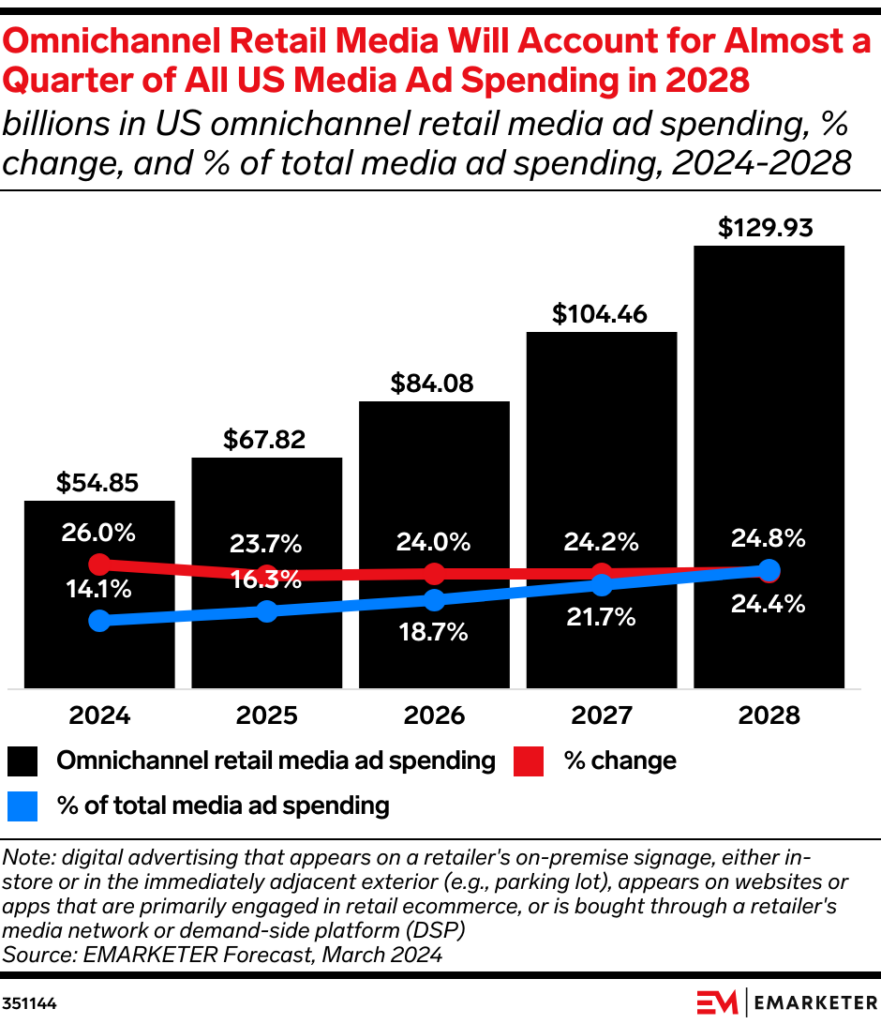
According to WARC, retail media will hit $142 billion this year, a massive number for a category that only started getting attention in the past few years. It’s growing at over 20% for the next 4 years, says eMarketer, and is set to become literally a quarter of all US ad spend in 2028. 

That’s shocking, literally shocking growth.


retail media growth PayPal


But — of course — there’s a problem.

Retail media has a big problem: no “Google AdSense”

If an advertiser wants to buy ads in retail media networks, they’re largely stuck in the dark ages of digital advertising: doing deals with individual retail media outlets 1 by 1. 

That’s fine, to a degree, if you only want to access inventory from a few large retailers or brands, but it gets tedious and tiresome if you want to aggregate bigger audiences. And it also renders the long tail of retail media basically inaccessible and therefore underutilized, undervalued, and under monetized.

For advertisers on Amazon this may not be a huge issue.

But for advertisers who might want to target 4.6 million Shopify stores across 170 countries, it certainly is.

This is no huge secret and there have been a few different attempts to solve this, of course. UNFI is one for small independent retailers; Axonet is another, Rokt is yet another.

But we have yet to see the Google AdSense of retail media: a truly large aggregator with huge scale. AdSense, of course, allowed millions of websites to monetize at the same time as it allowed advertisers to access potential customers across those very same millions of websites. 

No such platform exists yet for retail media, although Rokt might be coming close (more on that later).

PayPal to the rescue

PayPal thinks it has the solution to this emerging problem.

It already has scale at over 429 million active users: much more in the Western world than any individual retailer not named Amazon or Walmart or Apple (yeah, Apple is a top retailer). And with 30 million merchants, PayPal has size on both sides of the market: buyers and sellers. Which means that potentially, advertisers have a lot of opportunity.

Admittedly, many of PayPal’s 30 million vendors are tiny, but not all: Walmart accepts PayPal for online orders. So does Best Buy. I’ve used PayPal at TicketMaster, Apple accepts it, as do Burger King, Adidas, eBay, Etsy, Bose, and American Airlines.

So there’s definite scale on the retail side as well.

There’s also a ton of data to feed ad targeting and audience assembly: transaction data from those hundreds of millions of users. This is not just high-intent search data or top of funnel signal: it’s actual hard purchases. And since the best predictor of the future is the past — note, I didn’t say perfect, just best — purchase data is kind of the ultimate signal for what people will buy in the future.

“The sheer amount of transaction data that we have at our fingertips is just incredible — it’s much more than any single retailer would ever have,” Mark Grether, a PayPal exec who worked in Amazon’s and Uber’s ad businesses, told AdWeek.

I buy that, with the likely exceptions of the Amazons or Alibabas of the world, or other similar massive retail platforms.

So, PayPal has all the requirements, seemingly:

  1. A huge number of purchases
  2. A huge number of vendors
  3. A huge amount of transaction data

What could go wrong?

Becoming the retail media king won’t be easy

As young as the industry is, there are already heavyweights who loom large in retail media and likely won’t benefit from sharing their customer reach with PayPal. And PayPal’s hope-for ad empire will be limited, for at least some time, to PayPal’s own properties.

Those include:

  • PayPal (its own app)
  • Venmo, the payment-sharing app Venmo
  • Honey, the coupon and cash-back shopping tool

Let’s be clear: that is a huge business driver for PayPal Ads. Each of those apps is significant in its own way. Since PayPal has 429 million users, Venmo has around 90 million users, and Honey has about 20 million users, PayPal as a company has a large user base to begin with, even if those individual user bases largely overlap.

But expansion to retailers’ own sites will start next year, in 2025.

Meanwhile, competitors are already in place aggregating retailers right now, and 1 of them, Rokt, might have a leg up on the others. Rokt Ads “access an exclusive closed marketplace across 4.6B+ transactions on premium eCommerce sites,” the company says. The company boasts clients like Macy’s, Kohl’s Office Depot, HP, Domino’s, AMC Theaters, and TicketMaster, though it’s unclear if all of them use the ad product specifically.

The good news for PayPal is that Rokt says its ads get 3.6% engagement on average, and are 95% viewable. This makes sense, given that with retail media, the publisher has a higher incentive to ensure that not only do visitors/customers see the ads, they also are easy and inviting to engage with. 

PayPal can look forward to similar benefits when it gets going both internally and externally.

All in, retail media is going to get more interesting

PayPal Ads is almost guaranteed to achieve success even if it never progresses beyond the company’s owned (and very large and successful) apps. But the true potential lies in aggregating a retail media empire across thousands of significant retailers and millions of long tail retailers.

Whether PayPal can achieve that, time will tell. But if not PayPal, someone else certainly will.

Because 1 thing we’ve learned from adtech in the past 2 decades of massive expansion is that just like nature, advertising abhors a vacuum.