This is how the rebels win: Epic Games Store to be pre-installed on millions phones

The Epic Games Store is going to be pre-installed on millions of smartphones from a major EU carrier.

Many Bothans may have died, but the rebels now have the plans for the Death Star. The next steps are all about time and space and a smart strategy for dozens of X-Wing Starfighters, but we can see a clear path for third-party app stores to reach mass distribution and maybe even adoption.

And while that’s true in the EU today for Android, it’s also going to be true at some point in the near to mid-term future for the iOS App Store in Europe. 

But it’s not just Europe.

South Korea’s on that path. Japan’s Fair Trade Commission is trending this way. And in the U.S. the proposed Open App Markets Act seeks to prevent app store operators from requiring exclusive use of their own payment systems and from unfairly promoting their own apps over competitors

Epic Games Store to millions of phones, maybe 100s of millions

Epic Games, the makers of Fortnite and long-time App Store rebels, are in business. Yesterday the companies announced a “long term partnership” to bring the Epic Games Store to millions.

From the Epic press release:

“As a first step in this partnership, the Epic Games Store will now be pre-installed on all new compatible Android devices on the Telefónica network in Spain, UK, Germany and Spanish-speaking Latam. Players will now be able to more easily download Fortnite, Fall Guys and Rocket League Sideswipe as well as third party games in the future. This is just the beginning, and over the next year the companies plan to expand the partnership and bring more benefits to mobile players across the Telefónica network.”

Epic Games and Telefónica have some history: the 2 companies partnered on “interactive music adventures” during Covid, with over 10 million players participating in a virtual concert and entertainment experience.

And Telefónica is not some tiny player. The company has almost 400 million customers in Europe and Latin America: 1 rich iOS-heavy region and 1 developing Android-centric region.

A dream come true for carriers

This is, of course, a dream come true for carriers. 

Carriers have long felt underappreciated and undervalued. After all, their wires (initially) and wireless networks (now) are the highways and byways of the information age. Thousands of startups have made trillions of dollars from that interconnectivity, and the most valuable companies on the planet couldn’t exist without it.

And yet carriers are worth fractions of the companies that they enable.

Telefónica is worth less than $30 billion. AT&T is worth less than $200 billion. But Apple, Google, and Meta are all trillion-dollar companies, with Apple at a current valuation currently climbing within shouting distance of an almost-unbelievable $4 trillion.

So how can carriers monetize better? 

By not just acting as the dumb pipes that they hate being called, and by taking an active role in the digital economy via — of course — taking their cut of in-app purchases. Globally, that’s worth easily $200 billion, and just Apple’s revenue after expenses in 2024 alone is likely around $8 billion.

Details haven’t been released, but this is the deal: some kind of revshare is happening between the Epic Games Store and Telefónica. 

And the same could happen for other carriers, who would then have tremendous incentive to push the Epic Games Store — or whatever store they pick — as the primary app source for their customers.

And there’s plenty to pick from:

  • Samsung Galaxy Store
  • Huawei AppGallery
  • Xiaomi Mi GetApps
  • OPPO App Market
  • VIVO App Store
  • Amazon Appstore

Plus, of course a rag-tag bunch of other third-party app store competitors like Appland, GetJar, AltStore PAL, Setapp Mobile, and more.

The empire strikes back

Of course, distribution alone is no panacea. It’s also no guarantee of consumer adoption. 

And the empire (AKA Apple’s App Store and Google’s Google Play) has massive advantages in scope and scale, in brand recognition, in ease of use, in embedding into people’s existing mobile experience, and just in basic muscle memory.

If you’re already using the official App Store or Google Play (and that’s almost all of us) the path of least resistance is to do nothing at all … to not switch to some new and unproven option. Especially 1 that may not have Instagram, or Awesome App #87, or whatever you want right now, or whatever randomly gets hot tomorrow.

The strength of the official app store is in the promise: “there’s an app for that.” That promise is unlikely to be true on the new rebel app stores popping up.

Still, there will be ways for the rebels to win mindshare and market share:

  • Discounts (cheaper in-app purchases)
  • Special offers
  • Exclusive games … only available on …
  • Vertical-specific options
  • Geo-specific options
  • Unique features
  • Influencers

Epic Games Store: a crack in the wall

The thing is this: the Epic Games Store getting significant distribution is a crack in the wall. It’s the leading edge of the wedge.

The interesting part is what’s going to happen after, over the next few years. And in the next few countries and states to adopt legislation similar to the EU’s Digital Markets Act.

Ultimately, the trend is towards more openness in mobile in-app payments as well as app marketplaces.

Which is going to bring us to a very interesting new reality in terms of App Store Optimization, app marketing, in-app purchase pricing. There’s also going to be very interesting developments in vertical-specific and geo-specific app marketplaces.

All of which will also have an impact on privacy regulations and technologies like ATT, SKAdnetwork/AAK, and Privacy Sandbox (AAK is already explicitly third-party app store ready). Different app marketplaces will have different rules on all these things, and may actually use those differences as marketing tactics to appeal to different app publishers.

It’s going to be a very interesting world …

Hacking mobile games growth: the ultimate Growth Masterminds miniseries

What if you could get a mini MBA in hacking mobile games growth? A little pick-me-up with sweet tips from industry experts? Some fresh ideas over the coming holiday break to apply in 2025 as you get back to the task of growing your game?

Well, today’s your lucky day. You’ve won the lottery, you’ve scored the game-winning goal.

Because we’ve built a Growth Masterminds miniseries on hacking mobile games growth that is going to reinvigorate your mobile game marketing in 2025, and you can access it right now, completely free, right here.

Hacking mobile games growth: the 5 key topics we’re hitting

We picked 5 key topics for growth hacking your mobile games.

To win in 2025, you’re going to need game-changing creative that gets noticed AND gets results. You’ll still need to navigate iOS measurement as all the platforms bring in their own versions of AEM or TikTok’s Advanced Dedicated Campaigns, and AAK takes over from SKAN. When it’s time to grow, you have to look at channel — and partner — diversification, so we tackle that next. 

Sometimes you need to reinvigorate former players, so retargeting and re-engagement is session 4, and we end with probably the point of this whole enterprise: making more money with hybrid monetization.

Here are the 5 sessions, along with the experts for each:

  1. Mastering the art of creative
    Jesse Lempiäinen, CEO & co-founder at Geeklab
  2. Navigating iOS measurement and marketing
    Jesse Lempiäinen, CEO & co-founder at Geeklab
  3. Scaling with channel diversification
    Majej Lancaric, user acquisition consultant
    Kyle West, senior director of marketing at Mistplay
    Brendan O’Oconnor, growth director at Moloco
  4. Win them back: retargeting and re-engagement
    Günay Aliyeva, co-founder at GameLight
  5. Making money: hybrid monetization
    Felix Braberg, ad monetization consultant & host of Two & a Half Gamers

Sneak peek: the art of the creative

We kick off our hacking mobile games growth journey with creative, featuring the CEO of Geeklab, Jesse Lempiäinen. 

Geeklab works with the best of the best: 

  • Rovio
  • Wooga
  • Supercell
  • A Thinking Ape
  • And many more …

Their job: turning impressions into installs. That requires extreme creativity, innovation, insight, and execution. But as we learned in our chat with Jesse, creative ideas don’t just come from the stereotypically “creative” people.

In fact, one of the best ideas for a recent gaming customer came from their CTO. Watch this 30-second clip:

There’s much more in this segment, including:

  • Creative Strategies for Game Growth
  • Trends in Game Marketing
  • The Role of AI in Creative Development
  • Influencers and Celebrities in Game Marketing
  • Challenges and Successes in Creative Marketing
  • Future of Game Marketing: Predictions for 2025

Hacking mobile games growth: iOS measurement

If you want to hit high-value gamers, you pretty much need to have an iOS strategy. And if you want to have an iOS strategy, you pretty much need to achieve a level of excellence in iOS measurement.

(And yeah, you’re not alone here. We can help.)

So we hit iOS measurement with Jesse too and Niels Beenen, who leads partnerships for Singular in EMEA. 

As you’d expect, we chat about Apple’s IDFA changes, and the challenges with current attribution methods. Perhaps surprisingly, we end up with a fairly optimistic outlook for future measurement techniques. We also cover creative testing, AAK (the new SKAN), probabilistic methods that the big market players are coming out with, and how the industry is adapting.

Here’s Neils making a point about how your measurement needs to incorporate multiple signals, not just 1, because no single measurement methodology on iOS is perfect.

Check out his 35-second comment:

And, of course, there’s much more here too, including:

  • Current Challenges in iOS Mobile Measurement
  • Retargeting and Attribution Strategies
  • The Role of SKAdNetwork and Advanced Measurement
  • Probabilistic Attribution and Industry Trends
  • Unified Measurement and Incrementality
  • Web to App Campaigns and Creative Testing
  • Future of iOS Game Marketing in 2025

Scaling with channel (and partner) diversification

If you’re successfully hacking mobile games growth, you’re probably growing. And when you’re growing, you’re going to out-grow certain partners and — if you get big enough — out-grow certain channels.

So now you need to start thinking about partner diversification and channel diversification: finding new potential players for your games in new places, and convincing them to give your game a shot.

Matej Lancaric, Kyle West from Mistplay, and Brendan O’Connor from Moloco helped us out here. We talked about the timing and testing required to add new channels and scaling strategies. We also hit the efficacy of rewarded ads, influencer marketing, and CTV as new channels for hacking gaming growth. 

One of the things we touch on: how much do you need to spend to test a new partner?

Here’s what Matej says:

The rest of our conversation adds much more insight, including:

  • The Cold Start
  • Expanding Your Partner Network
  • Testing New Channels
  • Scaling and Diversifying
  • Geographical Considerations
  • The Role of DSPs
  • Exploring New Channels
  • The Rise of Rewarded Advertising
  • Influencer Marketing in Gaming
  • The Role of Influencer Marketing Managers
  • Celebrity Endorsements: Do They Work?
  • CTV Advertising Trends
  • Future of Ad Partners and Channels
  • Final Thoughts and Key Takeaways

Retargeting and re-engagement: essential parts of hacking mobile games growth

People leave. Players stop playing. 

It’s a fact of hacking mobile games growth that marketers need to take into account, and do. But that doesn’t mean you can’t win some of them back. Sometimes, they’re just taking a brief break and you can coax them back with smart retargeting and re-engagement strategies.

So we dove into the future of retargeting and remarketing in mobile gaming with Günay Aliyeva, co-founder at GameLight

We talked about the importance of retargeting even with increasing privacy restrictions, best practices for Android, different expectations and strategies for user re-engagement versus new user acquisition, and the challenges posed by retargeting in the iOS ecosystem. Günay gave us some incredibly valuable insights on how to use segmentation and seasonal events in retargeting campaigns, and we talked about future trends in this space.

Retargeted users have much higher LTV and ROAS than your average newly acquired player, says Günay:

We also talk about:

  • The State of Retargeting in 2025
  • Best Practices for Retargeting
  • Challenges and Common Mistakes
  • Retargeting on iOS vs. Android
  • Future of Retargeting

Finally: hacking mobile games growth by making more money

Last but definitely not least, we talked about making more money in your games with hybrid monetization, focused especially on ad monetization with the 1 and only Felix Braberg.

We chat about trends and strategies for optimizing game monetization: the nuances of hybrid monetization, the importance of A/B testing, the impact of ad duration on user experience, and the innovative tactics used by top gaming studios.

We also talk about the biggest reason games fail, according to Felix:

Finally, we dive into the complexities of measuring ad revenue, the significance of user acquisition strategies related to ad monetization, and how to balance monetization without alienating players.

All of that includes:

  • Current Trends in Hybrid Monetization
  • Building Effective Monetization Models
  • Ad Monetization Strategies
  • Innovative Monetization Techniques
  • Challenges in Ad Measurement
  • Future Trends and Tips for 2025

Hacking mobile games growth: check it all out right here

All of the above is available immediately and on demand right here.

Suggestion: bookmark it and come back during the holiday break to watch an episode a day. It’d be incredibly challenging to NOT come away with at least 1 good idea to try in your own mobile games marketing in 2025.

2024 year in review: what digital marketers need to know about the internet

What could you learn if 20% of the internet’s traffic traveled through your servers? Way too much, as it turns out, which includes some very interesting tidbits for mobile marketers. That’s why 1 of the things I look forward to every year is Cloudflare’s year in review report

Among other things, Cloudflare is a content delivery network, and that means it sees a massive percentage of global internet traffic. Internet traffic matters for app publishers and advertisers: just like roads and bridges might matter for physical goods retailers, the internet is how you build, distribute, and market your products.

It’s mostly invisible to us, hidden behind App Stores and AWS instances, but when it breaks or fails, it becomes very top of mind.

So what’s interesting in this year’s Cloudflare report? Read on …

Year in review: the coin of our ecosystem is up

Internet traffic is up 17.2% versus 2023: a massive leap in just 1 year. That likely correlates to a growing digital economy, just like new roads and physical infrastructure correlate to a growing traditional economy. 

It also correlates with rising spend trends for long-term Singular clients.

2024 year in review

Interestingly, as you can see, traffic increases in the Northern fall and early winter seasons.

A growing digital economy is a rising tide that tends to lift all boats: ad monetization is the first and most obvious beneficiary, but in-app purchases and subscriptions also tend to rise when more of life in general and economic activity in specific happens digitally.

More internet use, therefore, is a growth signal for the industry.

The giants of our industry are truly giant

It’s easy to forget when we’re heads-down in growth or campaign optimization that the giants of our industry are not just big fish in our local pond. They’re literally the biggest fish in the global ocean.

industry giants


That’s why it’s useful to look at the occasional year in review.

Google is #1. Apple is #3 on the top 10 most popular internet services globally. YouTube alone is #8 by itself, while Meta has Facebook at #3, Instagram at #7, and WhatsApp at #10. Add in TikTok at #4 and you have 4 of the most important companies for mobile marketers anywhere as top-ranked companies by digital footprint globally.

Dialing into social properties specifically, X still has a significant userbase at #4, followed by Snapchat at #4. Reddit, which has been growing in importance for marketers over the past year, slots in at #10 among social platforms.

It’s also interesting to see who has the largest digital properties in gaming:

  • Roblox is #1
  • Fortnite is #3
  • EA and Blizzard are in the top 10
  • So is Riot Games with Fortnite

Year in review: iOS vs Android by geo

We all know more than 70% of phones sold globally run Android, while iPhones account for about 28%. iOS does punch a little above its weight class, however, in internet traffic share, which is 67.4% Android and 32.6% iOS.

Interestingly, if you look at peak traffic share for each mobile operating system by country, peak Android share is over 95% and peak iOS is 66%.

iOS vs Android by geo


iOS wins in North America minus Mexico, Scandinavia, UK, Saudi Arabia, Japan, and Australia. Android is predominant pretty much everywhere else.

Market share is 1 thing; revenue share is another. While all the above is true, in 2023 the App Store took in $89.6 billion of app users’ money, while Google Play took in $47 billion. While there are exceptions,  iPhone owners tend to spend about double what Android users spend, making iOS still the most attractive mobile operating system for app publishers and marketers.

Google is the world’s default search engine

OK, this is no shock in a year in review: Google wins everywhere. But it is a little surprising how dominant Google remains globally.

  • Overall: 88.5%
  • Android: 90.2%
  • iOS: 91.2%
  • Windows: 80.1%
  • Mac: 93%

Honorable mention to Bing on Windows, with just over 10% share.

But the big question is what ChatGPT will do to this global dominance. I pay for OpenAI’s $20/month subscription, and it’s taken over at least 70% of my internet searching, which would otherwise be split between Google and DuckDuckGo.

Also, antitrust efforts in the U.S. and other countries might have something to say about where Google Search goes over the next few years.

Mobile vs desktop year in review

Somewhat surprisingly, desktop still wins in global share of traffic versus mobile. According to Cloudflare, only 41.3% of internet traffic is from mobile devices.

mobile vs desktop


Desktop wins largely based on economics: richer countries tend to have more desktops and more internet use in general. But it’s not just NA and Europe. Peru and Argentina are majority desktop, as are Libya, Kenya, and Botswana. China is majority desktop, and so are Japan and South Korea.

This is important info for marketers using web for mobile UA, or cross-device marketers. 

Desktop is not dead, and it likely has a long future ahead of it.

Almost half of internet outages are government caused

Those of us who are worried about the ongoing balkanization of the internet that is putting up barriers to publishing apps and building international companies won’t be happy to see this in the Cloudflare year in review: more than half of the internet outages in 2024 were government directed.

We’ll likely see more of that in 2025 and following, as there is increased digital nationalism and rejection of foreign company’s apps in locations like India, China, Russia, Bangladesh, and the United States.

internet outages


And we might see more examples of what Indonesia has done recently: ban the sale of iPhone 16s and recent Google Pixel phones because Apple and Google have not invested enough money in local economies. 

India has similar legislation, which is why Apple now builds iPhones in India, but that’s an enormous market that is a much easier yes for smartphone manufacturers to say yes to.

Much more in the full report

There is, of course, much more in the full report. But these are some of the most relevant parts for digital marketers, and especially mobile marketers.

2025 mobile ad spend projections: Singular’s strategic customers’ ad spend jumped 41%

Everything looks up and to the right for mobile ad spend projections for 2025. 

Singular’s strategic customers spent more on ads last month than in any month over the past 2 years. Year-over-year, November 2024 spending was up a staggering 41%. And while we often see a jump from October to November as the holiday season ramps up, this year’s month-over-month increase was easily double what we saw in 2023.

What does this mean for mobile ad spend projections for 2025?

The future, as usual, is hard to predict. But we can look at the recent past and search for patterns that might continue.

Mobile ad spend projections 2025

Data.ai SensorTower’s state of mobile report for 2024 forecast mobile ad spend of $402 billion, an 11% increase on 2023’s $362 billion. (Which in turn was an 8% increase over 2022.) We’ll have to wait to get the 2025 report to see if SensorTower thinks we actually made it there — or above — but all indications are positive.

The massive surge in ad spend from key Singular advertisers suggests that, if anything, the projected 11% growth rate might have been conservative.

And, it suggests that 2025 could be another big increase.

If we look at the overall ad marketing including non-mobile platforms, Statista suggests that it will continue to grow over the next few years:

  • 2024: $740.3 billion
  • 2025: $798.7 billion
  • 2026: $854.9 billion 
  • 2027: $910.3 billion

Assuming that the overall market continues to grow, mobile ad spend should continue to grow with it, for 2 reasons: 

  1. A rising tide tends to lift all boats
  2. Digital ad spend in general, and mobile ad spend in particular, has been taking a larger and larger percentage of overall ad spend

It’s not easy to tease that out on a global scale, but Zenith generally does a good job on its massive global ad spend reports, and said as far back as 2022 that digital ad spend would hit 61.5% of all ad spend and a projected 65.1% in 2024. We won’t see the 2025 report until later in December, but the 2024 report forecast continued growth in digital and online advertising.

If we do something dangerous and mix datapoints from 2 separate studies with differing baseline data and different assumptions, SensorTower’s $402 billion in mobile ad spend for 2024 would be 54.3% of all ad spend, based on Statista’s projections for the year.

Since their projection for 2025 is $798.7 billion in global ad spend, that same fraction would translate into $433.7 billion of mobile ad spend.

Add a little for growth and perhaps cannibalization from legacy media and channels — let’s say 56% — and you end up with a mobile ad spend projections for 2025 of $447.3 billion. Important point: there’s a lot of assumptions in that projection. It’ll be interesting to see where SensorTower’s and others’ projections come in over the next couple of months.

The upward trajectory of top Singular customers, which has been continuous throughout 2024, is a positive sign. We certainly didn’t see that in 2023.

What almost $450 billion in mobile ad spend means for mobile marketers

Every bid for a converted app install is, of course, essentially connected to estimated LTV from that user. Expect more revenue, you can bid more; expect less, you bid less. (Of course, as a frugal marketer you want to win this bargain and pay less while getting more.)

As such, at some level, it doesn’t matter what you pay as long as the return is there. Of course in the real world you need to have capital before you can deploy it, so higher acquisition costs can significantly slow growth rates even if the ROAS ratio remains the same.

My general sense, however, is that additional inventory will serve to soften the impact of additional money entering mobile marketing.


time on devices


According to the Digital 2024 Global Overview Report, time spent on mobile devices is still increasing while time spent with legacy media like TV and radio is still decreasing. Time on gaming consoles is also down.

All of this increasingly centers the mobile device as the information and entertainment nexus of our lives. And all of this provides additional inventory of time and attention for mobile publishers to sell against.

What it means for mobile app publishers

For mobile app publishers and especially all those who monetize based on advertising, this is good news. 

Whether you monetize via user acquisition for mobile games, or increased brand spend floods in as networks like AppLovin bring better targeting and tracking to retail spend, more cash being deployed on mobile ads is a major positive. 

Winners will see outsized benefits, of course, but everyone should benefit to some degree. An extra $45 billion of ad spend, if it materializes, feeds a lot of app publishers.

There’s still a lot of uncertainty

Of course, there’s still a lot of uncertainty in the markets. 

The war in Ukraine continues, and has global implications. The Middle East is extremely unsettled. A new president is coming in the United States, and there’s strong potential for new tariffs as well as deportations at scale, both of which could have serious impacts to international trade and domestic productivity.

Hopefully we weather the changes well, the conflicts die down, and the world can get back to the business of growth.

How LTV forecasting can help you scale your mobile game 10X faster

How can LTV forecasting change your growth curve? In a word: massively. Think orders of magnitude faster.

Just 1 example from about a decade ago, a very tasty mobile game used cohort-based LTV forecasting to boost marketing spend from double-digit millions to about $400 million, and in the process grow to a $2 billion juggernaut. I’m talking, of course, about King’s massive hit, the match-3 game Candy Crush Saga.

This game is an absolute beast:

  • Launched in 2012
  • Still getting hundreds of thousands of installs a month
  • Passed $20 billion in lifetime revenue in 2023
  • Still making over $1 billion/year
  • Has inspired spinoffs like Candy Crush Soda Saga and Candy Crush Jelly Saga

Anything’s possible, but I’m not sure that kind of absolute explosion is something that you can plan on or engineer, even with the best cohort-based forecasting. But it is an example from mobile growth history of what is possible.

To dive in more to what forecasting can offer, I wanted to talk to an expert. So in a Growth Masterminds episode released just this week, I chatted with Kohort’s Nathan Ceulemans about how LTV forecasting is the key that unlocks growth like this.

Watch the episode here:

Oh, and don’t forget to subscribe to our YouTube channel plus the podcast platform of your choice.

Growth without LTV forecasting …

What does growth look like without LTV forecasting?

Pretty much as you’d expect: simple, linear, slow.

  1. You invest $100 in advertising and promotion
  2. Your investment has a 200-day payback period
  3. After 200 days, you’re revenue-positive on your investment
  4. Rinse and repeat: you turn around and reinvest that acquired revenue

(Of course, there are plenty of details and complexities I’m not diving into here. You’re clearly making some percentage of your revenue back right on D1 and through D100, and past there, for example, and revenue that you recognize may not actually appear in your bank account instantly due to delayed store or ad partner payments.)

So this is a safe, easy-to-understand strategy that results in arithmetic growth: you only invest new money that you have already literally recouped. And perhaps you grow an overall 10% during this period after taking into account churn. Or maybe you get lucky and grow 25%.

No one’s gonna write you up in PocketGamer for your explosive market-smashing jump up the App Store/Google Play rankings, but hey, it’s growth.

The question is: how can you accelerate that growth cycle 2X? Or even 10X? 

You’re gonna need really, really good LTV forecasting.

Growth with LTV forecasting … hello Color Bomb and Lucky Candy!

So in Candy Crush, like many games, you can get a bunch of different power-ups. Perhaps the best is the Color Bomb, which removes all candies of a certain color from the board. Or maybe it’s the Lucky Candy, which matches more and helps you clear levels faster.

That’s like growth with forecasting.

If you get good enough at forecasting to predict future earnings with a high level of accuracy, you can potentially access capital via companies like PVX Partners or Braavo to spend earnings that you haven’t yet realized.

And that exponentially increases the rate at which you can grow.

The critical component, of course, is having enough faith in your LTV forecasting to spend as-yet-unrealized earnings. And Ceulemans says that, done well, you can get “single-digit accuracy.” That means your forecast is accurate plus or minus 9% … pretty good. If you can achieve that level of accuracy, you can safely spend up to 90% of your estimated future earnings on growth very quickly, and instead of having a 200-day cycle, maybe you have a 100-day or even 50-day cycle.

Again, there are caveats, and you’re going to want to validate assumptions and accuracy regularly: do all future cohorts behave the way existing cohorts do? Does my LTV forecasting take into account that existing users or players were low-hanging fruit and future cohorts might be less profitable? Not every cohort will be a ‘golden cohort,” perfectly self-selected to love your game.

But all things considered, growth can proceed much faster.

Forecasting results: 1 case study

Ceulemans can’t talk about every client and reveal all their private data, of course, but 1 case study that’s public is Lotum, a German mobile gaming company that is both a Singular and Kohort customer. Lotum offers games like The Test, with over 100 million global players, and 4 Pics 1 Word, with over 400 million players.

(In other words: this is not a tiny studio, and their marketing spend was already significant.)

Cohort-based LTV forecasting helped Lotum boost investment and results very quickly in new markets:

  • 55% increased UA spend
  • 15% boost in revenue
  • 10% boost in profits from 4 Pics 1 Word

The key: being able to infer long-term retention and monetization trends for Lotum’s new segments. More accurate forecasting provides the confidence to reinvest continuously at higher levels, speeding up growth.

More learnings

Of course, all this needs to be exceptionally rigorous. LTV forecasting is notoriously complex, and it also can be impacted by externalities that you have zero control over.

And your game needs to be mature enough as a baseline.

“Essentially it’s an extrapolation of historic current behavior,” says Ceulemans. “And so what goes into that is you need to have enough historic current behavior to base it on.”

And if you’re scaling user acquisition, there’s by definition going to be some level of variance in future cohorts.

That’s also true in a positive sense, of course:

“Sometimes a game update, no matter how inconsequential it might seem, just has completely outsize effects,” Ceulemans says.

The classic example is Clash of Clans introducing the Clan Wars feature in 2014. While the game was already popular with perhaps 30 million players and almost $900 million in revenue in 2013, by the next year that had increased to almost 40 million and well over $1 billion of revenue.

Much more in the full podcast!

Check out our complete conversation for much more, including:

  • 00:00 Introduction to Growth Masterminds
  • 01:03 The Importance of Forecasting in Scaling Games
  • 01:32 Understanding User Acquisition and Financials
  • 02:24 Forecasting Retention and Monetization
  • 04:15 Challenges in User Acquisition and Scaling
  • 07:31 The Role of Product Teams in Forecasting
  • 13:17 Accuracy in Forecasting with Neural Networks
  • 17:51 The Impact of Accurate Forecasting on Growth
  • 22:35 Conclusion and Final Thoughts

Retail subscriptions & going viral on Tiktok Shop with GNC VP Vivian Chang

Imagine going viral on TikTok and getting millions of free views on your products. Now imagine connecting those views to a purchasable product on TikTok Shop … and selling out in 3 days. That’s exactly what happened with GNC’s VP of e-commerce, Vivian Chang, and it’s just 1 of the things we chatted about in a Growth Masterminds podcast focusing on retail subscriptions.

Hit play to start the convo, and keep scrolling for a few of the highlights:

Retail subscriptions: how not to suck

GNC is a massive retail company. The brand has about 2,300 stores in the U.S. alone, and a presence in over 50 countries globally. Like most retail companies, it explored subscription retail early and now does a significant percentage of its income via subscriptions.

Success in subscription retail is messy though, according to Chang, who also led D2C at Clorox. It’s easy to annoy consumers.

“I think it’s consumers’ continued search for convenience, right, to not have to put in the legwork to go get a product or I already know I like this, so I might as well save a little bit of money,” Chang says. “But I think where it’s messy is … all of us lose track even of how many different streaming services we’re subscribed to and now we’re getting to physical products that are showing up at the house … and so there is a sense of being overwhelmed.”

That’s the danger point for retail subscriptions, clearly, and that’s the dance that retail subscriptions companies need to engage in: how to be helpful without being annoying. How to offer convenience without taking advantage.

You do that by having a great and needed product, but also by offering options, says Chang.

That includes being able to change the frequency of delivery: maybe I don’t use up all the toilet paper in 30 days … maybe I need a new shipment every 45 days. It also includes being able to be flexible: maybe I want a different flavor of energy drink, or a pause when I’m on vacation, or more in a period of heavy usage.

Of course, there are challenges with this:

“I think you have to play that line with consumers of offering convenience without being annoying,” says Chang. “And then make it really easy to adjust, to pause, to swap out flavors and all of those things that can sometimes be complex operationally to execute as a brand.”

Make it special

If the retail subscription is just about you as a retailer getting revenue certainty and customer retention, it’s likely to fail. If it’s super-valuable to your customer, you’ve got a good chance of success.

But sometimes the value is outside the specific product and the convenience of delivery.

Pricing obviously matters, as does quality, says Change, but there are other components:

  • Subscribe and get the newest
  • Subscribe and get the best
  • Subscribe and get exclusive products no-one else can get, or
  • Subscribe and get it first

In a way, it can become a club too:

“At Burt’s Bees, we had the loyalty club,” she says. “The really loyal Burt’s Bees lovers could help us vote on what the next new product might be, and they would have exclusive access to it.”

Key channels for retail subscriptions, including TikTok Shop

Affiliate is a big channel. Influencers are a big channel for retail subscription companies as well, and both of those are really good at bringing new people into the brand, which is important for growth.

But it’s not always the big influencers that are the most impactful.

“Actually what I’m seeing to be most efficient is the regular folks who, like you and I, are talking about how they use this product in their everyday life,” Chang says. “And they’re showing the messiness of their home or the chaos of having kids or pets or whatever else it is. And that is what resonates because it’s like … I see that myself in that person, so I’m going to trust their recommendations.”

Other channels Chang uses at GNC include the big social and search platforms with their dynamic product ads, of course.


TikTok shop


One place she’s seen extraordinary success was in a test of TikTok Shop:

“GNC is actively testing on TikTok Shop and we’ve actually seen pretty good success over the last couple months,” she says. “There was a product, a woman’s Stress Vita Pack, like a 30 day supply of all the supplements and pills to take, and it went viral. And we sold out of all of our inventory in 3 days.”

That’s impressive, but what’s perhaps even more impressive is that it drove other actions that might be even more important: bringing people to physical GNC stores, going to Amazon and buying there, and so on.

The best product for TikTok Shop, Chang says, is a starter pack or trial product. The price point typically needs to be lower — $30 or less — and there often needs to be a significant discount.

In other words, as I said in the podcast: it’s the new Groupon.

Interestingly, Facebook and Instagram shopping hasn’t caught on as quickly. My guess is that it’s because they have older audiences who aren’t familiar or comfortable with giving their payment information to Meta. Younger people adapt and change quicker, and they don’t have as much of a concern with handing over their credit car information.

“I think a lot of times now consumers are just used to going from Instagram to a mobile shop for the brand or a Shopify store or something like that, and it feels just as easy, without needing stay within the closed walled garden.

Retail and on-platform commerce: where does it fit?

Which brings up an interesting point: do you embrace the big social and search platforms that want to bring retail on to their own platforms, or do you always try to bring customers to owned platforms where you can capture all the revenue and much more customer data? For GNC, it’s about using those channels as open doors to bigger things down the road.

“It’s like a single product … how is that an acquisition channel to bring someone into the brand?” Chang says. “That’s how we’re thinking about it.”

Which is super smart.

Someone has already created a crowd; you’re jumping into that mix and sharing what you have. You don’t need to create your own crowd. And then, after, it’s about land and expand: how do you take that 1 sale and transition that into a deeper and longer relationship. Which speaks to packaging, messaging, and overall brand storytelling.

Because when you use TikTok Shop, you’re not getting all the customer data you would when someone buys at your own store. You’re essentially getting fulfillment data (if you’re fulfilling the product; you can also use TikTok’s own fulfillment functionality.

But: you can add those buyers to an audience in TikTok and retarget them, similarly to how Facebook and Instagram operate.

“Brands can have pretty interactive Facebook Messenger conversations with consumers, and so it’s almost taking a CRM strategy and replicating it within each of these ecosystems,” Chang says.

So much more in the full conversation …

Check out our full conversation by subscribing to our YouTube channel or adding Growth Masterminds to your list of podcasts on your favorite podcasting platform.

We also discuss:

  • 00:00 Introduction to GNC’s Success on TikTok
  • 01:32 Black Friday and Consumer Sentiment
  • 02:22 Understanding Subscription Retail
  • 08:48 Key Growth Levers in Subscription Retail
  • 10:53 The Role of Key Channels in Subscription Retail
  • 15:14 On-Platform Commerce: TikTok and Beyond
  • 23:17 Balancing E-Commerce and Physical Stores
  • 27:23 Final Thoughts and Hidden Keys to Success

Transportation, delivery, and on-demand: new research report

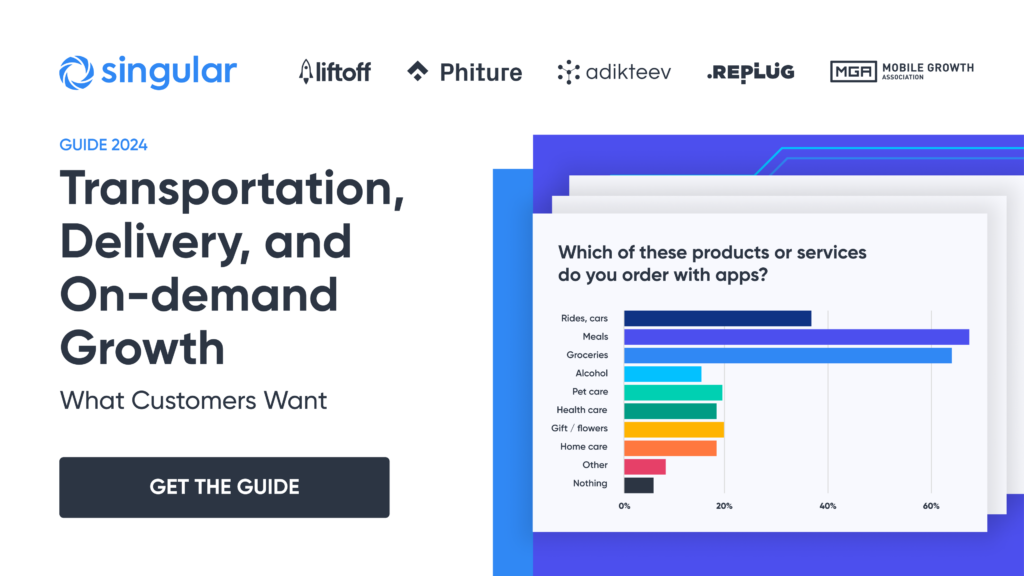
What do customers in transportation, delivery, and on-demand apps want? How do they want to be messaged and notified? How loyal are they, and what makes them switch apps and services to competitors?

Answers to all of that and much more is now available in a new consumer research report from Singular.

Transportation, delivery, and on-demand services are among the fastest growing categories for Singular customers, and we wanted to both learn and share some insights from users and customers. So we surveyed a representative sample of American smartphone-owning consumers to ask them key questions that marketers and product managers in on-demand need to know.

What’s in this new on-demand report?

You’ll find a ton of critical insights in this new report that can help you craft acquisition, conquest, activation, and retention for on-demand apps in the transportation and delivery sectors. 

We asked consumers questions to find critical data on things like:

  • Order frequency
  • Most active customer segments
  • Most loyal customer segments
  • Best customer acquisition targets
  • Categories that are winning
  • Categories that are still developing
  • How much people spend
  • Why people leave on-demand services
  • What people hate about on-demand services
  • The best ways to attract new on-demand customers
  • How to message and notify on-demand customers most effectively

Everything’s better with a few partners

Because everything’s better when we work together, we asked a few partners to add their insights to the data and report.

  • Adikteev
    Adikteev added insights about driving more engagement and reducing churn to make the most of your UA investment
  • Phiture
    Phiture asked and answered an important question: how can custom product pages (CPPs) boost conversion rates for on-demand apps?
  • Mobile Growth Association
    The MGA shared insights about innovation in understanding your users and customers, and how you can personalized to boost growth.
  • REPLUG
    REPLUG shared how connecting to the calendar — in other words, co-opting major local and global events — can help you accelerate growth.
  • Liftoff
    Closely connecting to some of the research findings, Liftoff shared how promotions add value in capturing new users, and how loyalty and re-engagement can keep them.

On-demand is just getting started

Transportation alone grossed $185 billion last year and is forecast to hit the better part of a trillion dollars by 2031. Key on-demand verticals like food, meals, and consumer goods are forecast to grow globally 21% annually for the next four years.

And while those are the top sectors, other on-demand areas are just starting to hit their stride:

  • Alcohol
  • Pet care
  • Health care
  • Gifts and flowers
  • Home care

Under 20% of consumers are currently using on-demand apps to access these products and services, but they are growing.

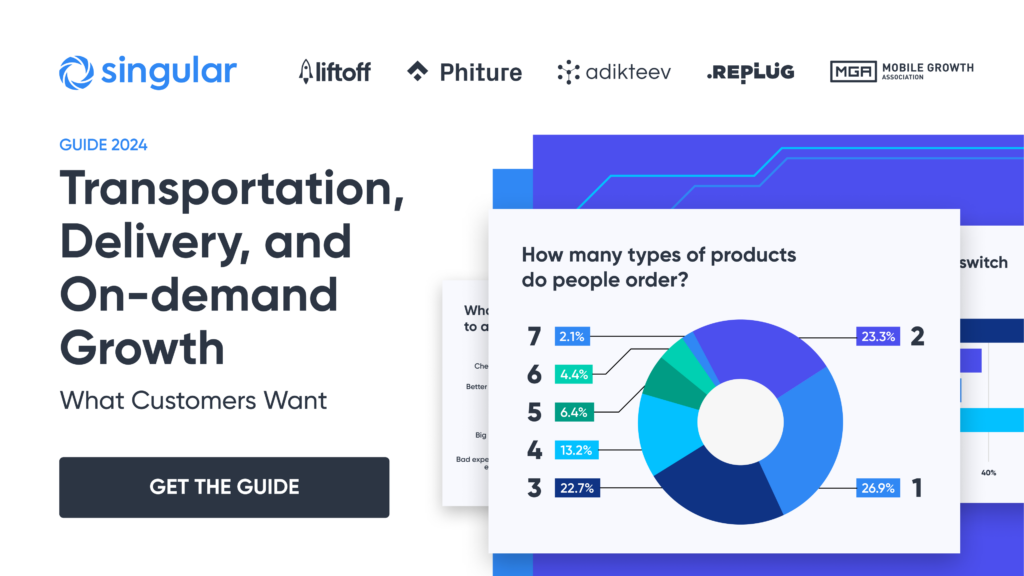
Currently, the average American orders just under 3 different types of services or products via on-demand apps. But that number is growing fast, and as it does, the opportunities to capture new customers or add new services to existing on-demand platforms just continue to increase.

Turbo-charge your strategy and tactics with this new insight:

8 keys to winning with web-to-app journeys

It’s no secret that web-to-app journeys are exploding right now. There’s dozens of reasons why marketers — and CFOs — are turning to web-to-app in search of increased profits, greater control of onboarding funnels, and long-term business advantages like owning your customer.

But what are some of the keys to making it work?

I’ve chatted with hundreds of marketers over the past few years, and I’m hearing more and more about web-to-app as the preferred solution for many. (But not all: we’ll chat about that too!) 

That includes flows from:

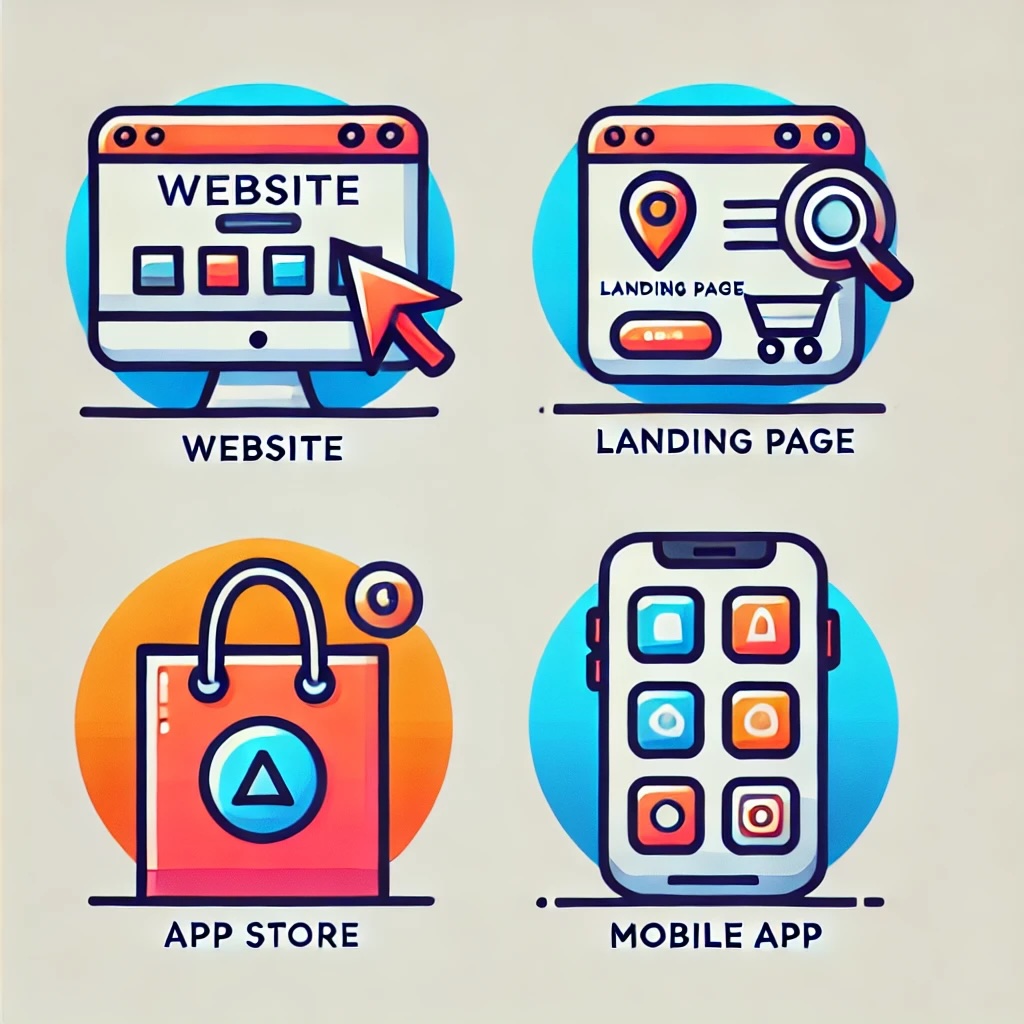
  • An ad or page on the desktop web to a landing page to an app store to your app listing, which might include technologies like SMS, email, or QR codes for that leap from the landing page to the app store, and
  • An ad in a mobile app to your mobile web landing page to an app store to an app listing

So in this post, I want to:

  • List some of the advantages of web-to-app
  • Share some of the challenges or disadvantages
  • Summarize what I’m seeing work right now
  • Detail some of the technologies that can make it all work for you

Let’s dive in …

web-to-app journeys

Advantages of web-to-app

First up, let’s list the key advantages of going web-to-app. 

There’s many, but I’ll list 10 key ones here. 

Spoiler alert:

A lot of them are tied to the increased control you have over your marketing, your sales process, and your customer data when you bring a potential customer/player/user to your web landing page.

  1. More revenue (no app store fees)
    This is pretty obvious. Implement Stripe and you’ll pay about 3% for payment processing. That’s just 10% of what Apple or Google will take, if you’re in a 30% in-app purchase fee category. Even if you’re lucky and in the 15% category, personally pocketing 12% more of your list price is a big deal for most companies.
  2. Owning your customer data
    If Google takes the payment, the customer is really Google’s, not yours. Same with Apple. Plus, you’ll never get all the customer data that you might want from the big platforms: address, email, SMS, credit card, name, etc. That severely limits your ability to retain customers over time or expand what they’re buying from you.
  3. Faster payments
    The big app stores can take a month and a half to pay you. That’s tough, because even if you theoretically have the cash to continue aggressively growing your app, you actually don’t … until it hits your bank account. That can force you to stop and restart growth campaigns, killing momentum, until you’re big enough to cover new advertising costs with reserves.
  4. Measureability
    Measurement is harder in mobile than it used to be. Sure, Unified Measurement on iOS makes it better, but without IDFAs it’s still tough to capture every detail. If you’re doing a web-to-landing page flow, you can get a huge amount of information, either via cookies or URL parameters. If you’re doing an ad-in-mobile-app to landing page flow, which is probably more common, you can still capture a lot of information via the link. That means creative, campaign, partner, CTA … you name it. And data, as marketers know, is power.
  5. More control over marketing/onboarding flow
    The wonderful thing about custom product pages on the App Store or Google Play is that you can customize messaging to different cohorts. But yeah … it’s still an app store platform with plenty of restrictions that are beyond your control. On your landing page, you’re in charge. Web-to-app lets you tell a bigger story, consultant Marcus Burke recently told me. And you can do long-form, short-form, audience-aligned … whatever you want, and however you want. That’s power.
  6. Experiments: marketers can play without distracting product
    Having control is a wonderful thing. Having it on your own website and landing pages means you can employ any number of low code/no code solutions so marketers can play with different landing pages, optimize existing ones, instantly implement new offers, and more. Which segues nicely into …
  7. Pricing flexibility and easy discounting
    Sure, Apple’s App Store offers 900 different pricing points in 10-cent, 50-cent, and $1, $5, $10, and $100 increments, but maybe you just want to price your subscription at $10/month, not $9.99. Or you want to bundle your service with something else you offer, or you have a seasonal sale. On your own website, you’re in charge.
  8. Simple throw-ins to seal the deal
    Planning to ship new customers a branded hoodie? You can do that. Bundling your product with another company’s complementary service? Also doable. 
  9. Longer funnel
    As an ad exec recently told me, as much as we want them to, not everyone is ready to buy or sign up instantly at the drop of a hat. For some, it takes time. They want to do some research, check some reviews, talk to a spouse. When you get an interested buyer who’s not quite ready to commit to your website, you can retarget them on the web. You can do a soft close (do you want to be informed if we have future sales, or product features, or whatever?) and get an email or phone number, and then nurture that customer over time.
  10. Easier affiliate marketing
    Maybe you have a $300/year service. Maybe there’s enough profit in it for you to onboard affiliate marketers, or give existing customers referral bonuses. On the web, this is all easy, familiar been-there-done-that territory. 
  11. (Bonus reason) Expanded ad network partner list
    I know I said 10 reasons, but … going web-to-app opens up the door to additional web-centric ad partners who can help you promote your offer … and web ads are often cheaper than in-app mobile ads.

And yes, there are some downsides of web-to-app

Web-to-app user journeys do have some obvious downsides as well.

Probably the biggest is a more complex execution of purchasing. 

I recently talked to the CTO of a mobile real-money gambling app which has a few off-store Android apps that need to be sideloaded. Granted, these are not in-app purchase scenarios where they’ll lose revenue by doing them on-store, but due to current Google Play regulations, they can’t get on the store. And they’d like to.

“It wasn’t technically challenging for us, but it’s a very challenging user journey,” the CTO told me (I’m withholding the name since it was an off-the-record conversation. “The natural thing is to go to the App Store … we want the distribution of the App Store and Google Play.”

That’s true for getting downloads. 

It’s also true for payments.

Most of us are pretty well trained right now in making in-app payments on our mobile platforms of choice: a simple doubleclick on your iPhone’s side button, or a biometric authentication on your Google Pixel. When it’s a credit card purchase on a website, we’re finding a wallet, pulling out a card, entering a number, and so on. 

Marketers can make this simpler by enabling Apple Pay, Google Pay, PayPal, or some other system, but it’s still not quite as seamless.

In addition to the tougher sales completion process with more steps, you’ll also suffer with poorer ASO and less traffic to your app because you’re only sending fully qualified and probable purchases to your app store listings … not a flood of ad-generated traffic that will boost your visibility in the Play Store or App Store. 

Plus, your app store optimization efforts will take longer, thanks to that lower traffic level.

Other things include extra effort for managing payments on your side, not just for users. Note, Stripe and others do a great job helping out there. But you’re still going to have to account for things like fraud, or chargebacks, or customer service issues that, if you’re simple accepting payments via Google Play or the App Store, are significantly less challenging.

Benefits vs challenges

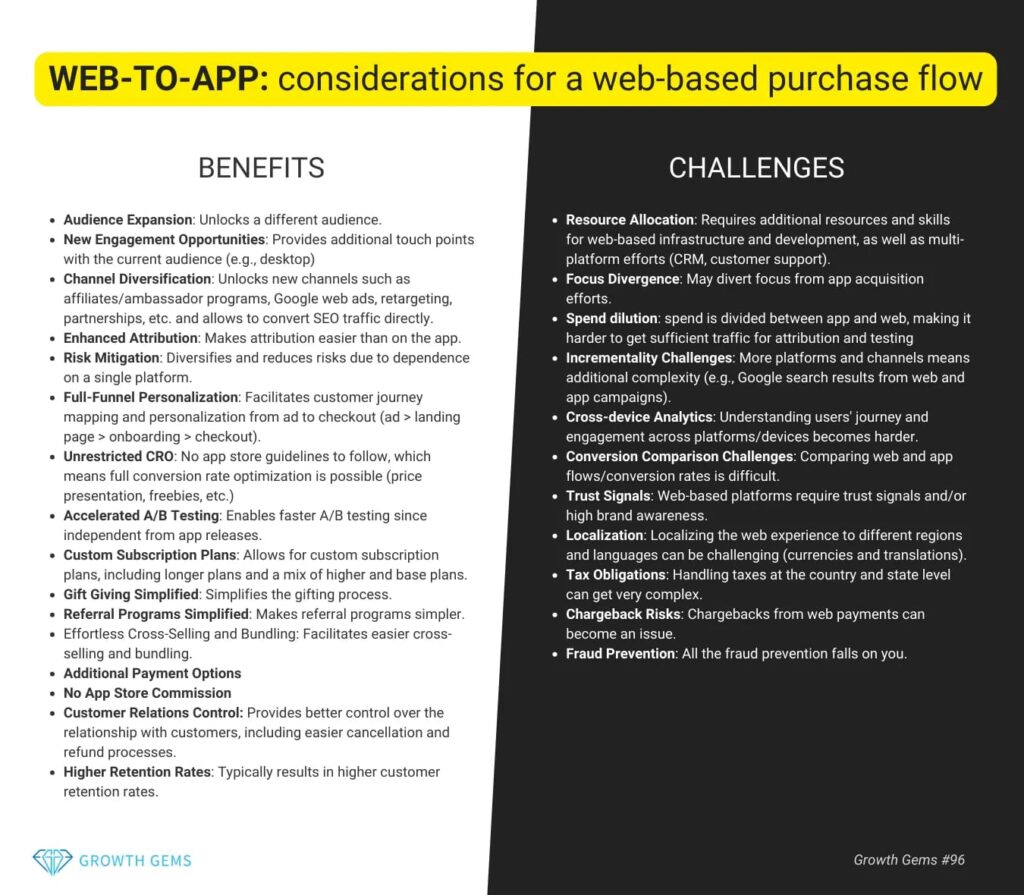
Sylvain Gauchet put together a great overview of both the benefits and challenges in Growth Gems 96

web-to-app benefits vs challenges

Some of those downsides can be mitigated with the right technology from Singular, but more on that later …

8 keys to web-to-app: what’s working right now

There’s at least 8 things that can help you make web-to-app journeys flow as smoothly as possible …

  1. Optimize your flow
    Landing page 101, I know, but get to the point and keep it there. Run some traffic through your landing pages and carefully observe the results, fixing any obvious issues.
  2. Use different conversion pages for different audiences/cohorts
    You have custom product pages in your app stores for a reason; use them here too. (And align landing pages with custom product pages.) The user experience from the specific ad group to the landing page to the app listing to first app open should be consistent, with similar messaging and design. Which is a good segue to … 
  3. Align web and app store experience (including with your CPPs)
    Fonts, colors, and images should be aligned throughout the entire funnel, just like the messaging, so that it feels like 1 seamless journey in spite of the fact that it’s actually quite segmented and segregated. 
  4. Keep it simple and aimed in the right direction
    Yes, your app does many things. Yes, your service has many benefits. But the person in your flow right now responded to 1 specific set of solutions. Keep your messaging on track.
  5. Center the app in your web sales flow
    Even though you’re trying to create a multi-platform customer who is truly your customer and whose payment lands as close to 100% in your pocket as possible, your app is going to be where product experience delivers on your marketing promises … or not. So keep it front and center during your landing page experience, with mockups, icons, and screens that show what your app will deliver and how it will do so.
  6. Register as soon as possible so you can nurture
    There’s a caveat here, but all other things being equal, you want to always be closing. Just by visiting your landing page, potential users or customers become available for retargeting campaigns, but that’s an iffy proposition today since cookies can expire, or they can be set in a sandboxed environment if opened in a social media network’s app or other app’s in-app browser. So try to get people to register or sign up. Immediately when they hit your landing page might be too soon, but don’t leave it too long either.
  7. Prioritize SMS over email
    Many in-app landing pages ask for an email address, and that makes sense, but text messages have a much higher open rate than email, and they’re far easier to type in, especially if you provide a number-centric data entry screen. In addition, they’re almost guaranteed to be opened on a mobile device, providing a short 1-click deep link hop to your app, while emails could be opened — if they are opened at all — on a desktop or laptop.
  8. Don’t jump the gun with a discount
    I see it all the time: click an ad in a social media app, go to a landing page, and BOOM … insert email address for 10% off. That immediate no-effort discount offer lessens perceived value and sniffs just a little bit desperate, always driving me away. Try another tactic, such as “let us tell you when the next sale starts,” or something like that.

As with everything mobile marketing, YMMV. Test, test, test, and see what works best for your vertical, app, your service, your price point, and your target audience.

Technologies you need

All the advantages you can get from web-to-app mobile user acquisition don’t come free, exactly. While you don’t need to buy every tool under the sun, there’s definitely some technology that would be helpful.

Here’s a short list, significant chunks of which you can get from Singular … at no extra cost, by the way:

  1. Deep links
    You need to connect journeys across platforms and maybe devices. Deep links help, and Singular’s got you covered there. Singular also ensures that people in your marketing funnel get where they need to go, no fuss, no muss: the ideal experience every time. And it’s fully integrated with Singular’s industry-leading cost aggregation and mobile attribution solutions, so you know your ROI and ROAS even when your customer journeys lead across apps, websites, email, social, SMS, push, and referrals.
  2. CAPIs
    Doing cool stuff on the web to generate growth? Links are great, and you’ll use them, but you can speed up campaign optimization with conversion APIs — which Singular offers. And CAPIs are both higher fidelity and more reliable than tracking pixels, which might get blocked by a VPN or a privacy-focused web browser.
  3. Web SDKs
    Sometimes you want an SDK in your website to correlated cross-platform journeys and provide an optimal customer experience. Also available from Singular.
  4. MMP attribution and analytics
    Yes, you need to get all the data with the fancy tech mentioned above. But you also need to combine it — something Singular’s best-in-class at — so that you get accurate reporting and measurement on your campaigns, even when they’re complex and cross-platform. That all happens via deep linking and cross-device matching via deterministic identifiers or probabilistic indicators.
  5. Landing page builder
    You want marketers to go wild, have fun, and try lots of crazy stuff. You don’t want them waiting on engineers to turn a bolt or plug in a cable. So a good landing page builder that integrates well with your MMP is a good idea.

There’s probably more, including some optimization and testing suites you can get, or campaign management tools you can invest in, or even retargeting tools. But that’s pretty much the basics.

Summing up: web-to-app is a big decision

Going web-to-app is a big decision, not to be underestimated. If you go this route, there are significant rewards. 

But there are also some key challenges and requirements.
If you’d like to have a discussion with one of our experts about what this might look like for you, please feel free to book some time.

Why the Roku remote is boosting CTV ad conversion rates 5X over QR codes

So we know CTV is all the rage. Digital marketers can now access it programmatically, it’s targetable, you can bring audiences, and CTV attribution has improved massively over the wild, wild west it used to be just a few short years ago. But how can something as simple as a remote control boost CTV ad conversion rates literally 5X over QR codes?

(Not to mention response or click-through rates that are hundreds of percent higher.)

That’s just 1 of the things former TUNE chief executive and current Roku head of ad innovation Peter Hamilton and I chatted about on the Growth Masterminds podcast

Click play and keep scrolling (but also don’t forget to subscribe):

Boosting CTV ad conversion rates

How can a remote control boost CTV ad conversion rates?

As usual, it’s all about the user experience. The key is buttons.

“The remote is just so much a part of the television viewing experience,” Hamilton says. “It’s what makes the TV a heads-up viewing display, right? A heads-up display means I’m looking at something, I’m doing something else with my hands and I’m not looking at my hands while I’m doing it.”

We all do this all the time.

For you, it might be the remote your TV came with. It might be your car. It might be a PlayStation or Xbox controller. Whatever it is, you’ve used it for enough hours in enough different situations that you know without looking where the skip or rewind buttons are, or where the jump or fire buttons are, or how to boost the volume on the car stereo, or drop it down a bit.

That’s heads-up.

Contrast that with a phone. Phones don’t come with buttons anymore, for the most part. To hit a control or make a change in an app, you need to look at your phone’s screen first. And that’s a different user experience.

A QR code, the first real attempt to make TV or CTV ad conversion rates directly and deterministically trackable, is actually a good thing to include in a CTV ad, but not so much for the reason you might think. Multiple marketers have told me that just the presence of a QR code boosts CTV ad performance rates. My guess is that’s because it’s a call to action, and you’ll see similar results for different measurement and trackability actions. But to actually make it work, someone has to interrupt their flow, grab their phone, look at the screen, find an app (the camera), and focus it on the screen.

Plus, they’ve got some work to do when the link actually pops up.

How the Roku remote helps is that Roku has an ad unit that you can respond to simply by clicking OK. No fumbling, no additional devices, just the 1 that is already in your hand.

“As we started building ad units where an overlay would come out over an in-stream video and say, press okay to learn more or buy now, we immediately saw baselines that were better than QR codes,” Hamilton says. “Over time as we continue to test these units, improve them, optimize what they look like, how they show, how they come in, how long they stay … we’ve gotten to the point where we see response rates up in the 1% level.”

Which compares to .02% to .04% for QR codes.

Which is a 2,400% boost, and which leads to 400-500% conversion rate improvements.

(There’s always some drop-off between click-through and conversion; and in this case there’s a few extra steps: check the text message, agree to the purchase, open the email, etc.)

CTV spend rates increasing, including by Singular customers

One of the reasons I wanted to chat with Roku on Growth Masterminds is that I do the Singular Quarterly Trends Report as well as the Singular ROI Index, and CTV keeps popping up. There’s a bunch of names that I’m seeing more and more, and with increased spend, including:

  • Roku
  • TVSquared
  • LG Ads
  • Unity CTV

But the biggest and fastest growing is Roku. 

That tracks with what the analysts are saying. In 2022 eMarketer said that CTV ad spend would double by 2026. More recently, Statista says that CTV ad spend should hit $42.4 billion by 2027. That’s still a fraction of mobile ad spend, but growth there is slowing, while growth in CTV is accelerating thanks to increased inventory as linear TV dies a slow, messy death and CTV becomes more programmatically addressable.

That’s been the primary driver of CTV ad growth, Hamilton says.

But he’s cautious to suggest that CTV is still in its early stages.

Performance marketing is more than harvesting

One of the reasons mobile marketers are coming to CTV, Hamilton suggests, is a growing understanding that performance marketers can’t just always harvest the fruit that others have planted.

I mean … that’s nice.

But sometimes you have a little bit more work to do as a growth marketer.

“Performance marketers and large scale digital marketers have sort of reached a plateau in their opportunity for optimization in search and social; they’re looking for alternative channels,” he says. “They’re also, I think, starting to feel the fatigue in their users … that direct response can’t be the only way they communicate to people: not everyone is ready to buy now. Some of them need a little education. Some of them might need to learn about your brand before they’re ready.”

It’s nice to just pick apples. But sometimes you have to plant a tree.

Video — and especially longer-form non-skippable video — is pretty good at telling those kinds of stories. Or so Disney says.

Boosting CTV ad conversion rates: so many options

One thing that shocked me when researching in preparation for this podcast was how many different kinds of ad placements Roku offers. We all know that Meta and Google offer dozens if not hundreds of different types of ad placements (you can fact-check me here if you disagree!)

But for CTV, you kinda think it’s the typical 15 or 30-second full-screen video.

Nope.

While that is the backbone and the foundation of advertising on Roku as well as other CTV platforms and ad networks, there’s actually a lot more. Just a few of the ones I found include:

  • Marquee ads on the Roku home screen
  • Roku City ads into Roku’s screensaver
  • Ads in custom themes for Roku’s UI
  • Spotlight ads on device activation
  • Brand showcases
  • Sponsored playlists
  • Movie or season pass ads
  • Standard video ads
  • Pause ads when people pause their shows
  • OK-to-text ads when an overlay prompts people to get more info
  • OK to email … same thing but via email
  • Scannable video ads with QR codes

That’s a much bigger list than I anticipated. The marketing benefit is that, although you’ll probably most go with the standard video ads, there are other options when a highly targeted opportunity comes up to attract attention from a niche audience.

Much more in the full podcast

Check out the full conversation in the video above, and don’t forget to subscribe to Growth Masterminds wherever you get your podcasts!

User acquisition diversification: DOOH, CTV, podcasts, radio

A few webinars ago, we polled our audience of user acquisition and direct marketing pros: who’s focused on user acquisition diversification as a core priority?

The result was astonishing. Almost everyone said diversifying their sources of growth was critical. If that’s actually the case, and not just something marketers say in polls, I chatted about a few applicants for the UA diversification job in a recent Growth Masterminds with Angelina Marmorato, a VP at Lemma

The applicants?

  • CTV
  • Podcasts
  • Digital out of home (DOOH)
  • Radio

Hit the play button to watch, and keep scrolling:

User acquisition diversification

There’s a bunch of reasons why user acquisition diversification is important to mobile marketers. They’re often looking for …

  1. New UA partners that just might possibly test out as more profitable than their existing ones.
  2. A price advantage, perhaps via channels or partners that their competitors have overlooked.
  3. To be able to drive new users from a previously untapped segment of people. (A gold mine if it turns out to be true.)
  4. Ways to reduce dependency on core UA partners.
  5. New ad units or modes that might work better at either top or bottom funnel growth.

When you’re doing that across new platforms and devices and channels, 1 of the things that’s going to matter is cross-device attribution and reporting.

More on that later …

Let’s start with CTV and podcasts

CTV and podcasts are pretty well known by mobile UA pros by now, even if they’re not being actively used. That’s something you might want to reconsider, says Marmorato

CTV can be significantly cheaper, for starters.

“You can really cost effectively get access to somebody watching super high production quality on mobile,” she says. “But since it’s on their iPad, it actually comes with a lot lower CPM. If you’re a performance marketer, you can do targeting like that on purpose.”

And, of course, CTV ads are typically unskippable, so you’re kind of guaranteed at least some minimum level of attention.

In addition, there isn’t as much performance marketing competition here, since “TV” has traditionally been the domain of brand marketers.

Podcasts are also a good option for user acquisition diversification, especially if you’re looking for specific niche audiences.

(Which, by the way, doesn’t mean your app only appeals to a niche. You could also target multiple segments of people for the same app or game by simply focusing on different aspects of it, or of the audiences.)

“Touching on podcasts, it’s a different experience, it’s unique,” says Marmorato.

“This is a niche audience …  people know what to expect when they’re watching. And that offers a really unique opportunity to really get in with niche audiences, to identify podcasts that really make sense for your audience … and so I think the ROI on that is often really high just based on the specificness of it.”

Radio and digital out of home (DOOH): next-level user acquisition diversification

But channels that UA pros have perhaps NOT considered are radio — more the new streaming radio than the old-fashioned terrestrial radio — and digital out of home, or DOOH.

The new radio is very different from the old radio, especially in how you buy ads against it.

“It’s really becoming more digital and for the first time a lot of the major players like iHeartRadio  are making a lot of their inventory available programmatically,” Marmorato says. “Performance buyers can buy them via the platforms they’re already using for their campaigns.”

That means it’s easier to apply your same targeting criteria, as well as measurement and insights, she adds, making them both feel and act like performance marketing channels should.

Plus, like podcasts, radio tends to be consumed in some degree of isolation and focus, meaning you have essentially a captive audience.

Similar things are happening to digital out of home.

“If you think about something like digital out of home, that’s something performance marketers would never touch that in the past, and we’re getting to a point where it’s easy and it’s cost effective because it’s now digital,” Marmorato says. “There’s a huge amount of impressions all of a sudden, and so you can really cost effectively — almost like around the same as a display ad — get some out of home spots.”

Measurement is more challenging, but can be addressed via specific URLs, calls to action, or good-old-fashioned coupon codes. Plus, of course, all the usual incrementality and lift tests.

Much more in the full podcast

As usual, there’s much more in the full podcast. Check out Growth Masterminds wherever you get podcasts, or on our YouTube channel.

What you’ll find includes:

  • 00:00 Meet Angelina Marmorato: VP at Lemma
  • 01:23 Understanding Omnichannel Platforms
  • 01:50 Exploring Emerging Media
  • 02:51 The Evolution of Out-of-Home Advertising
  • 03:55 The Rise of Digital Radio and Podcasts
  • 05:20 The Nostalgia of Traditional Radio
  • 07:08 Hyper-Local Targeting in Advertising
  • 08:24 The Explosion of CTV
  • 10:52 Challenges and Opportunities in CTV
  • 15:41 Gotchas and Measurement in New Media
  • 21:40 Final Thoughts and Insights

And, as noted earlier, when you’re focusing on new channels and partners for user acquisition diversification, you can still rely on Singular for cost aggregation, user journeys across platforms, and attribution functionality for apps, mobile web, desktops, and more, including deep links and short links.

Find more details here …