Conversion value
Key takeaways
- A conversion value is a number an iOS app sets after an install to describe what the user did next. It reaches the ad network in a privacy-safe postback that contains nothing about who the user is.
- In Google Ads and Meta Ads, the same term means the monetary worth of a conversion, which is a different thing.
- The conversion value schema can’t be applied retroactively, and it’s the signal ad networks optimize toward on iOS.
- Under SKAdNetwork 4, only the first postback can carry a fine value from 0 to 63. The second and third postbacks carry coarse values of low, medium, or high.
- AdAttributionKit keeps the same model and, from iOS 18, adds conversion values for re-engagement.
What is a conversion value?
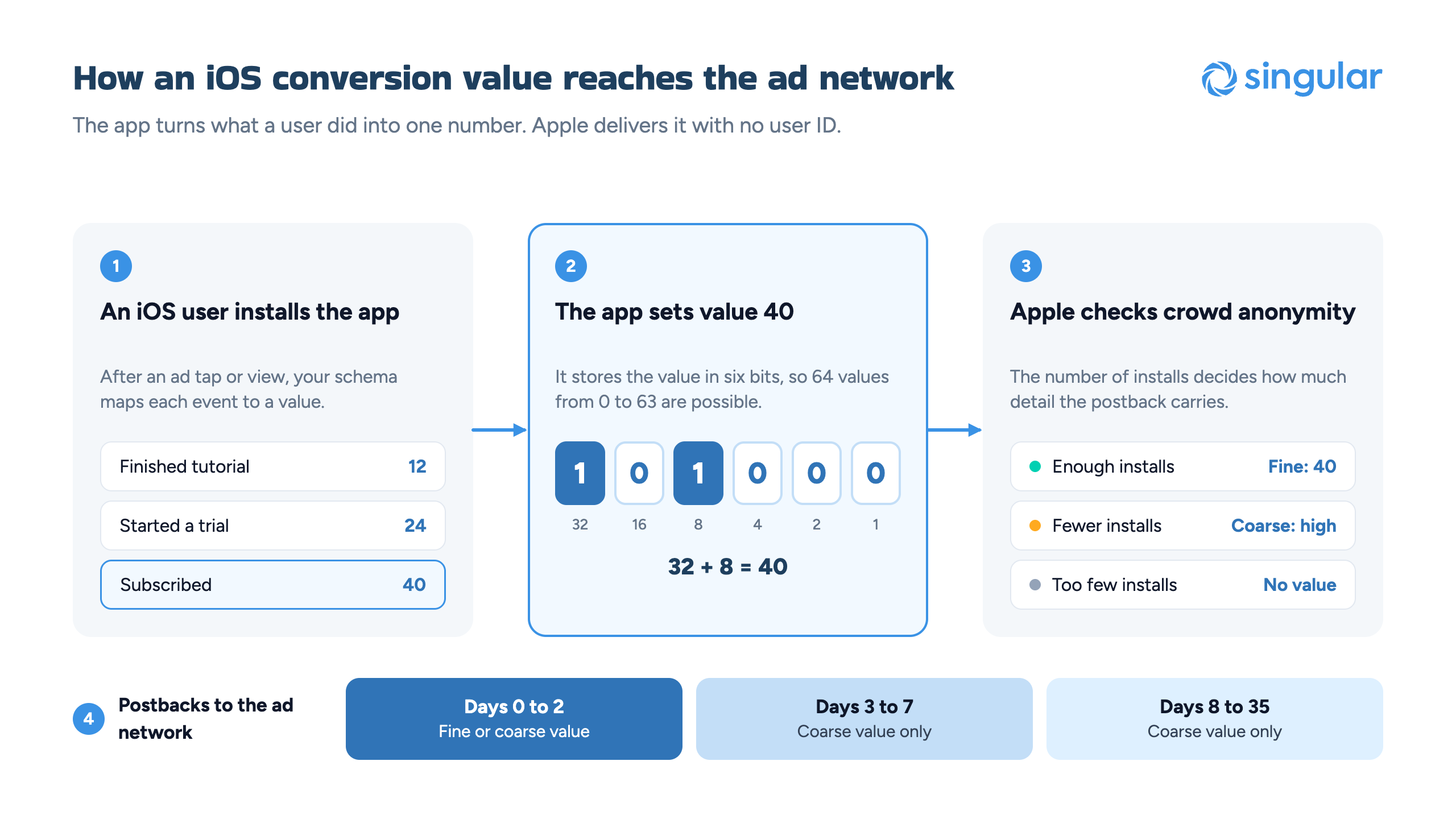
A conversion value is a number an iOS app sets after an install to describe what the user did next, such as finishing a tutorial or making a purchase. Apple’s SKAdNetwork and AdAttributionKit send it to the ad network in a postback that carries nothing identifying the user. Marketers decide what each number means, so value 12 might mean a completed tutorial and value 40 a subscription.
Want to get more out of your iOS conversion values?
See how Singular manages them for you.
Is this the same as conversion value in an ad platform?
No, and the two are easy to mix up. In Google Ads and Meta Ads, conversion value means the monetary worth of a conversion, such as a $49 purchase, and it powers value-based bidding like target ROAS. In iOS app measurement, it means an encoded behavior signal, which may represent revenue or a funnel or retention milestone.
Why does the conversion value schema matter so much?
Bids, budgets, and creative can all change while a campaign runs. The conversion value schema can’t be applied retroactively. Once a user installs and the measurement window closes, whatever the schema captured is the only record of what that cohort did. It’s also the signal ad networks optimize toward on iOS.
That makes schema design one of the most consequential choices in iOS measurement. An app that maps all 64 values to install-day events learns nothing about day 7 revenue. An app that maps them only to revenue buckets loses sight of which events predict retention. A schema set once at integration and left untouched limits how well iOS campaigns can be optimized.
What is the difference between fine and coarse conversion values?
A fine conversion value is a six-bit integer from 0 to 63. A coarse conversion value is low, medium, or high. Apple decides which one a postback carries based on crowd anonymity, its measure of whether enough installs exist to report a value without exposing an individual.
Apple calls this layered approach hierarchical conversion values. Under SKAdNetwork 4, each install can produce up to three postbacks, one per measurement window:
| Postback | Measurement window | What it can carry | Sent after the window closes |
| First | Days 0 to 2 | A fine value, a coarse value, or no value, depending on crowd anonymity | 24 to 48 hours |
| Second | Days 3 to 7 | A coarse value only | 24 to 144 hours |
| Third | Days 8 to 35 | A coarse value only | 24 to 144 hours |
Apps can also apply a lockWindow to close a window early and receive its postback sooner. The second and third postbacks extend measurement to 35 days after install, which matters for subscription, finance, and gaming apps where the decisive behavior happens well after install day.
In practice, smaller campaigns and smaller geos rarely see fine values. A schema designed only around the 64 fine states will return mostly coarse data for those campaigns, so the coarse mapping deserves the same care.
Does AdAttributionKit change how conversion values work?
Not at the core. AdAttributionKit builds on SKAdNetwork and keeps the same model: fine and coarse values, crowd anonymity tiers, and three measurement windows. Apple’s SKAdNetwork documentation now directs new campaigns to AdAttributionKit, but SKAdNetwork still works, and the two frameworks interoperate, so a single schema can serve both.
What AdAttributionKit adds is reach beyond the first install. From iOS 18 it can attribute re-engagement, when an ad click brings a user back into an app they already have, and those re-engagement conversions get their own conversion values. Apple’s WWDC25 updates added conversion tags for overlapping re-engagements, configurable attribution rules, and country codes in postbacks.
How do marketers design a conversion value schema?
There’s no universal schema, but useful ones share an approach. Start from the business outcome you want campaigns optimized toward, usually revenue or a strong retention proxy. Then work backward to the smallest set of events that predicts it within the first measurement window.
Revenue buckets work well for apps with early monetization, such as in-app purchases in the first days, since they let bidding optimize toward value rather than install volume. Event sequences suit apps where the decisive signal is behavioral, such as a completed onboarding followed by a second session. Mixed models split the values between revenue tiers and either funnel steps or conversion events. For SKAdNetwork 4, Singular offers two mixed models: Funnel and Revenue, and Events and Revenue.
Whichever shape you choose, map the coarse values deliberately for each window instead of treating them as a fallback, because for many campaigns they’ll be the only signal that arrives.
How does Singular support conversion values?
Singular, the marketing growth platform, manages conversion values from a model you configure in its dashboard, so changing the schema doesn’t require an app update. For model types and setup, see Understanding Singular’s Conversion Value Management and the SKAN 4.0 FAQ in the Singular Help Center. For modeled revenue and ROI when privacy thresholds hold values back, see the SKAN Advanced Analytics FAQ.