
Stay up to date on the latest happenings in digital marketing
Summary
-
Prioritize Early User Acquisition: Marketing professionals should initiate user acquisition (UA) campaigns without waiting for a "perfect" product. Focus on launching while monitoring retention and monetization metrics, as early user engagement can lead to substantial growth, as demonstrated by Tilting Point's scalability of Match 3D from $500K to $11M in monthly ad spend.
-
Embrace Diverse Monetization Strategies: With evolving revenue models in mobile gaming, marketers should explore hybrid monetization approaches, including subscriptions, season passes, and real-money rewards. This diversification can enhance revenue streams and provide competitive advantages by allowing for higher bids in UA.
-
Leverage Expert Insights for Growth: Collaborating with experienced professionals in the industry can help identify effective channels and strategies tailored to specific game genres. Utilizing external expertise can prevent costly mistakes and optimize campaign performance, making data-informed decisions vital for long-term success.
Tilting Point just raised a new $150 million fund for user acquisition. They’re the money behind SpongeBob, Star Trek, Warhammer, and Zombieland games. And they scaled monthly ad spend on Match 3D from $500K to $11M (!!!) helping them explode revenue 30X. In other words, these guys know what they’re talking about … and they might just have some UA lessons for the rest of us.
(Plus, who knows, they might even have some cash to help scale your game or app.)
I recently chatted with Asi Burak, Tilting Point’s Chief Business Officer, about the fund. But we also talked about improving monetization and retention in games, how to kickstart growth, how to scale growth, his best advice for indie developers, and the future of game monetization.
(Hint: it’s gonna get more diverse.)
And yes, we chatted about the new user acquisition fund.
Hit play and keep scrolling:
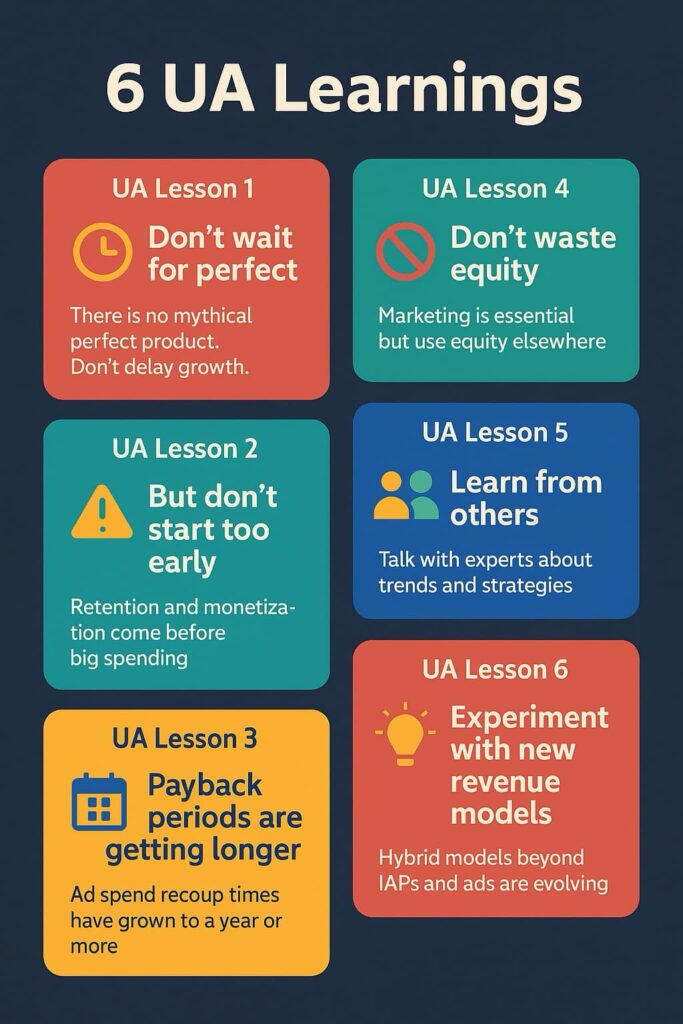
UA lesson 1: don’t wait for perfect
Sure, growth starts with a good product. But Burak can’t count how many developers he’s seen that want to kick off UA spend after the next version, or the next big feature, or the newest mechanic …
UA lesson 1: start.
“If you can put money and bring users and bring players and quality players, do it,” Burak says. “Don’t wait for permission … don’t wait for the next version that’s going to be so much better. If you can scale, scale.”
There is no mythical perfect product. Don’t delay growth. If your metrics show retention and monetization are strong, lean in.
That said, scaling requires discipline.
And a few doctor’s visits.
“I always tell developers … check the data, check the data, check the data. Test, test, test. Find the model and go get the doctor’s opinion … when they come to us, we’ll give them a very objective look.”
In other words, talk to smart people who have been there and done that. They’re the doctors who can diagnose growth problems or limiting factors.
UA lesson 2: but don’t start too early
Growth is pretty scientific these days, sure, but it’s also an art. And part of the art is in knowing when the hit the gas.
UA lesson 2 is all about remembering to focus on retention and monetization before kicking off big UA spending.
One of Tilting Point’s best-known success stories is Match 3D, which scaled from $500,000/month in UA spend to $11 million/month and achieved astonishing 30X revenue growth.
The reason? Exceptional retention and a unique genre.
“You saw a game that was super, super engaging, super sticky,” Burak says. “Day 90 retention was 5% … so we knew that we could start putting the gas on the pedal.”
If your product doesn’t retain well or monetize effectively, pouring money into UA just accelerates churn.
(Oh, and burns cash.)
UA lesson 3: payback periods are getting longer
Everyone wants the marketing spend back ASAP, but today you need to have a little more patience.
A few years ago, many mobile games recouped their ad spend in 30 to 90 days. UA lesson 3 is that now, payback often takes a year or more. And that’s a long time.
“Unfortunately … what happened to UA post‑ATT and some other things in the market … it became tougher,” Burak says. “We see objectively that paybacks extended … one year and a half, two years … and it’s not that they want to go beyond one year. They don’t have a choice.”
This means studios need a bigger financial cushion or external funding — like Tilting Point’s — to scale safely. Unless you have unlimited cash on hand.
UA lesson 4: don’t waste equity
Especially with payback periods getting longer, it’s tempting to sell equity for venture financing to fund user acquisition and growth.
Think twice.
UA spend is critical, but it’s not the best use of scarce equity or VC funding, says Burak.
“I want you to take your VC money … and help you to invest that money in your product, in the growth of your team, in your IP,” he says. “And take my money for the low‑quality investment [of funding user acquisition] … because it’s money that you recycle all the time.”
Marketing is essential, but it’s an ongoing cost. Investing equity into core product and long-term value drivers is smarter.
UA lesson 5: learn from others
UA lesson 5 might seem obvious, but we’ve all seen founders flush with cash burn it on things that didn’t matter.
Talk to people who are experts. Who have scaled mobile companies. Who know how to grow.
Tilting Point doesn’t just provide funding. They bring experience managing campaigns for over 80 games, which gives them a wide-angle view of UA and monetization trends:
“Because we work on so many … we can say, you know, for your genre, that channel might be something you should look at,” Burak says. “Or rewarded platforms have strong short‑term performance but long‑term retention challenges.”
That cross-genre expertise can identify new channels or strategies you wouldn’t see if you only focus on one title.
UA lesson 6: experiment with new revenue models
Most games are doing hybrid monetization now:
- IAPs
- Subscriptions
- Ads
That’s not all there is, or at least not all there will be, says Tilting Point. Mobile gaming revenue is evolving beyond in-app purchases (IAPs) and ads. Burak sees growth in hybrid models, season passes, real-money rewards, and even light Web3 or e-commerce integrations.
(Could web3 be back? Maybe only in very specific use cases: check the whole chat for more.)
“I think we’ll see more diversity in revenue sources … subscription, the season pass … even hybrid things like earned cash elements inside a regular game,” he says. “You add a layer of revenue that nobody else has.”
For marketers and product teams, that means more ways to monetize, and more data points to optimize campaigns. Importantly, it means more revenue than your competitors, which means more money for UA, and the ability to bid higher for premium revenue.
All of those are massive competitive advantages.
Oh and … yeah … that $150 million funding round
We didn’t just talk about UA lessons. We also talked money, because one of Tilting Point’s biggest differentiators is non‑dilutive funding. That means developers get growth capital without giving up ownership of their company.
“Developers were shocked, you know, they’re like, wait, wait, wait. So I’m not giving my equity for this? You’re not going to take my company away or something?” Burak says. “We want to give them an offer, a proposal, a model that doesn’t risk it at all. And in fact, in many cases we don’t even touch the corporate level … we collect revenue directly. Then we don’t even need to do any security agreement on the corporate level. So it’s not even getting to be a loan.”
Instead, Tilting Point’s funding focuses on user acquisition and performance marketing: investing millions of dollars a month into acquiring new players for promising games.
That’s worth checking out, and it’s the focus of this $150 million funding round.
Best-case scenario
It’s super rare, but the best case scenario for a new game or app is that you a) invent a new genre, and b) it turns out to be a massive hit.
(Yeah, crazy hard and unlikely on both counts, but we can dream, right?)
That’s the case with Match 3D:
“You see a guy that invented a genre … he did it with five guys in a room,” Burak says. “He later sold it for $200 million because his EBITDA was so crazy just for the fact he had such a lean team and made it so quickly.”
If you’re super-successful like that, Tilting Point doesn’t put a hard cap on the funding. (Especially because the payback period for this particular game was really fast.)
Much more in the full podcast!
You know you need to listen to or watch the podcast to get all the most juicy learnings, right?
Find your favorite podcast platforms here, or just subscribe to our YouTube page.
You’ll be happy you did.
Here’s what you’ll get in this podcast:
- 00:00 Introduction to Growth Mastermind’s Podcast
- 02:12 The Evolution of Tilting Point
- 05:05 Funding and Investment Strategies
- 08:12 The Importance of Data and Expertise
- 10:14 Challenges and Adaptations in UA
- 12:22 Collaborating with Developers for Success
- 16:18 Investor Expectations and Negotiations
- 16:50 Non-Dilutive Funding Model
- 18:21 Advice for Indie Developers
- 19:25 Persistence and Success Stories
- 21:45 Investment Strategies and Game Potential
- 24:13 Future of Gaming Industry
- 28:31 Cross-Platform and B2C Trends
- 30:16 Conclusion and Final Thoughts