
Content
- What’s in this post
- Challenge 1: Last-click attribution is giving credit to the wrong channels
- What multi-touch attribution actually measures
- Challenge 2: SKAdNetwork is technically complex and easy to get wrong
- Challenge 3: Ad fraud is more sophisticated than most detection can handle
- How Singular solves each of these challenges
- How the 3 solutions connect
- Mobile attribution accuracy is the foundation everything else is built on
- Frequently Asked Questions
Stay up to date on the latest happenings in digital marketing
Summary
-
Adopt Multi-Touch Attribution (MTA): Transition from last-click attribution to MTA to accurately assess the contribution of various channels in the customer journey, as Singular's data indicates that MTA can significantly enhance ROAS—up to 50% higher for Meta campaigns and 20% higher for Snapchat.
-
Invest in SKAdNetwork Infrastructure: Properly configure SKAdNetwork for iOS measurement to avoid misrepresenting campaign profitability. With iOS users showing higher conversion rates and LTV, neglecting SKAN setup could lead to significant revenue loss by not accurately capturing high-ROI iOS campaigns.
-
Implement Pre-Attribution Fraud Prevention: Use advanced fraud detection methods that operate before attribution occurs to protect your data integrity and budget. This strategy helps avoid budget misallocation due to fraudulent installs, as evidenced by companies saving significant marketing costs by preventing fraud before it impacts reporting.
Most mobile attribution problems don’t announce themselves.
They show up quietly: a channel that looks profitable but isn’t. An install counted twice. A campaign decision made on data that’s incomplete because iOS stopped sharing what it used to after Apple’s App Tracking Transparency (ATT) went into effect. By the time you notice something’s off, you’ve already reallocated budget based on the wrong signal.
That’s the real cost of bad mobile attribution. Not a line item. A compounding tax on every growth decision you make.
This post covers the 3 biggest challenges in mobile attribution today, and what it actually takes to solve them.
What’s in this post
- Why last-click attribution is still causing real budget damage
- What SKAdNetwork actually demands from your measurement setup
- Why ad fraud is harder to catch than most teams think
- How Singular addresses each of these at the infrastructure level
Challenge 1: Last-click attribution is giving credit to the wrong channels
Last-click attribution made sense once. One channel, one device, one conversion. Clean.
That world doesn’t exist anymore.
Today, a user might see a video ad on Snapchat, click a search ad two days later, and install after a TikTok retargeting placement. Last-click gives 100% of the credit to the final touchpoint. Every channel that drove discovery or consideration along the way? Zero credit.
The result: you scale the wrong channels and cut the ones doing the actual work.
Singular’s data science team has run large-scale multi-touch attribution analyses across 3 of the most widely used channels in mobile UA: Meta, Snapchat, and TikTok. The pattern is consistent across all 3. Meta campaigns showed up to 50% higher ROAS under MTA compared to last-touch. Snapchat showed 20% higher ROAS with a 51% assist rate, meaning it influenced more than half of all installs without ever getting last-touch credit. And for Afterverse on TikTok, MTA revealed a true ROI that was 2x what last-touch reported.
These aren’t edge cases. They’re what happens systemically when a single-touch model is applied to a multi-touch reality.
What multi-touch attribution actually measures
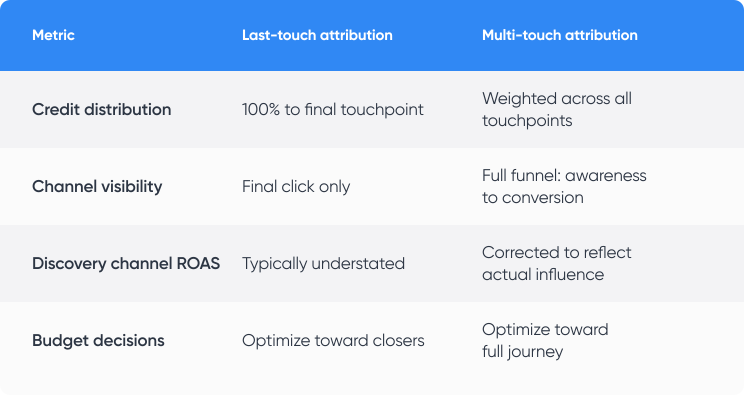
Multi-touch attribution distributes credit across all touchpoints in a conversion path, weighted by each one’s actual contribution. Instead of asking “who closed the deal?“, MTA asks “who made this possible?“
View-through attribution captures one more layer: the ad a user saw but didn’t click, that still influenced the eventual install. For video-heavy and upper-funnel channels, this is where a significant portion of real value disappears from last-touch reports entirely.
The table below shows what changes when you move from last-touch to multi-touch:
Challenge 2: SKAdNetwork is technically complex and easy to get wrong
When Apple introduced App Tracking Transparency in 2021, mobile measurement changed permanently. Users who decline tracking permission are measured through SKAdNetwork: Apple’s privacy-preserving attribution framework. On iOS, that covers the majority of users.
SKAdNetwork works very differently from traditional mobile attribution. The key concepts to understand:
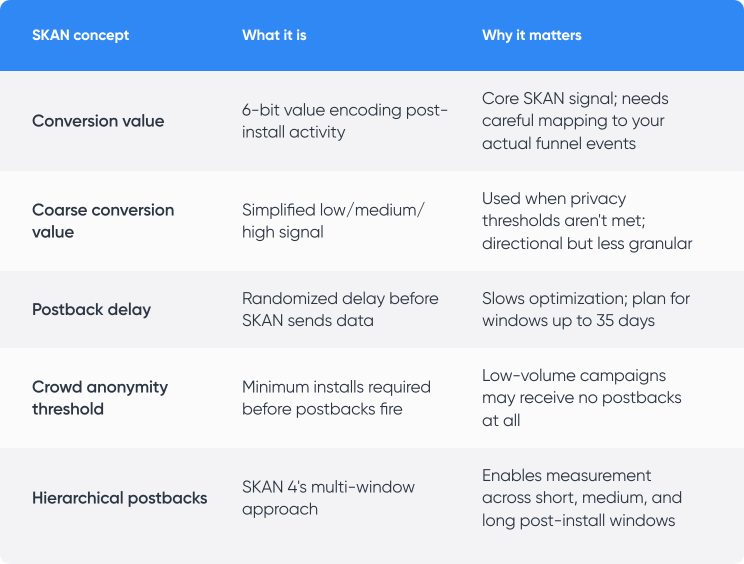
Most teams underestimate the configuration work SKAN requires. Conversion values need to be mapped thoughtfully to your actual funnel, and SKAN data needs to be stitched back to your broader reporting so iOS doesn’t sit in a measurement silo.
Here’s why getting this right has never mattered more: according to Singular’s ROI Index 2026, iOS is outperforming Android on ROI across multiple verticals. iOS users convert at higher rates and generate higher LTV. Teams that haven’t invested in proper SKAN infrastructure are leaving their highest-ROI channel half-measured.
Without proper SKAN infrastructure, iOS campaigns look unprofitable even when they’re not. In 2026, that’s the most expensive blind spot a mobile marketer can have.
Challenge 3: Ad fraud is more sophisticated than most detection can handle
Mobile ad fraud isn’t unsophisticated click farms anymore. Modern fraud includes:
- SDK spoofing: Malicious actors simulate real installs at scale with attribution signals that look legitimate, without a real device ever downloading your app
- Click flooding: Thousands of fraudulent clicks injected ahead of real installs, designed to steal attribution credit from legitimate channels
- Device farms: Real physical devices running scripts to generate fake engagement and installs at scale
- Incent fraud: Real users who install and complete the minimum actions to trigger a payout, with zero intent to use the app
The damage goes beyond wasted spend. When fraudulent installs enter your attribution, you’re making real budget decisions on channel mix, bids, and creative pivots based on signals that don’t represent actual user behavior.
Most teams don’t know how much fraud they’re absorbing because they’re looking at post-attribution data, not pre-attribution rejection. Post-attribution analysis tells you something went wrong after the fact. Pre-attribution fraud prevention stops bad installs before they enter your reporting at all.
How Singular solves each of these challenges
Multi-touch attribution: seeing the full channel picture
Singular’s mobile attribution supports last-touch, first-touch, linear, and multi-touch models out of the box. Teams can run them in parallel, so you’re never locked into a single perspective on performance.
Cross-device attribution connects the full user journey across mobile, web, CTV, PC, and console. View-through attribution is supported across channels including Meta AEM, giving visibility into impression-driven conversions that click-based models miss entirely.
The ROI Index 2026 introduced the first-ever MTA leaderboards, based on trillions of impressions and billions of installs, making Singular the only marketing measurement platform publishing MTA-based channel rankings at this scale.
“Singular’s real-time insights allowed us to acquire and retain a diverse range of high-value users, resulting in impressive results for both ROAS and retention.”
— Osku Makkyla, VP of Performance Marketing
SKAdNetwork: 35-day cohorts and modeled metrics
Apple chose Singular as an attribution vendor for SKAdNetwork. Singular supports 35-day SKAN cohort windows for measuring high-value post-install events – a significant advantage when competitors cap at 7 days. Modeled metrics fill gaps where SKAN data is coarse or missing, so iOS performance can be evaluated alongside Android in a unified view. Smart Conversion Models reduce the technical barrier to getting SKAN configured correctly from the start.
A Thinking Ape, a mobile gaming studio, switched to Singular specifically for SKAN. The results: 24 hours faster SKAN data, 3-5 hours of work saved per week, and 3 apps migrated successfully. In their words:
“It’s easier to read the data, and easier to understand the SKAN signals than it was with our previous provider.”
— Edouard Favier, Director of Growth, A Thinking Ape
Fraud prevention: stop it before it enters your data
Singular’s Fraud Prevention Suite uses 27 detection methods out of the box, operating pre-attribution. Fraudulent installs are rejected before they touch your reporting. Custom fraud rules let teams configure detection to their specific risk profile, and three detailed reports – rejected, suspicious, and protected – give full transparency into what was caught and why.
Beat, a mobility app, used Singular’s fraud prevention to protect their campaigns from organic poaching, SDK spoofing, and other sophisticated schemes.
“To date we have saved more than €50K in marketing costs since 2019 by not relying on misreporting when optimizing our campaigns and thereby, not paying for fraud in the first place.”
— Vitaly, Beat
“Singular is our one-stop shop for harnessing our growing amount of data, extracted as accurately and quickly as possible with the granularity needed to significantly scale.”
— Nimrod Klinger, VP of User Acquisition
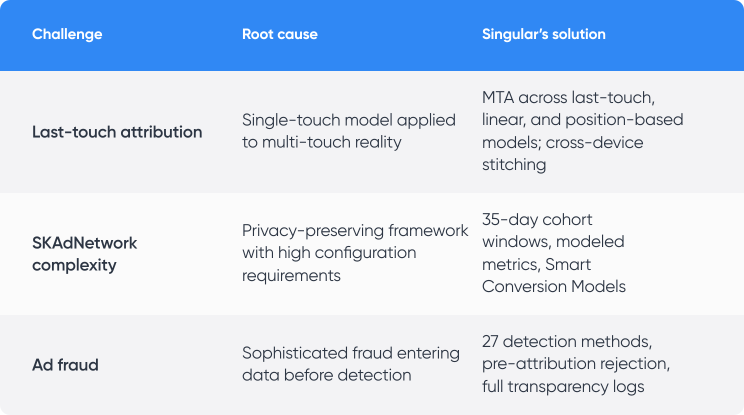
How the 3 solutions connect
Mobile attribution accuracy is the foundation everything else is built on
The teams that scale efficiently aren’t always the ones with the biggest budgets. They’re the ones making better decisions faster, because their mobile attribution data is cleaner, their models account for the full user journey, and their fraud exposure is contained before it corrupts reporting.
Every optimization decision – channel mix, creative testing, bid strategy, LTV modeling – is only as good as the attribution data underneath it.
Book a demo with our team and discover what makes Singular the top rated MMP on G2.
Frequently Asked Questions
What is mobile attribution?
Mobile attribution is the process of identifying which marketing channels, campaigns, and touchpoints drove a specific user action – an install, a purchase, a registration – inside a mobile app. It’s how marketers know which ad spend is working and which isn’t.
What is multi-touch attribution in mobile marketing?
Multi-touch attribution distributes conversion credit across all the ad touchpoints a user interacted with before converting, rather than giving all credit to the last click. It produces a more accurate picture of which channels are actually driving growth.
What is SKAdNetwork and why does it matter?
SKAdNetwork is Apple’s privacy-preserving attribution framework for iOS. Since App Tracking Transparency removed device-level tracking for users who opt out, SKAN has become the primary measurement mechanism for iOS campaigns. Getting it right requires careful conversion value configuration, modeling, and a measurement partner with deep SKAN integration.
What is the difference between last-touch and multi-touch attribution?
Last-touch attribution gives 100% of the conversion credit to the final touchpoint before an install. Multi-touch attribution distributes credit across all touchpoints in the journey, weighted by each one’s actual contribution. Singular’s research shows MTA consistently reveals higher ROAS for upper-funnel and discovery channels that last-touch models undervalue.
How does ad fraud affect mobile attribution?
Fraudulent installs pollute your attribution data, making low-quality or fake traffic appear to perform well. This causes budget misallocation toward fraud sources and away from legitimate channels. Pre-attribution fraud prevention catches and rejects these installs before they enter your reporting.


Amey Kulkarni

Amey is a marketing practitioner with hands-on experience across the martech space, and Senior Marketing Manager at Singular. He writes about AI, analytics, and growth - with a focus on what's actually changing for practitioners, not just what's trending