Data-driven creative: 13 sometimes contradictory secrets from Supercell, Earnin, & Vungle

How do you do data-driven creative optimization for digital advertising campaigns? Should you do data-driven creative optimization? Should you localize creative? And, should you always follow the data?

It’s not always obvious.

And, just to make it more confusing, top experts at leading mobile brands don’t always agree.

While there are commonalities between how leading mobile experts approach these questions, there’s also considerable diversity. That diversity is often tied to companies’ different strategy and tactics. It’s also a function of short versus long-term goals. It depends on how digital marketers do data-driven marketing in general.

And, this diversity suggests that there is not one true answer for your company and your brand either … but that you’re going to have to make an informed decision for yourself on how to proceed with data-driven creative optimization.
unify-panel-data-driven-creative

So while top mobile experts don’t always agree, what they say and how they disagree can help you formulate a customized data-driven creative strategy that works for your brand.

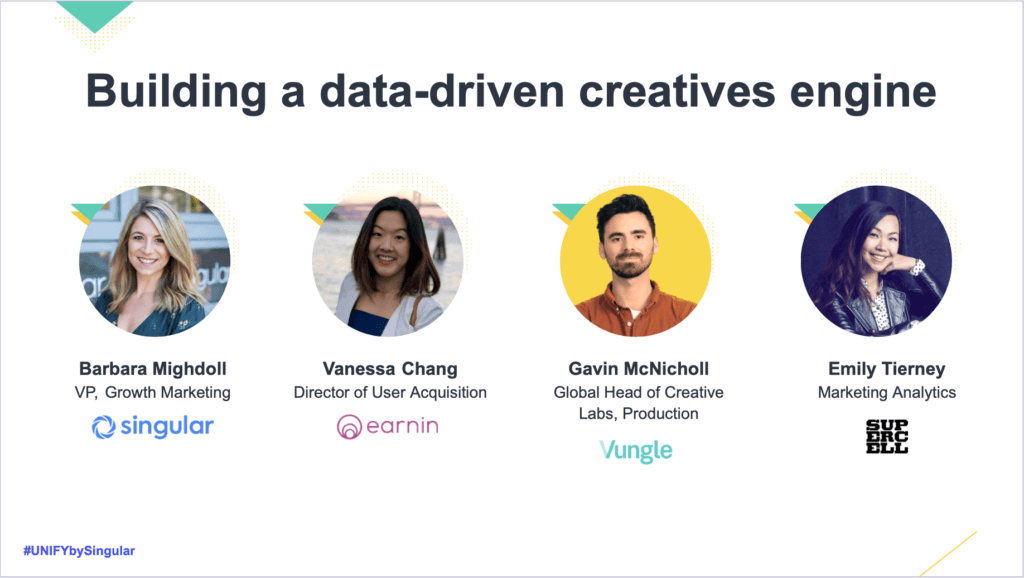
Here are the top 10 secrets we learned from marketing strategy experts at Supercell, Earnin, and Vungle at Singular’s big UNIFY mobile marketing conference.

(You can also watch the full presentation here … and get all of the UNIFY sessions in our free UNIFY @ Home mobile marketing masterclass.)

1. Testing matters (a lot) for data-driven creative

It’s probably not a shock to most people that testing matters when you’re trying to do creative optimization.

“Test everything,” says Earnin’s Director of User Acquisition Vanessa Chang. “Not just your in-house creative but your buttons, your copy, everything that can help impact your creative.”
Why do people test? It’s simple, says Supercell’s Emily Tierney:

“The best creative yields the best performance metrics.”

This is especially important when you scale data-driven marketing. (It’s also harder … which is why Singular’s Creative Analytics tool comes in handy for high-volume digital marketers.)

“When you scale and have a ton of volume, it gets more important to iterate quickly and you need to evaluate your results quickly as well,” Chang says. “What Singular has really allowed us to do is it answered questions we weren’t able to answer without the platform.”

2. Creative exhaustion is over-rated (sometimes)

Creative exhaustion is almost an item of faith for modern digital marketers. But sometimes it’s over-rated, as Singular CEO Gadi Eliashiv discovered in a data-driven creative exhaustion study he recently published.

For Supercell, there are higher priorities than optimizing for creative exhaustion or even individual ad performance.

“Optimizing for brand [is] very important for us,” Tierney says. “It’s more important to elevate our company so that people recognize Supercell as a global brand, so that when we create new IP, people immediately associate that it will be high-quality games with high-quality animations.”
brawl-stars-supercell

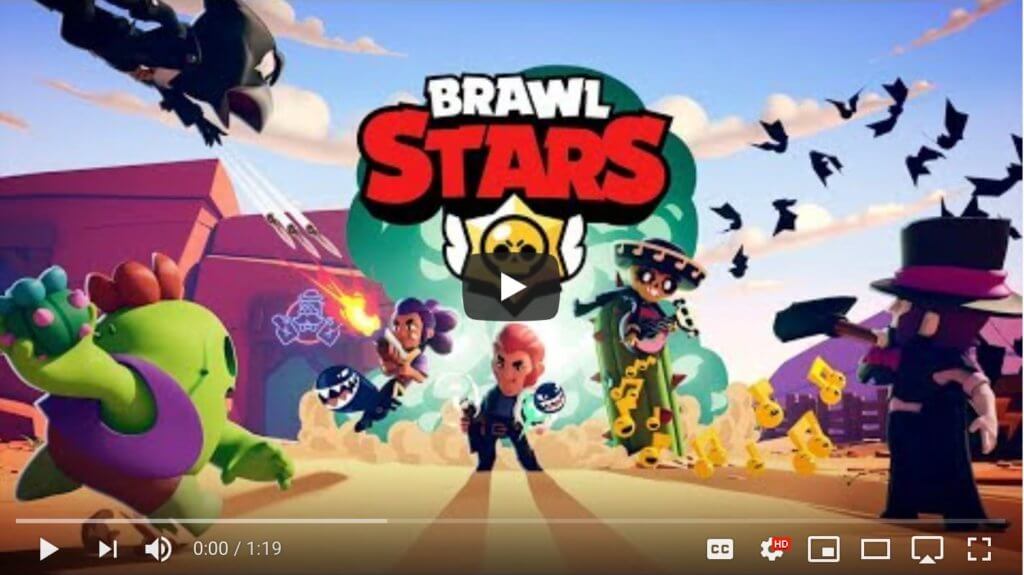
As a result, Supercell invested nine months in building one piece of creative … a 60-second long cinematic that is essentially a fully animated world-class 3D movie.

The result, “No Time To Explain,” brought in the lion’s share of new users for Brawl Stars with very low CPI, Tierney says. It had both long view time on both Facebook and Google and active engagement, and is still being used for user acquisition more than six months after launch.

Consumer behavior, clearly, does not always require new creative assets and new creative strategies.

3. And yet … creative exhaustion exists

On the other hand, marketers know that for many brands and campaigns, creative exhaustion is a very real thing. Digital marketing assets don’t last forever. Advertising ages.

“Ad fatigue is real,” says Vungle’s Global Head of Creative Labs Gavin McNicholl.”Our clients want to do testing … it’s expected in the space now.”

That’s something that Earnin sees as well, particularly when scaling spend. And it forces EarnIn to scale creative production as well.

Does this creative exhaust you?

“The more we were spending money, especially in the same channels, the more we needed to keep up the rotation and keep feeding the channels to find new winners,” Chang says. “We needed more message types, more actors.”

Even Supercell, which Tierney calls “lucky” for having some evergreen creative that she can run for a long time, sees decay.

“They do decay over time,” she said about her creative. “It’s not like we can run it for six years.”

The goal, according to Vungle is to keep looking for new evergreen creative while running iterations. The company’s algorithm, therefore, allocates a certain percentage of impressions for new units to try to find that new evergreen material.

4. Data-driven creative: Localization is not ALWAYS required

Localization is religion to marketers burned by stories of brands releasing culturally inappropriate messaging or products in different cultures. Often that even extends to different ad creatives and marketing campaigns by audience segment.

Supercell pays attention to culture, but it doesn’t focus on building geo-focused campaigns or creative.

Instead, Supercell goes for the universal in its creative process:

“We really believe in one true global creative,” says Tierney. “When we launch any new games, we really try to generate creative that resonates with all our communities and all regions, and it’s quite challenging. As you know, western creative sometimes doesn’t translate well to the east. Our games are games that people will play forever, and our creative is creative that people will remember forever.”

That may not work for every brand or every app. Advertising in general should focus on being relevant to its audience.

But Supercell is clearly doing something right … on a global scale.

5. BUT … localization is OFTEN required

As GM and its creative agencies found out when naming a car “Nova,” or “no go” in Spanish, not every name works in every culture. Similarly, not every image works for every culture.

When Vungle was working to localize Sherlock Holmes, the British actor Benedict Cumberbatch and the American actor Robert Downey Jr made perfect sense, although it’s possible they could have found one star to cover both countries.

But Japan … Japan was another story.

Suffice it to say: the creative process was entirely different.

sherlock-holmes-different-cultures

Now that’s localization with an added dose of gender-switching.

But you can go farther and do hyper-localization based on seasonal events, Vungle’s McNichol added.

“Chinese New Year is a very significant revenue period for us, so we’ve looked to scale out specific kinds of end cards that incorporate cultural elements,” he said. “So for Chinese New Year you have the red envelope — obviously, the connotations around that [are that] good things are coming your way. It was no surprise that clickthrough rates went through the roof there.”

6. Data-driven creative: Shockingly, data is incredibly important

It shouldn’t be surprising: data matters.

That’s not just the case on upper funnel. Lower funnel is probably even more important.

“When you scale and have a ton of volume, it gets more important to iterate quickly and you need to evaluate your results quickly as well,” says Earnin’s Chang. “What Singular has really allowed us to do is it answered questions we weren’t able to answer without the platform.”

By leveraging community as well as in-house creatives, Earnin was able to build 5X more creative concepts. Now, 50% of their ad impressions originate from community-sourced ads. And that’s resulted in a 25% funnel step improvement. Data drives actionable insights which can be fed into future creative thinking and marketing efforts.

Ultimately, Vungle looks at three kinds of data, says McNichol: performance, contextual, and user data:
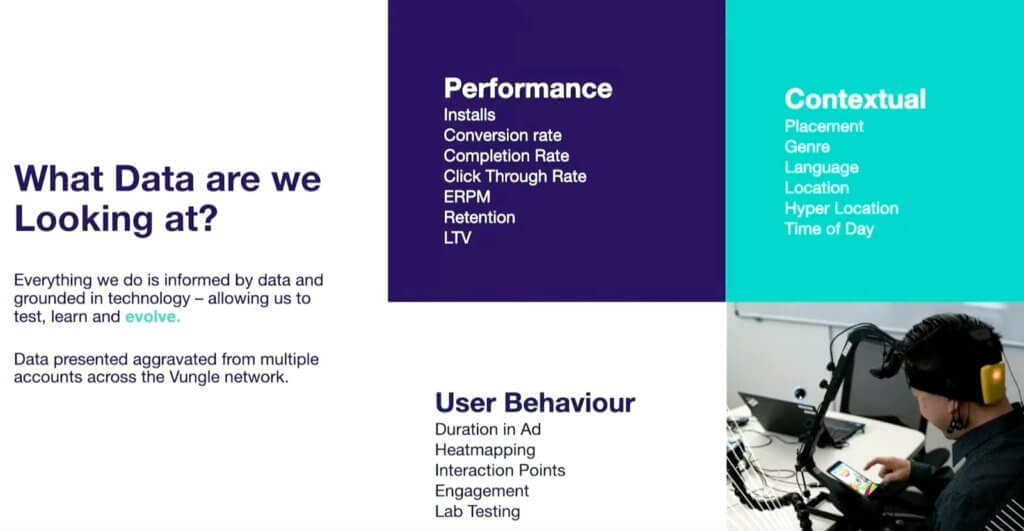
How Vungle analyzes data-driven creative performance

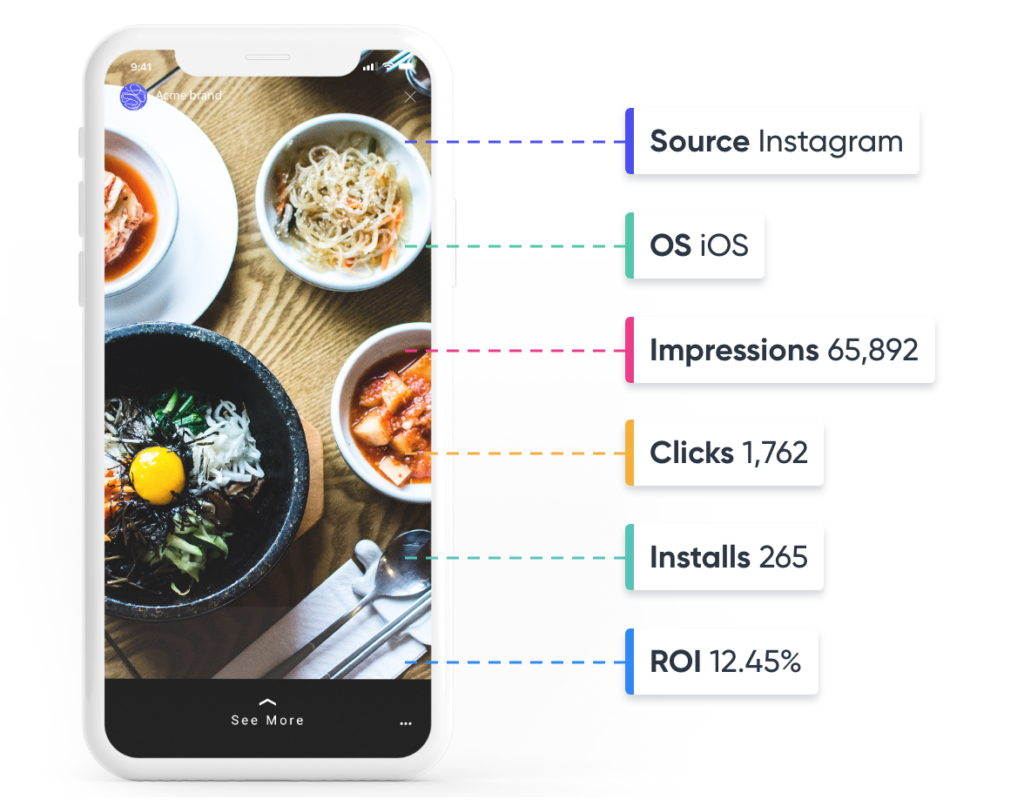
Performance data includes installs, conversions, and retention. Contextual data includes geographical location, time, and placement. User behavior is engagement, duration, and interaction points, as measured by heat mapping and lab testing.

Also important: target audience and some understanding of the customer journey.

7. But being purely data-driven could be the wrong approach

It’s not controversial to be data driven, and to be evaluating results for your data-driven creative. It would be controversial, on the other hand, if a digital marketer said that they’re not data driven.

Supercell has an interesting nuance on this.

“This is a philosophy we use a lot in Supercell: to become a data-informed marketing team instead of data-driven,” says Tierney. “It actually means optimizing for the brand, for the IP, for the company.”

That’s worth unpacking.

Supercell cares about data and performance of their ads and campaigns, but not the overall brand matters more than any given ad. And it matters more than individual campaign performance..

That’s why the first second of  every Supercell video is alway the Supercell logo. Supercell knows that the first five seconds of every video is the most important, and that they’re sacrificing 20% of that attention-grabbing time.

But they’re betting that positive long-term association with the Supercell brand outweighs individual ad performance. That’s data-informed — and you could argue data-driven on the macro level.

8. Your mobile ads CAN work on TV

You have to build creative assets uniquely for each platform or medium, right? Such as social media ads versus search ads, and mobile ads versus traditional TV ads?

Well … not necessarily, according to data-driven marketing experts. At least in the case of repurposing mobile ads to traditional and streaming TV platforms.

“As we scaled in streaming TV and linear TV, a lot of people were telling us that we should use very branded versions of creatives that were more for TV,” Earnin’s Chang says. “And I would challenge that because I think we have seen a lot of success in using our community-generated ads across many different platforms. It’s not necessarily about the format or the placement, I think it’s really about assessing how you want your message to go in all your different channels.”

That means that you actually can use a “low-quality” portrait creative on TV, she added. You just have to be aware of delivering that in a way that makes sense to the audience.

That’s a role reversal, Vungle’s McNichol says.

When Vungle first started building ads for mobile, they’d get a lot of executive asking them to run TV ads on mobile ad networks … something that doesn’t really work. (Especially back then.)

“What’s very interesting is the idea of the visual language of mobile and web finding its way onto TV,” says McNichol.

9. Your customers can make your ads

We’re not in the dawn of user-generated content any more. But there still aren’t many CMOs who are jumping up and down agitating for their customers to make their ads.

It make a ton of sense, however, if you don’t have enough time to produce a wide enough variety of creative. Just maybe, your community can help.

earnin-data-driven-creative-community

“We focus a lot of our efforts on using creative generated by our community,” says Chang. “This is really at the core of what we believe is one of our biggest differentiators as a financial tech brand … we have a real community supporting us.”

10. UA and creative need to be In Sync

User acquisition and the creative team need to be completely in sync … and co-location helps.

“We’re very aligned with our creative team,” says Chang. “First, we sit next to them so that makes it easy to share insights. And second, we actually have a weekly creative performance review where we share insights.”

Easy access to the same numbers doesn’t hurt either.

All creative producers at Earnin are well versed in the company’s dashboards — and Singular data — so they can check whenever they want on what’s performing well, what has high click-through rate, conversion rate, and so on.

11. Data-driven creative: Make playables MORE interactive

Playables are the highest-performing creative on the Vungle Ad Network, McNichol said. But by analyzing three million views of one particular playable ad, they learned how to make them better.

One hint: add more interactive elements.

“Always give the user something to interact with,” McNichol says. “They’re engaged … they want to get involved.”

Interaction heat maps show that users are tapping and swiping all over playable ads, including in places where there are no interaction points. Providing more interactive elements is important for engagement: when users are starting to engage, they stay in the experience.

And once they’re engaged, there’s a lot less “X’ing out” of the playable.

12. RPG game? Put characters in the ad

Many games, including RPG games, are character-driven. While it might seem important to demonstrate game-play in your video ads, Vungle has found that focusing on characters is critical.

Why?

People connect with characters, and connection drives engagement.

kings-game-mobile-characters

The result for for one Korean client’s mobile RPG game, King’s Raid, was 5X return on ad spend by day seven.

13. Playables aren’t just for gaming brands

Playables are just for games, right?

The short answer is no.

“We actually started introducing playable to some of our brand clients, including TikTok,” McNichol says. “We actually produced this playable unit where you kind of gamify it.”

Essentially, Vungle made a tapping game: as a cool video plays, you tap on it to make social-media-style love hearts pop up. That unlocks an even cuter video, and repetition unlocks an even cuter yet video. All of which represents what people actually do on Tiktok in a pretty authentic way, and yet is fun and playable for a complete Tiktok newbie.

“It became our highest-performing creative for Tiktok,” McNichol says. “So you can definitely gamify: take elements of the brand and have fun with it.”

Next steps: see all the sessions

Check out all the rest of the UNIFY @ Home sessions here.

And, if you’d like to see how to do data-driven creative on Singular’s platform, schedule a demo. We’d love to show you how top mobile marketers are beating the competition with a little help from our data and insights.

Experts from Airbnb, Stitch Fix, and Bark Box on multi-touch attribution & incrementality

Multi-touch attribution, incrementality, and lift are huge issues and opportunities for modern marketers. There’s a ton of confusion and disagreement on where they fit and how valuable they are. So what happens when you get world-class experts on marketing science together to talk about them?

You get the unexpected.

Especially about multi-touch attribution. It’s a hot attribution model right now, but is the hype justified? Does a marketer need to use MTA to understand all the customer journey touchpoints in order to perform accurate marketing attribution?

Perhaps not, a panel at Singular’s recent UNIFY conference said. In fact, almost certainly not … at least not yet.

“It’s a buzzword,” says Airbnb growth marketing lead Dmitry Stavitsky.

Multi-touch attribution: just a buzzword?

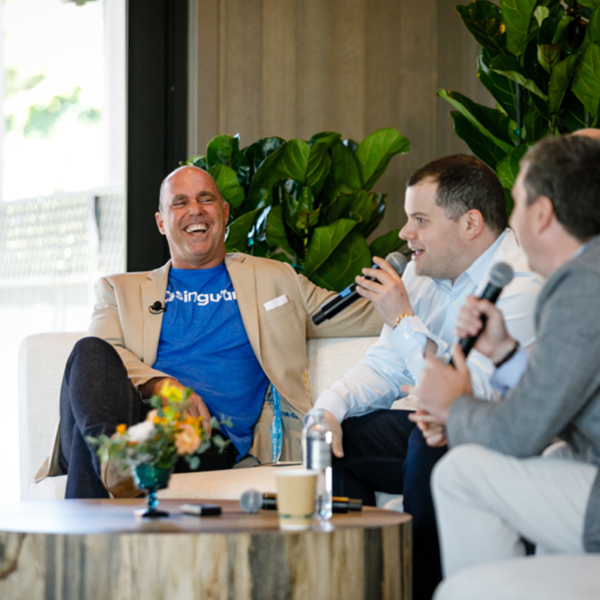
Stavitsky joined Bark Box’s Todd Kane and Stitch Fix’s Eric Kovalkoski on-stage at UNIFY. The conversation, moderated by Singular CRO Vince Cortese, started on cross-platform and cross-channel attribution. It quickly zeroed in on multi-touch attribution.

“It’s the holy grail of marketing,” says Kovalkoski. “Our data science team thinks — and I would agree with them — that it’s hard to trust. It’s still a way out.”

One challenge, Airbnb’s Stavitsky said, is what you’re using MTA for. And most people aren’t using it for the right reasons, which seriously limits multi-touch attribution’s ability to provide value.

“Some teams look at MTA as a way to re-slice the pie,” he said. “It kind of makes one channel look better, or one team look better … but the pie doesn’t get bigger. The key is to use multi-touch attribution to make the pie bigger. Ideally, MTA shows you some level of truth as to how your world of marketer works. In other words, what your customer journeys actually look like. What customers actually do. Where they actually touch you, or your marketing.”

Using multi-channel attribution should highlight more marketing touchpoints, places where your campaigns have impacted a customer. It should provide more insights than a linear attribution model, and should help you adjust your marketing mix. And it should provide better analytics on future marketing campaigns.

All of this, however, is not easy. Hence the “buzzword” comment, despite the real value that multi-touch attribution promises.

But one thing that is definitely not a buzzword is incrementality.

Incrementality: not simple to do right

But even if multi-touch attribution is not working amazingly well for you — and outside of B2B, not too many marketers have truly figured it out — incrementality is well within the realm of possibility. And incrementality does provide good insights into the value of your marketing efforts in each of the marketing channels you test.

“Our north star is incrementality,” says Stitch Fix’s Kovalkoski. “Everything we do is based off of randomized control trials.”

Sometimes called uplift, incrementality is testing the specific impact of one variable in a marketing campaign. When used in reference to ad networks and marketing partners, incrementality is the degree to which new partners access new audiences … and can engage with them.

“Five years ago when you were talking to an ad network about incrementality, they probably didn’t understand what you really meant, and what you wanted from them,” says Airbnb’s Stavitsky. “[They’d say] ‘of course it’s 100% incremental … of course these are all brand-new users that you would not find anywhere else … work with us!'”

But incrementality, like multi-touch attribution, isn’t easy to get right.

Even if initial results are positive.

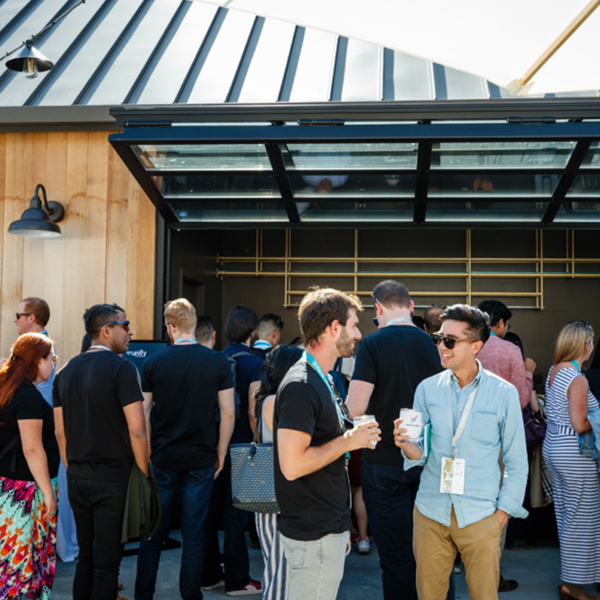
One of the scenes at UNIFY 2019

“We started to experiment with it five years ago,” Stavitsky said. “When you run your first series of lift tests it goes up and to the right, and [you feel] … now I understand how the world works. [But] when you continue running those tests … the more you know the less you understand.”

The results generally look good initially, but when you keep running lift tests, reality becomes more and more complex. Your marketing analytics become more and more confusing. There is hope, however. Eventually, Stavitsky said, you settle into a scientific method of marketing: doing Y, looking for X.

Experimenting, gathering evidence, and proceeding based on the results.

There’s art as well as science

One challenging thing: it’s a little different for everyone.

Different businesses with different products, revenue models, customer profiles, and paths to monetization will need to figure this out for themselves. A different customer journey means a different model. Different touch points change the math. So there’s science … but there’s also art.

One very real challenge that marketers deal with is channel exhaustion. And that’s something that marketers simple have to measure themselves, says Kovalkoski:

“One big channel that I can’t name on-stage … was trying to prove value to us,” he said. “But we did the analysis ourselves and found that the actual incremental CPA was actually 3X higher.”

Holdouts: the next big thing

Multi-touch attribution is hard. Incrementality is too, but it’s at least achievable for many marketers, and most ad networks have ways and means of enabling testing. Marketing mix modeling may not work for all.

The next major mountain for marketers to climb might be holdouts.

Holdouts might be more common traditionally in email marketing, where you can simple leave a percentage of your list off a series of communications in order to check if your newsletter or communications are actually successful in generating lift. But holdouts are also tremendously important in advertising campaigns.

And while marketers have been successful in fighting for incrementality and lift test, they shouldn’t rest on their laurels, says Stavitsky:

“The next thing we should be asking for is regular holdouts. I want a 5% lift test holdout always on … keep telling it to Facebook, keep telling it to Google, keep telling it to ad networks.”

Adding offline marketing to the digital mix

Interestingly, many of the most mobile-first or digital-first companies are now also hitting offline marketing channels … making multi-touch attribution and cross-channel measurement even more important.

(And opening the door to mix modeling and other marketing attribution models.)

“We’re launching physical gift cards this holiday period,” said Bark Box’s Todd Kane.

Bark Box is looking forward to learning how this impacts the customer experience. Bark Box customers are the company’s best sales people, Kane said, and the company is trying to understand what that looks like in physical retail spaces as opposed to digital marketing.

And that brings up a whole new list of challenges — at least for digital marketers — that will remind old-school professionals of their early careers.

“We were very proud because our online side of things is very much evidence based,” says Airbnb’s Stavitsky. “But at the same time, the offline side of things was very faith-based. Faith-based marketing … if you believe that it works, it works … but over time there were less and less believers.”

Ultimately … it comes down to clean data

Whether you’re doing multi-touch attribution or incrementality or lift testing or holdouts (or all of the above) it ultimately comes down to data, the panel agreed. If a marketer has the right data from his or her marketing channels, they’ll be able to use multiple marketing attribution models to understand the consumer journey.

Because data fuels marketing attribution. Data informs marketing insights on customer touchpoints. Marketing data enables cross-channel attribution. Data tells you which campaigns were successful. And whatever attribution solution you use, whatever attribution model you follow … data will inform your future marketing mix.

Good data.

Clean data.

Portable data.

And whatever strategies you take to understand your customer and your customers’ journeys will be improved by that good, clean, portable data.

“A couple years from now there will be another shiny thing that everyone will be obsessed about,” says Stavitsky. “I would do one thing: structure my data and build my systems in such a way that it’s easy to plug any attribution model in: last click, MTA, or MTA version two tomorrow …”

And that’s something that Singular can help with.

Get a first-hand look

Want to get a first-hand look at how companies like Airbnb, Stitch Fix, and Bark Box got so good at marketing? How they do marketing attribution and cross-channel attribution? What data-driven insights they generate from campaign data, social media, organic search, and other data-driven marketing?

Whether you use multi-touch attribution, last-click attribution, or other ways of attribution modeling, Singular can help you get data-driven insights from digital channels, online and offline sources, and all your marketing campaigns.

Get a customized tour of Singular’s technology today.

Request a demo

Or, watch all of the UNIFY 2019 sessions here, in our UNIFY @ Home masterclass

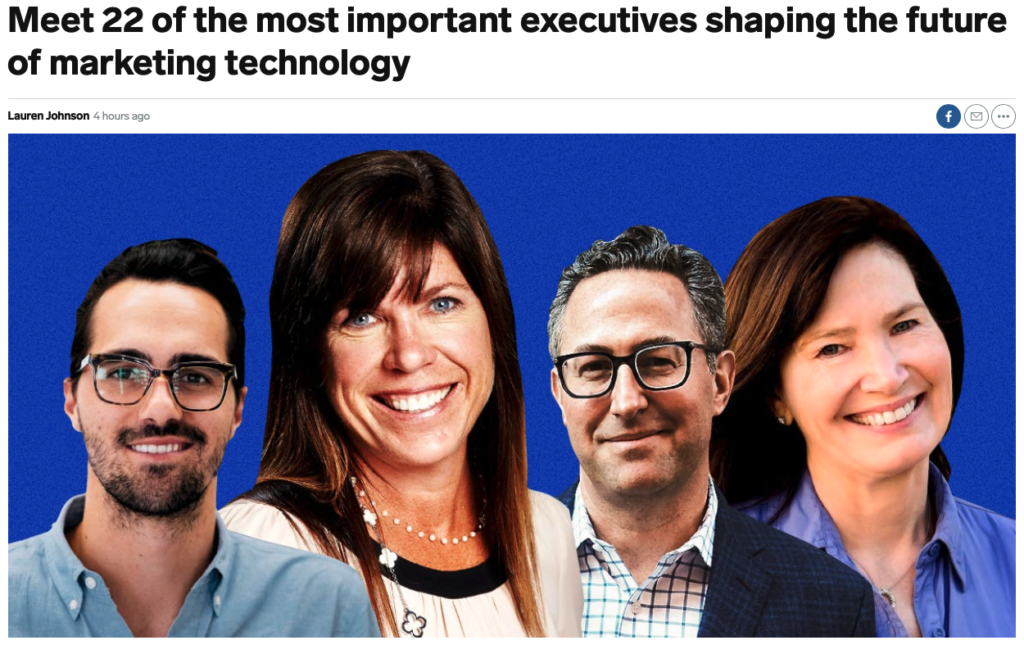
Singular CEO Gadi Eliashiv: One of top 22 ‘most important’ execs shaping marketing technology

Singular CEO Gadi Eliashiv has been recognized as one of the top 22 most important executives who are shaping marketing technology.

Lauren Johnson, Business Insider’s senior reporter for advertising and marketing compiled the list, which includes executives from Oracle, Shopify, Adobe, and Salesforce.

“Every marketer wants to know how much of its advertising leads to a sale, and Singular says it has answers,” Johnson writes. “When he’s not running Singular, Eliashiv leads a working group called Mobile Attribution Privacy coalition that aims to help marketers measure advertising in the age of privacy. The group includes organizations like the Mobile Marketing Association as well as Singular competitors such as Branch.”

business insider top 22 martech execs

It’s that combination — great data for marketers at the same time as total respect for consumer privacy — that makes Gadi stand out from the crowd.

At Singular, we’ve long known him as an inventor and technologist at heart.

Gadi identified the gap in the marketing technology ecosystem that Singular now fills. To drive optimal growth and survive in today’s hyper competitive world, companies and marketers need to know the ROI of each of their activities with complete control of both the high level totals, as well as the super granular details.

Gadi’s goal has always been providing marketers with a unified single source of truth for all their marketing investments, plus deep insights into how to grow faster.

We’re proud of our CEO Gadi Eliashiv and thankful for the recognition.

About Singular
Singular is a marketing intelligence platform that unifies marketing analytics, giving marketers actionable insights from previously siloed data. By connecting upper funnel marketing data with lower-funnel attribution data, marketers can measure ROI from every touchpoint across multiple channels and optimize spend down to the most granular levels. Singular currently tracks over $10 billion in digital marketing spend to revenue and lifetime value across industries including commerce, travel, gaming, entertainment, media, and on-demand services. Singular customers include companies like Lyft, Yelp, Airbnb, LinkedIn, Symantec, Zynga, Match, and Twitter. Singular is backed by Norwest Venture Partners, General Catalyst, Thomvest Ventures, Method Capital, Translink Capital, DCM and Telstra Ventures.

Growth marketing: 5 trends to watch from Singular CEO Gadi Eliashiv

Growth marketing is going through a major transition, especially in mobile marketing.

It’s not the growth hacking of a few years ago, with tips and tricks to juice user acquisition. And it’s not just about social media or a limited set of marketing channels. Rather, it’s a set of holistic marketing efforts based on a complete growth strategy, built with data-driven scientific marketing via tracking/measuring tools and incrementality data.

Singular CEO Gadi Eliashiv spoke about five key trends impacting the state of growth marketing at our recent UNIFY conference in Napa Valley. You can see his entire presentation — and almost all of the presentations at the conference — at UNIFY @ Home right here.

Or, watch it right here, starting at about 5:30 after our co-founder Susan Kuo’s intro to the conference:

So what are these key trends in growth marketing?

Trend 1: Convergence into a single platform

You’re using too many marketing analytics and other MarTech tools: maybe as many as 91 across your larger enterprise. And that’s a massive problem.

With so many different systems, you’ve got non-matching datasets and no clear way to combine the data together. So much for a single source of marketing truth!

The result is a new focus for marketing teams:

“People want to establish a single source of truth. They want to have one system with numbers they can count on,” Eliashiv says. “People want consistency … being able to consolidate your stack to the right platform really helps do that.”

That’s why Singular has evolved so much from its founding.

Where at the beginning Singular started with a single simple idea — data is at the core of marketing — the company has added analytics, automation, data governance, deep links, and deterministic fraud prevention. And that’s not all: Singular now also does audience management, bids and budgets, creative analytics, web measurement, automation, and (of course!) mobile measurement as an MMP.

Singular remains vendor agnostic, Eliashiv says. Marketers can plug different components in and out. And, they can use third-party vendors to complement what Singular does.

Still, people are consolidating their vendors:

“60% of our customers are streamlining their stack with us,” Eliashiv says.

Trend 2: Rise of the CGO (or growth organizations)

Marketing teams aren’t what they used to be. They’re not just awareness-generating machines, though they’re also not exactly sales teams. Nor are they simply silo-focused only on user acquisition or customer acquisition.

Instead, they’re growth teams, often led by Chief Growth Officers, VPs of Growth, or a growth manager. (Not, you’ll notice, growth hackers.)

Their focus, Eliashiv says?

These experts in digital marketing build a marketing team that can catalyze growth across the company.

“They are cross-functional by nature,” Eliashiv says. “They can deal with product, data science, with finance, with engineering, and with marketing of course … when these functions become successful, they take on more and more responsibility around the company, and that trend is very positive to companies being aware of their data.”

That means they pay attention to product-market fit. To the overall business. To product itself. To content marketing, where appropriate. And, of course, to some instances of growth hacking strategy and other elements of digital marketing … where they can be applied to long-term growth.

Interestingly, according to research we recently did, growth-focused organizations tend to have bigger teams — twice the size of typical companies. And a big component of what they do is data science and artificial intelligence.

Trend 3: Cross-platform and cross-device

We don’t just live on one digital platform anymore. Instead, we access services and information across a wide range of devices and platforms … and brands need to be able to serve people intelligently wherever that contact happens.

And adapt marketing strategies accordingly.

“Cross-platform is picking up steam really fast,” Eliashiv says. “In the past, a lot of products were built for a single platform: web, mobile, console. Now, a lot of products are really holistic across platforms.”

A growth marketer knows that the marketing funnel is actually multiple funnels, and the customer journey is perhaps as many journeys as there are customers.

That leads to a new set of challenges: incomplete and incompatible datasets across multiple marketing channels including web, mobile, and other platforms. Getting consistency of communication and customer state across platforms is a major challenge. Plus, measuring customer activity and conversion rate across multiple devices is hard, making ROI calculation difficult or impossible.

Ultimately, your strategy and your marketing campaigns need to adapt. Traditional marketing won’t cut it anymore.

The solution, Eliashiv says, is that Singular expanded data collection across about 500 new platforms.

“We are empowering unified data,” Eliashiv says, which enables cross-device attribution. “Often we receive customer data across platforms and do the stitching together on the back end … the key idea here is to be flexible.”

Trend 4: Doubling down on ad monetization

Ad monetization is not just about hyper-casual games.

“You can build quite a unique business model based entirely on ads,” Eliashiv said, hinting at the monetization model behind literally some of the biggest companies on the planet today.

But in traditional mobile publisher structures, that creates challenges for growth marketing teams: divided loyalties, or at least different goals.

The user acquisition team wants to do what it has always done: grow new users or customers. The monetization team wants to do what it has always done: maximize revenue. But now, the datasets are colliding.

Monetization teams need to look at in-app purchase (IAP) revenue plus ad monetization revenue (and any other way they’re building revenue). And they need that data consolidated, not separate. UA teams, in contrast, need to see ad revenue in ROI calculations so they can accurately understand return on ad spend (ROAS) and profitability for each new cohort of users.

Fortunately, Singular has a solution:

“To be able to see all the data in a single place, we worked on an analytics capability to aggregate, normalize, and provide all the key metrics that monetization teams care about,” Eliashiv says. “Like, what is my eCPM? What is my fill rate? That’s not necessarily tied to user acquisition but tied to my monetization. What kind of instances do I have, or placements?”

In addition, Singular has tied ad monetization into the ROI formula so that acquisition teams can get good data on their returns from their efforts.

Trend 5: Ad fraud

Ad fraud is still a “pain in the ass,” Eliashiv said. It’s a hidden cancer that both takes your money and destroys your optimization … because you don’t know what is true anymore.

That seriously cuts into your growth rate, brings in fake users, and stymies digital marketing campaigns.

But there’s a bigger problem in the fight against ad fraud:

“Two years ago … there was a lot of buzz,” Eliashiv says. “But then afterwards there pretty much was stagnation. There wasn’t any key innovation in the space. And what happened is that fraudsters got more and more sophisticated, to the point where people feel secure when they have ‘something’ that prevents fraud, but it doesn’t mean that it’s 100%. It doesn’t mean that it’s capturing what they need to capture. It doesn’t mean it’s even staying up to date.”

Attacks today are much more sophisticated, and growth teams might not even know that they’re losing money because their tools just are not intelligent enough or aware enough to block or identify new forms of fraud.

Singular took a different path and has been looking for 10X solutions to ad fraud, Eliashiv says.

That’s resulted in next-generation iOS fraud prevention and an industry-first: deterministic Android install validation, which we formally released in August of this year and has been saving companies hundreds of thousands of dollars.

There are a lot of misconceptions about fraud in the market.

“Not all solutions are alike,” Eliashiv says. “That’s probably the biggest misconception. People think: ‘I have a solution,’ but it doesn’t always mean that you truly are protected. People often think it’s a specific bad channel that you should avoid. We found fraud even in the biggest channels.”

That is why Singular now offers a complimentary “fraudit” … a fraud audit courtesy of our cybersecurity specialists. Solving fraud will kickstart user acquisition and customer acquisition by providing much better returns on marketing investments.

Next steps

The full video is available above, and all of the UNIFY videos are available at UNIFY @ Home.

In addition, if you’d like to see how Singular is addressing these issues in person, or if you’d like to have a fraud audit, talk to us about a private demo.

Singular wins 2019 Technology Innovation Award from Frost & Sullivan

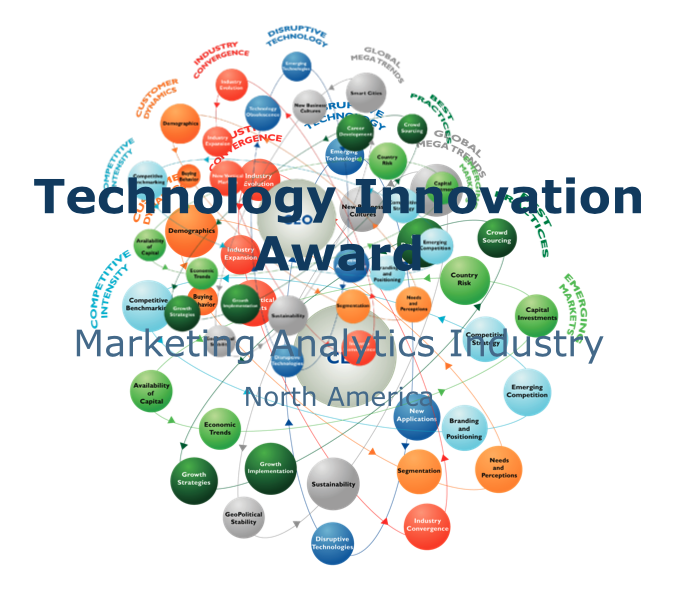
We’re pleased to announce that Singular has won the 2019 Technology Innovation Award for marketing analytics in North America from Frost & Sullivan.

Past recipients of Frost & Sullivan awards include Google, Verizon, Cisco, and IBM. Frost & Sullivan is a global research consultancy. 98% of the Fortune 1000 are clients, and the company creates original research for dozens of industries and sectors.

Singular wins Technology Innovation Award

That research included investigating five key technology attributes including Industry Impact, Product Impact, Scalability, Visionary Innovation, and Application Diversity.

Frost & Sullivan’s study also examined five future business value criteria: Financial Performance, Customer Acquisition, Technology Licensing, Brand Loyalty, and Human Capital.

“Against the backdrop of extensive primary and secondary research across the entire value chain, Frost & Sullivan is quite pleased to recognize Singular as the Technology Innovation Leader in the marketing analytics industry,” David Frigstad, Chairman of Frost & Sullivan, wrote in a letter of congratulations.

“Achieving excellence in technology innovation is never an easy task, and it is made even more difficult considering today’s competitive intensity, customer volatility, and economic uncertainty—not to mention the difficulty of innovating in an environment of escalating challenges to intellectual property,” Frigstad wrote. “In this context, your selection as recipient of this Award signifies an even greater accomplishment.”

It’s important to note that this was an independent study. Singular did not pay for it to be produced; we did not request that this report be created, and we did not apply for a technology innovation award.

And all of which, of course, makes winning that much sweeter.

Global brands have lauded Singular’s marketing intelligence platform as one of the strongest and most irreplaceable tools in their arsenal that has helped them obtain a clearer picture of their marketing effectiveness and maximize their return on investment.

– Frost & Sullivan report

More than anything else, Singular is focused on the success of our customers — the best marketers in the world. That makes this external validation of our recent progress particularly gratifying.

[Singular] has been an integral partner to some of the most innovative companies worldwide that have achieved phenomenal success with their marketing efforts.

– Frost & Sullivan report

That’s precisely what we’re seeing with customers like Ilyon: growing 98% with a little help from Singular. And Postmates: decreasing cost per buyer 80% with unified marketing analytics. And LinkedIn, which established a single source of truth for marketing performance using Singular.

“We’re very excited to get this award from Frost & Sullivan,” says Singular CEO Gadi Eliashiv. “It confirms that the most important thing we’ve been working on over the last year — our customers’ growth and success — is actually happening.”

UNIFY 2019 in pictures (sneak peek)

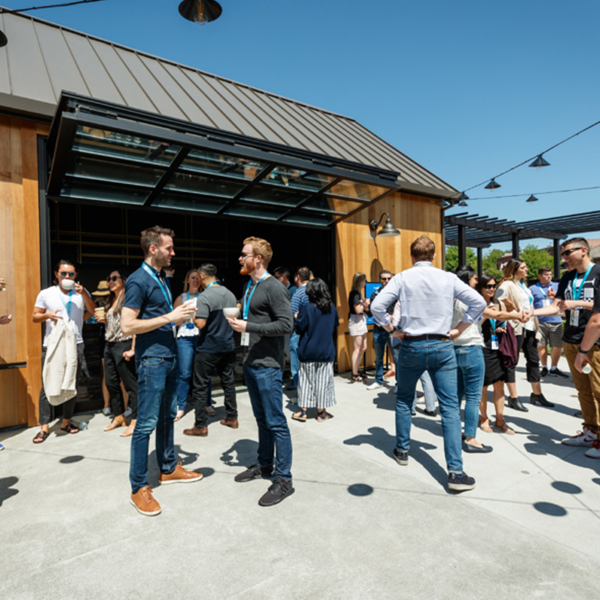
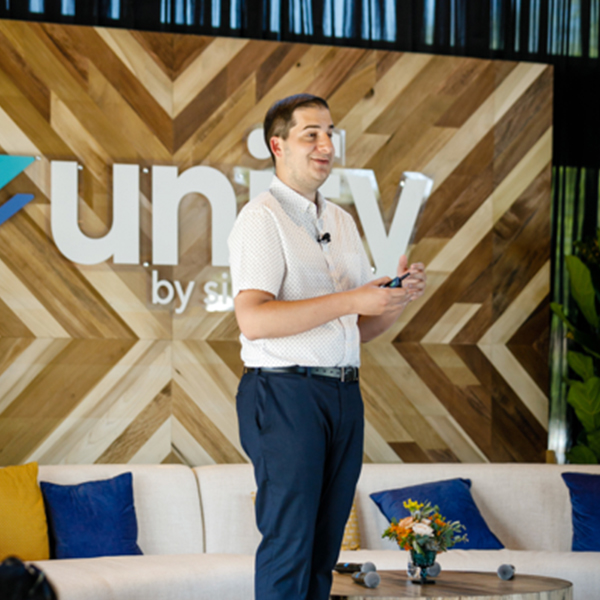
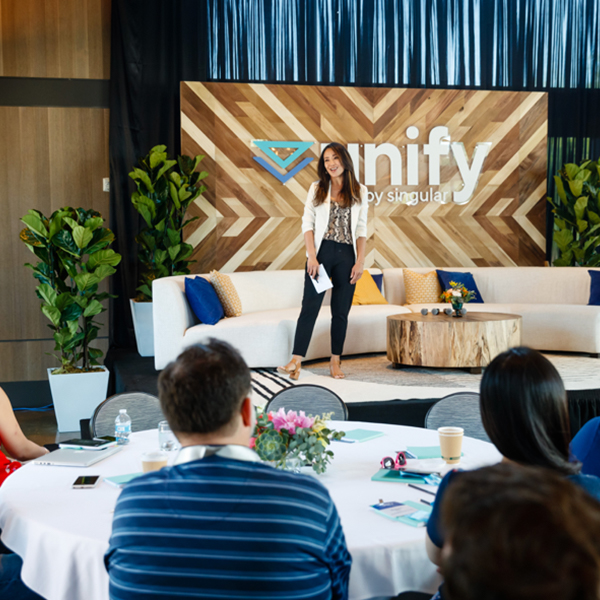
UNIFY 2019 was amazing. We had great speakers from major brands, good food, and a gorgeous setting in Napa, California.

But don’t take our word for it: check the pictures.

We can’t really take the credit. Sure, our events team did an amazing job setting the stage, but incredible speakers from brands like Amazon, Nike, AirBnB, Glue, Rovio, N3twork, DraftKings, Lyft, and StitchFix shared deep insights on their business and on marketing in general.

With their wit and wisdom, UNIFY 2019 could hardly help be amazing.

We’re going to publish many more details, including full video of individual sessions, over the next few weeks. And there are hundreds of pictures, the photographer tells us. But just to whet your appetite, here’s a teaser.

UNIFY 2019 in pictures


Over the next three to five weeks, we’ll be publishing full video of sessions, along with partial transcripts. So even if you couldn’t make it to UNIFY 2019, you’ll be able to get a huge amount of the benefit of being there.

Maybe next year we’ll see you in person at UNIFY 2020!

Singular CEO Gadi Eliashiv on chief growth officers and the rise of marketing intelligence [video]

Over the past decade we’ve seen the rise of the marketing technologist, who has one foot in the marketing department and another in engineering. And we’ve seen the data scientist role jump from almost nonexistent to being one of the fastest-growing jobs in just a decade.

Increasingly, as marketing is changing, technology is central to how marketers perform. Growth is now a key unifying function in brands and enterprise, and we’re also seeing the rise of the Chief Growth Officer.

We’re releasing a report on that in about a month.

But … our CEO Gadi Eliashiv gave a sneak peak at some of the results recently at Mobile Apps Unlocked in Las Vegas.

The rise of chief growth officers

Ultimately, the way chief growth officers lead their organizations is by using data-driven insights. Some of the most successful leaders drive those insights via marketing intelligence platforms like Singular.

The primary function of a marketing intelligence platform?

To provide insights for growth by connecting effort with outcome at granular and aggregate levels.

Ultimately, that’s how CGOs and other growth leaders get the score. Understand if they’re winning or losing. And know at both as high level and as granular as they want: how successful are our marketing, our campaigns, our ads, our creative.

Knowing that — and getting smart insights for optimization — powers breakthrough improvement in conversions and ROI. And that’s exactly what most brands, enterprises, and companies need.

Finished the video?

Click here to get a demo. See how Singular enables unprecedented growth for the most sophisticated marketers on the planet.

Singular adds former Gartner, Adobe, IBM, Kenshoo exec Vince Cortese as new Chief Revenue Officer

SAN FRANCISCO — May 7, 2019 — Marketing intelligence platform Singular is pleased to announce the hire of Vince Cortese as the company’s new Chief Revenue Officer.

Singular helps 50% of the top 100 apps on the iOS App Store and Google Play accelerate growth. Its marketing intelligence platform unifies marketing data, automates key components of marketers’ growth cycle, and provides intelligent insights for future opportunities.

Singular CRO Vince Cortese


Cortese comes from Kenshoo, the adtech platform that manages over $6 billion in annual ad spend. Prior to that he led sales at various levels in the marketing analytics industry at companies such as Adobe, IBM, Gartner, and Brandcast.

“Singular is scaling faster right now than any time in our history,” says Gadi Eliashiv, Singular CEO. “We’re excited to see Vince help us accelerate even more as we grow with global brands like Disney, LinkedIn, Wish, and AirBnB.”

Cortese will lead Singular’s global sales team, with offices in San Francisco, Tel Aviv, Seoul, London, Tokyo, and Bangalore. He’ll help expand the sales force domestically and internationally, and he’ll join a Singular leadership team that includes COO Susan Kuo, CTO Eran Friedman, and another recent addition, CFO Sam Wolff.

“I couldn’t be more excited to join Singular at this time as we are at the forefront of innovation in the marketing intelligence space,” says Cortese. “Singular not only has the best in class solution to help growth marketers meet their top line growth goals but our focus on customer centricity has been a major contributor to accelerating growth over the last few years. I am excited to be part of the team and help build out the company globally.”

“The timing couldn’t be better to bring on a world-class executive like Vince here at Singular,” said Scott Beechuk, Partner at Norwest Venture Partners and Singular board member. “Our customers understand that driving top line growth has become a data intelligence and automation problem. Vince has the experience building top-performing global sales organizations in the marketing data industry, and with our new mobile and web unified product line, Singular is uniquely positioned to lead this rapidly expanding market.”

About Singular 
Singular is a Marketing Intelligence Platform that transforms marketing data into accurate, granular and actionable insights to drive growth. By unifying marketing campaign data with attribution data, marketers can measure ROI from every touchpoint across multiple channels for a single source of truth. Singular currently tracks over $10 billion in digital marketing spend to revenue and lifetime value across industries including retail, finance, travel, gaming, entertainment, media, and on-demand services. Singular customers include companies like Lyft, Yelp, Airbnb, LinkedIn, Symantec, Zynga, Match, and Twitter. Singular is backed by Norwest Venture Partners, General Catalyst, Thomvest Ventures, Method Capital, Translink Capital, DCM and Telstra Ventures. Visit www.singular.net to learn more.

Why the most talented people in the world choose to work at Singular: Enterprise account exec Channing Berry

How do you scale a company that has the right product at the right time for the right problem? You hire the right people.

That’s easier said than done, which is why we have a stellar VP of People growing our team.

One of those “right people” is Channing Berry. A former LinkedIn, Sprint, Oracle, and Siebel sales leader, Channing has one of the more interesting stories of any recent Singular hire: being pitched by Serena Williams to join a different company … just before he made the call to say yes to Singular.

I interviewed Channing to learn a little more about him, why he chose Singular, and how he came to be pitched by probably the greatest player in women’s tennis history.

Koetsier: Who are you and what’s your background?

Berry: My name is Channing Berry and I am an Enterprise Account Executive at Singular. I grew up for the most part in Modesto, CA. I went to college at the University of Arkansas (after a short stint at the University of Wisconsin) where I was on a track scholarship where our teams won a couple of NCAA National Championships.

Koetsier: What’s your role, and what does it include?

Berry: I am an Enterprise Account Executive responsible for selling into the Enterprise marketplace.

Koetsier: You recently became one of Singular’s newest employees … and you apparently got pitched by someone famous to take a different offer.

Berry: Just to clarify, this person [Serena Williams] was on the board of one of the companies on my final list. She was definitely trying to get me to join their team. It was a great gesture by the company and her as she is someone I admire who is a great example for my daughters. I am paraphrasing, but she said she was proud of my accomplishments to date and she knows I have a tough choice but would love to have me a part of their team.

Koetsier: What are your passions, and how do they relate to your job?

Berry: My daughters, my family, sports, outdoors, connecting with people and working on living my best life.

Koetsier: What are the things that surprised you most about Singular in the first few weeks after joining?

Berry: Definitely, the outreach of support from all teams. They all made it clear they were open and willing to help at any time. This includes the founders, board members, Customer Support, Marketing, Sales Ops, and Sales Development. You get the point. I felt extremely welcomed and was able to establish connections quickly.

Koetsier: What’s the best part of your job?

Berry: I get to tackle the challenge of helping a growing start-up to provide an extremely valuable tool to marketers who tackle growth on a daily basis. The vision and future roadmap is extremely exciting

Koetsier: Anything you’d say to someone else getting an offer from Singular?

Berry: Yes, what they tell you during your interview process is true. They were very upfront with where they are where they want to go and where you fit in. If they are giving you an offer, it means they have carefully selected based on how you fit the culture of the company.

Koetsier: Finally, what do you think about the pets policy?

Berry: I love that pets are allowed in the building. I can get my dog fix since I don’t have one at home.

Koetsier: Thanks for your time!

Why the most talented people in the world choose to work at Singular: Singular VP of People Viviana Notcovich

How do you grow a team quickly while keeping the values that made your company what it is … and keeping the level of talent and character high? This is a massive and ongoing challenge for fast-growing venture-backed companies like Singular.

One of the ways we’ve addressed it?

Hiring a VP of People.

Viviana Notcovich has led growth and human resources teams at Wix, Careers 360, and Elbit Systems, and has a varied international background: perfect for a company like Singular with operations in six countries (and growing).

I interviewed her to learn why people choose to work at Singular:

Koetsier: Tell me a little about your background.

Notcovich: My multicultural background has shaped me. I was born in Argentina, developed my career in Israel, and I’m now thriving in the Bay area. I had vast experience in developing human resource business plans in the corporate big enterprise and pre to post-IPO transformation.

I’m super-happy to build the journey at Singular today.

Koetsier: You’re the VP of People at Singular. It’s an unusual title … how and why did you select it?

Notcovich: I see the people-leading role as focused on developing a scalable, healthy, talent-based organization focusing on developing skills and enhancing engagement through best management practices. The most traditional HR functions including recruitment, benefits, training and development, and other operational roles are musts to have an organization running, but are not sufficient to keep talent in a competitive market.

Focusing on people rather than HR operations adds a more strategic layer to the role and brings true added value to the business.

Koetsier: One of the first things you did in your new role at Singular is talk to almost everyone in the company. What are some of the key things you learned?

Notcovich: First of all, I had a lot of fun interacting with everybody, and this is the basis of what we do. I have a long history of people management in the tech industry but I was amazed to learn about the level of engagement our people have.

This is a huge differentiator for our team: people are here “to build a good company.” They say things like “this is mine,” “we will win”, and “we have the best product in the market, period!” These are the most common answers in our offices around the world.

Koetsier: You also did a survey of everyone, asking them a number of questions. One of them was: why do you work at Singular? Can you share some of those answers?

Notcovich: Everyone has a mix of reasons.

When it comes to the most important one, almost 40% of our people are here primarily due to the friendships, teams, and community they’ve built. Another 34% are here mostly because they believe in the product and the story that we’re building. 20% see room for a lot of professional development here, and 6% are here primarily because of our CEO, Gadi Eliashiv!

Koetsier: Does that differ from other companies you’ve worked for? If so, how?

Notcovich: First of all we have the most talented engineering team in the world, with full-stack engineers (some of them coming from the 8200 intelligence unit of the Israeli Army), with extremely low turnover rates.

But this is not only that, this company was founded by friends, and this sticks very hard in our DNA. Every startup in the valley will have a ping pong table with graffiti saying “work hard, play hard” on the board. At Singular this level of commitment and camaraderie is taken to a different level. The velocity of the work and the impact we all have on setting our collective future connects us, developing a deep level of trust in each other.

This is the core of a truly functional team: everyone is respected and empowered to move forward and make us win!

Koetsier: You work with teams in the U.S., London, Tel Aviv, Seoul, India, and Japan. What are some of the similarities across those teams, and what are some of the differences?

Notcovich: We are a very lean company spread out in five different offices, speaking four different languages, in six different time zones, with hundreds of different upbringings. Still, we have a lot in common. Throughout a very selective recruitment process (4% acceptance rate, lower than Harvard!), we built a team across the globe that has a strong feeling of accountability and is dependable and resourceful — even at a series B level with tons of infrastructure to build!

We believe that building deep connections can achieve greatness — between people, teams, and cultures. That’s why we love working closely together across the globe, over-communicate, trust each other and care more about success than credit.

Koetsier: Why do you work at Singular?

Notcovich: I chose Singular because I trusted that we have a good business opportunity and because I wanted to work with Gadi. There are lots of bright CEOs in San Francisco, but Gadi is not only a smart product visionary but a super personable and humble leader.

I work at Singular today because I got addicted to the mission, the crazy high pace … the ability to enable impactful change. And most importantly, I love the team!

Koetsier: Thank you for your time!