
Content
- What is AI-driven attribution?
- Why are AI-driven journeys harder to measure?
- How does ChatGPT Ads attribution work?
- How do you measure organic traffic from AI answers?
- How do you measure AI mentions that never produce a click?
- How do you compare AI traffic with your other channels?
- How does Singular help you measure AI-driven traffic?
- FAQ
Stay up to date on the latest happenings in digital marketing
Summary
-
Optimize AI Attribution: Marketing professionals should implement AI-driven attribution to accurately credit app installs and revenue to channels originating from ChatGPT Ads and organic referrals. This involves using structured tracking links, UTM parameters, and ensuring web-to-app forwarding is set up correctly to capture user journeys effectively.
-
Monitor Consumer Behavior: Recognize that AI-driven user journeys often span multiple sessions and devices, which can distort traditional attribution models. Utilize multi-touch attribution (MTA) to assess the impact of AI assistants on campaign performance, ensuring all touchpoints receive appropriate credit and optimizing budget allocation across channels.
-
Leverage Data Insights: Regularly analyze buyer behaviors and trends by tracking branded searches and mentions of your app in AI responses. Tools like Singular can help consolidate data across platforms for a comprehensive view of campaign performance, allowing for better decision-making and strategy adjustments based on user engagement patterns.
Ask ChatGPT for a good budgeting app and you get a short list with reasons, sometimes with a ChatGPT Ads placement underneath. A few people tap straight through. Others come back two days later, search the app store by name, and install. Most attribution setups file that second group as organic, so AI is already sending users that your reports credit elsewhere.
Paid ChatGPT traffic now runs through standard attribution tools: on October 5, 2026, OpenAI named its first attribution and measurement partners for ChatGPT Ads, Singular among them. The organic side is still messy, so it pays to fix the two separately and then bring the results into one view.
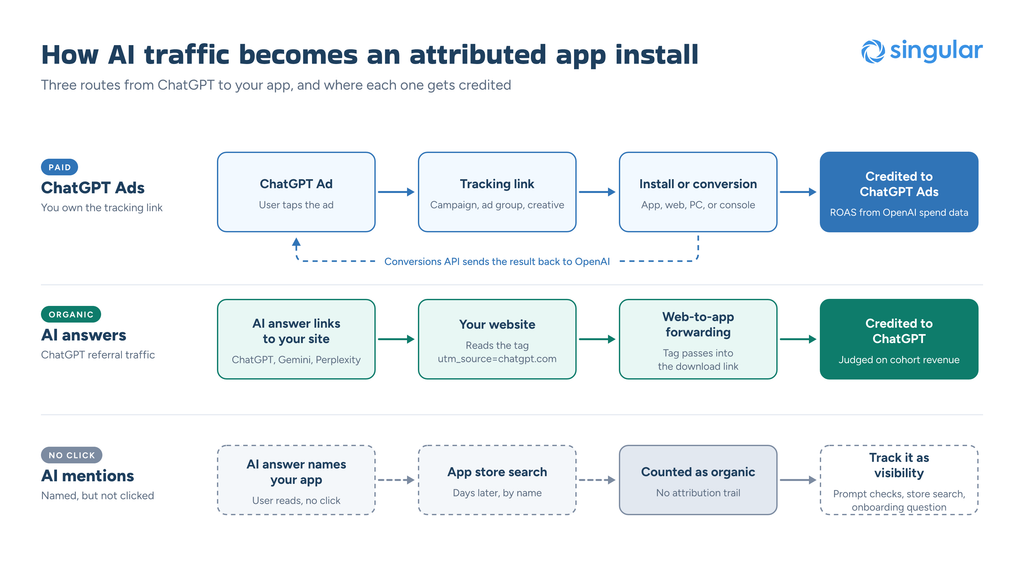
What is AI-driven attribution?
AI-driven attribution credits installs and revenue to the AI assistant that sent the user. That user may have arrived through a paid ad in ChatGPT or through an organic link in an AI answer. The method relies on the tools you already use for other channels, applied to journeys that rarely run straight from click to install.
App install tracking works differently for paid and organic AI traffic:
| Question | Paid: ChatGPT Ads | Organic: ChatGPT referral traffic |
| Who controls the link? | You do, through your tracking link | The assistant does, so tracking starts on your website |
| How is the source identified? | Campaign, ad group, and creative IDs on the tracking link | The utm_source=chatgpt.com tag, when ChatGPT adds it |
| Can you attribute app installs? | Yes. App attribution is click-based, so ad views without a click are missed | Yes, when the visit passes through your site and web-to-app forwarding carries the tag |
| Can conversions go back to OpenAI? | Yes. ChatGPT Ads conversion tracking runs through the Conversions API, so bidding learns from real outcomes | No. There is no ad campaign to optimize |
| How do you judge performance? | ROAS and ROI, using spend from the OpenAI Ads API | Installs and day 7 or day 30 cohort revenue, since there is no media cost |
| What do you need to set up? | Partner setup, the Conversions API, and cost data | UTM tracking, referrer grouping, and web-to-app forwarding |
Why are AI-driven journeys harder to measure?
OpenAI’s ads team wrote in October 2026 that people use ChatGPT to work through a decision, so clicking an ad is often not their next step. That behavior breaks several assumptions built into standard attribution:
- Research spreads across sessions, so the install often arrives days later and outside short click windows, the same problem covered in why last-touch attribution undervalues your best growth channels.
- Many answers send people to a website first, and the install happens on a second click that loses the source unless something carries it over.
- App attribution for ChatGPT Ads is click-based, according to OpenAI’s help center. Someone who sees an ad, skips it, and installs later leaves nothing to attribute.
- Most ChatGPT clicks reach your site without a referrer, so the utm_source=chatgpt.com tag carries the source on its own. When a bug stripped the tag from many links between October 8 and 15, 2026, that traffic showed up as direct, Adobe analyst Cedric Huesler reported.
ChatGPT also sends most of this traffic. SE Ranking’s June 2026 study of 101,574 websites put it at 74.78% of AI referral traffic from January to April 2026, ahead of Gemini at 11.56% and Perplexity at 7.23%. Singular’s data shows the same pull: the number of Singular advertisers receiving referral traffic from chatgpt.com grew about 18% from Q2 to Q3 2026.
How does ChatGPT Ads attribution work?
Paid ChatGPT traffic is the measurable half, because you own the link. ChatGPT Ads tracking follows the same pattern as other ad networks:
- Add OpenAI Ads (ChatGPT) as a partner in your attribution platform, using your ChatGPT Ads Pixel ID and Conversions API key.
- Create a tracking link for each campaign so that clicks are tied to campaign, ad group, and creative.
- Attribute the conversion where it happens, whether that is an app install, a web sign-up, or a PC or console game download.
- Send attributed conversions back to OpenAI through its conversions API, mapped to OpenAI event names, so its bidding learns from real outcomes.
- Pull spend, impressions, and clicks from the OpenAI Ads API and join them to attributed installs and revenue to calculate ROI and ROAS.
The last two steps carry the commercial value. The conversions API gives OpenAI a cleaner optimization signal, and the cost join puts ChatGPT Ads on equal terms with the rest of the media plan.
How do you measure organic traffic from AI answers?
Organic AI traffic usually reaches your website before your app, so measurement starts on the website. Four practices recover the traffic that leaves a trace:
- Report on the utm_source=chatgpt.com tag wherever it appears. It’s the most reliable signal ChatGPT sends, and any tool that reads UTM parameters can use it without extra setup.
- Group AI referrers such as chatgpt.com, perplexity.ai, and gemini.google.com into one web analytics channel, so visits that arrive with a referrer but no tag still count.
- Web-to-app forwarding passes UTM parameters from the landing page into the link behind your download button, so the install is credited to the AI source.
- The pages that AI answers already cite each need a clear download path with a tracked link.
Forwarding matters most, because without it a user who goes from ChatGPT to your site and then to the app store becomes an organic install, even when the visit carried the tag. The web-to-app glossary entry explains that handoff.
How do you measure AI mentions that never produce a click?
Many AI answers name an app without linking to it, and readers can skip the link when there is one. These mentions leave no attribution trail, so treat them as visibility and read them against your organic install trends:
- Run the same set of buyer questions through ChatGPT, Gemini, and Perplexity every month, and record whether your app is named and which pages each answer cites.
- Watch store search alongside it. App Store Connect and Google Play Console both report installs that came from store search, and Play Console also lists the search terms behind them. A rise in branded searches after your AI visibility improves is a directional signal worth tracking.
- Ask how people found you during onboarding and add “an AI assistant” as an option. It picks up installs that arrive with no tag and mentions that never produced a click.
- Check what the answers say about your app. When an assistant repeats an outdated or wrong claim, the source is usually a page it cites, so update your own pages and ask third-party sites to correct theirs.
How do you compare AI traffic with your other channels?
AI-driven installs become useful once they sit in the same reports as the rest of your media, under the same definitions. A few habits keep the comparison fair:
- Use one naming taxonomy for source, campaign, and creative across web and app, so ChatGPT campaigns roll up like every other network.
- Judge AI traffic on day 7 and day 30 cohort revenue, because users who research before installing often convert later.
- Deduplicate across channels, since a user who saw a ChatGPT Ad may also click a search ad before installing.
- Report paid and organic AI traffic on separate rows, so a strong organic presence does not hide a weak paid campaign.
- Expect OpenAI’s conversion count and yours to differ. OpenAI’s reporting API includes view-through and credits only ChatGPT, while your attribution platform credits each install once. Use the gap: take out view-through, line up the attribution windows, and check which other channels show up in the same journeys.
Multi-touch attribution helps here, because AI assistants tend to appear early in a journey that ends on another channel. Singular’s MTA data shows 43% higher ROI on average for incremental channels, the kind last-touch reporting tends to undervalue.
Incrementality testing goes a step further and asks whether the ads caused the install. OpenAI says its own incrementality work is early, but one study it published, a geo-lift test for the brand Dose, estimated 2.3 times more incremental orders than last-click attribution caught.
How does Singular help you measure AI-driven traffic?
Singular, the marketing growth platform built for the AI era, treats ChatGPT as one more channel in the same data model as the rest of your media, across mobile, web, PC, and console. OpenAI named Singular among its ChatGPT Ads attribution partners in October 2026, and the number of Singular advertisers running ChatGPT Ads went from none in Q2 2026 to dozens in Q3. The integration covers both routes:
- Automated cost reporting that pulls ChatGPT Ads spend, impressions, and clicks in alongside Singular’s 1,200+ cost data connectors and joins them to attributed installs and revenue for ROI.
- Attribution for ChatGPT Ads across mobile apps, websites, and PC and console games through Singular Links, with Advanced Attribution adding multi-touch and assists data.
- Web-to-app attribution that forwards UTM parameters, including utm_source=chatgpt.com, from your website into app installs. Those installs report under the source chatgpt.com, while ChatGPT Ads installs report under ChatGPT, so paid and organic stay separate. When web, app, and owned journeys are measured together, Singular customers see 3X estimated higher ROI accounting for the full cross-platform journey.
- A conversions API integration that sends attributed events and revenue to OpenAI, mapped to OpenAI event names.
- Audience sync that sends segments built in Singular straight into ChatGPT Ads custom audiences.
- MCP integrations that let Claude, ChatGPT, or any LLM query the same ChatGPT Ads data in plain language.
Setup steps are in the help center guides to OpenAI Ads attribution and CAPI and the OpenAI Ads data connector. Launch details are in ChatGPT Ads measurement with Singular, and the audience integration is in sync your Singular audiences straight into ChatGPT Ads.
FAQ
How do you track app installs from ChatGPT Ads?
Add OpenAI Ads (ChatGPT) as a partner in your attribution platform with your Pixel ID and Conversions API key, then run every campaign through a tracking link. Installs, web sign-ups, and PC or console downloads are attributed to campaign, ad group, and creative, and the conversions API sends those outcomes back to OpenAI for optimization.
Does ChatGPT add UTM parameters to its links?
OpenAI’s publisher FAQ says ChatGPT adds utm_source=chatgpt.com to referral URLs, which lets analytics tools identify the visit. Most ChatGPT clicks carry no referrer, though, so the tag is the main signal. A bug stripped it from many links between October 8 and 15, 2026, so note that week in your reports.
Can you attribute app installs to organic ChatGPT answers?
Yes, when the user passes through your website on the way to the app. Your web SDK reads the utm_source=chatgpt.com tag on the landing page, and web-to-app forwarding carries it into the download link, so the install is credited to ChatGPT. Direct app store visits that carry no tag still appear as organic installs.
Why does AI traffic show up as direct or organic?
Two gaps cause it. Some AI links reach your site with no UTM tag and no referrer, so analytics files the visit as direct. Other users read an answer, then search the app store by name. Forwarding and onboarding surveys recover part of both groups.
How do you calculate ROAS for ChatGPT Ads?
Divide the revenue from users attributed to ChatGPT Ads by the spend pulled from the OpenAI Ads API for the same campaigns and dates. Use cohort revenue at day 7 or day 30 for a fair read, since AI-assisted users often take longer to convert, and compare the result with other networks under identical definitions.
Want ChatGPT Ads and AI answers in the same reports as every other channel?
See how Singular attributes installs, including those assisted by ChatGPT. Book a demo.


Amey Kulkarni

Amey is a marketing practitioner with hands-on experience across the martech space, and Senior Marketing Manager at Singular. He writes about AI, analytics, and growth - with a focus on what's actually changing for practitioners, not just what's trending

