
Content
Stay up to date on the latest happenings in digital marketing
Summary
-
Prioritize Independent Measurement: Marketing professionals must ensure their measurement platforms are advertiser-controlled to avoid biases that can skew automated decision-making, especially as AI-driven budget reallocations become prevalent.
-
Establish Transparent Governance: Singular’s Customer Governance Board structurally provides advertisers with a voice and visibility into critical decisions, ensuring that measurement practices align with their interests.
-
Focus on Fraud Prevention and Methodology Clarity: Advertisers should actively engage in discussions around fraud prevention, attribution methodologies, and data governance to safeguard their advertising investments and optimize campaign performance in the evolving digital landscape.
Every company relies on signals in order to make the right marketing decisions to grow their business, things like which campaigns deserve to scale, which partners should get more of their budget, where fraud might be draining spend, and ultimately where the next dollar should go. Those signals come from a marketing measurement platform [MMP], and the money follows wherever they point.
So one question matters more than it ever has: who owns the truth your growth depends on?
For Singular, it has always been the advertiser, and today, we are making that fundamental belief more formal.
We are forming the Singular Customer Governance Board: a cross-section of advertisers we serve, with real visibility and a real voice on the decisions that shape their results.
We do this work for thousands of companies, from startups to the world’s largest companies, and the more they depend on our measurement, the more our priorities and our governance have to stay visibly aligned with them. The Singular Customer Governance Board is how we make sure these stay aligned.
The Board’s founding members include leaders from Uber, Electronic Arts, Rovio Entertainment, DraftKings, Lyft, Inc., Exness, Modo.us, and Gen Digital.
Who does your measurement company really work for?
As an advertiser, it’s crucial to make sure your measurement platform works for you, and not for competing interests. Every day, billions of dollars are spent on advertising across the digital sphere. Unbiased measurement is now even more important, as we see two major forces converging in the market today.
The first force is AI. Media buying is becoming even more automated, and these AI systems reallocate budgets across channels and campaigns faster than any human team can realistically review. The data directing them is precisely the output measurement companies like Singular produce. That changes what measurement is. It stops being a report you read after the fact, and becomes the reward signal the machine optimizes towards. A small bias, a blind spot, or a single change in the choice of methodology gets amplified across millions of automated decisions before a human ever notices.
AI can only optimize toward the truth it is given. A skew as small as a few percentage points can make or break a business; margins continue to shrink and competition continues to intensify.
The second force is ownership. The market is split into two models: measurement governed in the interest of media companies, and measurement governed in the interest of the advertiser.
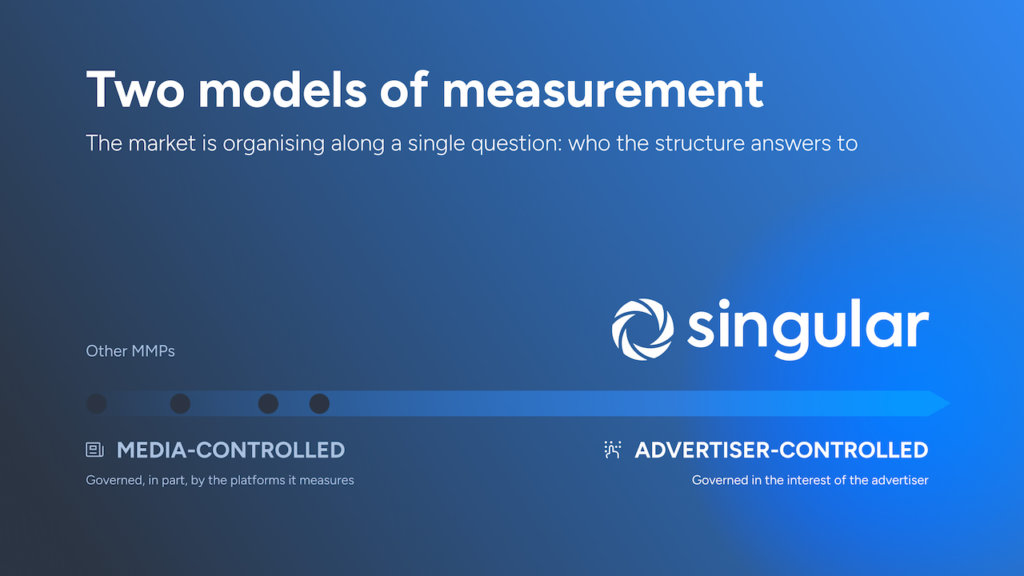
This difference in ownership fundamentally means whoever governs the structure also decides whose interest it protects when priorities get hard and those interests stop aligning.
Media companies are essential partners, and we work closely with all of them. But the important thing to remember here is that Singular is here to serve the advertisers.
Why we are building the Customer Governance Board
Every company can claim they are “unbiased,” “independent, “neutral,” and “trustworthy”. We believe it has to be more than a statement or a promise. It has to be a structure you can see and verify.
A measurement company sits between the advertiser and all of their media partners, and the measurement company is who makes the calls that shape the signals the advertiser trusts: how attribution methodology and incrementality are set, how aggressively fraud is policed, how channels get ranked, what makes the roadmap, and how data is governed.
These are exactly the areas the Governance Board will have structured visibility into and a real voice on.
The board is not ceremonial, and its job is not to run Singular. The board is there to make sure that when a question of neutrality comes up, the people with a formal voice are the advertisers whose money is being measured.
What happens next
Our founding members, drawn from the advertisers who know this industry best, are helping shape the Board’s foundations. In the coming weeks, we will share how it operates, cadence, and the decisions where the Board will have a formal voice.
Every topic it takes on, from fraud to measurement methodology in the AI era, will become part of an ongoing, transparent conversation.
The truth an advertiser depends on belongs to the advertiser, and we do not expect anyone to just take our word for it.
If you want to see how independent, unbiased measurement actually works for your business, talk to our team.
Independent measurement: frequently asked questions
What is independent measurement?
Independent measurement means the company measuring ad spend, performance and ROI is governed in the interest of the advertiser paying for the media, rather than the media platforms it evaluates. It works closely with every platform while answering to the advertiser.
Why does unbiased measurement matter in the AI era?
AI-driven buying systems reallocate budgets continuously based on the data measurement companies produce. Measurement effectively becomes the reward signal for automated decisioning, so a small bias or blind spot gets amplified across millions of decisions before anyone notices. AI can only optimize toward the truth it is given.
What is the difference between advertiser-controlled and media-controlled measurement?
Advertiser-controlled measurement is governed in the interests of the party paying for media and relying on the numbers. Media-controlled measurement is partly owned or governed by the platforms being measured. The difference is in whose interests the structure is built to serve.