
Table of contents
- Introduction
- Executive summary: what the 2026 ROI Index tells us
- AI is not the edge. It is the baseline.
- Privacy-first measurement has matured
- Multi-touch attribution is no longer optional
- Scale is concentrated, but it is not narrow
- Consolidation is amplifying visibility
- Rewarded ecosystems are now core strategy
- Emerging markets are stabilizing
- Gaming vs non-gaming is no longer a hard divide
- Methodology summary
- Global ROI leaderboards
- Regional ROI Index
- MTA ROI leaderboards
- Platform density: who shows up the most
- Full methodology
- Apple Ads performance benchmarks reveal a high-intent, high-stakes channel
- See also: Quarterly Trends Report
- Methodology
Introduction
Welcome to the Singular ROI Index 2026!
This is our annual benchmark of what is actually working in mobile advertising, built on trillions of impressions, clicks, and installs across millions of campaigns from thousands of ad networks worldwide.
This is not a hype report. This is not a puff piece. This is a performance benchmark.
If a network appears here, it’s because they earned their place through consistent ROI delivery at scale.
No leaderboard replaces strategy; vertical, geo mix, creative strength, and measurement framework still matter. But when certain platforms show up again and again across operating systems and verticals, that is not coincidence, it’s a signal.
And in 2026, the signal is clear: AI is foundational.
Scale is consolidating.
Privacy-first measurement is no longer disruption. It is infrastructure.
Author Saadi Muslu • Business Intelligence Lead Gaston J. Laterza • Data Engineer Pablo Agustín Navarro
Executive summary: what the 2026 ROI Index tells us
If you only read one section, read this. Here is what the data is actually saying.
AI is not the edge. It is the baseline.
Every platform that appears repeatedly across 2026 leaderboards is investing heavily in:
- Automated bidding
- Creative-level optimization
- Predictive modeling under sparse signals
- Cross-channel signal aggregation
AI is now table stakes. The differentiator is how effectively it is applied at scale.
What this means:
Push partners on how they model under signal loss.
Push on creative automation.
Push on assist weighting and cross-channel influence.
Privacy-first measurement has matured
We are no longer in the “ATT shock” phase.
2025 accelerated infrastructure stability beyond SKAdNetwork, including:
- Aggregated Event Measurement from Meta
- Advanced real-time reporting from Tiktok and Snap
- Expanded on-device modeling from Google Ads
The consistency of scaled iOS leaderboards reflects that maturity.
What this means:
iOS is no longer unstable. It is simply more model-dependent. Sophistication now determines performance.
Multi-touch attribution is no longer optional
Last-touch alone underestimates contribution.
Some networks dominate Exclusive Reach.
Some dominate Assist Power.
Some expand meaningfully under MTA Uplift.
Platforms appearing across multiple MTA metrics are influencing more of the journey than last-click reporting suggests.
What this means:
Budget allocation should consider assist-heavy contributors, not just final-click closers.
Scale is concentrated, but it is not narrow
A core group of media channels repeatedly appears across:
- All-platform global lists
- Gaming and non-gaming splits
- iOS and Android scaled leaderboards
That includes:
- Apple Ads
- AppLovin
- Google Ads
- Liftoff
- Meta
- Mintegral
- Moloco
- Tiktok For Business
- Unity Ads
- Snapchat Ads
- X Ads
These platforms are not just large. They are versatile and performing across operating systems and verticals.
What this means:
If you are allocating the majority of your spend, this is the competitive arena. These platforms have demonstrated the ability to sustain ROI at meaningful volume.
Consolidation is amplifying visibility
M&A and ecosystem expansion are increasing cross-leaderboard density for certain platforms.
Broader infrastructure translates into:
- Stronger modeling
- More signal access
- Cross-portfolio durability
Growth-tier networks are still carving out efficient pockets.
What this means:
Balance core scaled allocation with disciplined testing in the growth tier.
Rewarded ecosystems are now core strategy
Rewarded and incentive-driven platforms continue to appear prominently across gaming and growth leaderboards.
These are no longer experimental budget lines.
They have matured through:
- Stronger retention filtering
- Better fraud controls
- More disciplined optimization
What this means:
If rewarded was previously dismissed due to quality concerns, it may be time to re-test under modern guardrails.
Emerging markets are stabilizing
Android-heavy regions in particular show more consistent ROI patterns than in prior volatile cycles.
Infrastructure investment and platform maturity are reducing unpredictability.
What this means:
Re-evaluate geo expansion strategies. Volatility has decreased in several regions.
Gaming vs non-gaming is no longer a hard divide
In previous years, you could clearly bucket networks by vertical strength.
In 2026, that line is softer.
Many scaled partners now appear across both gaming and non-gaming leaderboards, on both OS environments.
Optimization systems are adapting more fluidly across signal types, including subscription events, purchase flows, and ad monetization.
What this means:
Revisit old assumptions. Cross-vertical channel testing is more viable than it was even two years ago.
Methodology summary
The Singular ROI Index 2026 is built on trillions of impressions, billions of clicks, and billions of installs.
To prevent scale from distorting efficiency comparisons, we separate:
- Scaled leaders
Partners meeting defined minimum spend and volume thresholds within each category. - Growth leaders
Partners demonstrating strong ROI performance below those scale thresholds.
Leaderboards are presented alphabetically among qualifying networks. Inclusion is based strictly on performance thresholds.
Regional data remains largely Android-weighted due to privacy-safe limitations on granular iOS geo reporting.
A full methodology appears at the end of this report.

AdAction

Adikteev

Adjoe

Almedia

Appier

Apple Ads

AppLovin

AppSamurai

Aragon Premium

Aura from Unity

Ayet Studios

Benjamin

Bidease

Bigabid

BIGO

BlueStacks

Brown Boots

Buzzvil

Criteo

Dataseat

Digital Turbine

Exmox

Fluent Co



HangMyAds

Influence Mobile

KashKick

Kwai

Liftoff

Meta

Mega Fortuna

Mintegral

Mistplay

Moloco

Motive Interactive

MAF

Persona.ly


Play2Pay

Playio

Prodege

PubScale


Remerge

Revenue Universe

Rewards.de

RevX

Rokt

RTB House

RZR

Scrambly

Sky Flag

Smadex

Snapchat

TaurusX

TikTok

The Penny Hoarder

TyrAds

Unity Ads

Vibe

VYBS

W-Digital

X

Xiaomi Global

Yandex

YouAppi

Zucks
Global ROI leaderboards
The Global ROI leaderboards reflect aggregated performance across the full dataset, spanning all major markets and vertical categories.
Unlike regional views, which surface localized strengths, the global rankings highlight platforms demonstrating consistent ROI across heterogeneous environments. This includes differences in signal availability, OS dynamics, and category-specific optimization pressures.
When a network appears across multiple global segments, it indicates cross-environment robustness rather than isolated outperformance.
Regional ROI Index
Regional performance is where global scale meets local nuance.
Regional leaderboards are largely Android-weighted due to iOS privacy constraints. Scaled leaders across APAC, EMEA, North America, and South America reflect a mix of global platforms and regionally strong networks.
Emerging regions show increasing stability and repeat performance among core scaled platforms, with growth-tier networks carving out localized strengths.
Under SKAN, there’s limited geographical data available for most iOS installs, and that which is available is inside each advertiser’s own slightly customized SKAN conversion model. So our regional data is largely Android-based.
MTA ROI leaderboards
For the first time, the ROI Index includes dedicated multi-touch attribution (MTA) leaderboards.
Last-touch attribution remains the industry default, but it captures only the final interaction before conversion. In reality, most user journeys involve multiple touchpoints across discovery, consideration, and conversion. Channels that influence early engagement or mid-funnel consideration often receive no credit under last-touch models.
Multi-touch attribution addresses this by evaluating the full conversion path and assigning value to all meaningful interactions. This provides a clearer picture of how different channels work together to drive growth.
Singular’s analysis consistently shows that when campaigns are evaluated with multi-touch attribution, certain networks demonstrate significantly greater influence than last-touch reporting suggests. These channels may not always close the conversion, but they play a critical role in shaping the user journey.
The takeaway for marketers is simple: evaluating networks solely through last-touch attribution can undervalue important drivers of growth. Multi-touch attribution helps reveal those contributions and enables smarter budget allocation.
For a deeper overview of how Singular’s multi-touch attribution works, see the product release:
https://www.singular.net/blog/multi-touch-attribution-assists/
MTA metrics used in the ROI Index
To capture how networks contribute across the conversion journey, the ROI Index includes three MTA metrics.
Exclusive Reach
Installs where a network was the only engagement in the path to attribution.
Highlights platforms delivering truly unique audiences.
Assist Power
Installs where a network appeared in the journey but did not receive last-touch credit.
Surfaces channels influencing discovery and consideration.
MTA Uplift
The increase in a network’s measured contribution under multi-touch attribution compared with last-touch attribution.
Reveals platforms whose influence extends beyond final-click attribution.
Interpreting the MTA leaderboards
Networks appearing across multiple MTA metrics are influencing more than just the final step in the conversion journey.
They may introduce new audiences, shape user consideration, or help close conversions.
For marketers building diversified acquisition strategies, these platforms often represent partners that drive value across the full funnel, not just the last click.

Aarki
AdAction
Adikteev
Adjoe
Almedia
Appier

Apple Search Ads
Applovin
AppSamurai
Aragon Premium
Aura from Unity
Ayet Studios

Benjamin
Bigabid
BIGO
Bidease
BlueStacks

Blind Ferret

Brown Boots
Buzzvil
Criteo

Dataseat
Digital Turbine
Exmox
Fluent

GameLight
Google Ads
Hang My Ads
Influence Mobile

InMobi

Jampp

Kakao Ads
KashKick
Kwai
Liftoff

Line Ads
MAF

Mega Fortuna
Meta Ads
Mintegral
Mistplay
Moloco
Motive Interactive

MyFreeApp
Persona.ly

Play2Pay
Playio
Prodege

PubScale
Remerge
Revenue Universe
Rewards.de
Revu
RevX
Rokt Ads
Rtb House
Scrambly
Skyflag

Smaad
Smadex
Snapchat
TaurusX
Tiktok

Tnk Factory

Tradingworks
Tyrads
Unity Ads

Upyeild
Vibe

VYBS
W Digital
X (Twitter)
Xiaomi Global
Yandex.Direct
YouAppi
Zucks
Platform density: who shows up the most
Platforms with the highest number of leaderboard placements demonstrate cross-category durability.
Network
# of rankings
31
31
31
31
29
28
27
27
25
24
25
18
18
16
16
16
14
What this tells us:
Durability matters. These platforms are not winning in one pocket. They are appearing across OS splits, verticals, and MTA views. For marketers building diversified portfolios, this density map is strategic guidance.
Full methodology
The Singular ROI Index 2026 is based on aggregated, anonymized performance data across:
- Trillions of impressions
- Billions of clicks
- Billions of installs
- Thousands of ad networks
- Millions of campaigns
Leaderboards are divided into Scaled and Growth categories to prevent scale from distorting efficiency comparisons.
Rankings are presented alphabetically among qualifying networks. Inclusion is based strictly on performance thresholds.
Regional data is largely Android-weighted due to privacy-safe limitations on granular iOS geo reporting.
All MTA metrics are calculated using multi-touch modeling frameworks that account for assist contributions and full-path engagement.
Marketers: an important note
The data in this report provides valuable insights drawn from a diverse range of sources based on campaigns in pretty much every country on the planet, including some regions that aren’t even countries.
(We’ll see data from scientists using their phones at McMurdo Station, for instance, in Antarctica.)
That offers a compelling look at key trends shaping the marketing landscape.
However, it’s important to note that this is not a complete view of the entire ecosystem: it’s a view of what Singular clients are doing. While the findings are based on billions of dollars of spend and installs, and trillions of ad impressions, making it highly indicative of what’s actually going on, marketers should consider the ROI Index as part of a broader context and complement them with additional data sources and strategic judgment.
That’s also why we’ll often bring in external data and insights to complement what we see in Singular data.
Apple Ads performance benchmarks reveal a high-intent, high-stakes channel

Mike Talashko
Head of Customer Success & Support

SplitMetrics’ Apple Ads most recent campaign data reflects the channel’s immense value in user acquisition and an increasing role in discovery.
Search results ads remain the core driver of revenue on the platform. Our most recent Apple Ads Search Results Benchmarks Report, based on aggregated data from apps and mobile games that optimize Apple Ads search results campaigns using SplitMetrics Acquire, January — December, and released in 2026, shows an average tap-through rate of 9.7% and a strong conversion rate of 66.2%, with significant disparities across app categories.
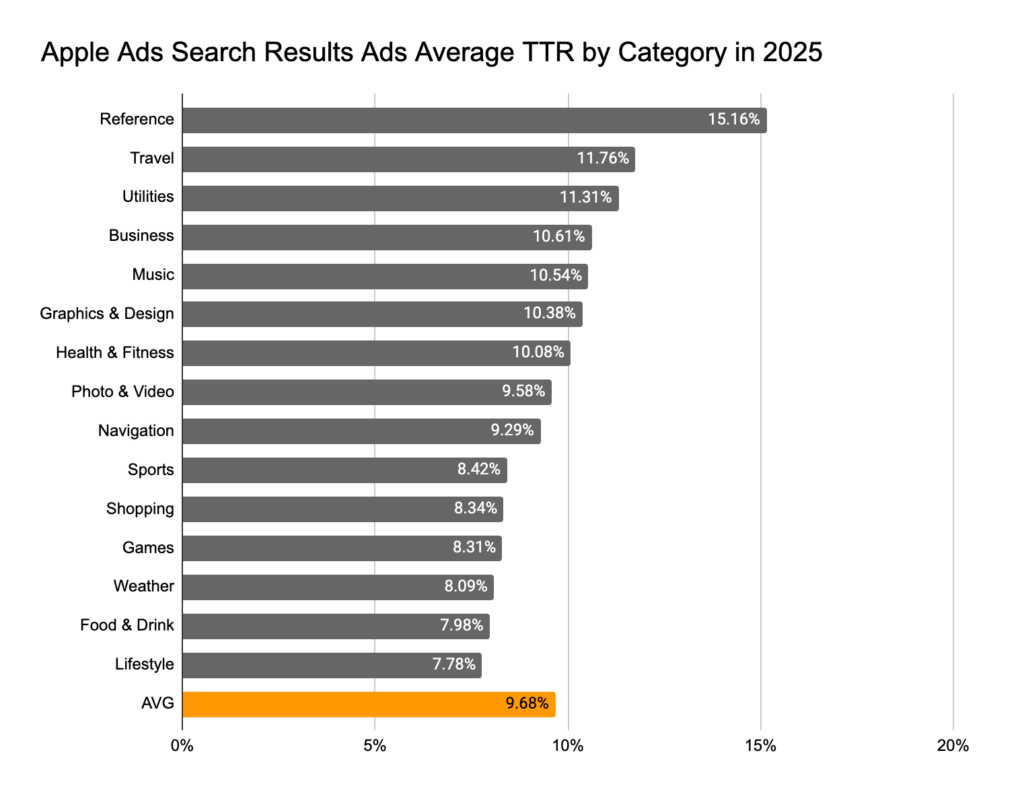
Source: Apple Ads Search Results Benchmarks Report 2026. The report is based on aggregated data from apps and mobile games that optimized Apple Ads search results campaigns using SplitMetrics Acquire from January — December 2025.
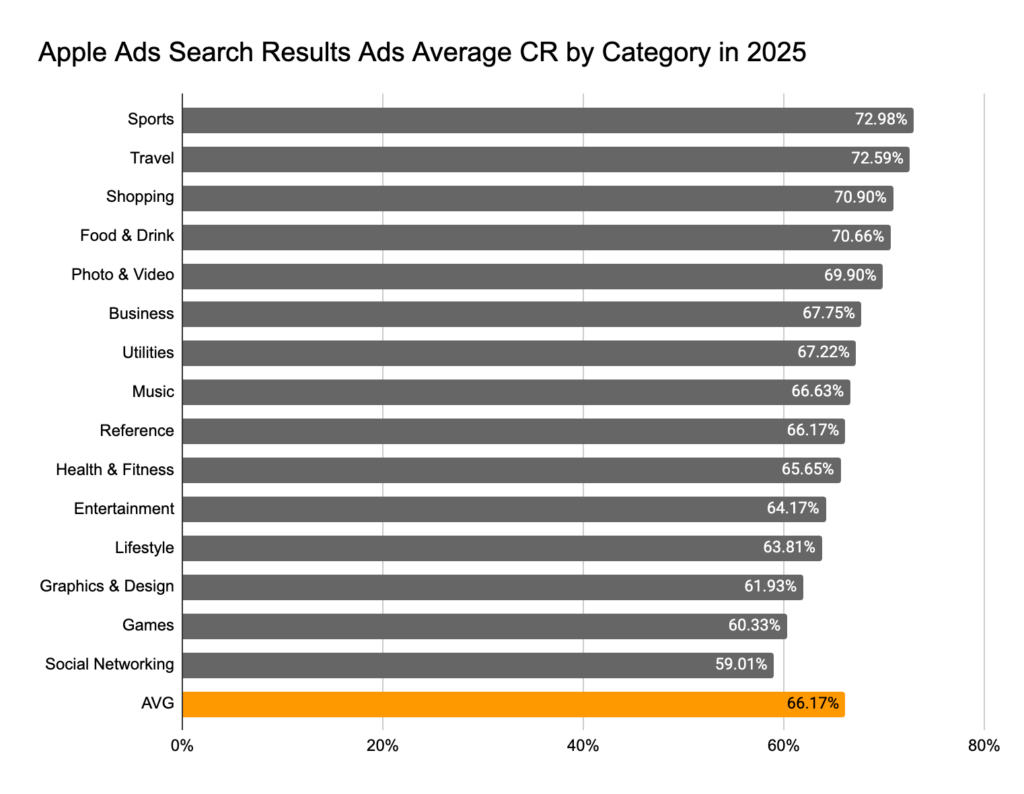
Source: Apple Ads Search Results Benchmarks Report 2026. The report is based on aggregated data from apps and mobile games that optimized Apple Ads search results campaigns using SplitMetrics Acquire from January — December 2025.
These figures reflect a high-intent channel, where the key to successful scaling lies in grounding an app’s strategy in user journeys relevant to a particular category or subcategory.
How exactly? For example, Finance apps use additional placements to reach users who deliver strong post-install performance, thereby leveraging and strengthening their brands.
Entertainment apps may rely more on visual storytelling and "impulse" discovery, making Today Tab placement an important driver of engagement.
Sports apps benefit greatly from addressing seasonality, in some cases even single-day events that can drive noticeable engagement spikes.
Food & Drink and Health & Fitness may benefit from a strategic daily budget allocation to capture high-intent users’ attention at the right moment of day (e.g., a food order or workout).
As for cost-efficiency metrics, our campaign data show that the average cost per tap across categories was $2.25 in 2025, and the overall average cost per acquisition was $3.76. However, there are still significant disparities between categories.
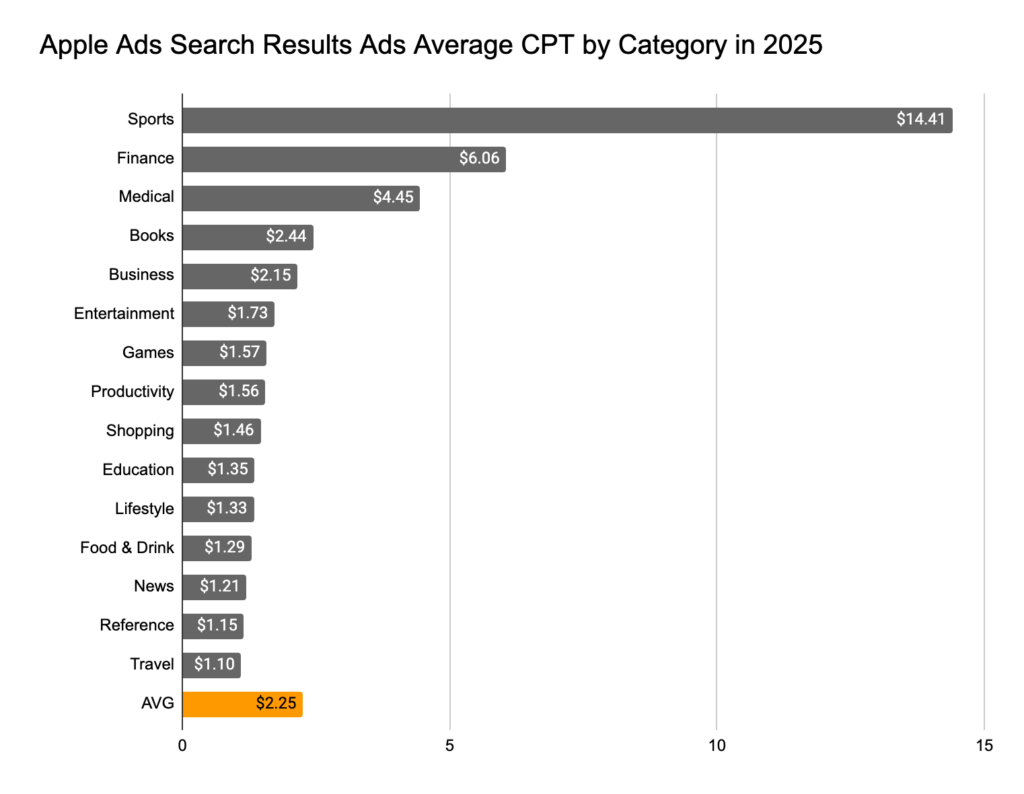
Source: Apple Ads Search Results Benchmarks Report 2026. The report is based on aggregated data from apps and mobile games that optimized Apple Ads search results campaigns using SplitMetrics Acquire from January — December 2025.
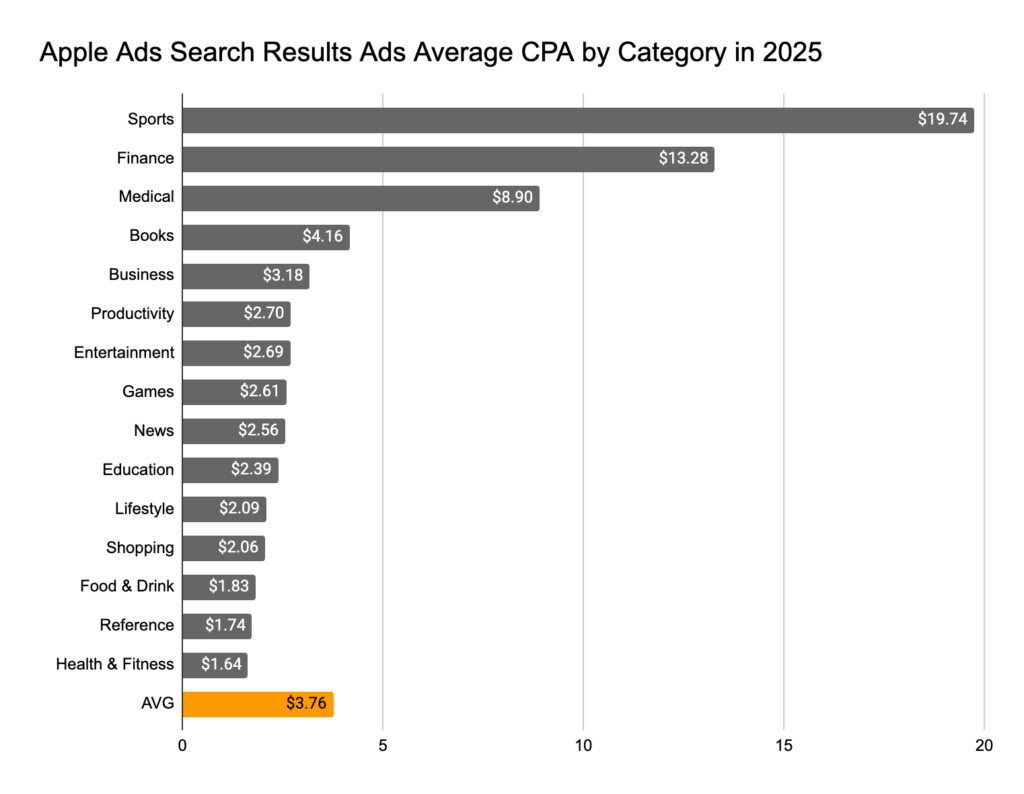
Source: Apple Ads Search Results Benchmarks Report 2026. The report is based on aggregated data from apps and mobile games that optimized Apple Ads search results campaigns using SplitMetrics Acquire from January — December 2025.
In Apple Ads, a high average CPA indicates a high average LTV. Profitability can be maintained even when both metrics are in the double-digit territory, such as in Finance or Sports (especially the sports betting apps subsegment).
Still, the App Store is a highly competitive environment, regardless of absolute CPT and CPA values. The path to profitability and good return on ad spend (ROAS) can’t lie in outbidding competitors alone. Effective UA teams think beyond bidding by:
- Making App Store Optimization and Apple Ads work together: optimizing your conversion rates with best-performing creatives and aligning organic and paid search results is a critical cost-optimization measure.
- Increasing relevance with custom product pages: we estimate that top categories such as Sports and Finance have an adoption rate of 65-80%, with a double-digit CR uplift (20-50%), indicating a tremendous impact on CPT and CPA.
- Implementing a multi-placement ad strategy to follow user journeys through the App Store more closely. We estimate that apps running them typically allocate 80% of the budget to search results and 20% to discovery placements (Today Tab, Search Tab, product pages). We believe that the increasing adoption of additional placements is tied to a better understanding of their impact on overall performance through wider view-through attribution with mobile measurement partners (MMP), which we highly recommend.
- Addressing seasonality: our market intelligence data show strong CPT/CPA fluctuations that follow significant increases in engagement during critical periods (like festive events) and in spend, at times by three-digit percentages (300-500%), depending on the relevance of a particular app type.
However, bidding remains a critical element of Apple Ads, and experience shows that overall success hinges on dynamic, granular control over campaigns. We observe experienced UA teams increasingly moving toward fully automated AI tools to handle this challenge, as profitability in Apple Ads is within reach, but AI may be critical to achieving it.
Additionally, the platform itself is continuously evolving, delivering new features that open up new opportunities for advertisers to connect with their audiences. The additional placement in search results (its rollout started in March 2026) will be a great opportunity to create more impressions, and the extended number of custom product pages (now also visible organically) further strengthens the role of ASO in growing on the App Store.

See also: Quarterly Trends Report
Singular publishes the ROI Index annually, with occasional refreshes.
We also now publish the Singular Quarterly Trends Report, which focuses on data points such as CPI rates, hottest genres, top ad networks, share of spend data, web versus in-app ads, ATT opt-in rates, paid versus organic, and hundreds of regional data points.
Methodology
Singular data analysts summarized the data from trillions of ad impressions, billions of clicks, and billions of installs by thousands of ad networks and platforms to find top performing advertising partners.
On Android, we prioritize networks with scale in both spend and number of customers who work with them. We analyze retention, click-to-install counts, relative fraud levels, and weight them along with the most important metric, return on investment, to find the top ad networks.
On iOS, we use similar scale parameters but utilize Singular Unified Measurement as the primary source of data, with the exception of Apple Search Ads that uses a separate API. Unified Measurement includes data from SKAdNetwork, where we analyze the raw postbacks we receive as well as the information we have about the meaning of the conversion values and ad network parameters. We then translate these postbacks and to find higher-ROI conversions.
In both cases, we control for outliers and spurious data.