Conversions API (CAPI)
What is a conversions API (CAPI)?
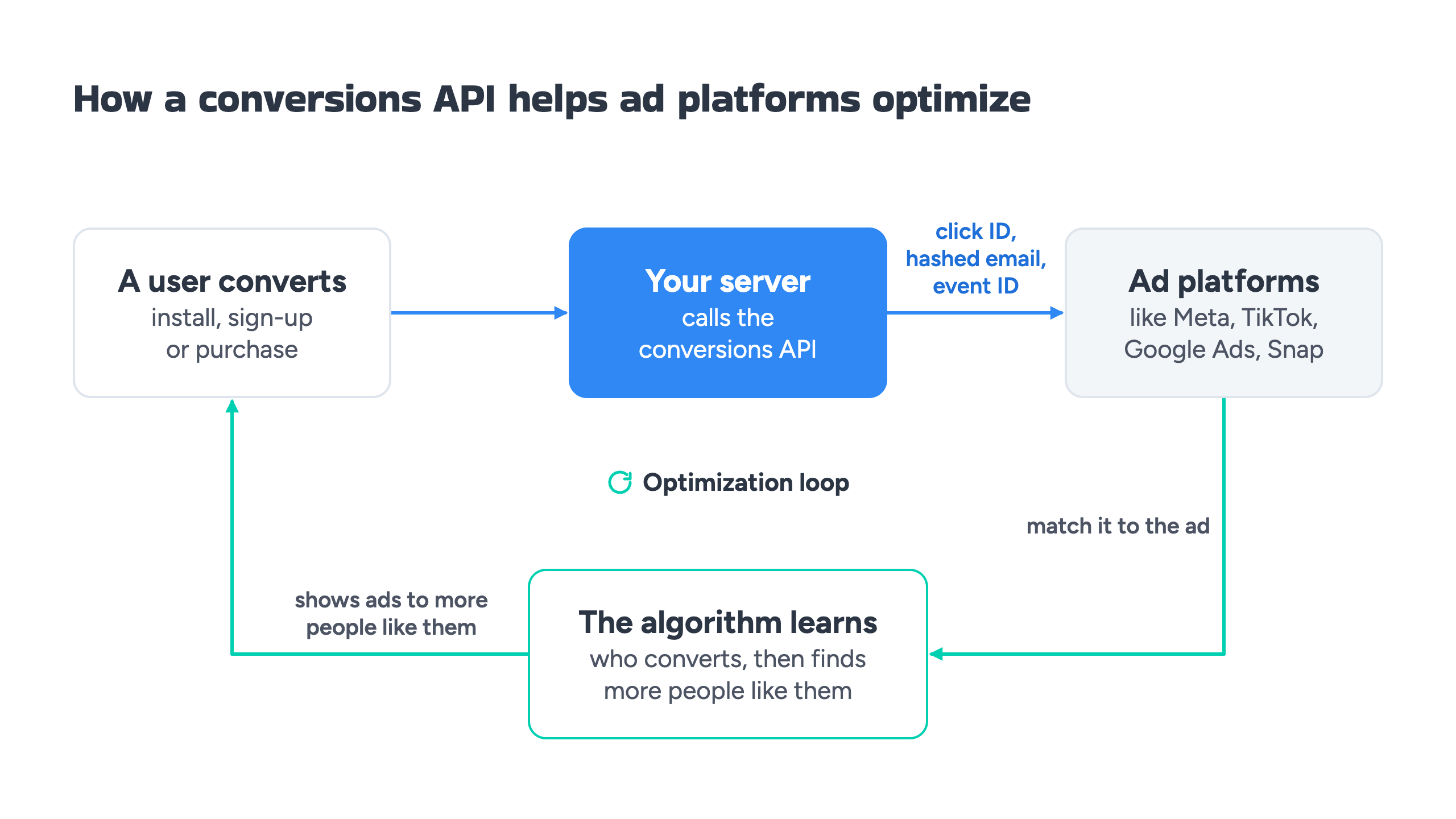
A conversions API (CAPI) is a server-to-server connection that sends conversion events, such as installs, sign-ups, and purchases, from an advertiser’s systems to an ad platform. The platform matches each conversion to the person who saw or clicked the ad. Its algorithm then learns who converts and optimizes the campaign to reach more people like them.
CAPI is also written as conversion API, and the Meta Conversions API is still widely searched as the Facebook conversions API. A CAPI is related to, but narrower than, server-side tracking. Server-side tracking is the broad practice of collecting events on a server instead of in the browser, while a conversions API is the specific endpoint an ad platform provides to receive those events.
Because the data travels server to server, ad blockers and browser cookie limits don’t block it. A CAPI can also report conversions that a browser pixel can’t see, such as an in-app purchase after a web ad. Meta, TikTok, Google Ads, LinkedIn, Snapchat, and Reddit all accept server-side conversions, and Meta, TikTok, LinkedIn, and Snapchat recommend running a CAPI alongside the pixel for web campaigns.
Want to integrate conversions APIs into your marketing strategy?
See how Singular connects them for you
How does a conversions API work?
When a user converts, your server, or a measurement platform like Singular working for you, sends the event to the ad platform’s API over HTTPS. The request carries the event name, time, and value, plus identifiers such as a click ID or a hashed email. The platform matches those identifiers to an ad interaction and records the conversion.
A web conversion usually moves through six steps:
- A user clicks an ad, and the platform adds a click ID to the landing page URL. Google Ads uses gclid, Meta uses fbclid, and TikTok uses ttclid.
- Your website, app, or backend records the conversion when it happens, along with the click ID and any customer data the user agreed to share.
- Your server normalizes and hashes personal data with SHA-256, then sends the event with its name, timestamp, value, and a unique event ID.
- The platform matches the event to the ad click or to a signed-in user. Sending more identifiers, such as a click ID plus a hashed email, helps it match more of your conversions.
- If the pixel also reported the conversion, the platform removes the duplicate using the shared event ID. Each platform sets its own rules for how and when it deduplicates.
- The conversion appears in reporting and feeds the bidding model.
How does Singular support conversions APIs?
Singular attributes web, web-to-app, PC, and console conversions, then sends them to each partner’s conversions API with the click ID and standardized hashed match keys. Supported partners include Meta, Google Ads, TikTok, Snapchat, Reddit, X, and OpenAI Ads in ChatGPT, each set up in Singular’s Partner Configuration.
For more on conversions APIs, see the Conversion API Integrations guides in the Singular Help Center.